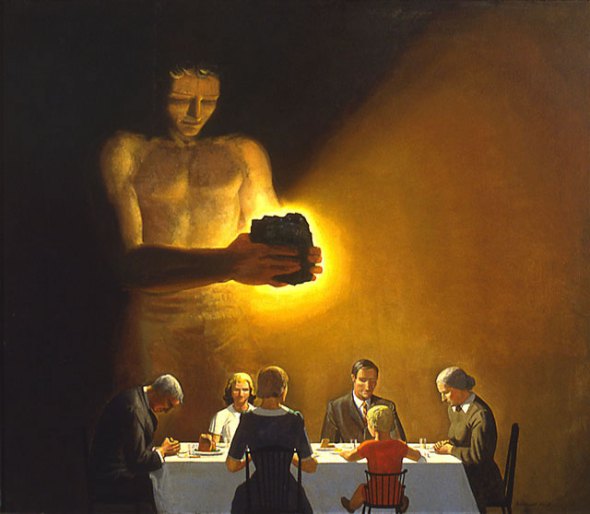
Baker of the Bread of Abundance — Rockwell Kent

baker-of-the-bread-of-abundance

“When I Knew Stephen Crane” — Willa Cather

“When I Knew Stephen Crane” by Willa Cather

It was, I think, in the spring of ’94 that a slender, narrow-chested fellow in a shabby grey suit, with a soft felt hat pulled low over his eyes, sauntered into the office of the managing editor of the Nebraska State Journal and introduced himself as Stephen Crane. He stated that he was going to Mexico to do some work for the Bacheller Syndicate and get rid of his cough, and that he would be stopping in Lincoln for a few days. Later he explained that he was out of money and would be compelled to wait until he got a check from the East before he went further. I was a Junior at the Nebraska State University at the time, and was doing some work for the State Journal in my leisure time, and I happened to be in the managing editor’s room when Mr. Crane introduced himself. I was just off the range; I knew a little Greek and something about cattle and a good horse when I saw one, and beyond horses and cattle I considered nothing of vital importance except good stories and the people who wrote them. This was the first man of letters I had ever met in the flesh, and when the young man announced who he was, I dropped into a chair behind the editor’s desk where I could stare at him without being too much in evidence.

Only a very youthful enthusiasm and a large propensity for hero worship could have found anything impressive in the young man who stood before the managing editor’s desk. He was thin to emaciation, his face was gaunt and unshaven, a thin dark moustache straggled on his upper lip, his black hair grew low on his forehead and was shaggy and unkempt. His grey clothes were much the worse for wear and fitted him so badly it seemed unlikely he had ever been measured for them. He wore a flannel shirt and a slovenly apology for a necktie, and his shoes were dusty and worn gray about the toes and were badly run over at the heel. I had seen many a tramp printer come up the Journal stairs to hunt a job, but never one who presented such a disreputable appearance as this story-maker man. He wore gloves, which seemed rather a contradiction to the general slovenliness of his attire, but when he  took them off to search his pockets for his credentials, I noticed that his hands were singularly fine; long, white, and delicately shaped, with thin, nervous fingers. I have seen pictures of Aubrey Beardsley’s hands that recalled Crane’s very vividly. Continue reading ““When I Knew Stephen Crane” — Willa Cather”

Inspiration — Nikolay Bogdanov-Belsky

The Magician — Ingmar Bergman

As the Volante — Remedios Varo

Illustrated Manuscript Page from Tolkien’s Lord of the Rings

tolkien manuscript

The Norns — Anselm Kiefer

“Giant Snail” — Elizabeth Bishop

“Giant Snail” by Elizabeth Bishop

The rain has stopped. The waterfall will roar like that all
night. I have come out to take a walk and feed. My body–foot,
that is–is wet and cold and covered with sharp gravel. It is
white, the size of a dinner plate. I have set myself a goal, a
certain rock, but it may well be dawn before I get there.
Although I move ghostlike and my floating edges barely graze
the ground, I am heavy, heavy, heavy. My white muscles are
already tired. I give the impression of mysterious ease, but it is
only with the greatest effort of my will that I can rise above the
smallest stones and sticks. And I must not let myself be dis-
tracted by those rough spears of grass. Don’t touch them. Draw
back. Withdrawal is always best.
The rain has stopped. The waterfall makes such a noise! (And
what if I fall over it?) The mountains of black rock give off such
clouds of steam! Shiny streamers are hanging down their sides.
When this occurs, we have a saying that the Snail Gods have
come down in haste. I could never descend such steep escarp-
ments, much less dream of climbing them.
That toad was too big, too, like me. His eyes beseeched my
love. Our proportions horrify our neighbors.
Rest a minute; relax. Flattened to the ground, my body is like
a pallid, decomposing leaf. What’s that tapping on my shell?
Nothing. Let’s go on.
My sides move in rhythmic waves, just off the ground, from
front to back, the wake of a ship, wax-white water, or a slowly
melting floe. I am cold, cold, cold as ice. My blind, white bull’s
head was a Cretan scare-head; degenerate, my four horns that
can’t attack. The sides of my mouth are now my hands. They
press the earth and suck it hard. Ah, but I know my shell is
beautiful, and high, and glazed, and shining. I know it well,
although I have not seen it. Its curled white lip is of the finest
enamel. Inside, it is as smooth as silk, and I, I fill it to perfection.
My wide wake shines, now it is growing dark. I leave a lovely
opalescent ribbon: I know this.
But O! I am too big. I feel it. Pity me.
If and when I reach the rock, I shall go into a certain crack
there for the night. The waterfall below will vibrate through
my shell and body all night long. In that steady pulsing I can
rest. All night I shall be like a sleeping ear.

Randolph Churchill Reading — Winston Churchill

Study for Nighthawks — Edward Hopper

01-HopperDrawing01

Five Notes from Nathaniel Hawthorne’s Note-Books

  1. To picture the predicament of worldly people, if admitted to paradise.
  2.  As the architecture of a country always follows the earliest structures, American architecture should be a refinement of the log-house. The Egyptian is so of the cavern and mound; the Chinese, of the tent; the Gothic, of overarching trees; the Greek, of a cabin.
  3. “Though we speak nonsense, God will pick out the meaning of it,”–an extempore prayer by a New England divine.
  4. In old times it must have been much less customary than now to drink pure water. Walker emphatically mentions, among the sufferings of a clergyman’s wife and family in the Great Rebellion, that they were forced to drink water, with crab-apples stamped in it to relish it.
  5. Mr. Kirby, author of a work on the History, Habits, and Instincts of Animals, questions whether there may not be an abyss of waters within the globe, communicating with the ocean, and whether the huge animals of the Saurian tribe–great reptiles, supposed to be exclusively antediluvian, and now extinct–may not be inhabitants of it. He quotes a passage from Revelation, where the creatures under the earth are spoken of as distinct from those of the sea, and speaks of a Saurian fossil that has been found deep in the subterranean regions. He thinks, or suggests, that these may be the dragons of Scripture.

Notations from Nathaniel Hawthorne’s American Note-Books

Vulture (Peanuts)

vulture

“Emerson” — Charles Ives

“Emerson” — Charles Ives

from Essays Before a Sonata

It has seemed to the writer, that Emerson is greater—his identity more complete perhaps—in the realms of revelation—natural disclosure—than in those of poetry, philosophy, or prophecy. Though a great poet and prophet, he is greater, possibly, as an invader of the unknown,—America’s deepest explorer of the spiritual immensities,—a seer painting his discoveries in masses and with any color that may lie at hand—cosmic, religious, human, even sensuous; a recorder, freely describing the inevitable struggle in the soul’s uprise—perceiving from this inward source alone, that every “ultimate fact is only the first of a new series”; a discoverer, whose heart knows, with Voltaire, “that man seriously reflects when left alone,” and would then discover, if he can, that “wondrous chain which links the heavens with earth—the world of beings subject to one law.” In his reflections Emerson, unlike Plato, is not afraid to ride Arion’s Dolphin, and to go wherever he is carried—to Parnassus or to “Musketaquid.”

We see him standing on a summit, at the door of the infinite where many men do not care to climb, peering into the mysteries of life, contemplating the eternities, hurling back whatever he discovers there,—now, thunderbolts for us to grasp, if we can, and translate—now placing quietly, even tenderly, in our hands, things that we may see without effort—if we won’t see them, so much the worse for us.

We see him,—a mountain-guide, so intensely on the lookout for the trail of his star, that he has no time to stop and retrace his footprints, which may often seem indistinct to his followers, who find it easier and perhaps safer to keep their eyes on the ground. And there is a chance that this guide could not always retrace his steps if he tried—and why should he!—he is on the road, conscious only that, though his star may not lie within walking distance, he must reach it before his wagon can be hitched to it—a Prometheus illuminating a privilege of the Gods—lighting a fuse that is laid towards men. Emerson reveals the less not by an analysis of itself, but by bringing men towards the greater. He does not try to reveal, personally, but leads, rather, to a field where revelation is a harvest-part, where it is known by the perceptions of the soul towards the absolute law. He leads us towards this law, which is a realization of what experience has suggested and philosophy hoped for. He leads us, conscious that the aspects of truth, as he sees them, may change as often as truth remains constant. Revelation perhaps, is but prophecy intensified—the intensifying of its mason-work as well as its steeple. Simple prophecy, while concerned with the past, reveals but the future, while revelation is concerned with all time. The power in Emerson’s prophecy confuses it with—or at least makes it seem to approach—revelation. It is prophecy with no time element. Emerson tells, as few bards could, of what will happen in the past, for his future is eternity and the past is a part of that. And so like all true prophets, he is always modern, and will grow modern with the years—for his substance is not relative but a measure of eternal truths determined rather by a universalist than by a partialist. He measured, as Michel Angelo said true artists should, “with the eye and not the hand.” But to attribute modernism to his substance, though not to his expression, is an anachronism—and as futile as calling today’s sunset modern.

As revelation and prophecy, in their common acceptance are resolved by man, from the absolute and universal, to the relative and personal, and as Emerson’s tendency is fundamentally the opposite, it is easier, safer and so apparently clearer, to think of him as a poet of natural and revealed philosophy. And as such, a prophet—but not one to be confused with those singing soothsayers, whose pockets are filled, as are the pockets of conservative-reaction and radical demagoguery in pulpit, street-corner, bank and columns, with dogmatic fortune-tellings. Emerson, as a prophet in these lower heights, was a conservative, in that he seldom lost his head, and a radical, in that he seldom cared whether he lost it or not. He was a born radical as are all true conservatives. He was too much “absorbed by the absolute,” too much of the universal to be either—though he could be both at once. To Cotton Mather, he would have been a demagogue, to a real demagogue he would not be understood, as it was with no self interest that he laid his hand on reality. The nearer any subject or an attribute of it, approaches to the perfect truth at its base, the more does qualification become necessary. Radicalism must always qualify itself. Emerson clarifies as he qualifies, by plunging into, rather than “emerging from Carlyle’s soul-confusing labyrinths of speculative radicalism.” The radicalism that we hear much about today, is not Emerson’s kind—but of thinner fiber—it qualifies itself by going to A “root” and often cutting other roots in the process; it is usually impotent as dynamite in its cause and sometimes as harmful to the wholesome progress of all causes; it is qualified by its failure. But the Radicalism of Emerson plunges to all roots, it becomes greater than itself—greater than all its formal or informal doctrines—too advanced and too conservative for any specific result—too catholic for all the churches—for the nearer it is to truth, the farther it is from a truth, and the more it is qualified by its future possibilities. Continue reading ““Emerson” — Charles Ives”

Reading — Valerio Adami

“What lips my lips have kissed, and where, and why” — Edna St. Vincent Millay

esvm

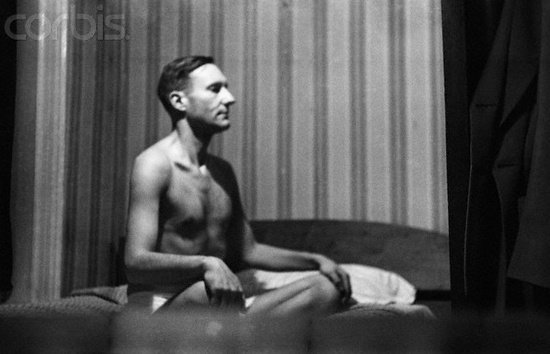
Topless William Burroughs

topless burroughs

Duchamp’s Funeral I — Adrian Ghenie