Hi, Mom! — Brian De Palma (Full Film)

Borges Riff/Borges Anxiety

borgesscan
Art by Roman Muradov

1. Jorge Luis Borges is 115 today.

2. I’ve shared clips from my scattered readings of Borges on this blog (receiving the occasional takedown notice as well)—but I’ve never mustered the energy to try to say anything about him or describe his writing or try to situate it or analyze it or anything—

3. Because that’s what Borges does: He situates, analyzes, condenses, clarifies, expands, complicates, archives, curates, cultivates, teaches, improves literature.

4. And he does it in a way that makes following him with my own mealy mottled words seem superfluous (or maybe futile is the word I want—although I think Borges is unrelentingly positive and futile is such an ugly word).

5. I read a book of Borges’ essays this summer, a collection entitled Other Inquisitions. I read most of it in the Great Smoky Mountains, where the crisp morning air was perfect for Borges. Or for me to read Borges. It was lovely.

6. I wanted to write about Borges’ book—or, rather, and more exactly, I wanted to have written Borges’ book.

7. In one essay—I’ve put the book aside for now and can’t recall exactly which essay (maybe on FitzGerald and Omar Khayyam?); nor will I go look; if I had it out I’d only cite it, recycle it here; the book would kill this riff immediately, put a stake through its heart—Borges suggests that “A great writer creates his precursors.” — This, years, decades before Harold Bloom makes a career out of the same notion.

8. And Borges’ essays are a canon-making: His own canon–the formation and creation of his own precursors: Whitman, Kafka, DeQuincey, Carlyle, Becher, Valery, Wilde, Poe, Hawthorne…

9. The shock I experienced reading Borges’ essay on Nathaniel Hawthorne. That Borges had set about to riff on Hawthorne’s Note-Books, the same note-books I’d been reading since the early spring, the same note-books that seemed and still seem so generative to me, so full of entire worlds, so rich, so much fuller and richer than Hawthorne’s novels or his stories, so full in their singularity and off-focus, these notes, these Borgesian notes. Oh and that Borges had written the essay that I wished I could write!

10. Borges, who never wrote a novel, whose entire work might be some kind of postmodern novel.

11. Borges, whose short stories often seem like pretexts to an essay he’d like to write—and here pretext is not the right word, again—-so maybe the short stories, so many of them so brilliant, act as some kind of surface text that illuminates and yet simultaneously hides an essay underneath.

12. The great joy of reading Borges: We read through Borges: Borges the librarian grants us access to so many minds. We get to share his perceptions, read over his shoulder, or maybe through his glasses—we get to glance over his annotations, his notes. But that’s not accurate—he’s so much more lucid than that scatter-shot image suggests, even when he’s at his most Borgesian, which is to say his most labyrinthine, mirrored, winding, forking, decentering and recentering, deferring, echoing, prefiguring…

13. I’ve written more than I intended to and have yet barely edged into all the thicket of anxieties that guard Borges’ oeuvre from poseurs like myself. It’s enough to know that his works exist, will exist.

Little Nemo Goes Whaling (Winsor McCay)

15_winsormccay_littlenemo_1907_apr30

(Via/more).

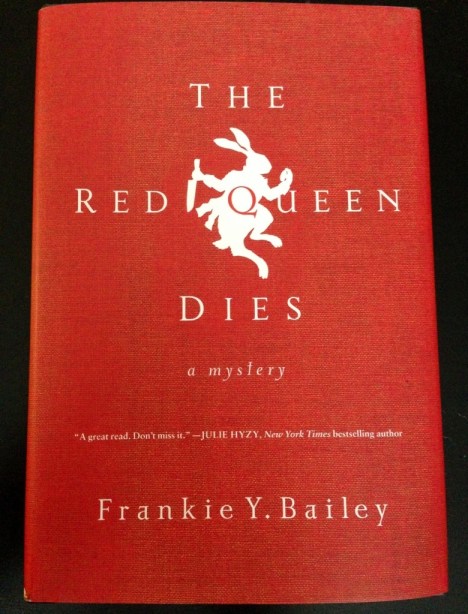
The Red Queen Dies (Book Acquired, 8.22.2013)

20130824-102919.jpg

Great cover design for Frankie Y. Bailey’s new set-in-the-future-kinda-sci-fi-definitely-mystery The Red Queen Dies: elegant, minimal, and very striking. Wish there was more of this in genre fiction. Publisher Macmillan/Minotaur’s blurb:

Frankie Bailey introduces readers to a fabulous new protagonist and an Alice in Wonderland-infused crime in this stunning mystery, which kicks off an exciting new series set in the near future.

The year is 2019, and a drug used to treat soldiers for post-traumatic stress disorder, nicknamed “Lullaby,” has hit the streets. Swallowing a little pill erases traumatic memories, but what happens to a criminal trial when the star witness takes a pill and can’t remember the crime? When two women are murdered in quick succession, biracial police detective Hannah McCabe is charged with solving the case. In spite of the advanced technology, including a city-wide surveillance program, a third woman is soon killed, and the police begin to suspect that a serial killer is on the loose. But the third victim, a Broadway actress known as “The Red Queen,” doesn’t fit the pattern set by the first two murders.

With the late September heat sizzling, Detective Hannah McCabe and her colleagues on the police force have to race to find the killer in a tangled web of clues that involve Alice in Wonderland, The Wizard of Oz, and Abraham Lincoln’s assassination. Fast-paced and original, this is a one-of-a-kind mystery from an extremely talented crime writer.

The Torment of St. Anthony — Michelangelo

“Four Beasts in One—The Homo-Cameleopard” by Edgar Allan Poe

“Four Beasts in One—The Homo-Cameleopard” by Edgar Allan Poe

                     Chacun a ses vertus.
                        —Crebillon's Xerxes.

ANTIOCHUS EPIPHANES is very generally looked upon as the Gog of the prophet Ezekiel. This honor is, however, more properly attributable to Cambyses, the son of Cyrus. And, indeed, the character of the Syrian monarch does by no means stand in need of any adventitious embellishment. His accession to the throne, or rather his usurpation of the sovereignty, a hundred and seventy-one years before the coming of Christ; his attempt to plunder the temple of Diana at Ephesus; his implacable hostility to the Jews; his pollution of the Holy of Holies; and his miserable death at Taba, after a tumultuous reign of eleven years, are circumstances of a prominent kind, and therefore more generally noticed by the historians of his time than the impious, dastardly, cruel, silly, and whimsical achievements which make up the sum total of his private life and reputation.

Let us suppose, gentle reader, that it is now the year of the world three thousand eight hundred and thirty, and let us, for a few minutes, imagine ourselves at that most grotesque habitation of man, the remarkable city of Antioch. To be sure there were, in Syria and other countries, sixteen cities of that appellation, besides the one to which I more particularly allude. But ours is that which went by the name of Antiochia Epidaphne, from its vicinity to the little village of Daphne, where stood a temple to that divinity. It was built (although about this matter there is some dispute) by Seleucus Nicanor, the first king of the country after Alexander the Great, in memory of his father Antiochus, and became immediately the residence of the Syrian monarchy. In the flourishing times of the Roman Empire, it was the ordinary station of the prefect of the eastern provinces; and many of the emperors of the queen city (among whom may be mentioned, especially, Verus and Valens) spent here the greater part of their time. But I perceive we have arrived at the city itself. Let us ascend this battlement, and throw our eyes upon the town and neighboring country.

“What broad and rapid river is that which forces its way, with innumerable falls, through the mountainous wilderness, and finally through the wilderness of buildings?”

That is the Orontes, and it is the only water in sight, with the exception of the Mediterranean, which stretches, like a broad mirror, about twelve miles off to the southward. Every one has seen the Mediterranean; but let me tell you, there are few who have had a peep at Antioch. By few, I mean, few who, like you and me, have had, at the same time, the advantages of a modern education. Therefore cease to regard that sea, and give your whole attention to the mass of houses that lie beneath us. You will remember that it is now the year of the world three thousand eight hundred and thirty. Were it later—for example, were it the year of our Lord eighteen hundred and forty-five, we should be deprived of this extraordinary spectacle. In the nineteenth century Antioch is—that is to say, Antioch will be—in a lamentable state of decay. It will have been, by that time, totally destroyed, at three different periods, by three successive earthquakes. Indeed, to say the truth, what little of its former self may then remain, will be found in so desolate and ruinous a state that the patriarch shall have removed his residence to Damascus. This is well. I see you profit by my advice, and are making the most of your time in inspecting the premises—in

-satisfying your eyes

With the memorials and the things of fame

That most renown this city.—

I beg pardon; I had forgotten that Shakespeare will not flourish for seventeen hundred and fifty years to come. But does not the appearance of Epidaphne justify me in calling it grotesque?

“It is well fortified; and in this respect is as much indebted to nature as to art.”

Very true.

“There are a prodigious number of stately palaces.”

There are.

“And the numerous temples, sumptuous and magnificent, may bear comparison with the most lauded of antiquity.”

All this I must acknowledge. Still there is an infinity of mud huts, and abominable hovels. We cannot help perceiving abundance of filth in every kennel, and, were it not for the over-powering fumes of idolatrous incense, I have no doubt we should find a most intolerable stench. Did you ever behold streets so insufferably narrow, or houses so miraculously tall? What gloom their shadows cast upon the ground! It is well the swinging lamps in those endless colonnades are kept burning throughout the day; we should otherwise have the darkness of Egypt in the time of her desolation.

“It is certainly a strange place! What is the meaning of yonder singular building? See! it towers above all others, and lies to the eastward of what I take to be the royal palace.”

Continue reading ““Four Beasts in One—The Homo-Cameleopard” by Edgar Allan Poe”

Hand Holding Book — Asa Ames