A Short Documentary About Vincent Van Gogh by Alain Resnais

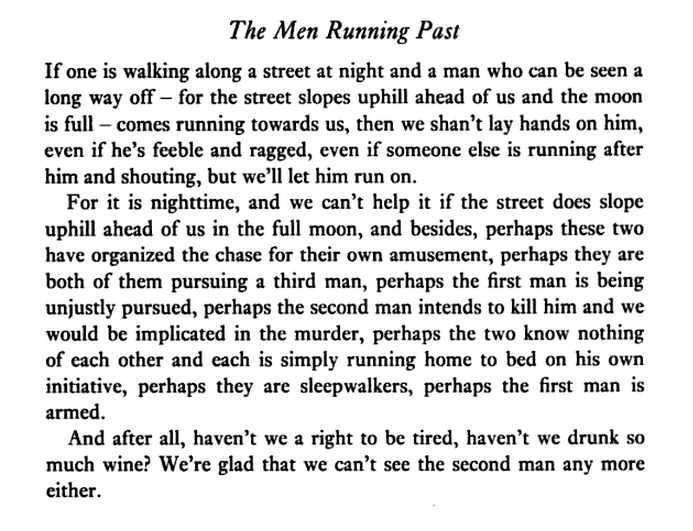
“The Men Running Past” — Franz Kafka

kafka

Two Arabs Reading — Edwin Lord Weeks

Plagiarism

Art and cultural property crime—which includes theft, fraud, looting, and trafficking across state and international lines—is a looming criminal enterprise with estimated losses in the billions of dollars annually.

Jan van Eyck: The Just Judges.

Early to mid-1800s: Burkel paints After the Hunt (c. 1830), Amalfi Cave (c. 1845), and The Horse Round-up (c.1861-1863).

In October 1969, two thieves entered the Oratory of San Lorenzo in Palermo, Italy and removed the Caravaggio Nativity from its frame. Experts estimate its value at $20 million.

Vincent van Gogh: View of the Sea at Scheveningen(1882).

1925: All three Burkel paintings are acquired and subsequently exhibited by the Pirmasens Museum in Germany.

On December 31, 1999, during the fireworks that accompanied the celebration of the millennium, a thief broke into the Ashmolean Museum in Oxford, England and stole Cezanne’s landscape painting View of Auvers-sur-Oise. Valued at £3 million, the painting has been described as an important work illustrating the transition from early to mature Cezanne painting.

Johannes Vermeer: The Concert (c.1658–1660).

On September 8, 2011, Madeleine Leaning on Her Elbow with Flowers in Her Hair by Pierre Auguste Renoir was stolen during an armed robbery in a Houston home. The masked robber is described as a white male, 18 to 26 years old, who weighs about 160 pounds and is approximately 5’10” tall. He was armed with a large-caliber, semi-automatic handgun. A private insurer is offering up to $50,000 for information leading to the recovery of the painting.

Rembrandt: The Storm on the Sea of Galilee (1633).

May 13, 1942: To avoid Allied bombings, the Burkel paintings were taken to a local air-raid shelter outside of Pirmasens.

Approximately 100 paintings stolen from a Florida family’s art collection in a fine art storage facility. This collection included works by Picasso, Rothko, Matisse and others that were recovered from Chicago, New York and Tokyo.

Vincent van Gogh: Congregation Leaving the Reformed Church in Nuenen (1884).

Radu Dogaru’s mother, hoping to free her son from prosecution, told the police that on a freezing night in February, 2013, she placed seven stolen paintings — which included Monet’s 1901 Waterloo Bridge, London; Gauguin’s 1898 Girl in Front of Open Window” and Picasso’s 1971 Harlequin Head — in a wood-burning stove used to heat saunas and incinerated them.

September 19, 1945: The Pirmasens Museum reports that “about 50 paintings which had been stored in the air-raid shelter at Husterhoh School during the war have been lost during the arrival of the American troops on March 22, 1945.” The works were later smuggled to the U.S. by unknown individuals.

Jean-Baptiste Oudry: The White Duck (1753).

Mid-1960s: A New Jersey man purchases the Burkel paintings.

How Picassos, Matisses, Monets and other precious masterpieces may have met a fiery fate in a remote Romanian village, population 3,400, is something the police are still trying to understand.

Amadeo Modigliani: La Femme à l’éventail (Modigliani) (1919).

Late 1980s: The Burkel paintings are handed down to the New Jersey man’s daughter.

Caspar David Friedrich: Landschaft mit Regenbogen (c. 1810).

October 25, 2005: The William H. Bunch Auction and Appraisal Company in Pennsylvania advertises the sale of the Burkel paintings on the Internet and through the print media. Heike Wittmer, Pirmasens Museum Director and Archivist, spots the paintings for sale and alerts German authorities. U.S. Embassy officials contact the FBI, which halts the sale and takes custody of the paintings from the consignor, who voluntarily agrees to their return to Germany.

Rembrandt’s Self Portrait (1630): Recovered in a sting operation in Copenhagen carried out in cooperation with ICE and law enforcement agencies in Sweden and Denmark. The FBI had previously recovered Renoir’s The Young Parisian. Both paintings had been stolen from the Swedish National Museum in Stockholm in 2000.

February 10, 2006: The Burkel paintings are repatriated to Germany by the U.S.

Pablo Picasso: Le pigeon aux petits pois(1911).

In December 2002, two thieves used a ladder to climb to the roof and break in to the Vincent Van Gogh Museum, Amsterdam, The Netherlands. In just a few minutes the thieves stole two paintings: Van Gogh’s View of the Sea at Scheveningen and Congregation Leaving the Reformed Church in Nuenen, valued at $30 million. Dutch police convicted two men in December 2003, but did not recover the paintings.

Forensic analysis of ash found in Mrs. Dogaru’s stove, conducted by Romania’s National History Museum, found nails and tacks that indicated that at least three had been burned.

Franz Marc: The Tower of Blue Horses 1913 (missing since 1945).

Carl Spitzweg: Der Liebesbrief 1845-1846 (missing since 1989).

IF YOU HAVE ANY INFORMATION CONCERNING THESE WORKS OF ART OR CIRCUMSTANCES OF THESE CRIMES, PLEASE CONTACT YOUR LOCAL FIELD OFFICE OR THE NEAREST U.S. EMBASSY OR CONSULATE.
Watch This Terrible Book Trailer for Thomas Pynchon’s New Novel Bleeding Edge (Or Don’t)

I don’t know, I’m guessing this is intentionally awful. I mean, book trailers are supposed to be awful, right?

Meet Me in the Park — Norman Bluhm and Frank O’Hara

“Why I Am Not a Painter” — Frank O’Hara

“Why I Am Not a Painter” by Frank O’Hara

I am not a painter, I am a poet.
Why? I think I would rather be
a painter, but I am not. Well,

for instance, Mike Goldberg
is starting a painting. I drop in.
“Sit down and have a drink” he
says. I drink; we drink. I look
up. “You have SARDINES in it.”
“Yes, it needed something there.”
“Oh.” I go and the days go by
and I drop in again. The painting
is going on, and I go, and the days
go by. I drop in. The painting is
finished. “Where’s SARDINES?”
All that’s left is just
letters, “It was too much,” Mike says.

But me? One day I am thinking of
a color: orange. I write a line
about orange. Pretty soon it is a
whole page of words, not lines.
Then another page. There should be
so much more, not of orange, of
words, of how terrible orange is
and life. Days go by. It is even in
prose, I am a real poet. My poem
is finished and I haven’t mentioned
orange yet. It’s twelve poems, I call
it ORANGES. And one day in a gallery
I see Mike’s painting, called SARDINES.


Sardines — Mike Goldberg

sardines

“Bernhard is an architect of consciousness” — Ben Marcus on Thomas Bernhard

Bernhard is an architect of consciousness more than a narrative storyteller. His project is not to reference the known world, stuffing it with fully rounded characters who commence to discover their conflicts with one another, but to erect complex states of mind-usually self-loathing, obsessive ones-and then set about destroying them. Bernhard’s characters are thorough accomplices in their own destruction, and they are bestowed with a language that is dementedly repetitive and besotted with the appurtenances of logical thinking. The devious rationality of Bernhard’s language strives for a severe authority, and it tends to make his characters seem believable, no matter how unhinged their claims. Phrases don’t get repeated so much as needled until they yield graver meanings, with incremental changes introduced as though a deranged scientist were adding and removing substances in the performance of an experiment. “You wake up, and you feel molested,” Strauch says:

In fact: the hideous thing. You open your chest of drawers :a further molestation. Washing and dressing are molestations. Having to get dressed! Having to eat breakfast! When you go out on the street you are subject to the gravest possible molestations. You are unable to shield yourself. You lay about yourself, but it’s no use. The blows you dole out are returned a hundred fold. What are streets, anyway? Wendings of molestation, up and down. Squares? Bundled together molestations.

Without a story to drive it, Frost builds not through unfolding events but by telemarking around Strauch’s bitter cosmology while the narrator follows him through the woods, fattening himself on the rage of his new mentor. A chart of Strauch’s worldview would produce a splotchy Rorschach of points and counterpoints, contradictions, reversals, and the occasional backflip, none of which could really hold up to a logician’s scrutiny, which adds to his mystery. Strauch, a failed artist who only painted in total darkness, is opposed to nearly everything, and lest you think he’s a humanist at the core, with a fondness for the arts (that classic virtue of the misanthrope), he claims that “artists are the sons and daughters of loathsomeness, of paradisiac shamelessness, the original sons and daughters of lewdness; artists, painters, writers and musicians are the compulsive masturbators on the planet.”

From Ben Marcus’s 2011 essay “Misery Loves Nothing,” first published in Harper’s and available in full for free at Marcus’s site. I’m about halfway through Bernhard’s early novel Frost, a book that is very dark, bitter, intriguing, and funny. Very very funny.

The Artist’s Granddaughter at the Table — Max Liebermann

Expectation — Richard Oelze

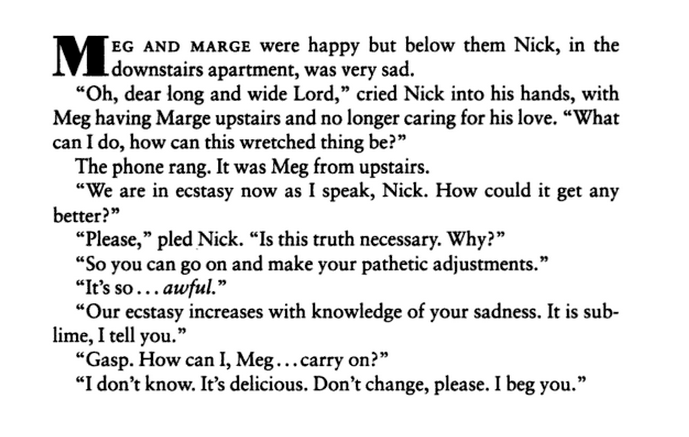
“Dear Awful Diary” — Barry Hannah

dadbh

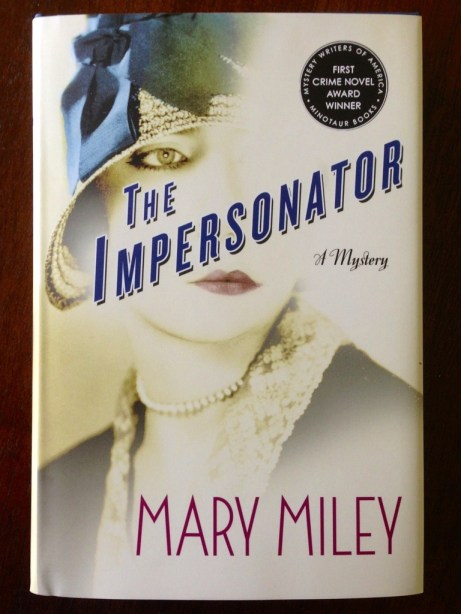
The Impersonator (Book Acquired, 8.26.2013)

20130830-074003.jpg

The Impersonator, a mystery by Mary Miley. Publisher Macmillan/Minotaur’s blurb:

In 1917, Jessie Carr, fourteen years old and sole heiress to her family’s vast fortune, disappeared without a trace. Now, years later, her uncle Oliver Beckett thinks he’s found her: a young actress in a vaudeville playhouse is a dead ringer for his missing niece. But when Oliver confronts the girl, he learns he’s wrong. Orphaned young, Leah’s been acting since she was a toddler.

Oliver, never one to miss an opportunity, makes a proposition—with his coaching, Leah can impersonate Jessie, claim the fortune, and split it with him. The role of a lifetime, he says. A one-way ticket to Sing Sing, she hears. But when she’s let go from her job, Oliver’s offer looks a lot more appealing. Leah agrees to the con, but secretly promises herself to try and find out what happened to the real Jessie. There’s only one problem: Leah’s act won’t fool the one person who knows the truth about Jessie’s disappearance.

Set against a Prohibition-era backdrop of speakeasies and vaudeville houses, Mary Miley’s Minotaur Books/Mystery Writers of America First Crime Novel Competition winner The Impersonator will delight readers with its elaborate mystery and lively prose.

Walt Kelly’s NO!

WaltKelly_NO-1_cover_100

Read all of Walt Kelly’s NO! at Whirled of Kelly.

“Perhaps the universe is suspended on the tooth of some monster” (Thoughts from Anton Chekhov’s Note-Books)

* * * * *

A scholar, without talent, a blockhead, worked for twenty-four years and produced nothing good, gave the world only scholars as untalented and as narrow-minded as himself. At night he secretly bound books—that was his true vocation: in that he was an artist and felt the joy of it. There came to him a bookbinder, who loved learning and studied secretly at night.

* * * * *

But perhaps the universe is suspended on the tooth of some monster.

* * * * *

Keep to the right, you of the yellow eye!

* * * * *

Do you want to eat? No, on the contrary.

* * * * *

A pregnant woman with short arms and a long neck, like a kangaroo.

* * * * *

How pleasant it is to respect people! When I see books, I am not concerned with how the authors loved or played cards; I see only their marvelous works.

* * * * *

To demand that the woman one loves should be pure is egotistical: to look for that in a woman which I have not got myself is not love, but worship, since one ought to love one’s equals.

* * * * *

The so-called pure childlike joy of life is animal joy.

* * * * *

—From Anton Chekhov’s Note-Books.

Portrait of Y.E. Kustodieva — Boris Kustodiev

Last Year at Marienbad — Alain Resnais (Full Film)