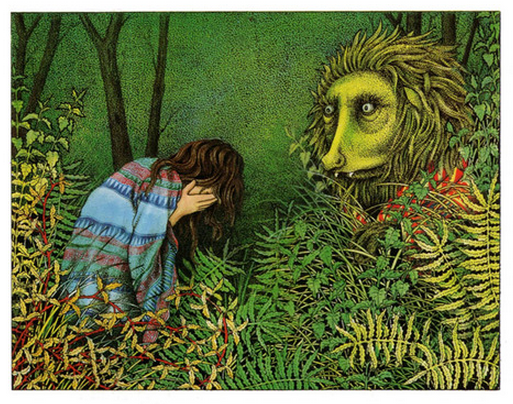
Beauty and the Beast — Alan Baker

Capture

“The conventional means of attaining the castle” (Donald Barthelme)

80. The conventional means of attaining the castle are as follows: “The eagle dug its sharp claws into the tender flesh of the youth, but he bore the pain without a sound, and seized the bird’s two feet with his hands. The creature in terror lifted him high up into the air and began to circle the castle. The youth held on bravely. He saw the glittering palace, which by the pale rays of the moon looked like a dim lamp; and he saw the windows and balconies of the castle tower. Drawing a small knife from his belt, he cut off both the eagle’s feet. The bird rose up in the air with a yelp, and the youth dropped lightly onto a broad balcony. At the same moment a door opened, and he saw a courtyard filled with flowers and trees, and there, the beautiful enchanted princess.” (The Yellow Fairy Book)

From Donald Barthelme’s short story “The Glass Mountain” (read it here).

Cluster No. 11– John Latham

Fallen — Fred Kelemen (Full Film)

National Day of Encouragement Reading List

Today, a dollar store calendar my grandmother gave me tells me, is National Day of Encouragement, which is totally a real thing. So here is a National Day of Encouragement Reading List, which is also totally a real thing. Much encouragement to you, citizens!

  1. King Lear, William Shakespeare
  2. Blood Meridian, Cormac McCarthy
  3. “Before the Law,” Franz Kafka
  4. Candide, Voltaire
  5. First Love and Other Sorrows, Harold Brodkey
  6. “Rappaccini’s Daughter,” Nathaniel Hawthorne
  7. Camp Concentration, Thomas Disch
  8. “The Lottery,” Shirley Jackson
  9. “The Raven,” Edgar Allan Poe
  10. The Awakening, Kate Chopin
  11. Things Fall Apart, Chinua Achebe
  12. The Bell Jar, Sylvia Plath
  13. Correction, Thomas Bernhard
  14. Butterfly Stories, William Vollmann
  15. “A Good Man Is Hard to Find,” Flannery O’Connor
  16. The Road, Cormac McCarthy
  17. 2666, Roberto Bolaño
  18. “The Fall of the House of Usher,” Edgar Allan Poe
  19. Wuthering Heights, Emily Brontë
  20. From Hell, Alan Moore & Eddie Campbell
  21. The Flame Alphabet, Ben Marcus
  22. The Painted Bird, Jerzy Kosinski
  23. Heart of Darkness, Joseph Conrad
  24. “The Wasteland,” T.S. Eliot
  25. Hamlet, William Shakespeare
  26. The Pearl, John Steinbeck
  27. Distant Star, Roberto Bolaño
  28. Notes from Underground,  Fyodor Dostoyevsky
  29. The Yearling, Marjorie Kinnan Rawlings
  30. The Kindly Ones, Jonathan Littell
  31. “The Life You Save May Be Your Own,” Flannery O’Connor
  32. Gargoyles, Thomas Bernhard
  33. The Plague, Albert Camus
  34. “The Yellow Wallpaper,” Charlotte Perkins Gilman
  35. Frankenstein, Mary Shelley
  36. Where the Red Fern Grows, Wilson Rawls
  37. A Farewell to Arms, Ernest Hemingway
  38. “Good Old Neon,” David Foster Wallace
  39. 1984, George Orwell
  40. Nausea, Jean-Paul Sartre

Aged Phoenix — Paul Klee

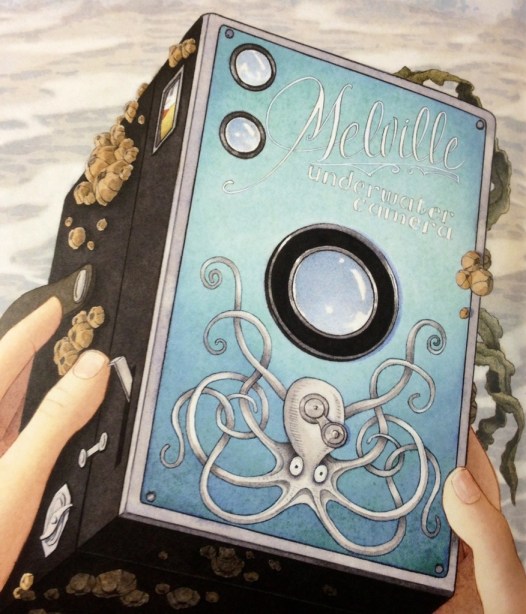
Melville Underwater Camera

20130912-114628.jpg

From David Wiesner’s marvelous wordless wonder book Flotsam.

“A Note on Realism” — Robert Louis Stevenson

“A Note on Realism” by Robert Louis Stevenson

Style is the invariable mark of any master; and for the student who does not aspire so high as to be numbered with the giants, it is still the one quality in which he may improve himself at will.  Passion, wisdom, creative force, the power of mystery or colour, are allotted in the hour of birth, and can be neither learned nor simulated.  But the just and dexterous use of what qualities we have, the proportion of one part to another and to the whole, the elision of the useless, the accentuation of the important, and the preservation of a uniform character from end to end—these, which taken together constitute technical perfection, are to some degree within the reach of industry and intellectual courage.  What to put in and what to leave out; whether some particular fact be organically necessary or purely ornamental; whether, if it be purely ornamental, it may not weaken or obscure the general design; and finally, whether, if we decide to use it, we should do so grossly and notably, or in some conventional disguise: are questions of plastic style continually rearising.  And the sphinx that patrols the highways of executive art has no more unanswerable riddle to propound.

In literature (from which I must draw my instances) the great change of the past century has been effected by the admission of detail.  It was inaugurated by the romantic Scott; and at length, by the semi-romantic Balzac and his more or less wholly unromantic followers, bound like a duty on the novelist.  For some time it signified and expressed a more ample contemplation of the conditions of man’s life; but it has recently (at least in France) fallen into a merely technical and decorative stage, which it is, perhaps, still too harsh to call survival.  With a movement of alarm, the wiser or more timid begin to fall a little back from these extremities; they begin to aspire after a more naked, narrative articulation; after the succinct, the dignified, and the poetic; and as a means to this, after a general lightening of this baggage of detail.  After Scott we beheld the starveling story—once, in the hands of Voltaire, as abstract as a parable—begin to be pampered upon facts.  The introduction of these details developed a particular ability of hand; and that ability, childishly indulged, has led to the works that now amaze us on a railway journey.  A man of the unquestionable force of M. Zola spends himself on technical successes.  To afford a popular flavour and attract the mob, he adds a steady current of what I may be allowed to call the rancid.  That is exciting to the moralist; but what more particularly interests the artist is this tendency of the extreme of detail, when followed as a principle, to degenerate into merefeux-de-joie of literary tricking.  The other day even M. Daudet was to be heard babbling of audible colours and visible sounds. Continue reading ““A Note on Realism” — Robert Louis Stevenson”

Reading the Newspaper — Fyodor Bronnikov

Bomb Island — Peter Doig

Wonder Woman — Bill Sienkiewicz

wwbs

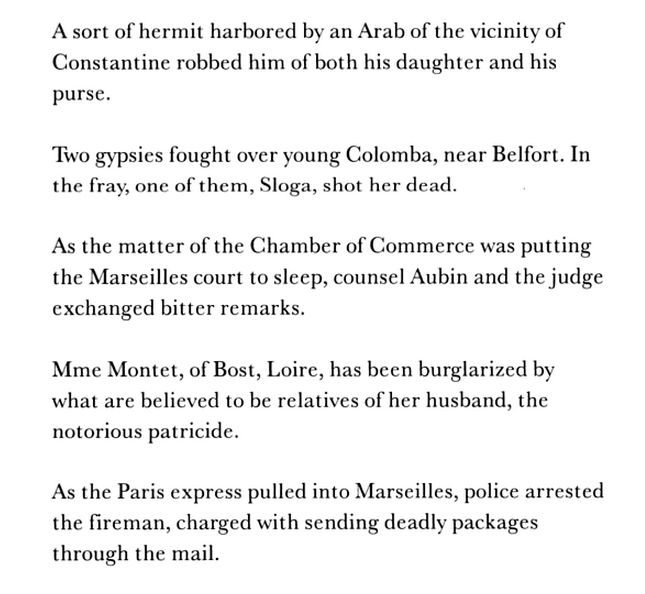
Five from Félix Fénéon

ffff

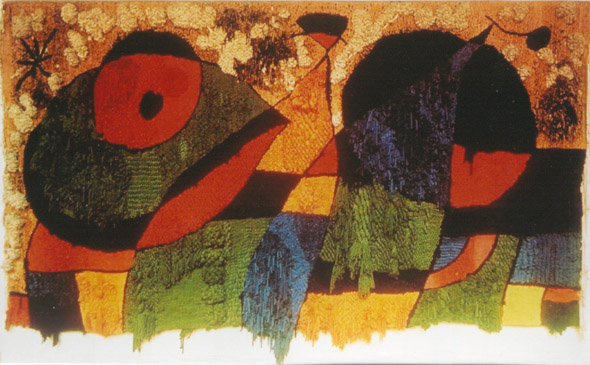
World Trade Center Tapestry — Joan Miró

wtctjm

“The only form of discourse” (Donald Barthelme)

“The only form of discourse of which I approve,” Miss R. said in her dry, tense voice, “is the litany. I believe our masters and teachers as well as plain citizens should confine themselves to what can safely be said. Thus when I hear the words pewter, snake, tea, Fad #6 sherry, serviette, fenestration, crown, blue coming from the mouth of some public official, or some raw youth, I am not disappointed. Vertical organisation is also possible,” Miss R. said, “ as in

pewter

snake

tea

fad #6 sherry

serviette

fenestration

crown

blue.

I run to liquids and colours,” she said, “but you, you may run to something else, my virgin,’ my darling, my thistle, my poppet, my own. Young people,” Miss R. said, “run to more and more unpleasant combinations as they sense the nature of our society. Some people,” Miss R. said, “run to conceits or wisdom but I hold to the hard, brown, nutlike word. I might point out that there is enough aesthetic excitement here to satisfy anyone but a damned fool.” I sat in solemn silence.

From Donald Barthelme’s short story “The Indian Uprising”; read the full story.

Reading Girl — Rik Wouters

Melancholy — William Blake

“Childhood is still running along beside us like a little dog” (Thomas Bernhard)

“Childhood is still running along beside us like a little dog who used to be a merry companion, but who now requires our care and splints, and myriad medicines, to prevent him from promptly passing on.” It went along rivers, and down mountain gorges. If you gave it any assistance, the evening would construct the most elaborate and costly lies. But it wouldn’t save you from pain and indignity. Lurking cats crossed your path with sinister thoughts. Like him, so nettles would sometimes draw me into fiendish moments of unchastity. As with him, my fear was made palatable by raspberries and blackberries. A swarm of crows were an instant manifestation of death. Rain produced damp and despair. Joy pearled off the crowns of sorrel plants. “The blanket of snow covers the earth like a sick child.” No infatuation, no ridicule, no sacrifice. “In classrooms, simple ideas assembled themselves, and on and on.” Then stores in town, butchers’ shop smells. Façades and walls, nothing but façades and walls, until you got out into the country again, quite abruptly, from one day to the next. Where the meadows began, yellow and green; brown plowland, black trees. Childhood: shaken down from a tree, so much fruit and no time! The secret of his childhood was contained in himself. Growing up wild, among horses, poultry, milk, and honey. And then: being evicted from this primal condition, bound to intentions that went way beyond himself. Designs. His possibilities multiplied, then dwindled in the course of a tearful afternoon. Down to three or four certainties. Immutable certainties. “How soon it is possible to spot dislike. Even without words, a child wants everything. And attains nothing.” Children are much more inscrutable than adults. “Protractors of history. Conscienceless. Correctors of history. Bringers-on of defeat. Ruthless as you please.” As soon as it could blow its own nose, a child was deadly to anything it came in touch with. Often—as it does me—it gives him a shock, when he feels a sensation he had as a child, provoked by a smell or a color, but that doesn’t remember him. “At such a moment you feel horribly alone.”

From Thomas Bernhard’s novel Frost.