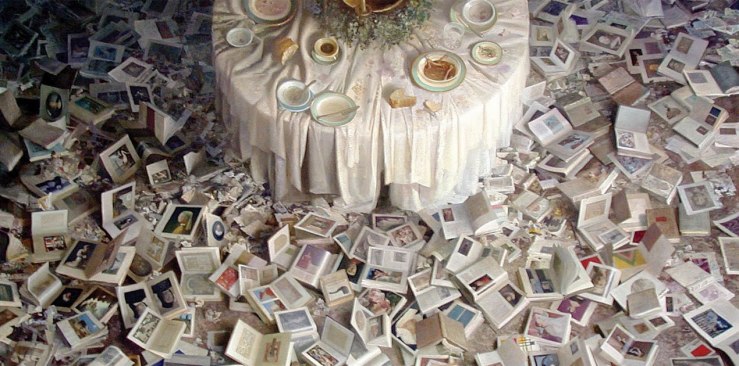
Untitled (Hostess & Sailor) — Wang Xingwei

(More).

Facts, Questions, and Images from Nathaniel Hawthorne’s Note-Books

  1. The Abyssinians, after dressing their hair, sleep with their heads in a forked stick, in order not to discompose it.
  2. At the battle of Edge Hill, October 23, 1642, Captain John Smith, a soldier of note, Captain Lieutenant to Lord James Stuart’s horse, with only a groom, attacked a Parliament officer, three cuirassiers, and three arquebusiers, and rescued the royal standard, which they had taken and were guarding. Was this the Virginian Smith?
  3. Stephen Gowans supposed that the bodies of Adam and Eve were clothed in robes of light, which vanished after their sin.
  4. Lord Chancellor Clare, towards the close of his life, went to a village church, where he might not be known, to partake of the Sacrament.
  5. In the tenth century, mechanism of organs so clumsy, that one in Westminster Abbey, with four hundred pipes, required twenty-six bellows and seventy stout men. First organ ever known in Europe received by King Pepin, from the Emperor Constantine, in 757. Water boiling was kept in a reservoir under the pipes; and, the keys being struck, the valves opened, and steam rushed through with noise. The secret of working them thus is now lost. Then came bellows organs, first used by Louis le Débonnaire.
  6. After the siege of Antwerp, the children played marbles in the streets with grape and cannon shot.
  7. A shell, in falling, buries itself in the earth, and, when it explodes, a large pit is made by the earth being blown about in all directions,–large enough, sometimes, to hold three or four cart-loads of earth. The holes are circular.
  8. A French artillery-man being buried in his military cloak on the ramparts, a shell exploded, and unburied him.
  9. In the Netherlands, to form hedges, young trees are interwoven into a sort of lattice-work; and, in time, they grow together at the point of junction, so that the fence is all of one piece.

From Nathaniel Hawthorne’s American Note-Books.


Cockaigne — Vincent Desiderio

Vincent-Desiderio-Cockaigne

Happy Machine — Masaaki Yuasa

Biblioklept Is Seven Today, So Here are Seven Sets of Seven Somethings

*

Seven Reviews of Seven Books I Love

The Rings of Saturn — W.G. Sebald

Denis Johnson’s Train Dreams Is a Perfect Novella

The Pale King — David Foster Wallace

Candide — Voltaire

I Riff on Clarice Lispector’s Novella The Hour of the Star, a Strange Work of Pity, Humor, Terror, and Abjection

The Collected Stories of Lydia Davis

Intertexuality and Structure in Roberto Bolaño’s 2666

*

Seven Hands (Van Gogh)

*

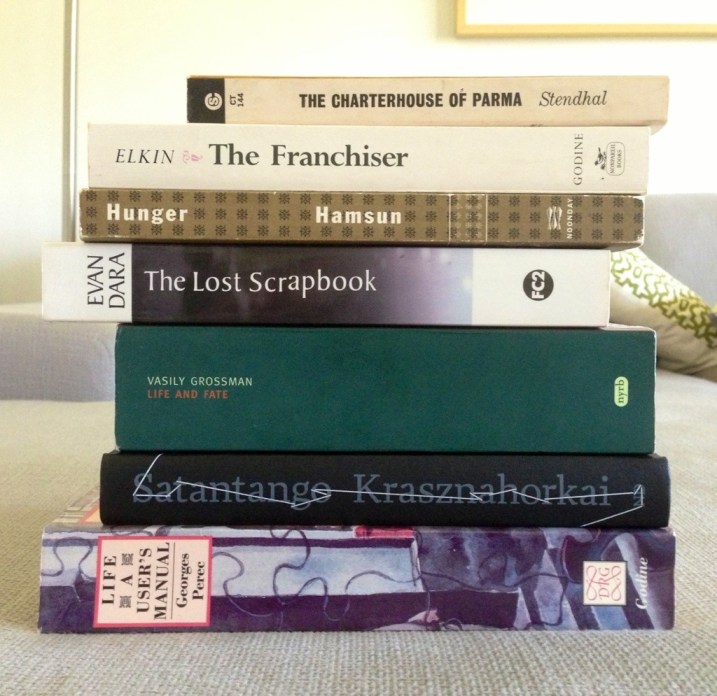
Seven Books I’d Like to Read Sometime in the Next Seven Years

20130909-164115.jpg

*

Seven Negative Reviews

Why I Abandoned Chad Harbach’s Over-Hyped Novel The Art of Fielding After Only 100 Pages

Jonathan Lethem’s Bloodless Prose

I Super Hated Gary Shteyngart’s Super Sad True Love Story

The Instructions — Adam Levin

Sunset Park — Paul Auster

The Passage — Justin Cronin

The Sot-Weed Factor — John Barth

*

Seven Ballerinas (Picasso)

*

Seven Perfect Short Stories

“The Death of Me” — Gordon Lish

“A Good Man Is Hard to Find” — Flannery O’Connor

“Emergency” — Denis Johnson

“The School” — Donald Barthelme

“Sweat” — Zora Neale Hurston

“Wakefield” — Nathaniel Hawthorne

“Good Old Neon” — David Foster Wallace

*

Seven Deadly Sins (Bosch)

*

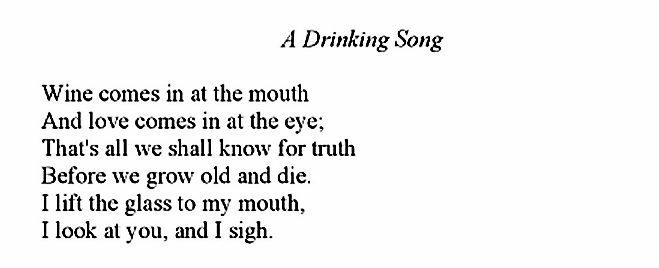
“A Drinking Song” — W.B. Yeats

Capture

Tylosaurus and the 108 Outlaws — Mu Pan

mupan

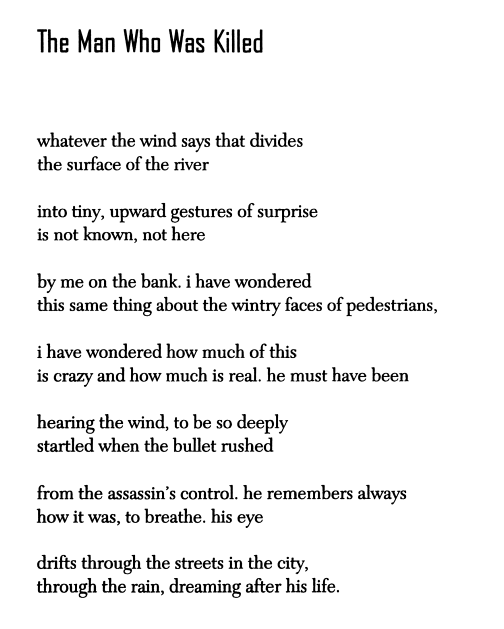
“The Man Who Was Killed” — Denis Johnson

mankilled

KB with Art in America — Alex Kanevsky

alex-kanevsky

The Cow — Dariush Mehrjui (Full Film)

Biblioklept’s Dictionary of Literary Terms

APHORISM

A concise, often witty, turn of phrase that should be shared out of context on Twitter or Pinterest.

BILDUNGSROMAN

Novel where someone (preferably male) matures into the ideal state of bitter disillusionment.

CATHARSIS

Evocation of fear and pity. Best exemplified in modern storytelling by Lifetime Network original movies.

DECONSTRUCTION

A form of textual analysis. No one knows what it means. Apply liberally.

EXISTENTIALIST

Use to describe any French novel of the 20th century. Serve with coffee and cigarettes.

FOIL

First, Outer, Inner, Last.

GENRE FICTION

Deride genre fiction at all times. If a writer uses genre tropes, praise her for genre bending. (See LITERARY FICTION).

HYSTERICAL REALISM

Use to describe any big ambitious novel that does not meet your aesthetic and/or moral needs.

IAMBIC PENTAMETER

All poetry is composed in iambic pentameter.

JUVENILIA

A writer’s immature work, which she usually (wisely) withholds from publication. After the writer dies, every scrap should be published, scrutinized, and passed around the internet out of context.

KAKFAESQUE

Synonym for “odd.” Apply freely.

LITERARY FICTION

A genre of fiction that pretends not to be a genre. What your book club is reading this month.

MAGICAL REALISM

Use to describe any novel by a South American writer.

NARRATOLOGY

Use structuralist techniques to analyze narrative plots—and watch the kids go wild! Narratology is the number one thing the audience of a book review is interested in.

ORPHAN

All heroes must be orphans.

PANOPTICON

Use this term liberally in any discussion of modern politics. Pairs well with film studies courses.

QUEER THEORY

A form of literary analysis that conveniently begins with the letter “Q,” making it ideal for silly alphabetized lists like this one.

ROUND CHARACTER

A character portrayed in psychological and emotional depth to the degree that she comes alive in your imagination. Round characters provide an excellent alternative to making meaningful human relationships.

SOUTHERN GOTHIC

Use to describe the style of any writer from the Southern part of the United States.

TAUTOLOGY

A tautology is a tautology.

UTOPIA

Synonym for dystopia. Argue about its pronunciation, indicating that you understand the complexities of Greek prefixes.

VERISIMILITUDE

Literary trickery.

WHODUNNIT

A genre of books that sells well in airports.

XENA

Beloved warrior princess. Look, is hardokay?

YOUNG WERTHER

The original sad bastard; he invented emo.

ZEITGEIST

Time’s ghost. You’re soaking in it, which makes it hard to see.

Tending to the Dead — Kristine Moran

tumblr_mjrqxf5PHM1s5k2rfo2_1280

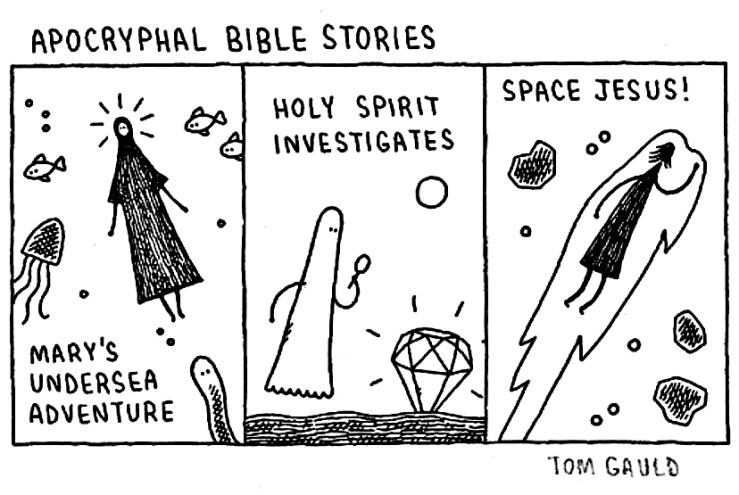
Apocryphal Bible Stories — Tom Gauld

tg

“The Hobo and the Fairy” — Jack London

“The Hobo and the Fairy” by Jack London

He lay on his back. So heavy was his sleep that the stamp of hoofs and cries of the drivers from the bridge that crossed the creek did not rouse him. Wagon after wagon, loaded high with grapes, passed the bridge on the way up the valley to the winery, and the coming of each wagon was like the explosion of sound and commotion in the lazy quiet of the afternoon.

But the man was undisturbed. His head had slipped from the folded newspaper, and the straggling, unkempt hair was matted with the foxtails and burrs of the dry grass on which it lay. He was not a pretty sight. His mouth was open, disclosing a gap in the upper row where several teeth at some time had been knocked out. He breathed stertorously, at times grunting and moaning with the pain of his sleep. Also, he was very restless, tossing his arms about, making jerky, half-convulsive movements, and at times rolling his head from side to side in the burrs. This restlessness seemed occasioned partly by some internal discomfort, and partly by the sun that streamed down on his face and by the flies that buzzed and lighted and crawled upon the nose and cheeks and eyelids. There was no other place for them to crawl, for the rest of the face was covered with matted beard, slightly grizzled, but greatly dirt-stained and weather-discolored.

The cheek-bones were blotched with the blood congested by the debauch that was evidently being slept off. This, too, accounted for the persistence with which the flies clustered around the mouth, lured by the alcohol-laden exhalations. He was a powerfully built man, thick-necked, broad-shouldered, with sinewy wrists and toil-distorted hands. Yet the distortion was not due to recent toil, nor were the callouses other than ancient that showed under the dirt of the one palm upturned. From time to time this hand clenched tightly and spasmodically into a fist, large, heavy-boned and wicked-looking.

The man lay in the dry grass of a tiny glade that ran down to the tree-fringed bank of the stream. On either side of the glade was a fence, of the old stake-and-rider type, though little of it was to be seen, so thickly was it overgrown by wild blackberry bushes, scrubby oaks and young madrono trees. In the rear, a gate through a low paling fence led to a snug, squat bungalow, built in the California Spanish style and seeming to have been compounded directly from the landscape of which it was so justly a part. Neat and trim and modestly sweet was the bungalow, redolent of comfort and repose, telling with quiet certitude of some one that knew, and that had sought and found. Continue reading ““The Hobo and the Fairy” — Jack London”

Interior with a Young Man Reading — Vilhelm Hammershøi

The Rules of the Game — Jean Renoir (Full Film)

Lovers Man and Woman — Egon Schiele