Testament of Orpheus — Jean Cocteau (Full Film)

Souvenir I — Kerry James Marshall

A German Picturesque (Book Acquired, 11.14.2013)

20131122-123857.jpg

A Riff-Report on Elisabeth Sheffield’s Fort Da: A Report

First steps in my Cognitive-Behavioral Therapy for Obsessive-Compulsive Disorder, and the exponentially more crushing and debilitating fear it would produce each step I took outside of my apartment, required morning chats with my brain. As in: “Brain, when I go out there today, you’re going to make me think when I see y. I know you’re going to do that, and expect it”–and here’s the worst part of it–“so bring it on.” I still do it. And it helps. And the silliness of that last phrase hasn’t left. Maybe because of pride, or because it does offer some small affirmation that OCD is distinct from me or, instinctively, “I” feel all therapy is fundamentally justification and posturing. But a necessary justification and posturing nonetheless. This might also apply to literature, criticism, philosophy, art, etc. Bernhard: “When one thinks of death, everything is ridiculous.” Kraszhnahorkai, in an interview with The White Review, says, “there is no medicine.” Just because there is no medicine does not mean that we can not strive for medicine, even if that medicine is “there is no medicine.”

Alternatively, I might try something that the narrator/character/subject/patient/object Rosemarie Romeo Ramee from Elisabeth Sheffield’s novel/report/study/apologia Fort Da: a report (FC2) employs. “Disguised” as a report on her “affair” with a pre-adolescent/pubescent Cypriot boy named Aslan, Ramee confesses and searches for understanding and empathy by externalizing her self, “RR,” in a supposed strict description of the events to a Ms. Wall, who we learn was RR’s AP English 12 instructor. We begin at the end of RR’s story, writing from some where that’s part-prison, part-clinic, with legal prosecution waiting for her. RR’s “account” of the ways in which she sexually, emotionally and physically consumed Aslan is dissociating the “I” away from her own constructions of Self. (For more on this, I recommend Michael W. Clune’s fantastic essay on Beckett and Bernhard at NonSite). My therapist suggested a similar approach. In not so many words, he said “write out your trauma as if it were a play, like stage directions.” But in the attempt to objectify and externalize an ostensible past iteration of my self, at least to Ramee,  presupposes failure.

For we know at this stage in evolution, the amygdala has a greater influence on the cortex than the cortex has on the amygdala–allowing emotional arousal dominate and control thinking. A person doesn’t want to be unreasonable, but feeling is a variable that cannot be discounted. // Another is the nature of memory. The inherent inexactitude of the internal record of external events–this must be acknowledged. Yes it must be acknowledged that the neuronal record of reality is selective, if not capricious, a spotty chronicle at best. … Also, it must be conceded that an illness such as cerebral malaria can diminish the reliability of the record even further, smearing the ink, so to speak, deleting entire pages. … Therefore, this account will probably fail as an etiology–the sequence of cause and effect being incomplete. Nevertheless, it will be as rigorous as possible. And she will try not to cry. (19-20).

Continue reading “A Riff-Report on Elisabeth Sheffield’s Fort Da: A Report”

Kennedy Motorcade — Audrey Flack

Jason Schwartz Interviewed at 3:am Magazine

3:am Magazine has published an interview with novelist Jason Schwartz. Schwartz’s latest, John the Posthumous, is my favorite book of 2013.  In the interview, Jason Lucarelli talks with Schwartz about John the Posthumous, his experiences with Gordon Lish, and teaching writing. The final answer of the interview though is my favorite moment—it reads like a wonderful and bizarre microfiction. Here it is, sans context:

This comes to mind: long ago, in New York, I taught middle school for a year. Rough and tumble sort of place. Lots of mischief, and no textbooks, as these had all been lost or destroyed or thrown out into a courtyard, where—I may be revising the memory slightly—there was a great pile of books, a pile nearly one story high. So it was upon the teacher to scratch out lessons on the blackboard. This was transcription, the transcription of many items, all these chapters from the absent books. And once this had been accomplished, once the blackboard had been covered with words, first thing in the morning, it was upon the teacher to guard the blackboard all day. So what to do when the fistfight breaks out? You know how people gather around. The teacher now fears the press of bodies, and the tendency of bodies to smudge, or even erase, words. Stop the fight or protect the blackboard? This seemed to me, at the time, the central educational dilemma. If you’re lucky, the fracas is close by, and you might arrange things accordingly—one hand here and one hand there, finding yourself in various complicated postures. I never managed that to successful effect. And perhaps all this explains why, in the old country, contortionists were always thought the best schoolteachers. Anyway, Mr. O’Riley’s room has been set afire in the meantime, or Mrs. Wilson has been trampled in the stairwell. The day would pass in that fashion, and then I would go home and write about postage stamps and Judas Iscariot.


Read/Listen to JG Ballard’s “The Assassination of John Fitzgerald Kennedy Considered as a Downhill Motor Race”

Author’s note. The assassination of President Kennedy on November 22, 1963, raised many questions, not all of which were answered by the Report of the Warren Commission. It is suggested that a less conventional view of the events of that grim day may provide a more satisfactory explanation. Alfred Jarry’s “The Crucifixion Considered as an Uphill Bicycle Race” gives us a useful lead.

Oswald was the starter.

From his window above the track he opened the race by firing the starting gun. It is believed that the first shot was not properly heard by all the drivers. In the following confusion, Oswald fired the gun two more times, but the race was already underway.

Kennedy got off to a bad start.

There was a governor in his car and its speed remained constant at about fifteen miles an hour. However, shortly afterwards, when the governor had been put out of action, the car accelerated rapidly, and continued at high speed along the remainder of the course.

Read the rest of JG Ballard’s short story “The Assassination of John Fitzgerald Kennedy Considered as a Downhill Motor Race” (and the Jarry text)or let Miette read it to you.

John F. Kennedy — Elaine de Kooning

Night — Jean-Leon Gerome

“Persephone” — D.M. Thomas

Capture

“The Blind Pensioners at Quinze Vingt,” A Philosophical Digression by Voltaire

“The Blind Pensioners at Quinze Vingt” by Voltaire

A SHORT DIGRESSION.—When the hospital of the Quinze Vingt was first founded, the pensioners were all equal, and their little affairs were concluded upon by a majority of votes. They distinguished perfectly by the touch between copper and silver coin; they never mistook the wine of Brie for that of Burgundy. Their sense of smelling was finer than that of their neighbors who had the use of two eyes. They reasoned very well on the four senses; that is, they knew everything they were permitted to know, and they lived as peaceably and as happily as blind people could be supposed to do. But unfortunately one of their professors pretended to have clear ideas in respect to the sense of seeing, he drew attention; he intrigued; he formed enthusiasts; and at last he was acknowledged chief of the community. He pretended to be a judge of colors, and everything was lost.

This dictator of the Quinze Vingt chose at first a little council, by the assistance of which he got possession of all the alms. On this account, no person had the resolution to oppose him. He decreed, that all the inhabitants of the Quinze Vingt were clothed in white. The blind pensioners believed him; and nothing was to be heard but their talk of white garments, though, in fact, they possessed not one of that color. All their acquaintance laughed at them. They made their complaints to the dictator, who received them very ill; he rebuked them as innovators, freethinkers, rebels, who had suffered themselves to be seduced by the errors of those who had eyes, and who presumed to doubt that their chief was infallible. This contention gave rise to two parties.

To appease the tumult, the dictator issued a decree, importing that all their vestments were red. There was not one vestment of that color in the Quinze Vingt. The poor men were laughed at more than ever. Complaints were again made by the community. The dictator rushed furiously in; and the other blind men were as much enraged. They fought a long time; and peace was not restored until the members of the Quinze Vingt were permitted to suspend their judgments in regard to the color of their dress.

A deaf man, reading this little history, allowed that these people, being blind, were to blame in pretending to judge of colors; but he remained steady to his own opinion, that those persons who were deaf were the only proper judges of music.

Invisible Bust of Voltaire — Salvador Dali

The Lady of Shalott — William Holman Hunt

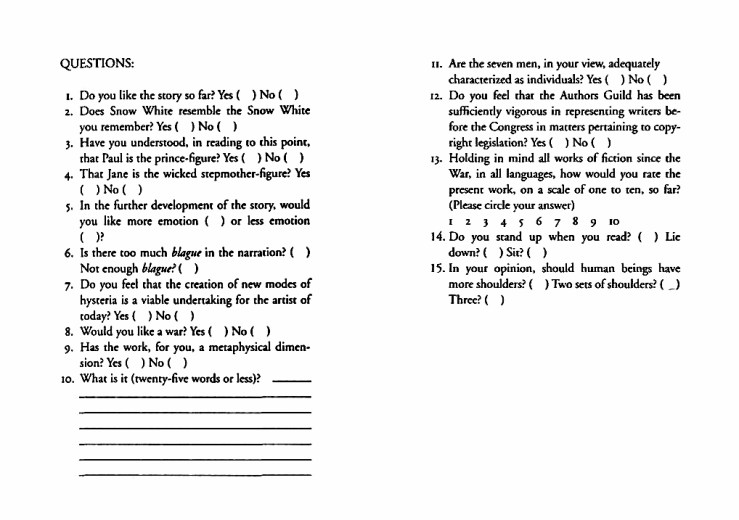
Questions (Donald Barthelme’s Snow White)

questions

Tribulations of Saint Anthony — James Ensor

I Will Marry You (Beauty and the Beast) — Edmund Dulac

Blade Runner — The Aquarelle Edition

This strange and impressionistic paraphrase of Ridley Scott’s 1982 film Blade Runner is by Anders Ramsell, who painted all 12,597 frames using only water colors. The edit features dialogue and music from the film and the radical compression of the plot—edited down to just over half an hour—gives this painted film a dreamy, surreal texture. (Via Boing Boing, which I’m sure all you hepcats follow anyway, but this film is too lovely not to share again, in case, y’know, you didn’t already see it somehow).