
PREVIOUSLY:
Introductions + stories 1956-1959
Stories of 1960
Stories of 1961
Stories of 1962
“The Subliminal Man,” Black Friday, and Consumerism
IN THIS RIFF:
“The Reptile Enclosure” (1963)
“A Question of Re-Entry” (1963)
“The Time Tombs” (1963)
“Now Wakes the Sea” (1963)
“The Venus Hunters” (1963)
“End-Game” (1963)
“Minus One” (1963)
“The Sudden Afternoon” (1963)
“The Screen Game” (1963)
“Time of Passage” (1964)
“Prisoner of the Coral Deep” (1964)
“The Lost Leonardo” (1964)
“The Terminal Beach” (1964)
“The Illuminated Man” (1964)
“The Delta at Sunset” (1964)
“The Drowned Giant” (1964)
“The Gioconda of the Twilight Noon” (1964)
“The Volcano Dances” (1964)
1.”The Reptile Enclosure” (1963) / “A Question of Re-Entry” (1963) / “The Time Tombs” (1963) / “Now Wakes the Sea” (1963) / “The Venus Hunters” (1963) / “Minus One” (1963) / “Prisoner of the Coral Deep” (1964) / “The Illuminated Man” (1964) / “The Delta at Sunset” (1964) / “The Gioconda of the Twilight Noon” /”The Volcano Dances” (1964)
There are 98 stories in The Complete Short Stories of J.G. Ballard. That’s a lot of stories. Maybe too many. Too many for me to write about in full, anyway. I’ve lumped these stories together because they are somewhat unremarkable: Ballard does his Ballardian thing way better elsewhere. Several of these stories feel like sketches (or leftovers) from Ballard’s early novels like The Drowned World, The Burning World, and The Crystal World. Themes of time, memory, art, and nature abound here, usually glommed on to simple adventure narratives or sci-fi pulp treadthroughs. Jungles, watches, crystals, structures, beaches. Misanthropy, paranoia, nagging wives, misunderstood heroes. Man apart from nature, but beholden to nature. Etc. The worst moments of these stories—and we can find these moments all through early Ballard, to be fair—suffer from a bad case of White Man’s Burden doubled up with a shot of misogyny. I’ve written it before in these posts, but the most disappointing aspect of early Ballard is our would-be futurist’s inability to transcend the patriarchal ideology of the post-war era. So now let’s move to the good stuff.
2. “End-Game” (1963)
I first read “End-Game” when I was sixteen or seventeen, and it’s always stuck with me. It’s the story of a former “party member” who’s been imprisoned under nebulous circumstances—only his prison isn’t that bad—a nice little villa, comfortable, with books and a chess set. He even has a housekeeper. Unfortunately, the housekeeper is also his executioner, and the date and method of the execution is forever withheld from him:
This ironic inversion of the classical Kafkaesque situation, by which, instead of admitting his guilt to a non–existent crime, he was forced to connive in a farce maintaining his innocence of offences he knew full well he had committed, was preserved in his present situation at the execution villa.
The psychological basis was more obscure but in some way far more threatening, the executioner beckoning his victim towards him with a beguiling smile, reassuring him that all was forgiven. Here he played upon, not those unconscious feelings of anxiety and guilt, but that innate conviction of individual survival, that obsessive preoccupation with personal immortality which is merely a disguised form of the universal fear of the image of one’s own death. It was this assurance that all was well, and the absence of any charges of guilt or responsibility, which had made so orderly the queues into the gas chambers.
Ballard directly invokes Kafka, whose tale “Before the Law” comes to mind here (not to mention The Trial and The Castle); “End-Game” also feels like Ballard’s take on 1984. It’s a great little tale, and I think it helps to prove that Ballard is at his best when he sticks to a confined, limited cast and setting. Much of the force of “End-Game” comes from Ballard pitting his prisoner/protagonist against the protagonist’s mental conception of his guard/executioner. Part of my ideal collection, The Essential Short Stories of J.G. Ballard.
3. “The Sudden Afternoon” (1963) / “Time of Passage” (1964)
In “The Sudden Afternoon” and “Time of Passage,” Ballard explores how time and place—context, I suppose—constitute identity. The former story is a tale of metempsychosis with a troubling take on Indian spirituality, wherein a doctor—an Indian, of course—transplants his psyche and his wife’s psyche into the bodies of another couple (his wife is dying of a terminal disease). Ballard’s own wife died a year after the story was first published (I’m reminded of Poe here, whose wife Virginia died after the publication of “The Raven”). “The Sudden Afternoon” isn’t very good, but structurally we see Ballard beginning to employ something approaching the cut-ups/fragments he’ll move to in the next decade.
“Time of Passage” is essentially a rewrite of F. Scott Fitzgerald’s “The Curious Case of Benjamin Button.” It’s also basically a rewrite of Ballard’s own 1961 tale “Mr. F Is Mr. F” — only this time, Ballard dispenses with abject-horror-for-maternal-body in lieu of a fable-like exploration of what a life in reverse might actually look like. A lovely story. Stick it in The Essentials.
4. “The Screen Game” (1963)
Another Vermilion Sands story. More insanity. Another femme fatale. An attempt at the story of Orpheus, perhaps. I would have lumped it in with the stories in point 1, but I wanted to clarify: The Vermilion Sands stories are the worst.
 5. “The Lost Leonardo” (1964)
This is an excellent little detective tale with mystical-magic undertones. I’m a sucker for any story of art theft, too. We all know Dan Brown ripped off Umberto Eco, but maybe Eco ripped off Ballard? Who cares. Lovely stuff. Ballard is excellent at the detective story; Poe is one of his clearest predecessors, but like Poe, he’s more famous for other stuff. Too bad. Let’s call it Essential.
6. “The Terminal Beach” (1964)
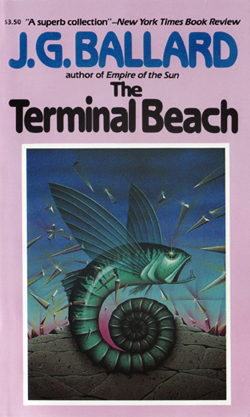
1964’s “The Terminal Beach” is such a big break through for Ballard in terms of formal elements and structuring that it probably deserves its own post, but I’ll jab at it here anyway. Up until now, Ballard’s stories have been notable almost entirely for their ideas—his prose has improved some, but ultimately, the pulp fiction he’s writing for magazine publication constrains him to a pedestrian rhetoric that simply can’t match how far out his concepts are. With “The Terminal Beach,” Ballard finally approaches a narrative structure—fractured, polyglossic, shifting through interiors to exteriors, breaking through different forms—that can match the themes of his tale. The story–clearly an Essential—points to the finest of Ballard’s future work. You can read it here in two parts, but here’s a taste that I think stands alone as a microfiction:
The Fly
(A small fly, which Traven presumes has followed him into the fissure, now buzzes about the corpse’s face. Guiltily, Traven leans forward to kill it, then reflects that perhaps this minuscule sentry has been the corpse’s faithful companion, in return fed on the rich liqueurs and distillations of its pores. Carefully, to avoid injuring the fly, he encourages it to alight on his wrist.)
DR YASUDA: Thank you, Traven. In my position, you understand
TRAVEN: Of course, Doctor. I’m sorry I tried to kill it – these ingrained habits, you know, they’re not easy to shrug off. Your sister’s children in Osaka in ’44, the exigencies of war, I hate to plead them. Most known motives are so despicable, one searches the unknown in the hope that YASUDA: Please, Traven, do not be embarrassed. The fly is lucky to retain its identity for so long. ‘That son you mourn, not to mention my own two nieces and nephew, did they not die each day? Every parent in the world grieves for the lost sons and daughters of their earlier childhoods.
TRAVEN: You’re very tolerant, Doctor. I wouldn’t dare – YASUDA: Not at all, Traven. I make no apologies for you. Each of us is little more than the meagre residue of the infinite unrealized possibilities of our lives. But your son, and my nephew, are fixed in our minds forever, their identities as certain as the stars.
TRAVEN: (not entirely convinced) That may be so, Doctor, but it leads to a dangerous conclusion in the case of this island. For instance, the blocks – YASUDA: They are precisely what I refer to, Traven. Here among the blocks you at last find an image of yourself free of the hazards of time and space. This islandis an ontological Garden of Eden, why seek to expel yourself into a world of quantal flux?
TRAVEN: Excuse me (The fly has flown back to the corpse’s face and sits in one of the dried-up orbits, giving the good doctor an expression of quizzical beadiness. Reaching forward, Traven entices it on to his palm. He examines it carefully) Well, yes, these bunkers may be ontological objects, but whether this is the ontological fly is doubtful. It’s true that on this island it’s the only fly, which is the next best thing
YASUDA: You can’t accept the plurality of the universe – ask yourself why, Traven. Why should this obsess you? It seems to me that you are hunting for the white leviathan, zero. The beach is a dangerous zone. Avoid it. Have a proper humility, pursue a philosophy of acceptance.
TRAVEN: Then may I ask why you came here, Doctor?
YASUDA: To feed this fly. ‘What greater love – ?’
TRAVEN: (Still puzzling) It doesn’t really solve my problem. The blocks, you see
YASUDA: Very well, if you must have it that way
TRAVEN: But, Doctor
YASUDA: (Peremptorily) Kill that fly!
TRAVEN: That’s not an end, or a beginning.
(Hopelessly, he kills the fly. Exhausted, he falls asleep beside the corpse.)
7. “The Drowned Giant” (1964)
Another Essential, this puzzling fable readily recalls Gabriel García Márquez’s story “A Very Old Man with Enormous Wings.” Ballard rarely handles archetypes so directly as he does here. Even if the story’s theme seems almost too-plain—we lose the miracle, we cast down the old gods, we deny the sublime, etc.—its construction and telling are wonderfully achieved.
The lower jaw, typically, found its way to the museum of natural history. The remainder of the skull has disappeared, but is probably still lurking in the waste grounds or private gardens of the city – quite recently, while sailing down the river, I noticed two ribs of the giant forming a decorative arch in a waterside garden, possibly confused with the jaw–bones of a whale. A large square of tanned and tattooed skin, the size of an indian blanket, forms a backcloth to the dolls and masks in a novelty shop near the amusement park, and I have no doubt that elsewhere in the city, in the hotels or golf clubs, the mummified nose or ears of the giant hang from the wall above a fireplace. As for the immense pizzle, this ends its days in the freak museum of a circus which travels up and down the north–west. This monumental apparatus, stunning in its proportions and sometime potency, occupies a complete booth to itself. The irony is that it is wrongly identified as that of a whale, and indeed most people, even those who first saw him cast up on the shore after the storm, now remember the giant, if at all, as a large sea beast.
8. On the horizon:
Ballard plays with fragmentation again in “The Beach Murders” and “The Assassination of John Fitzgerald Kennedy Considered as a Downhill Motor Race” — and we finally get to his stories of the late sixties.




 Biblioklept