“Beckett is a very blue man” (William H. Gass)

Remember how the desperate Molloy proceeds:

I took advantage of being at the seaside to lay in a store of sucking stones. They were pebbles but I call them stones I distrutibed them equally between my four pockets, and sucked them turn and turn about. This raised a problem which I first solved in the following way. I had say sixteen stones, four in each of my four pockets these being the two pockets of my trousers and the two pockets of my greatcoat. Taking a stone from the right pockct of my greatcoat, and putting it in mv mouth , I replaced it in the right pocket of my greatcoat bv a stone from the right pocket of my trousers, which I replaced by a stone from the left pocket of my trousers, which I replaced by a stone from the left pocket of my greatcoat, which I replaced by the stone which was in my mouth, as soon as I had fin-ished sucking it. Thus there were still four stones in each of my four pockets , but not quite the same stones…. But this solution did not satisfy me fully. For it did not escape me that, by an extraordinary hazard, the four stones circulating thus might always be the same four. In which case, far from sucking the sixteen stones turn and turn about, I was really only sucking four, always the same, turn and turn about.

Beckett is a very blue man, and this is a very blue passage.

From William H. Gass’s On Being Blue: A Philosophical Inquiry (and of course, Samuel Beckett’s Molloy).
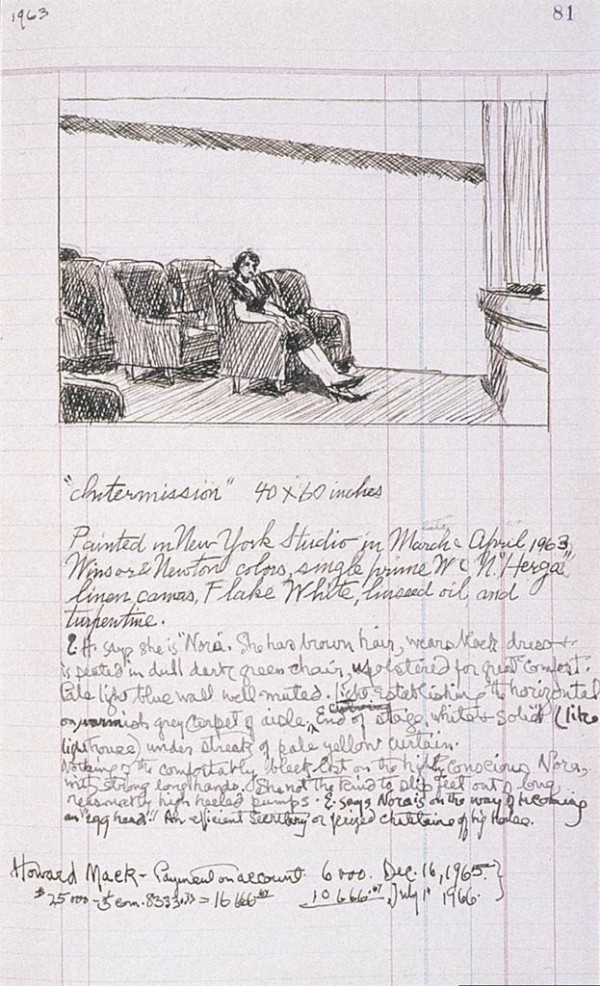
Study for Intermission — Edward Hopper

intermission

“Distant Shore” (Live) — Dirty Three

Judgement of Paris — Pier Francesco Mola

So musical a discord, such sweet thunder

Capture

“I am learning to see.” (Rilke)

Have I said it already? I am learning to see. Yes, I’m beginning. It is still going badly. But I want to make use of my time.

For instance, I never realized how many faces there are. There are lots of people but still more faces, for everyone has several. There are people who wear a face for years, of course it wears out, gets dirty, cracks in the folds, stretches like a glove one has worn on a journey. Those are thrifty, simple people: they don’t change it, they don’t even have it cleaned. It’s good enough, they maintain, and who can convince them otherwise? The question does arise, since they have several faces, what do they do with the others? They keep them in reserve. Their children will get to wear them. But it also happens that their dogs wear them when they go out. And why not? Face is face.

Other people put on their faces with uncanny rapidity, one after the other, and wear them out. At first it seems to them as if they have them forever, but they are barely forty and this one is already the last. That of course has its tragic side. They are not used to take care of faces, they run through the last one in a week, there are holes in it, in many places it is as thin as paper, and then slowly what’s underneath emerges, the not-face, and they walk around with that.

From The Notebooks of Malte Laurids Brigge. Translated by Burton Pike.

Blue Girl Reading — Frederick C. Frieseke

blue girl