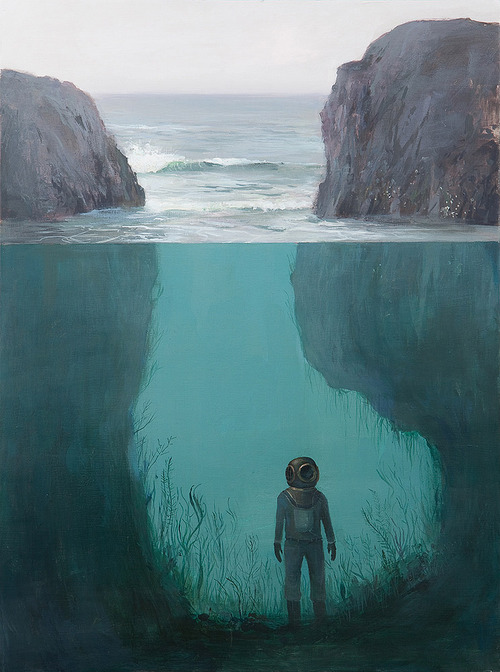
“The Blind Man” — Robert Walser

20140621-082923-30563343.jpg

Some People — Luke Pearson

some people

Portraits of Serafino and Francesco Falzacappa — Pier Leone Ghezzi

Peace — William Turner

“A Night at the Opera” — Janet Frame

We acted the cliché. We melted with laughter. Not the prickly melt that comes from sitting on a hot stove but the cool relaxing melt, in defiance of chemistry, like dropping deep into a liquid feather bed. We did not know or remember the reason for laughing. There was a film, yes: a dumb sad man with hair like wheat and round eyes like paddling pools; another man with a mustache like a toy hearth brush; and many other people and things—blondes, irate managers, stepladders, whitewash, all the stuff of farce. And there was a darkened opera house growing cardboard trees and shining wooden moons.

I shall never know why we laughed so much. Perhaps other films had been as funny, but this one seemed to contain for us a total laughter, a storehouse of laughter, like a hive where we children, spindly-legged as bees, would forever bring our foragings of fun to mellow and replenish this almost unbelievably collapsing mirth.

Nor was it the kind of laughter that cheats by turning in the end to tears, or by needing reinforcement with imagery. It was, simply, like being thrown on a swing into the sky, and the swing staying there, as in one of those trick pictures we had seen so often and marvelled at—divers leaping back to the springboard, horses racing back to the starting barrier. It was like stepping off the swing and promenading the sky.

After the film, we managed somehow to walk home. The afternoon was ragged with leaves and the dreary, hungry untidiness of a child’s half past four. Faces and streets seemed wet and serious. The hem of sky, undone, hung down dirty and gray.

But the laughter stayed with us, crippling, floating, rolling, aching, dissolving.

“It must have been a comic picture,” our mother said, not knowing, not knowing, when she saw our faces.

Read the rest of Janet Frame’s short story “A Night at the Opera.”

Searching — Jeremy Miranda

searchingwebsite

Hands of Bresson

Lying is the proper aim of Art (Oscar Wilde)

CYRIL.  …I want you to tell me briefly the doctrines of the new aesthetics.

VIVIAN.  Briefly, then, they are these.  Art never expresses anything but itself.  It has an independent life, just as Thought has, and develops purely on its own lines.  It is not necessarily realistic in an age of realism, nor spiritual in an age of faith.  So far from being the creation of its time, it is usually in direct opposition to it, and the only history that it preserves for us is the history of its own progress.  Sometimes it returns upon its footsteps, and revives some antique form, as happened in the archaistic movement of late Greek Art, and in the pre-Raphaelite movement of our own day.  At other times it entirely anticipates its age, and produces in one century work that it takes another century to understand, to appreciate and to enjoy.  In no case does it reproduce its age.  To pass from the art of a time to the time itself is the great mistake that all historians commit.

The second doctrine is this.  All bad art comes from returning to Life and Nature, and elevating them into ideals.  Life and Nature may sometimes be used as part of Art’s rough material, but before they are of any real service to art they must be translated into artistic conventions.  The moment Art surrenders its imaginative medium it surrenders everything.  As a method Realism is a complete failure, and the two things that every artist should avoid are modernity of form and modernity of subject-matter.  To us, who live in the nineteenth century, any century is a suitable subject for art except our own.  The only beautiful things are the things that do not concern us.  It is, to have the pleasure of quoting myself, exactly because Hecuba is nothing to us that her sorrows are so suitable a motive for a tragedy.  Besides, it is only the modern that ever becomes old-fashioned.  M. Zola sits down to give us a picture of the Second Empire.  Who cares for the Second Empire now?  It is out of date.  Life goes faster than Realism, but Romanticism is always in front of Life.

The third doctrine is that Life imitates Art far more than Art imitates Life.  This results not merely from Life’s imitative instinct, but from the fact that the self-conscious aim of Life is to find expression, and that Art offers it certain beautiful forms through which it may realise that energy.  It is a theory that has never been put forward before, but it is extremely fruitful, and throws an entirely new light upon the history of Art.

It follows, as a corollary from this, that external Nature also imitates Art.  The only effects that she can show us are effects that we have already seen through poetry, or in paintings.  This is the secret of Nature’s charm, as well as the explanation of Nature’s weakness.

The final revelation is that Lying, the telling of beautiful untrue things, is the proper aim of Art.  But of this I think I have spoken at sufficient length.  And now let us go out on the terrace, where ‘droops the milk-white peacock like a ghost,’ while the evening star ‘washes the dusk with silver.’  At twilight nature becomes a wonderfully suggestive effect, and is not without loveliness, though perhaps its chief use is to illustrate quotations from the poets.  Come!  We have talked long enough.
From “The Decay of Lying” by Oscar Wilde.

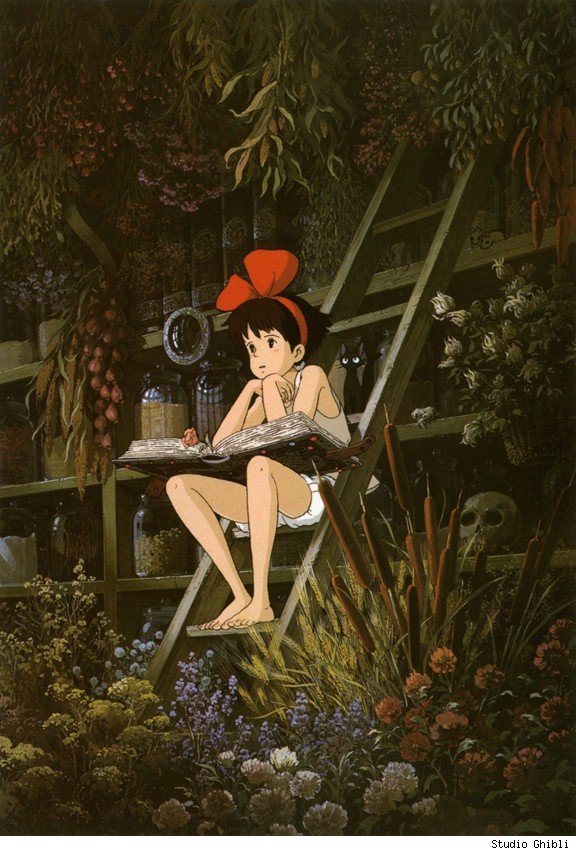
Kiki Reading — Hayao Miyazaki/Studio Ghibli

kiki

The BFG — Quentin Blake

20140619-203914-74354216.jpg

The Golden Age — Lucas Cranach the Elder

Beauty, grace, truth of the first water, I knew they were all beyond me.

20140619-160536-57936873.jpg

Watch The Danish Poet, an Animated Short by Torill Kove (Narrated by Liv Ullmann)

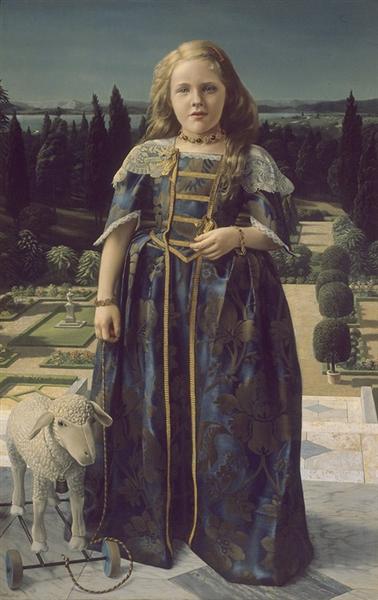
Girl in Renaissance Costume — Carel Willink

girl-with-a-small-sheep-girl-in-renaissance-costume-1946large

Work Work Work / Read Read Read (Barry Moser’s Advice to Artists)

The best advice I could possibly give you, and forgive me if this seems glib, is to work. Work. Work. Work. Every day. At the same time every day. For as long as you can take it every day, work, work, work. Understand? Talent is for shit. I’ve taught school for nearly thirty years and never met a student who did not have some talent. It is as common as house dust or kudzu vine in Alabama and is just about as valuable. Nothing is as valuable as the habit of work, and work has to become a habit. This I learned from Flannery O’Connor. Read her. Read her letters especially, and her essays. You will learn more about what it is you want to do from people like her and Ben Shahn and Eudora Welty than you will ever learn from drawing classes. Read. Read. Read. You are in the business of words more than pictures. You must understand words and the craft and art of putting words together to move men’s souls and minds and hearts. Listen to music. Listen to Bach’s Art of the Fugue and the Goldberg Variations over and over and over. Every day, day after day after day until you begin to sense, if not understand, what he is up to. Then try to implement what you intuit from Bach into your own work. I don’t care if you don’t like classical music. Do it. It is invaluable, but you have to listen, and then don’t listen. Let it fill your mind at one moment and then let it flow over you and into you until you are paying it no attention whatever. Bach will teach you form and structure and rhythm and all sorts of things you never imagined.

Advice Barry Moser gave to The Children’s Literature Symposium at Clemson in 1996. Read the rest of the address here (other advice includes eating green vegetables and not drinking and driving).

Gaby and Luciano — Franz Gertsch

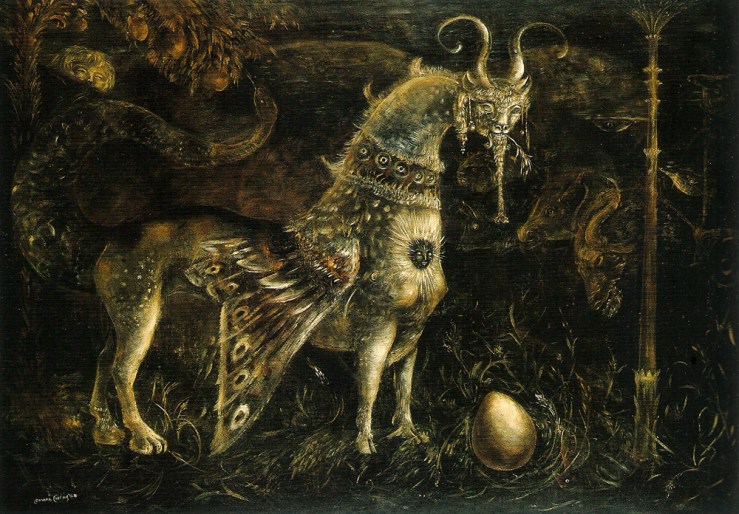
Who Art Thou White Face? — Leonora Carrington

who art thou white face leonora carrington