A Conversation about Ben Lerner’s Novel 10:04 (Part 2)

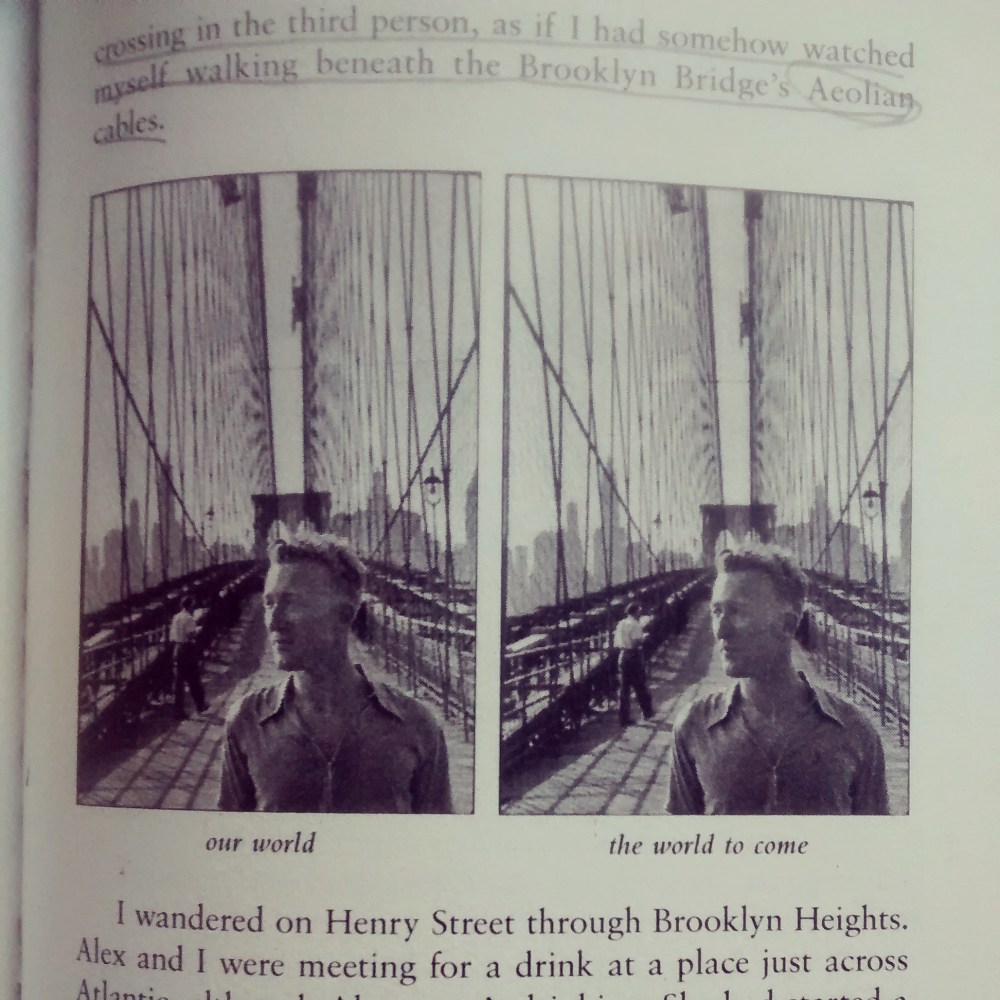
IMG_20140920_084354

[Context/editorial noteThis is the second and final part of a discussion between Biblioklept contributor Ryan Chang and myself about Ben Lerner’s new novel 10:04. You can read the first part of the discussion here, if you like—the gist of that conversation is that I am kinda sorta hating the book, while Ryan makes a strong case for my finishing it. Which I did. — ET].

Edwin Turner: Okay, Ryan, so I’m still having a hard time with the book, and I think that Hari Kunzru pins down why in his (diplomatic) review at The New York Times:

Does [the novel’s] ironic tone (which often feels like a reflex, a tic) preclude sincerity? Is all this talk of community no more than an artful confection, the purest kind of cynicism? The question is impossible to resolve, so each of these episodes — and indeed the book as a whole — takes on a sort of hermetic undecidability.

I find the “hermetic undecidability” not so much unsettling—the proper rhetorical gambit to match the novel’s themes—but rather a dodge, an escape hatch even, to avoid adequately answering to the model that the narrator wants to find in Whitman. There’s this wonderful moment where the narrator says “Art has to offer something other than stylized despair” — and I take this to be something like the mission of the book — but the archness, the cleverness of the book, its frequent retreats away from (what I take to be) Whitman’s project (the kosmos, the roughneck with the unstopped throat) — I just don’t see much but a kind of stylized ennui (if not despair) about the “bad forms of collectivity” our narrator is forced (forces himself) to partake in.

My favorite moments of the book continue to be the essay passages, the art or literary theory that he spackles in—the riff on Peggy Noonan writing Reagan’s Challenger-explosion speech, the elements of borrowed language, etc. (Again, I’m almost the same age as Lerner. I was in Young Astronauts, and our field trip to Cape Canaveral was canceled because of inclement weather, so we watched it in the cafeteria—live. I did not understand what happened, but I remember my teachers crying).

Ryan Chang: Hey man, I just skimmed the NYT review—per the excerpt you provided—because I don’t want Kunzru clouding any of my response. It’s certainly a question I too grapple with, and I think Kunzru is right insofar that the question is “undecidable” but not for the reason(s) he suggests. I agree with you that he dodges the question, whether or not from editorial pressure or a reticence to actually address “hermetic undecidability.”

For one, I’m not sure myself if The Author ever arrives at the Whitmanic model of democracy he posits. I’m also not sure if he is supposed to “arrive” in the sense that a finality is set. I guess I also want to riff a bit on how finality might be described. Is finality then something static; as in, somehow 10:04 transmits–electrocutes, reverberates–through its readership, now coeval (the when negligent, the position of the reader enmeshed in the text is the same at 10 PM here as it is at 5 AM there), the novel’s theses and everything is suddenly Whitmanic? Community successfully reimagined and cemented? That sounds too easy, too convenient, too short-sighted. Or is it a kind of arrival into an embodiment of time that exists outside of conventional literary clocks, which is also a Market-based clock — it’s my sense that the kind of democracy Whitman envisions in his work is one constantly in flux, a “reality in process” and thus in opposition to the capitalist clock? That is, we know we are supposed to “stop” working at 5, the embodiment of the currency-based clock disappears after 5, but it’s a contrasting relationship. Our time outside of the currency then absorbs a negative value (I think The Author only mentions once or twice how we are all connected by our debt, a negativity projected into the future), though the illusion of the clock is that we are “free” in our time. OK: in a literary sense, wouldn’t this be a sense of a text’s world stopping, a suspension that retroactively pauses the whole book? That 10:04 ends not only with a dissolution of prose into poetry, but also The Author into Whitman and thus recasting the first-/third-person narrator into a lyric-poet mode suggests the book’s integration into our, the reader’s, time (and also, retroactively, the entirety of the text). In that sense, for me, the issue whether or not The Author of 10:04 integrates the book fully into a Whitmanic model is not necessarily the point — it is that he, and also we hopefully through him — actively participate in remaking a “bad form of collectivity” less so. Continue reading “A Conversation about Ben Lerner’s Novel 10:04 (Part 2)”

The Bus — Paul Kirchner

“Clay” — James Joyce

“Clay”

by

James Joyce

The matron had given her leave to go out as soon as the women’s tea was over and Maria looked forward to her evening out. The kitchen was spick and span: the cook said you could see yourself in the big copper boilers. The fire was nice and bright and on one of the side-tables were four very big barmbracks. These barmbracks seemed uncut; but if you went closer you would see that they had been cut into long thick even slices and were ready to be handed round at tea. Maria had cut them herself.

Maria was a very, very small person indeed but she had a very long nose and a very long chin. She talked a little through her nose, always soothingly: “Yes, my dear,” and “No, my dear.” She was always sent for when the women quarrelled over their tubs and always succeeded in making peace. One day the matron had said to her:

“Maria, you are a veritable peace-maker!”

And the sub-matron and two of the Board ladies had heard the compliment. And Ginger Mooney was always saying what she wouldn’t do to the dummy who had charge of the irons if it wasn’t for Maria. Everyone was so fond of Maria.

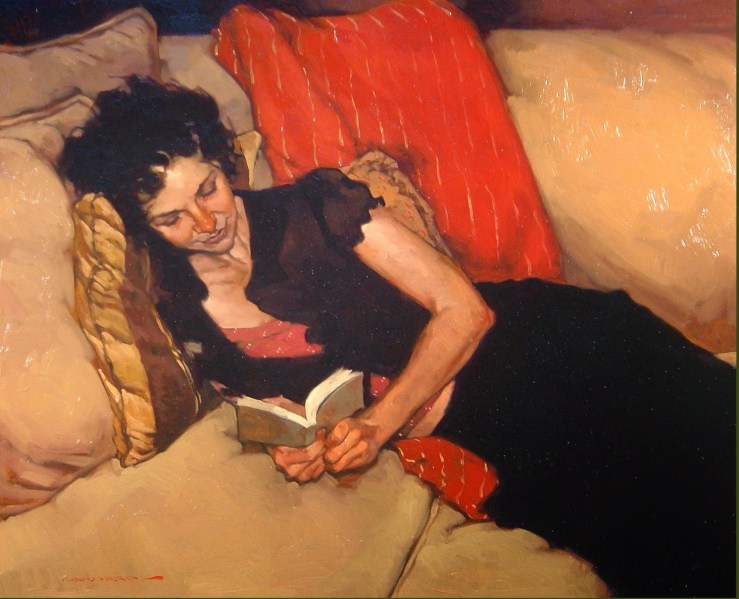
The women would have their tea at six o’clock and she would be able to get away before seven. From Ballsbridge to the Pillar, twenty minutes; from the Pillar to Drumcondra, twenty minutes; and twenty minutes to buy the things. She would be there before eight. She took out her purse with the silver clasps and read again the words A Present from Belfast. She was very fond of that purse because Joe had brought it to her five years before when he and Alphy had gone to Belfast on a Whit-Monday trip. In the purse were two half-crowns and some coppers. She would have five shillings clear after paying tram fare. What a nice evening they would have, all the children singing! Only she hoped that Joe wouldn’t come in drunk. He was so different when he took any drink. Continue reading ““Clay” — James Joyce”

Reading the Sonnet — Joseph Lorusso

Lorusso, Joseph (1966-...) Reading the sonnet