
- The desire to manufacture and maintain happiness leads our culture, our society, our whatever to repeatedly perform contrived aesthetic scenarios.
- Happiness being, perhaps, a modern, or at least modernish, invention.
- Modernish affect.
- And happiness, we maybe telling ourselves, the goal, the telos, the whatever, of religion, politics, culture.
- Like many Americans, I have absolutely no idea what will make me happy.
- I know that happiness is not stable.
- One of Blake’s chimney sweepers remarks that because he is happy and dances and sings they (God/priest/king) are absolved from the belief that they’ve done him injury.
- Religion, or the practice and observance of religion, is the maintenance, repetition, and performance of contrived aesthetic scenarios.
- Months ago at a baptism I witnessed a man sway.
- The swayer swayed rhythmically: his eyes closed, his brow wrinkled, his mouth downturned in the pretense of ecstasy—he swayed to the guitar-strumming of an Episcopalian priest, who plucked and sang a song I’d never heard.
- The assembled witnesses mumbling through words of which they weren’t sure.
- (Or mute, glaring, like my brother, my father, myself).
- Later the priest reserved damning words for this world.
- (I’ve committed no details of the sermon to memory, but we may file the whole damn deal under “Platonic shadows of some other promised Real-to-Come“).
- And yet the backdrop of the whole affair—did I mention this baptism was outside?—this backdrop was the mighty north-flowing St Johns River, a beautiful spring day, hot, goddamn was it hot-–this backdrop was beautiful, ecstatically beautiful, the deep dark blue choppy river, so broad, coursed in the background, dotted with white sails—trees: announce them: cypress, sweetbay, oak—they swayed—or their branches swayed, their green leaves tickled in the occasional too-brief wind—the sky blazed azure, that’s the word we have, streaked with violent clouds (they were not fluffy)—birds flew—can I remember them, the birds? Let’s license my memory: let’s say white ibises beat past the spectacle, that black vultures hovered not too close. Let’s imagine limpkins and red-shouldered hawks, like the proud avian who lives in the oak across the street from me. Ospreys. Hell, throw in a bald eagle.
- The world, this world, which is to say this particular aesthetic arrangement had the potential to authorize happiness—and yet the man in black yapped on about its utter falseness, this world, this beautiful beautiful world.
- Emily Dickinson claimed to keep the Sabbath at home, by which I think she meant her back yard. Sounds nice there—the sermon is never long, and instead of getting to Heaven at last – you’re going, all along.
- (I had to preserve and repeat and maintain the aesthetics of Ms. Dickinson’s dash).
- I went and stood in the shade and tried to feel happy.
- But the man, the swaying man—his performance of ecstasy—all this, mixed with the sermon to spoil the happiness, which I probably enjoyed just as much—the which there referring to the feeling of feeling spoiled happiness, or rather the feeling of potential happiness spoiled.
- That the feeling of the feeling was as pure as it might be, mediated by Nature and its enemy Religion.
- And finding the man’s swaying performance so thoroughly unconvincing, having witnessed ecstasy my own damn self, at least once or even twice in thirty-five years.
- And maybe even experiencing ecstasy, its edges, its agony.
- (Ms. Dickinson reported that she liked a look of agony. Its truth).
- That ecstasy, or awe, or reverence, or pick your own synonym, because, hey, language is weak as usual, as always, as always-shall-be—language can’t pin down transcendence to a signifying utterance—where was I, am I?—that ecstasy might be pantomimed in the service of a service, of a system, of a religion—this is the shadow of happiness, the shadow of the ideal of happiness: the problem. The problem.
- I was never close enough to hear the infant’s cries, coos, wails, burbles, sounds, which she must have uttered—maybe she slept through the ordeal—but any sounds she made must have been the purest utterances at the occasion, the repetitions of Nature, still outside of the culture in which we had gathered to inscribe her.
- I wrote all this for me, not for you, not for anyone else—but let me end with the cloying sentimental jeering pretense that I wrote it for the baptized baby, a supporting character in this narrative, whose life I hope is mostly happy.
Day: November 18, 2014
Clothes, Clothes, Clothes. Music, Music, Music. Boys, Boys, Boys. (Book Acquired, 11.18.2014)

This one looks pretty good: Viv Albertine’s memoir Clothes, Clothes, Clothes. Music, Music, Music. Boys, Boys, Boys. U.S. publisher St. Martin’s Press’s blurb:
Viv Albertine is a pioneer. As lead guitarist and songwriter for the seminal band The Slits, she influenced a future generation of artists including Kurt Cobain and Carrie Brownstein. She formed a band with Sid Vicious and was there the night he met Nancy Spungeon. She tempted Johnny Thunders…toured America with the Clash…dated Mick Jones…and inspired the classic Clash anthem “Train in Vain.” But Albertine was no mere muse. In Clothes, Clothes, Clothes. Music, Music, Music. Boys, Boys, Boys., Albertine delivers a unique and unfiltered look at a traditionally male-dominated scene.
Her story is so much more than a music memoir. Albertine’s narrative is nothing less than a fierce correspondence from a life on the fringes of culture. The author recalls rebelling from conformity and patriarchal society ever since her days as an adolescent girl in the same London suburb of Muswell Hill where the Kinks formed. With brash honesty—and an unforgiving memory—Albertine writes of immersing herself into punk culture among the likes of the Sex Pistols and the Buzzcocks. Of her devastation when the Slits broke up and her reinvention as a director and screenwriter. Or abortion, marriage, motherhood, and surviving cancer. Navigating infidelity and negotiating divorce. And launching her recent comeback as a solo artist with her debut album, The Vermilion Border.
Clothes, Clothes, Clothes. Music, Music, Music. Boys, Boys, Boys. is a raw chronicle of music, fashion, love, sex, feminism, and more that connects the early days of punk to the Riot Grrl movement and beyond. But even more profoundly, Viv Albertine’s remarkable memoir is the story of an empowered woman staying true to herself and making it on her own in the modern world.
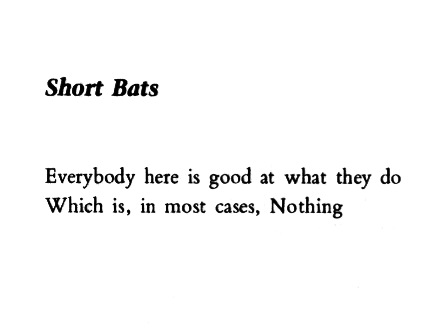
“Short Bats” — Tom Clark
Melville Cover — Robert Gibbings

Motives for writing (William H. Gass)
Very frequently the writer’s aim is to take apart the world where you have very little control, and replace it with language over which you can have some control. Destroy and then repair. I once wrote a passage in which I had the narrator say, “I want to rise so high that when I shit I won’t miss anybody.” But there are many motives for writing. Writing a book is such a complicated, long-term, difficult process that all of the possible motives that can funnel in will, and a great many of those motives will be base. If you can transform your particular baseness into something beautiful, that’s about the best you can make of your own obnoxious nature.
From a 1978 conversation between John Gardner and William H. Gass.
The Scholar — John Henry Dolph

 Biblioklept