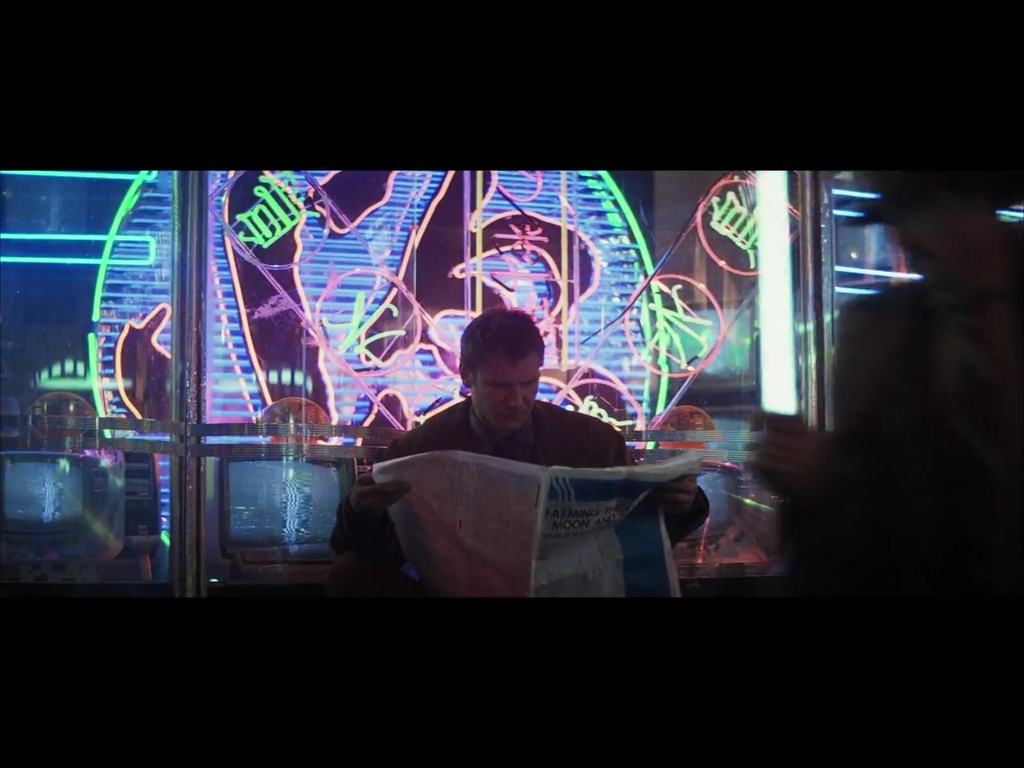
Deckard Reading (Blade Runner)


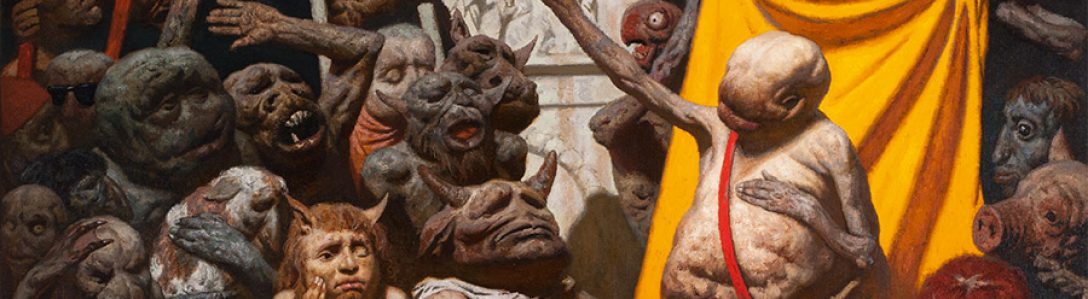
Spoons — Margaret Bourke-White

bourke_spoons

The Martyrdom of St. Sebastian — Hans Memling

Paris Red (Book acquired some time in February, 2015)

IMG_5138

Maureen Gibbon’s novel Paris Red is forthcoming (April 2015) in hardback from W.W. Norton. Their blurb:

For readers of Girl with a Pearl Earring, a luminous and evocative novel of Édouard Manet’s muse.

Paris, 1862. A young girl in a threadbare dress and green boots, hungry for experience, meets the mysterious and wealthy artist Édouard Manet. The encounter will change her—and the art world—forever.

At seventeen, Victorine Meurent abandons her old life to become immersed in the Parisian society of dance halls and cafés, meeting writers and artists like Baudelaire and Alfred Stevens. As Manet’s model, Victorine explores a world of new possibilities and stirs the artist to push the boundaries of painting in his infamous portrait Olympia, which scandalizes even the most cosmopolitan city.

Manet becomes himself because of Victorine. But who does she become, that figure on the divan?

Intense, erotic, and beautifully wrought, Paris Red evokes the unconventional love story of a painter and his muse that changed the history of art.

“Aunt Zézé’s Tears,” a short story by Carmen Dolores

“Aunt Zézé’s Tears”

by

Carmen Dolores

Translated from the Portuguese by Isaac Goldberg

From Brazilian Tales

Pale and thin, for eighteen years she had lived with her youngest sister, who had married very early and now possessed five children: two young ladies of marriageable age, a third still in short dresses, and two little boys.

Maria-José, whose nickname was Zézé, had never been beautiful or winning. Upon her father’s death it was thought best that she should go to live with her sister Engracigna’s family. Here she led a monotonous existence, helping to bring up her nephews and nieces, who were born in that young and happy household with a regularity that brooked small intervals between the births.

A long, pointed nose disfigured her face, and her lips, extremely thin, looked like a pale crack. Her thoughtful gaze alone possessed a certain melancholy attractiveness. But even here, her eyes, protruding too far for the harmony of the lines upon her face seemed always to be red, and her brows narrow and sparse.

Of late, an intricate network of wrinkles as fine as hairs, had formed at the corner of her eyes. From her nose, likewise, two furrows ran along the transparent delicacy of her skin and reached either side of her mouth. When she smiled, these wrinkles would cover her countenance with a mask of premature age, and threatened soon to disfigure her entirely. And yet, from habit, and through passive obedience to routine, Maria-José continued to dress like a young girl of eighteen, in brightly colored gowns, thin waists and white hats that ill became her frail and oldish face. Continue reading ““Aunt Zézé’s Tears,” a short story by Carmen Dolores”

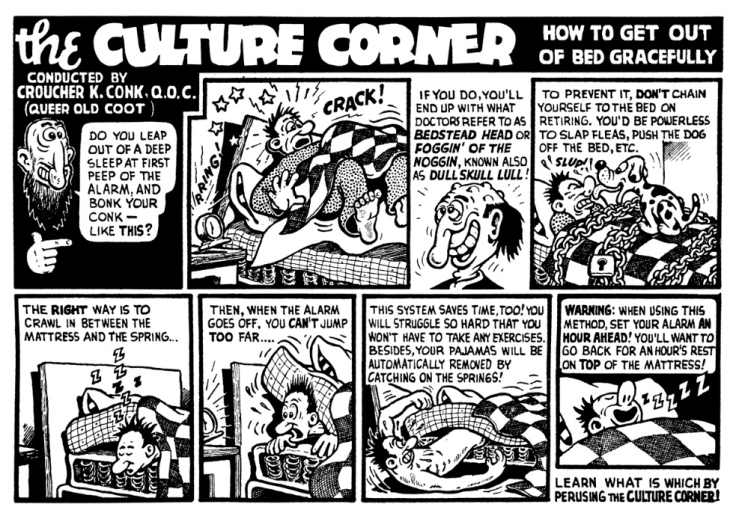
“How to Get Out of Bed Gracefully” — Basil Wolverton

IMG_0178


“All art constantly aspires towards the condition of music”

Spirit of Heron Maiden –Taniguchi Kokyo

Taniguchi_Kokyo-No_Series-Spirit_Of_The_Heron_Maiden-00036089-070707-F12

The extinction of the dodo (Pynchon’s Gravity’s Rainbow)

He left the dodoes to rot, he couldn’t endure to eat their flesh. Usually, he hunted alone. But often, after months of it, the isolation would begin to change him, change his very perceptions—the jagged mountains in full daylight flaring as he watched into freak saffrons, streaming indigos, the sky his glass house, all the island his tulipomania. The voices—he insomniac, southern stars too thick for constellations teeming in faces and creatures of fable less likely than the dodo—spoke the words of sleepers, singly, coupled, in chorus. The rhythms and timbres were Dutch, but made no waking sense. Except that he thought they were warning him… scolding, angry that he couldn’t understand. Once he sat all day staring at a single white dodo’s egg in a grass hummock. The place was too remote for any foraging pig to’ve found. He waited for scratching, a first crack reaching to net the chalk surface: an emergence. Hemp gripped in the teeth of the steel snake, ready to be lit, ready to descend, sun to black-powder sea, and destroy the infant, egg of light into egg of darkness, within its first minute of amazed vision, of wet downstirred cool by these south-east trades… . Each hour he sighted down the barrel. It was then, if ever, he might have seen how the weapon made an axis potent as Earth’s own between himself and this victim, still one, inside the egg, with the ancestral chain, not to be broken out for more than its blink of world’s light. There they were, the silent egg and the crazy Dutchman, and the hookgun that linked them forever, framed, brilliantly motionless as any Vermeer. Only the sun moved: from zenith down at last behind the snaggleteeth of mountains to Indian ocean, to tarry night. The egg, without a quiver, still unhatched. He should have blasted it then where it lay: he understood that the bird would hatch before dawn. But a cycle was finished. He got to his feet, knee and hip joints in agony, head gonging with instructions from his sleeptalkers droning by, overlapping, urgent, and only limped away, piece at right shoulder arms.

Continue reading “The extinction of the dodo (Pynchon’s Gravity’s Rainbow)”

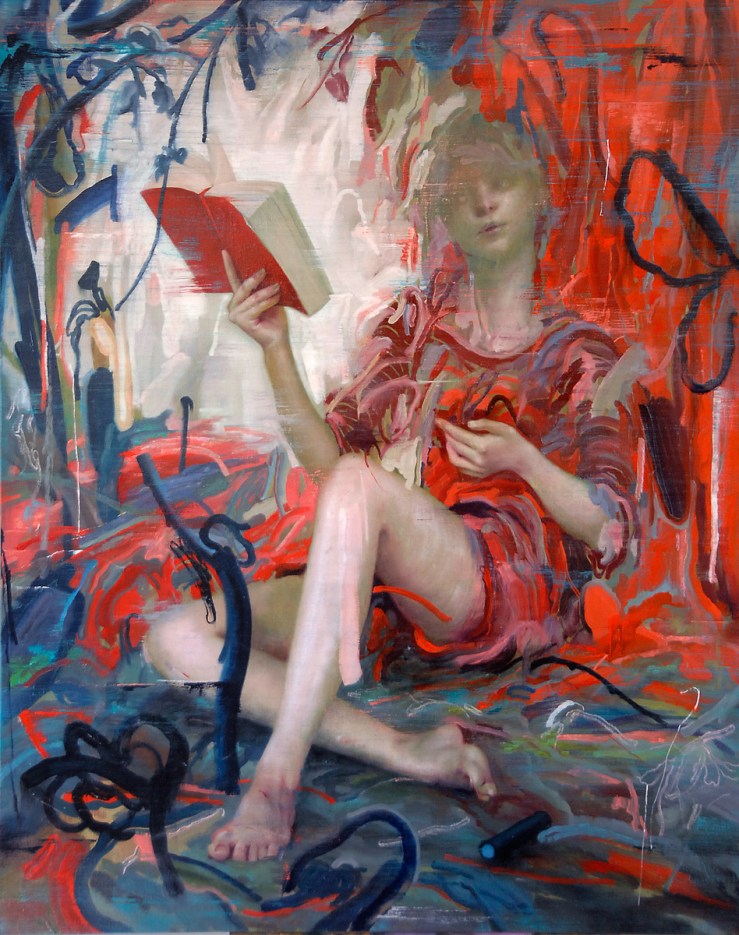
Reader — James Jean

tumblr_mr59qa3Iba1s213u5o1_1280

Read Bret Harte’s short story “Miggles”

“Miggles”

by

Bret Harte

We were eight, including the driver. We had not spoken during the passage of the last six miles, since the jolting of the heavy vehicle over the roughening road had spoiled the Judge’s last poetical quotation. The tall man beside the Judge was asleep, his arm passed through the swaying strap and his head resting upon it—altogether a limp, helpless-looking object, as if he had hanged himself and been cut down too late. The French lady on the back seat was asleep, too, yet in a half-conscious propriety of attitude, shown even in the disposition of the handkerchief which she held to her forehead and which partially veiled her face. The lady from Virginia City, traveling with her husband, had long since lost all individuality in a wild confusion of ribbons, veils, furs, and shawls. There was no sound but the rattling of wheels and the dash of rain upon the roof. Suddenly the stage stopped and we became dimly aware of voices. The driver was evidently in the midst of an exciting colloquy with someone in the road—a colloquy of which such fragments as “bridge gone,” “twenty feet of water,” “can’t pass,” were occasionally distinguishable above the storm. Then came a lull, and a mysterious voice from the road shouted the parting adjuration:

“Try Miggles’s.”

We caught a glimpse of our leaders as the vehicle slowly turned, of a horseman vanishing through the rain, and we were evidently on our way to Miggles’s.

Who and where was Miggles? The Judge, our authority, did not remember the name, and he knew the country thoroughly. The Washoe traveler thought Miggles must keep a hotel. We only knew that we were stopped by high water in front and rear, and that Miggles was our rock of refuge. A ten minutes splashing through a tangled by-road, scarcely wide enough for the stage, and we drew up before a barred and boarded gate in a wide stone wall or fence about eight feet high. Evidently Miggles’s, and evidently Miggles did not keep a hotel.

The driver got down and tried the gate. It was securely locked. “Miggles! O Miggles!”

No answer. Continue reading “Read Bret Harte’s short story “Miggles””

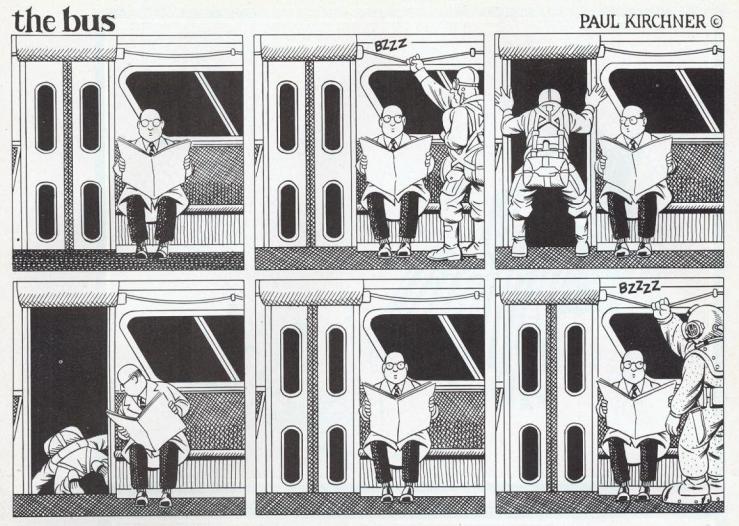
The Bus — Paul Kirchner

OVxVv4H

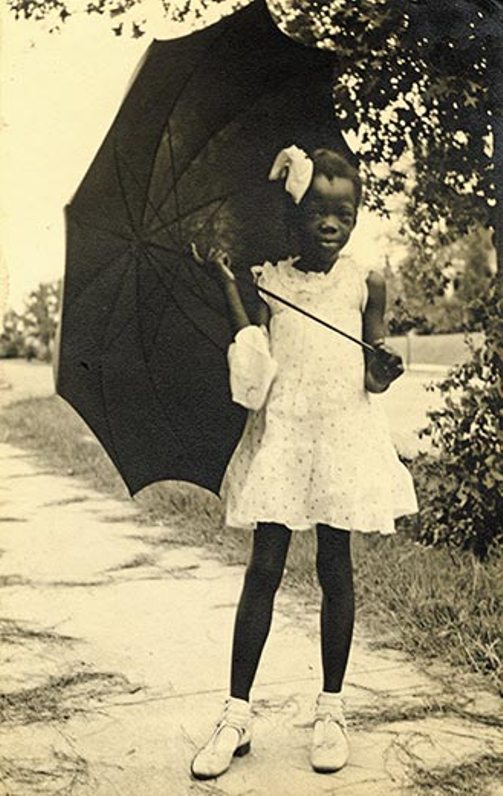
Sunday Morning — Eudora Welty

eudora-welty05

Seated Woman with Bent Knee — Egon Schiele

“The Camel’s Back” — F. Scott Fitzgerald

“The Camel’s Back” by F. Scott Fitzgerald

The glazed eye of the tired reader resting for a second on the above title will presume it to be merely metaphorical. Stories about the cup and the lip and the bad penny and the new broom rarely have anything, to do with cups or lips or pennies or brooms. This story Is the exception. It has to do with a material, visible and large-as-life camel’s back.

Starting from the neck we shall work toward the tail. I want you to meet Mr. Perry Parkhurst, twenty-eight, lawyer, native of Toledo. Perry has nice teeth, a Harvard diploma, parts his hair in the middle. You have met him before—in Cleveland, Portland, St. Paul, Indianapolis, Kansas City, and so forth. Baker Brothers, New York, pause on their semi-annual trip through the West to clothe him; Montmorency & Co. dispatch a young man post-haste every three months to see that he has the correct number of little punctures on his shoes. He has a domestic roadster now, will have a French roadster if he lives long enough, and doubtless a Chinese tank if it comes into fashion. He looks like the advertisement of the young man rubbing his sunset-colored chest with liniment and goes East every other year to his class reunion.

I want you to meet his Love. Her name is Betty Medill, and she would take well in the movies. Her father gives her three hundred a month to dress on, and she has tawny eyes and hair and feather fans of five colors. I shall also introduce her father, Cyrus Medill. Though he is to all appearances flesh and blood, he is, strange to say, commonly known in Toledo as the Aluminum Man. But when he sits in his club window with two or three Iron Men, and the White Pine Man, and the Brass Man, they look very much as you and I do, only more so, if you know what I mean.

Now during the Christmas holidays of 1919 there took place in Toledo, counting only the people with the italicized the, forty-one dinner parties, sixteen dances, six luncheons, male and female, twelve teas, four stag dinners, two weddings, and thirteen bridge parties. It was the cumulative effect of all this that moved Perry Parkhurst on the twenty-ninth day of December to a decision. Continue reading ““The Camel’s Back” — F. Scott Fitzgerald”

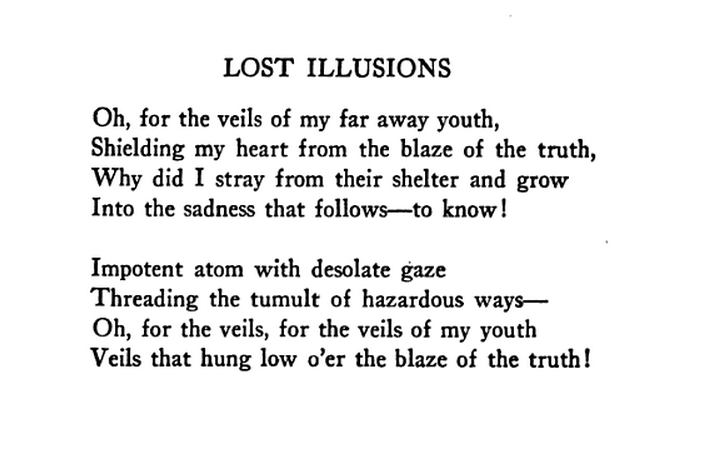
“Lost Illusions” — Georgia Douglas Johnson

Capture