I’ve salvaged not a word (Cormac McCarthy’s Suttree)

From all old seamy throats of elders, musty books, I’ve salvaged not a word. In a dream I walked with my grandfather by a dark lake and the old man’s talk was filled with incertitude. I saw how all things false fall from the dead. We spoke easily and I was humbly honored to walk with him deep in that world where he was a man like all men. From the small end of a corridor in the autumn woods he watched me go away to the world of the waking. If our dead kin are sainted we may rightly pray to them. Mother Church tells us so. She does not say that they’ll speak back, in dreams or out. Or in what tongue the stillborn might be spoken. More common visitor. Silent. The infant’s ossature, the thin and brindled bones along whose sulcate facets clove old shreds of flesh and cerements of tattered swaddle. Bones that would no more than fill a shoebox, a bulbous skull. On the right temple a mauve halfmoon.

I read Cormac McCarthy’s Suttree five years ago and still haven’t recovered.

I started listening to the audiobook of it this week as I returned to my fall work (school) commute—the language is marvelous in the reading—but I have to go back and dwell on passages, like the one above, which resonates strongly with so much of McCarthy’s work—the son or grandson communing with the dead father, out of dimness, opposite equals advancing. And damn, somehow I’d forgotten that Suttree had a stillborn twin brother. And that the novel begins with a suicide. More to come.

Three Princesses of the Underworld — Viktor Vasnetsov

William Faulkner’s 4th grade report card

Screenshot 2015-08-28 at 12.27.24 PM

Via The Harry Ransom Center’s Instagram account.

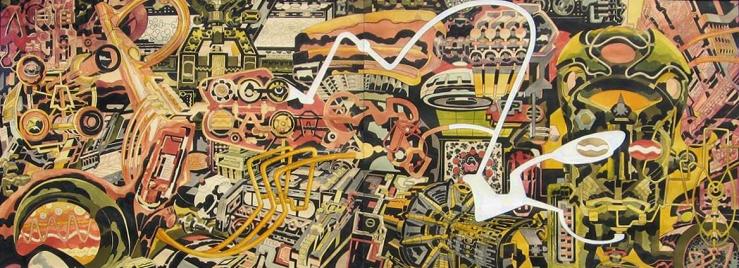
Dream Machine — Jack Kirby

kirby-machine

And here’s a topless Kirby at work on the painting:

KirbyWorking

A riff on Philip K. Dick’s novel Martian Time-Slip

Untitled, Zdislav Beksinski
  1. A colleague dropped by today, burst in my office really, if you’ll forgive the cliché, animated, ecstatic almost—Read this!—he commanded, thrusting a big fat hardbacked Gore Vidal volume in front of me. Read this, his finger pointing to the last paragraph of the 1981 essay “Pink Triangle and Gold Star” (ostensibly a review of Renaud Camus’ novel Tricks).  So I read it. See? It’s just like today! my colleague declared. Vidal’s essay ends with a call for the unity of marginalized people to resist “our ruling class” — the banks, The Wall Street Journal, the Pentagon — and “their kindly voice,” Ronald Reagan. We then had a brief discussion about Donald Trump’s bid for the presidency, something I have until now refused to talk about at all because it’s all just too weird.
  2. I sometimes feel like I’m living in a Thomas Pynchon novel.
  3. I sometimes feel like I’m living in a J.G. Ballard short story.
  4. I sometimes feel like I’m living in some distorted, slipped timeline.
  5. Reading Philip K. Dick’s novel  Martian Time-Slip, I kept wanting to burst into someone’s office, animated, pointing to a paragraph, crying, Read this! See? It’s just like today!
  6. Not that we’ve colonized Mars but—
  7. —colonial metaphors, yes? Cowboys and Indians…
  8. But also, that we’d want the final frontier to be just like home: Desert Mars with green lawns, irrigated flower gardens. Swimming pools. Dick’s Mars is California 1964 and California 2015. And: a water-scarce environment to come.
  9. Did I mention that the novel is set in 1994?
  10. I sometimes feel like I’m living in a Don DeLillo novel.
  11. But where was I? I launched into this riff with a long anecdote, so—What my colleague and I worked into was, ultimately, a discussion of the sheer irreality of modern life—the paranoia that permeates American culture, the sense that the last two decades seem like a bad repetition of Bad Times that outdated textbooks told us had been conquered.
  12. (Or maybe I’m just getting old).
  13. (Sorry for the scatterbrainededness of this ordeal. I finished the novel this afternoon and if I don’t get this down now it seems I won’t get anything down).
  14. So obviously you can find alienation, instability, and repetition right there in the title Martian Time-Slip.
  15. And Dick loads the novel with images and props and ideas to evoke those themes of alienation, instability, and repetition: autism, primitivism, schizophrenia.
  16. Colonies, camps, U.N. as World Police.
  17. Health food.
  18. And land speculation.
  19. And abjection.
  20. And abjection erupts in paranoia and irreality, pointing to a People Who Aren’t People:
  21. He saw, through the man’s skin, his skeleton. It had been wired together, the bones connected with fine copper wire. The organs, which had withered away, were replaced by artificial components, kidney, heart, lungs­—­everything was made of plastic and stainless steel, all working in unison but entirely without authentic life. The man’s voice issued from a tape, through an amplifier and speaker system.

    Possibly at some time in the past the man had been real and alive, but that was over, and the stealthy replacement had taken place, inch by inch, progressing insidiously from one organ to the next, and the entire structure was there to deceive others.

  22. —so the sense that the contemporary person is just a technological mediation, a deception, inauthentic. (Dear reader, attach this passage to what you will, but it seems to me surpassing prescient).
  23. I’ve done a poor job of outlining the plot, right? Sorry. But look, it’s a Philip K. Dick novel, and certainly one of his better ones—and if you’re a more-than-casual reader, you know it, I think, and if you’ve read his finest—VALISThe Man in the High CastleUbikA Scanner DarklyPalmer Eldritch—you might should could read Time-Slip.
  24. But so plot, well: Here’s Lawrence Sutin on the novel, from Divine Invasions: A Life of Philip K. Dick:
  25. Life in the bleak Martian colonies bears a striking resemblance to business as usual on modern-day Earth…In the parched Martian colonies, grasping Arnie Kott is the chief of the powerful plumber’s union (based on the fifties Berkely Co-op Phil despised for its wrangling politics). The little guy, repairman Jack Bohlen, is a onetime schizophrenic who still lives with schizophrenia’s aftereffects. An autistic kid, Manfred Steiner, slipslides helplessly forward and backward in time, into realms of entropy and death.

  26. Arnie seeks to capitalize on Manfred’s timeslipping, and Dick—who, let’s just admit it, isn’t always the most writerly writer (whatever that means) handles the time slippage with rhetorical aplomb, making the reader slip-slide through time with Manfred, Arnie, and Jack. I shared an extended passage a few days ago as an example; it shows us (a version of) Manfred decaying in a future Martian slum. The imagery is abject and pitiful, evoking again the notion of a human’s decay into machination:
  27. He lay there for a hundred and twenty­three years and then his artificial liver gave out and he fainted and died. By that time they had removed both his arms and legs up to the pelvis because those parts of him had decayed.

    He didn’t use them anyhow. And without arms he didn’t try to pull the catheter out, and that pleased them.

  28. Time-Slip rockets into rhetorical reverberation, cycling its final chapters into a strange decay. The timeslips jar the reader’s narrative perception—Hey wait, didn’t I already read this?—unsettling expectations, and ultimately suggesting that this Martian Time-Slip is just one version of Martian Time-Slip. That there are other timelines, distorted, slipped.
  29. And there are threads—wires, if we want to borrow one of the novel’s motifs—that don’t fully connect. There are short circuits, misfires, gaps. Dick tears into the real stuff, the inner material, and pulls it up to the surface without putting it all back together too neatly.
  30. There’s even a slippiness to Dick’s resolved wires (if you’ll excuse my torturing the metaphor). The novel concludes in a strange jolt of domestic restoration, a kind of farce of the traditional comedic and tragic conventions where all returns to normal—there is no normal, never—and so No normal never is, paradoxically, paranoiacally, normal.
  31. I sometimes feel like I’m living in a Philip K. Dick novel.

If Nabokov ruled any modern industrial state absolutely, what would he abolish?

image

From Vladimir Nabokov’s 1969 interview with James Mossman for BBC2’s Review. Reprinted in the same year in The Listener, and collected in Strong Opinions.

One Day This Will All Be Yours — Michael Kagan

kagan_006

“The Sisters” — James Joyce

“The Sisters”

by

James Joyce


THERE was no hope for him this time: it was the third stroke. Night after night I had passed the house (it was vacation time) and studied the lighted square of window: and night after night I had found it lighted in the same way, faintly and evenly. If he was dead, I thought, I would see the reflection of candles on the darkened blind for I knew that two candles must be set at the head of a corpse. He had often said to me: “I am not long for this world,” and I had thought his words idle. Now I knew they were true. Every night as I gazed up at the window I said softly to myself the word paralysis. It had always sounded strangely in my ears, like the word gnomon in the Euclid and the word simony in the Catechism. But now it sounded to me like the name of some maleficent and sinful being. It filled me with fear, and yet I longed to be nearer to it and to look upon its deadly work.

Old Cotter was sitting at the fire, smoking, when I came downstairs to supper. While my aunt was ladling out my stirabout he said, as if returning to some former remark of his:

“No, I wouldn’t say he was exactly… but there was something queer… there was something uncanny about him. I’ll tell you my opinion….”

He began to puff at his pipe, no doubt arranging his opinion in his mind. Tiresome old fool! When we knew him first he used to be rather interesting, talking of faints and worms; but I soon grew tired of him and his endless stories about the distillery.

“I have my own theory about it,” he said. “I think it was one of those… peculiar cases…. But it’s hard to say….” Continue reading ““The Sisters” — James Joyce”

Cave Bird – Leonard Baskin

Baskin - Cave Bird

From Cave Birds: An Alchemical Cave Drama. Poems by Ted Hughes, illustrations by Leonard Baskin.

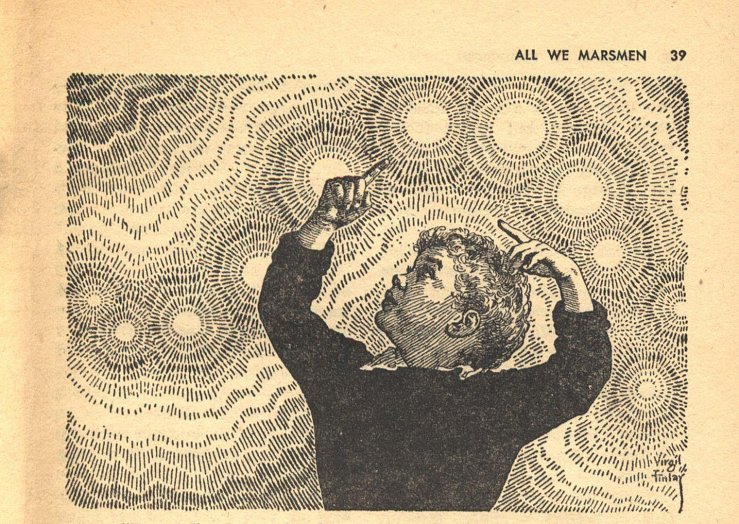
All We Marsmen (PKD)

VWoT196308-0039F27

Walt Whitman in Camden, NJ — Samuel Murray

tumblr_lz24m1GVmM1qghk7bo1_1280

Turning Plant — Diet Wiegman

tumblr_lnmdeloZAe1qjgfu0

“A little road not made of man” — Emily Dickinson

Screenshot 2015-08-25 at 8

Kashchei the Immortal — Viktor Vasnetsov

It was about the commander of a death squad in El Salvador who falls in love with a nun he’s supposed to massacre (Nell Zink’s Mislaid)

Meg took advantage of Karen’s absence to start another play. It was about the commander of a death squad in El Salvador who falls in love with a nun he’s supposed to massacre. In the early drafts, they were a man and a woman. They were always in bed by act 1, scene 2, because they didn’t have much to say to each other.She decided to draft them as lesbians to make them more communicative. Afterward she could go back and change the death squad commander character to be male. But it didn’t work. The openhearted death squad commander refused to seem male to her.

She rewrote him as a man. Pouty and sarcastic. Instantly the nun became a solicitous bore. He ignored her. And there they were again, back in bed.

She tried again, establishing the female character first, in scenes with other nuns. Now the death squad commander seemed superfluous. She made him win her heart away from the nice nuns by being even nicer, but they were both so unsexy as affectionate chatterboxes, the love story just fell apart. They had to ignore each other to get anything done.

She tried one last time. She rewrote him as a complete jerk. Instead of falling in love with anybody, the commander said he would kill his own death squad to have sex with the nun. Afterward the nun went to bed with him to reward him. It was kind of sexy.

Meg saw a distinct pattern to it: patriarchy.

She had wanted to write about idealized partners. But the impressive men she had known weren’t anybody’s partner. They were lone wolves and dictatorial heads of families. The idea of partnering with a powerful man—well, it sounds nice enough, but even on paper it won’t fly. A novel ends with a wedding for a reason. Partnership is antidramatic. Partners are not adversaries. Partners don’t fuck. Yet she dreamed of loving a lesbian partner. Was she stupid?

Lee had been sexy to her at one time. But it wasn’t because they had a relationship. It was the opposite. Because they didn’t. And then she stupidly became his partner. She wasted her love on a wolf. What an excellent use of her youth and beauty! She glared at the typewriter, blaming it for her existential angst.

She finished the play with the nun sacrificing the other nuns one by one to protect the death squad commander from the revenge of his dead death squad’s death squad friends. She tore it into very small pieces and buried it deep in the trash can.

From Nell Zink’s novel Mislaid.

Mislaid is taking me a lot longer to get through than The Wallcreeper, maybe in large part because I’m reading it as an ebook, which means it’s competing with other stuff on my iPad that’s easier to read after a glass or two (or bottle or two) of red wine—Wittgenstein’s aphoristic Culture and Value, which I can squint at, or Netflix, which is also easier to read. But Mislaid is not uneasy to read at all—it’s good stuff—very very funny, pivoting into plots and places unexpected. The passage above stands on its own (I think), but also does a fair job summarizing (a part of the piece of an aspect of) the plot.

The Temptation of St. Anthony — Pieter Huys

pieter-huys-e-la-sua-tentazione-di-santantonio-1547

Watch A Day in the Afterlife, a 1994 documentary about Philip K. Dick