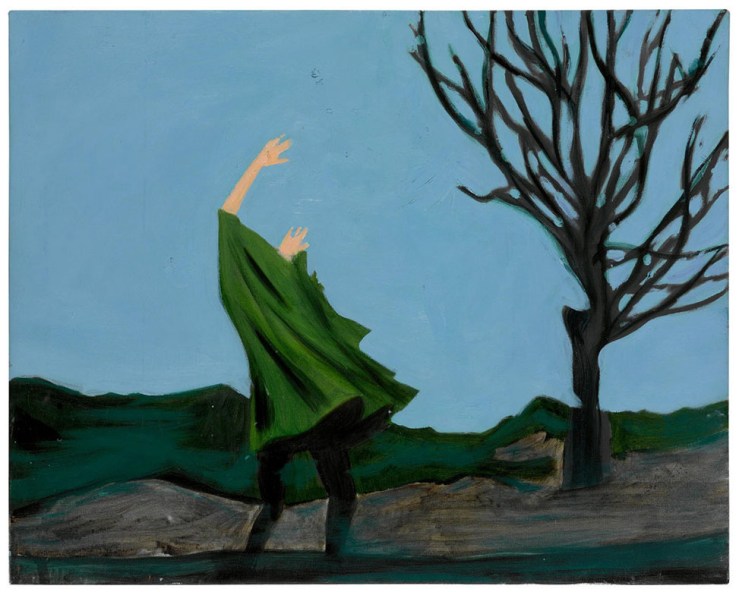
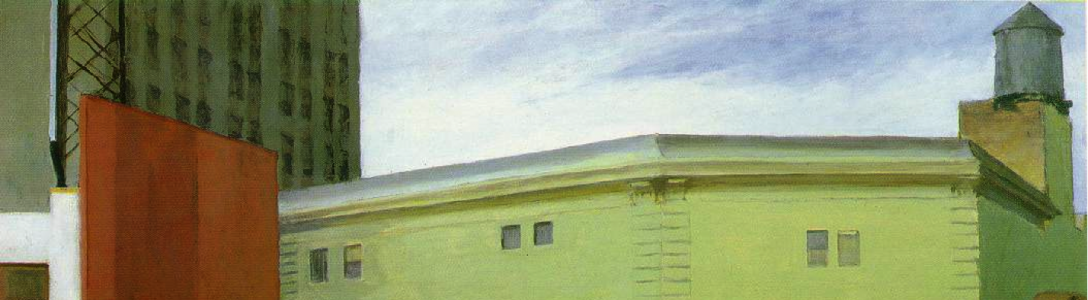
Chateau de Versailles, Yvelines — Elliott Erwitt

Christopher Columbus in Prison — Thomas Eakins

Dream delivers us to dream, and there is no end to illusion (Emerson)

Dream delivers us to dream, and there is no end to illusion. Life is a train of moods like a string of beads, and as we pass through them they prove to be many-colored lenses which paint the world their own hue, and each shows only what lies in its focus. From the mountain you see the mountain. We animate what we can, and we see only what we animate. Nature and books belong to the eyes that see them. It depends on the mood of the man whether he shall see the sunset or the fine poem. There are always sunsets, and there is always genius; but only a few hours so serene that we can relish nature or criticism. The more or less depends on structure or temperament. Temperament is the iron wire on which the beads are strung. Of what use is fortune or talent to a cold and defective nature? Who cares what sensibility or discrimination a man has at some time shown, if he falls asleep in his chair? or if he laugh and giggle? or if he apologize? or is infected with egotism? or thinks of his dollar? or cannot go by food? or has gotten a child in his boyhood? Of what use is genius, if the organ is too convex or too concave and cannot find a focal distance within the actual horizon of human life? Of what use, if the brain is too cold or too hot, and the man does not care enough for results to stimulate him to experiment, and hold him up in it? or if the web is too finely woven, too irritable by pleasure and pain, so that life stagnates from too much reception without due outlet? Of what use to make heroic vows of amendment, if the same old law-breaker is to keep them? What cheer can the religious sentiment yield, when that is suspected to be secretly dependent on the seasons of the year and the state of the blood? I knew a witty physician who found the creed in the biliary duct, and used to affirm that if there was disease in the liver, the man became a Calvinist, and if that organ was sound, he became a Unitarian. Very mortifying is the reluctant experience that some unfriendly excess or imbecility neutralizes the promise of genius. We see young men who owe us a new world, so readily and lavishly they promise, but they never acquit the debt; they die young and dodge the account; or if they live they lose themselves in the crowd.

From Ralph Waldo Emerson’s essay “Experience.”

Great streets of silence led away / To neighborhoods of pause (Emily Dickinson)

Screenshot 2015-10-11 at 8

Illustration to East of the Sun and West of the Moon — Kay Nielsen

03_nielson_eastrofthesun_outflewthemoon

The Spot on the Map — Rene Magritte

A Glass Jug (Detail from the Concert of Angels from the Isenheim Altarpiece) — Matthias Grünewald

Three Books

IMG_0046

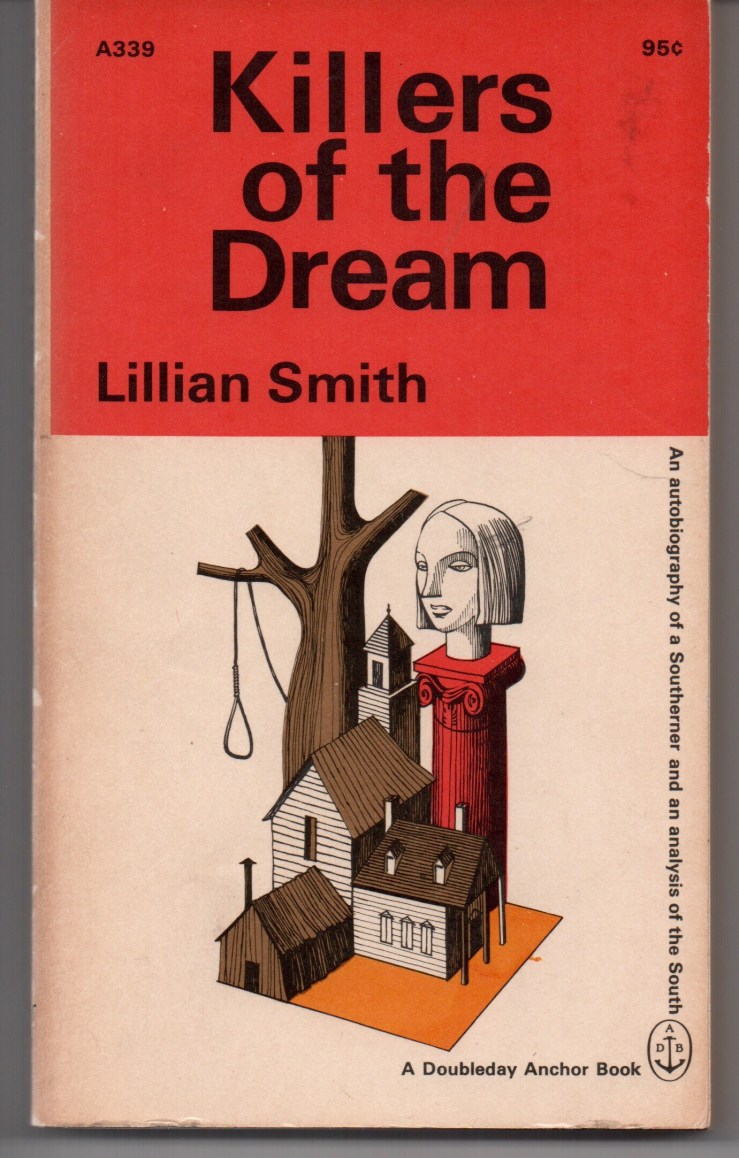
Killers of the Dream by Lillian Smith. Doubleday Anchor, 1963 mass market paperback edition. Cover design by George Giusti. Smith’s memoir-essay-critique is an underappreciated masterful dissection of the South in particular and humanity in general.IMG_0047

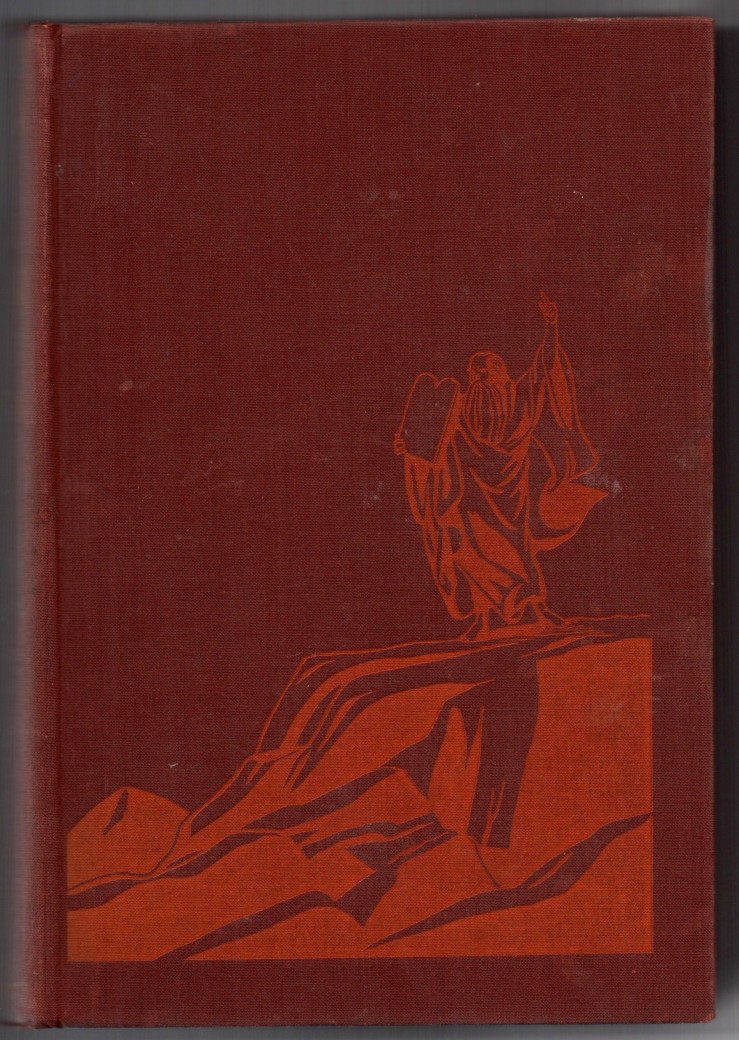
Moses, Man of the Mountain by Zora Neale Hurston. First-edition clothbound hardback from J. B. Lippincott, 1939. The dust jacket is missing, and no designer is credited in the book. I picked this up for eight dollars a few years ago. I lent my paperback copy to a student years ago; she never returned it. (Good for her!).IMG_0048

Afro-Cuban Tales by Lydia Cabrera. 2004 trade paperback by the University of Nebraska Press. Book design by R. Eckersley; cover illustration by Lydia Cabrera. Cabrera (1899-1991), an ethnographer, went beyond documenting the tales and fables of her native Cuba: she synthesized them into new tellings, new variations (not unlike Zora Neale Hurston’s folklore work in Mules and Men and Tell My Horse). Cabrera deserves a wider audience.

Crashed Aeroplane — John Singer Sargent

Exhibition — Mattias Adolfsson

The primary meaning of the gothic romance, then, lies in its substitution of terror for love as a central theme of fiction

The primary meaning of the gothic romance, then, lies in its substitution of terror for love as a central theme of fiction. The titillation of sex denied, it offers its readers a vicarious participation in a flirtation with death—approach and retreat, approach and retreat, the fatal orgasm eternally mounting and eternally checked. More than that, however, the gothic is the product of an implicit aesthetic that replaces the classic concept of nothing-in-excess with the revolutionary doctrine that nothing succeeds like excess. Aristotle’s guides for achieving the tragic without falling into “the abominable” are stood on their heads, “the abominable” itself being made the touchstone of effective art. Dedicated to producing nausea, to transcending the limits of taste and endurance, the gothic novelist is driven to seek more and more atrocious crimes to satisfy the hunger for “too-much” on which he trades.

It is not enough that his protagonist commit rape; he must commit it upon his mother or sister; and if he himself is a cleric, pledged to celibacy, his victim a nun, dedicated to God, all the better! Similarly, if he commits murder, it must be his father who is his victim; and the crime must take place in darkness, among the decaying bodies of his ancestors, on hallowed ground. It is as if such romancers were pursuing some ideal of absolute atrocity which they cannot quite flog their reluctant imaginations into conceiving…

Some would say, indeed, that the whole tradition of the gothic is a pathological symptom rather than a proper literary movement, a reversion to the childish game of scaring oneself in the dark, or a plunge into sadist fantasy, masturbatory horror. For Wordsworth, for instance, heir of the genteel sentimentality of the eighteenth century, gothic sensationalism seemed merely a response (compounding the ill to which it responded) to the decay of sensibility in an industrialized and brutalized world—in which men had grown so callous that only shock treatments of increasing intensity could move them to react.

From Leslie Fiedler’s Love and Death in the American Novel.
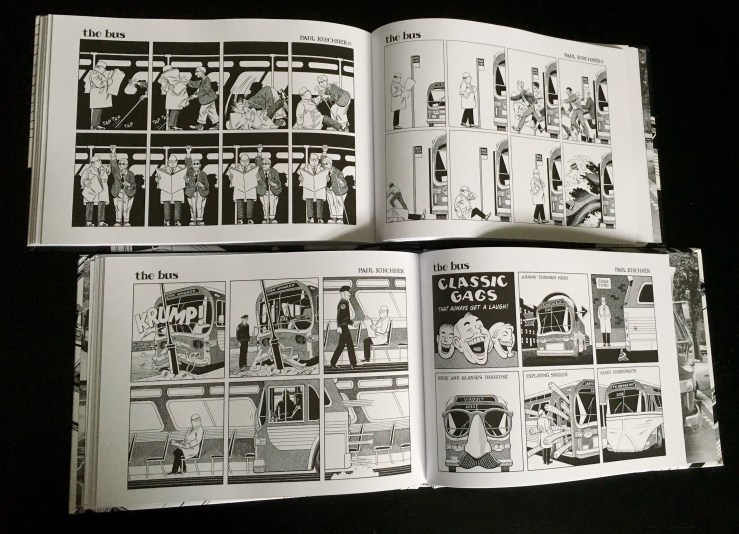
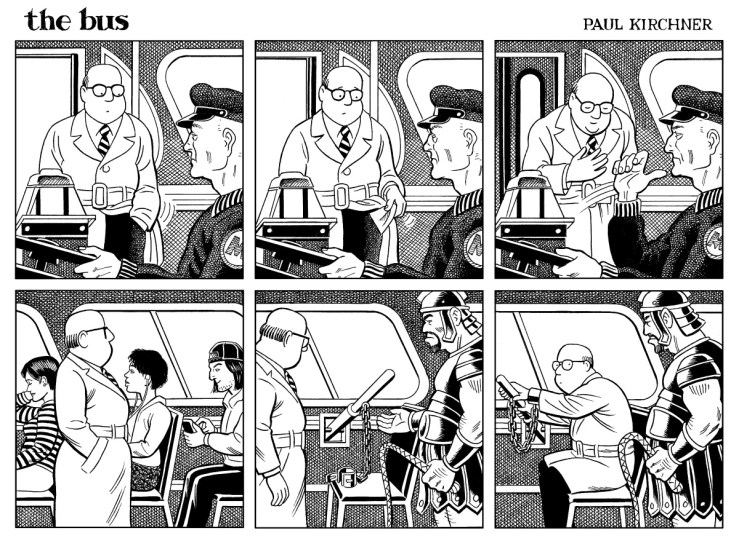
Paul Kirchner’s The Bus…and The Bus 2 (Books acquired, 10.03.2015)

image

Paul Kirchner’s The Bus is excellent. We know this, yes? Editions Tanibis sent me their copy of the surreal, philosophical strip’s first run. I’ve enjoyed going back through it again (bingeing, to be honest)—Tanibis’s volume is beautiful, crisp, and far more complete than the Imgur album that was such a hit this year.
image

Tanibis also sent along The Bus 2, which publishes late this month, and I’ll have a full review then (some time after Halloween), but for now, a teaser:

02

Breakfast Nook — Charles Blackman

Heliodora — Leonor Fini

ccf070991230fd759bf1826c56c0fce5