Truthful people are a big pain. That is their aim in life: to be a big pain. Because we naturally love lies. Lies are more fun, far pleasanter to hear, for the most part, and certainly more effective. In fact, they are called for. Parents pretend they want to know whether Gertie is screwing in the parlor and whether Peter is smoking pot in the barn. And if the kids tell the truth, as they are beseeched to do, they will be ragged and snagged and grounded unmercifully. So the kids learn. Lying promotes freedom. Lying guards privacy. Lying saves lives and wins elections. It describes things as they ought to be. Of course, we need to be truthful, but only on occasion.Lying is a vice that succeeds, as so many other vices do, only in an environment of truthfulness. Remember the paradox: Cretans are liars, the Cretan swore. And retell to yourself the fable about the boy who cried, “Wolf … wolf …” one too many times. Vices need virtues and vice versa. I am speaking, of course, about the little lies of daily life, not the big lies of priests and politicians, those who want to fix things and those who want things fixed.
People who publically complain of sin so often privately enjoy it. Lutherans, for instance, don’t like lust. Catholics and Calvinists are both against it. Mormons allow us several wives but it’s not on account of lust. Baptists are not on lust’s side. If you measure a man by the quality of his enemies, Casanova figures well.
The trouble with temperate people is that they are rarely temperate. All the temperance societies I know promote abstinence. “Nothing too much yet everything a little bit” is not their motto. No. Nothing is the operative word. “Masturbation in moderation” is not their motto. A truly temperate person doesn’t play golf every day. A truly temperate person doesn’t run more than a block a week. A temperate reader won’t read all of Austen or a lot of Balzac. Temperate persons eat sensibly, which means they never diet. But those whose profession is temperance only rail against sex and alcohol, drugs and atheism. Professionally temperate people are cranks. Atheism they ought to like. Atheists admire the word nothing. But they probably don’t admire lust much. Not a single favorable vote from the Methodists. Pietists—nix.
Piety is a nasty little virtue. Reverence for Pa the father, Ra the god, and hurrah the flag. Piety is respect for power and privilege, ancestors and the dead-and-gone deities. There is nothing in the world worth worship.
From William H. Gass’s essay “Lust.” Collected in Life Sentences.


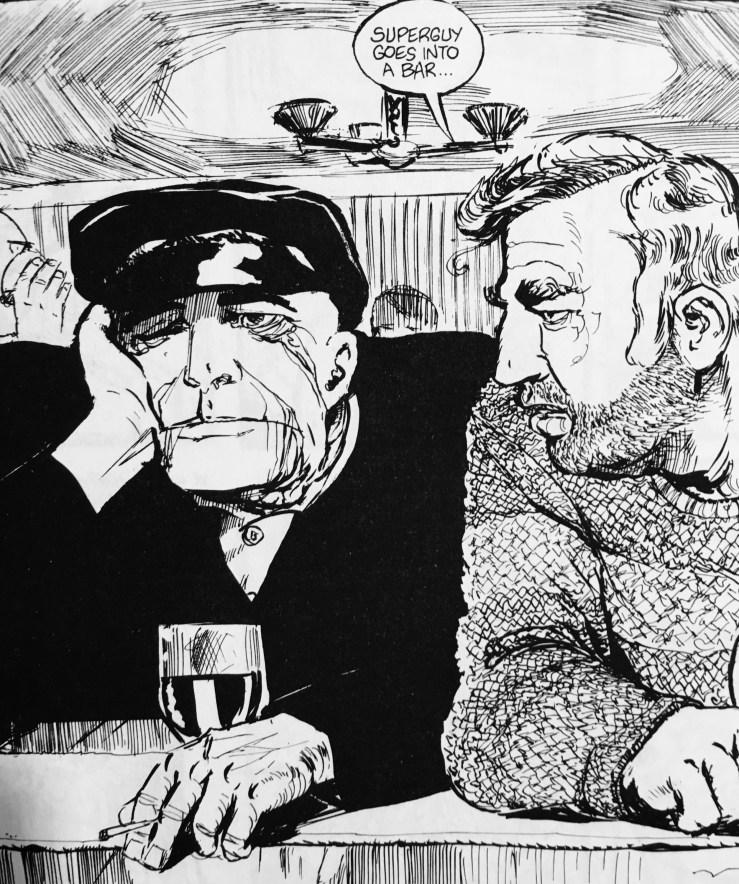
 The first time I saw Campbell’s art I was shocked. I was 12 or 13—it was in a back issue of Cerebus which I had bought in the comic shop next to the music store where I took trombone lessons (don’t ask)—so, being 12 or 13, I was still capable of shock. Dave Sim had printed (or reprinted?) the prologue, or part of the prologue, from


 Biblioklept