Blog about the first paragraph of Arkady and Boris Strugatsky’s surreal novel The Snail on the Slope

I have been listening to Arkady and Boris Strugatsky’s 1972 novel The Snail on the Slope on audiobook over the last two weeks.

This new English translation is by Olena Bormashenko, who also translated Roadside Picnic and Hard to Be a God. (I listened to Roadside Picnic last year—this fantastic audiobook is read by Robert Forster—and read Bormashenko’s translation of Hard to Be a God after watching Aleksei German’s 2013 film adaptation. All are excellent). Chris Andrew Ciulla narrates the new audiobook of The Snail on the Slope and he does a very good job. 

Like I said, I’ve been listening to this new translation of The Snail on the Slope for a few weeks. I should be done (the book is only 9.5 hours), but I’ve listened to most of the chapters twice, and restarted the book once, because The Snail on the Slope is fucking bonkers. The novel is a wild trip, full of bizarre transformations, failed plans, jungle swamps,  marching ants, deadlings, mushrooms, foolish bureaucrats, and broken calculators—it’s abject, savage, funny, and just so fucking weird, a bizarre beast tumbling around on its own radical logic. I have about 3 hours left, but I don’t think I’ll muster a review—or a summary, I mean. Or anyway—

I mean, here’s my review: I love itI love its strange mucky weirdness, its refusal to clearly delineate the contact points of its allegorical satire, its sheer absurdity, its utter alterity. But a summary seems too much to ask so—

Here is publisher Chicago Review Press’s blurb—

The Snail on the Slope is a neglected masterpiece by Russian science fiction greats Arkady and Boris Strugatsky, who thought of it as their “most complete and important work.” now, in a stunning translation, this tour de force is ready to be introduced to a new generation of American readers. The novel takes place in two worlds. One is the Administration, an institution run by a surreal, Kafkaesque bureaucracy whose aim is to govern the forest below. The other is the Forest, a place of fear, weird creatures, primitive but garrulous people, and violence. Peretz, who works at the Administration, wants to visit the Forest. Candide crashed in the Forest years ago and wants to return to the Administration. Their journeys are surprising and bizarre, and readers are left to puzzle out the mysteries of these foreign environments. Brilliant, enigmatic, and revelatory, The Snail on the Slope is one of the greatest literary works to come out of Soviet Russia.

Here is the cover + blurb of Bantam’s 1980 edition of The Snail on the Slope (translated by Alan Meyers). Bob Larkin’s cover is more interesting to me than the “respectable” cover that Chicago Review Press put together so—

thsnlnthsl1980

This edition was apparently recalled, distribution was halted, and existing copies were destroyed.

The German cover (credited to Ute Osterwalder and Hans Ulrich Osterwalder) is also pretty cool—

dschnckmhn1978

But I promised in this blog’s headline to riff on the first paragraph, which isn’t that long, but in some ways reveals the sheer oddity of The Snail on the Slope. So here is that paragraph:

From this height, the forest looked like dappled, fluffy foam; like a gigantic, world-encompassing porous sponge; like an animal that had once lain hidden in wait, then had dozed off, becoming overgrown with coarse moss. Like a shapeless mass, hiding a face no one had ever seen.

The viewer at this height is one of the novel’s two heroes, Peretz, who dangles his feet over the forest that calls to him. I could go on about Peretz’s attraction to the unknowable forest, but let’s look instead at the similes the Strugatskys (and their translator Bormashenko) deploy here:

The forest is like

  1. foam
  2. a sponge
  3. a dozing, bemossed animal
  4. an indefinite mass with an unseen face

The utter alterity of the forest is announced at the novel’s outset. This shifting series of similes shows that the central space of The Snail on the Slope cannot have a fixed definition—it cannot even have a stable referent of similitude. Rather, the forest is ever-shifting, from the playful guise of a space of “fluffy foam” to the sinister aspect of a “shapeless mass” that hides an unknown (and unknowable) visage. The Strugatskys shuttle us from simile to simile, foregrounding one of the novel’s central themes—language has a limited purchase of reality. Peretz, a surrogate for the reader, cannot settle on a simile, which only entices him more: What is this place? What would it mean to know this place—in language? Significantly, Peretz is a linguist, but he—and the reader–have no training to properly comprehend what enfolds when The Snail on the Slope takes us into the forest. And this is the fucked up joy of the novel—one weird transformation morphs into another, similes unwinding in a stretch toward an ultimate referent that refuses to arrive on time.
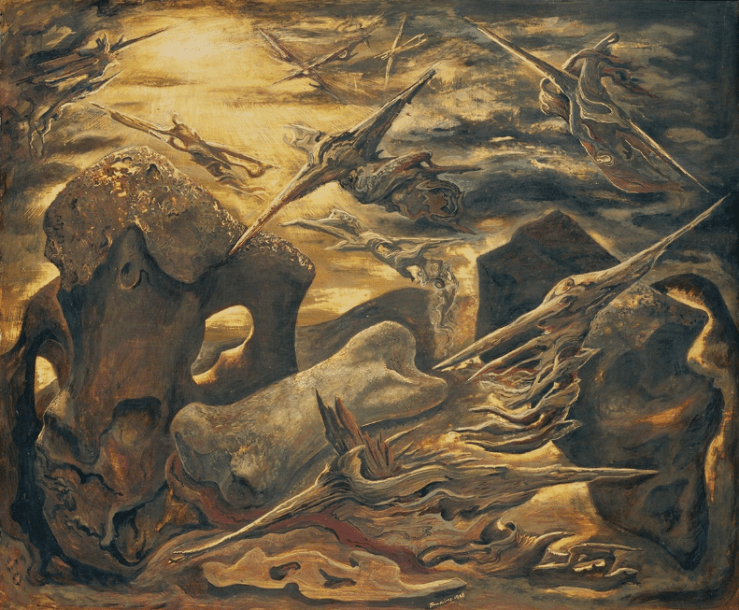
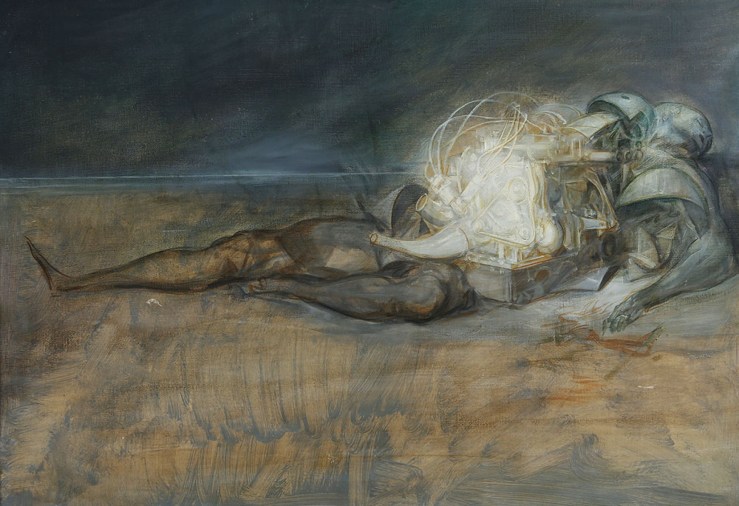
Metamorphosis — Margaret Tomkins

Screenshot 2018-09-07 at 4.33.26 PM

Metamorphosis, 1943 by Margaret Tomkins (1916-2002)

Metamorphosis — Riccardo Tommasi Ferroni

57e0f65a2858e

Metamorphosis, 1965 by Riccardo Tommasi Ferroni (1934-2000)

Culmin’s Ghost Appears to His Mother — Nicolai Abildgaard

nicolai_abildgaard_-_culmin27s_ghost_appears_to_his_mother_-_wga00016

Culmin’s Ghost Appears to His Mother, 1794 by Nicolai Abildgaard (1743–1809)

Near are the steps of Culmin; the youth came, bursting into tears. Wrathful he cut the wind, ere yet he mixed his strokes with Fillan. He had first bent the bow with Rothmar, at the rock of his own blue streams. There they had marked the place of the roe, as the sunbeam flew over the fern. Why, son of Cul-allin! why, Culmin, dost thou rush on that beam of light? It is a fire that consumes. Son of Cul-allin, retire. Your fathers were not equal in the glittering strife of the field. The mother of Culmin remains in the hall. She looks forth on blue-rolling Strutha. A whirlwind rises, on the stream, dark-eddying round the ghost of her son. His dogs are howling in their place. His shield is bloody in the hall. “Art thou fallen, my fair-haired son, in Erin’s
dismal war?”

From The Poems of Ossian by James McPherson. 

The Confidence Man — Guy Pène du Bois

guy_pc3a8ne_du_bois_-_the_confidence_man_-_google_art_project

The Confidence Man, 1919 by Guy Pène du Bois (1884-1958)

cm

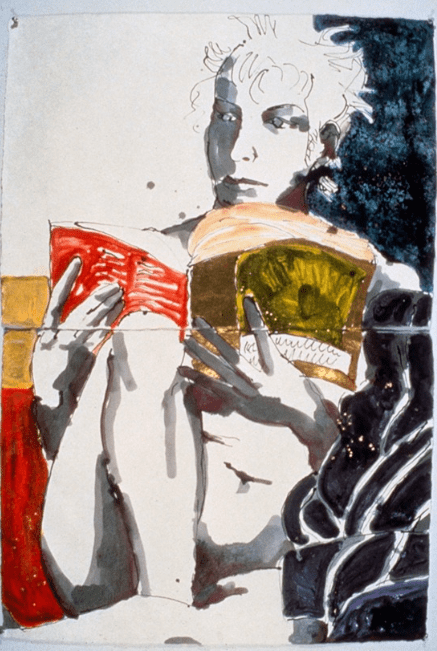
Reading — Robert Kushner

Screenshot 2018-07-31 at 5.37.53 PM

Reading, 1987 by Robert Kushner (b. 1949)

Prometheus in Chains — Frantisek Kupka

prometeo_kupka

Prometheus in Chains, 1905 by Frantisek Kupka (1871-1957)

“Youwarkee” — Jorge Luis Borges

yo

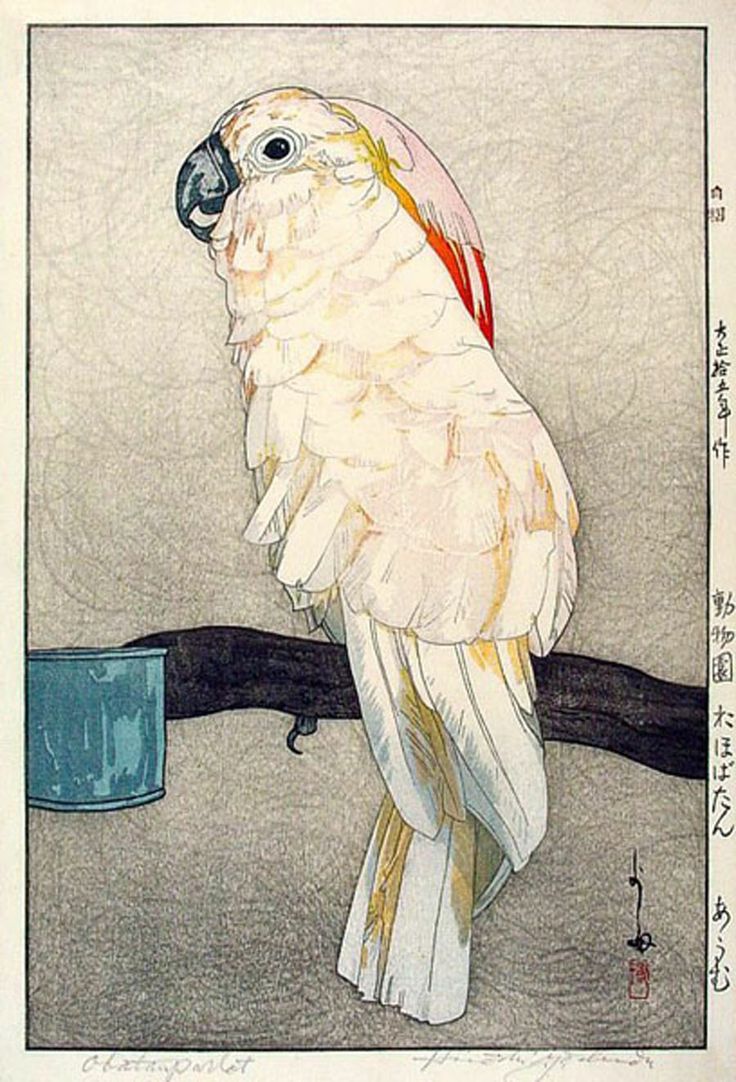
Obatan Parrot — Hiroshi Yoshida

698cf212a6c17282e4bcf8bb3608a8dd-hiroshi-yoshida-exotic-birds

Obatan Parrot, 1926 by Hiroshi Yoshida (1876-1950)

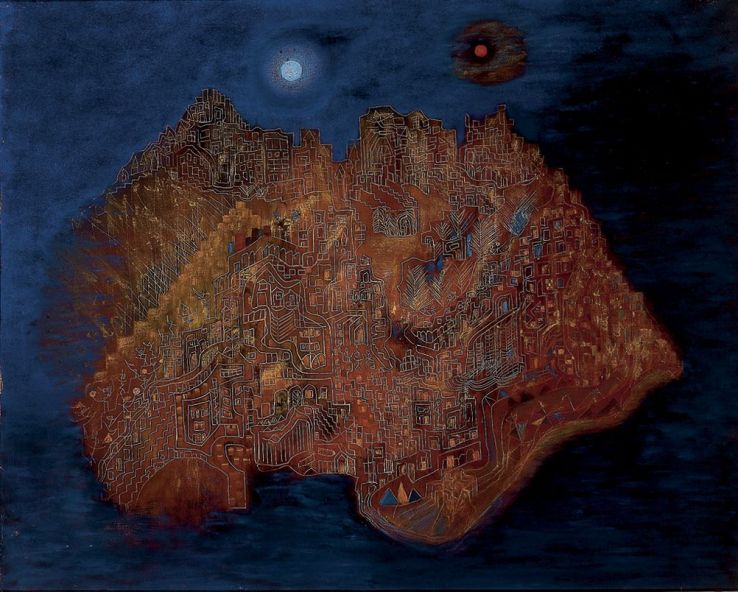
The Inner City — Alice Rahon

9e54175d8140d93f3049de38a6690254

The Inner City by Alice Rahon (1904–1987)

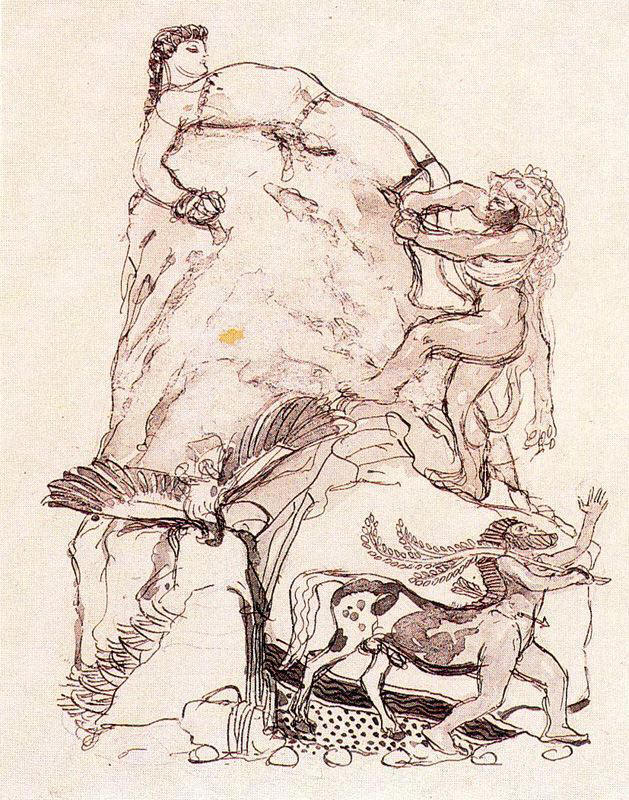
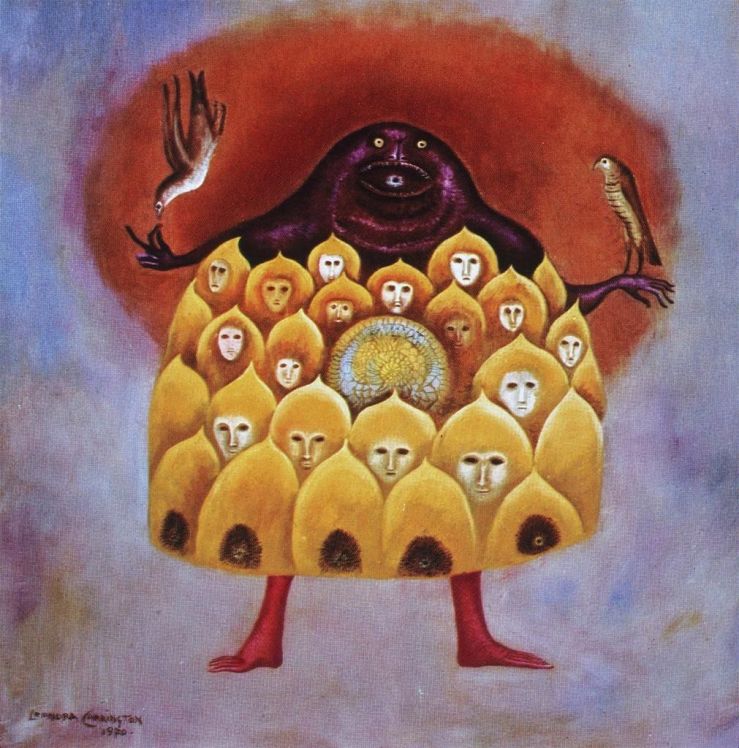
The God Mother — Leonora Carrington

08a11b329eca88910d78417434a56882

The Godmother, 1970 by Leonora Carrington (1917–2011)

A gathering impossible / General merriment (From Pynchon’s Against the Day)

A DAY OR TWO LATER, Lew went up to Carefree Court. The hour was advanced, the light failing, the air heated by the Santa Ana wind. Palm trees rattled briskly, and the rats in their nests up there hung on for dear life. Lew approached through a twilit courtyard lined with tileroofed bungalows, stucco archways, and the green of shrubbery deepening as the light went. He could hear sounds of glassware and conversation.

From the swimming pool came sounds of liquid recreation—feminine squeals, deep singlereed utterances from high and low divingboards. The festivities here this evening were not limited to any one bungalow. Lew chose the nearest, went through the formality of ringing the doorbell, but after waiting a while just walked in, and nobody noticed.

It was a gathering impossible at first to read, even for an old L.A. hand like Lew—society ladies in flapper-rejected outfits from Hamburger’s basement, real flappers in extras’ costumes—Hebrew headdresses, belly-dancing outfits, bare feet and sandals—in from shooting some biblical extravaganza, sugar daddies tattered and unshaven as street beggars, freeloaders in bespoke suits and sunglasses though the sun had set, Negroes and Filipinos, Mexicans and hillbillies, faces Lew recognized from mug shots, faces that might also have recognized him from tickets long cold he didn’t want to be reminded of, and here they were eating enchiladas and hot dogs, drinking orange juice and tequila, smoking cork-tip cigarettes, screaming in each others’ faces, displaying scars and tattoos, recalling aloud felonies imagined or planned but seldom committed, cursing Republicans, cursing police federal state and local, cursing the larger corporate trusts, and Lew slowly began to get a handle, for weren’t these just the folks that once long ago he’d spent his life chasing, them and their cousins city and country? through brush and up creek-beds and down frozen slaughterhouse alleyways caked with the fat and blood of generations of cattle, worn out his shoes pair after pair until finally seeing the great point, and recognizing in the same instant the ongoing crime that had been his own life—and for achieving this self-clarity, at that time and place a mortal sin, got himself just as unambiguously dynamited.

He gradually understood that what everybody here had in common was having survived some cataclysm none of them spoke about directly—a bombing, a massacre perhaps at the behest of the U.S. government. . . .

“No it wasn’t Haymarket.”

“It wasn’t Ludlow. It wasn’t the Palmer raids.”

“It was and it wasn’t.” General merriment.

—Thomas Pynchon’s novel Against the Day. Happy Labor Day.


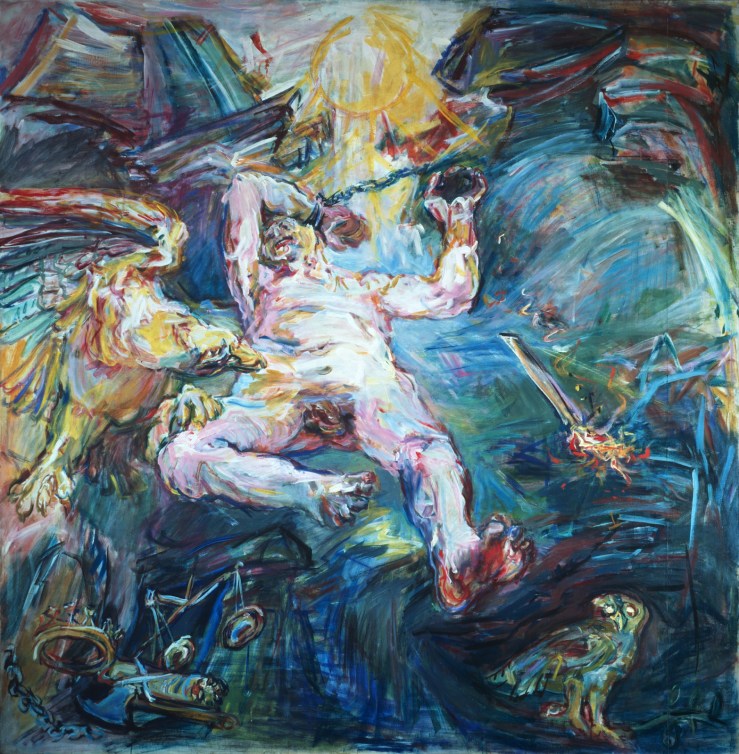
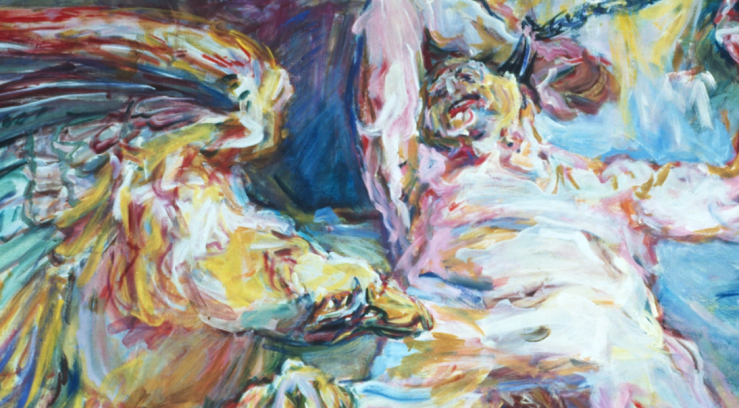
Prometheus — Oskar Kokoschka

p-1978-pg-210-3-png-10870

Prometheus (panel from The Prometheus Triptych), 1950 by Oskar Kokoschka (1886-1980)

Screenshot 2018-09-03 at 4.05.49 PMScreenshot 2018-09-03 at 4.05.37 PMScreenshot 2018-09-03 at 4.05.10 PM

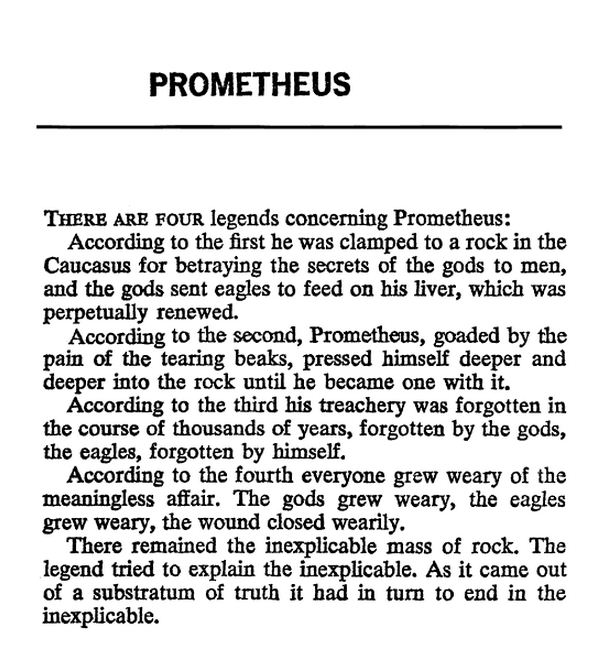
“Prometheus” — Franz Kafka


Camus, Eliot, and Kuper’s Kafka (Books acquired, 31 Aug. 2018)

img_0894

I went to my favorite used bookshop on Friday afternoon to browse, order another Gerald Murnane novel, and pick up a copy of George Eliot’s Silas Marner.

I spied a late fifties mass market copy of Albert Camus’ novel Exile and the Kingdom from Vintage Books. I fell in love with the cover (by George Giusti) and ended up picking it up, although I’ll admit I haven’t read a Camus novel since college (it was The Plague if memory serves).

Browsing copies of Silas Marner, I found this monstrosity:

img_0892

I don’t even know where to start with this cover. I mean, even the colors seem to clash. It doesn’t really come across in the photo, but this hardback has a cheap greasy feel to it. I initially assumed that it was some kind of TV or film tie in, but as far as I can tell…no. Horrifying. I ended up going with the Oxford edition with Ferdinand Hodler’s painting Unemployed on the cover.

When I got home, the mail had come. It included a copy of Peter Kuper’s Kafkaesque, which collects 14 of Kuper’s illustrated Kafka translations. Publisher Norton’s blurb:

Award-winning graphic novelist Peter Kuper presents a mesmerizing interpretation of fourteen iconic Kafka short stories.

Long fascinated with the work of Franz Kafka, Peter Kuper began illustrating his stories in 1988. Initially drawn to the master’s dark humor, Kuper adapted the stories over the years to plumb their deeper truths. Kuper’s style deliberately evokes Lynd Ward and Frans Masereel, contemporaries of Kafka whose wordless novels captured much of the same claustrophobia and mania as Kafka’s tales. Working from new translations of the classic texts, Kuper has reimagined these iconic stories for the twenty-first century, using setting and perspective to comment on contemporary issues like civil rights and homelessness.

Longtime lovers of Kafka will appreciate Kuper’s innovative interpretations, while Kafka novices will discover a haunting introduction to some of the great writer’s most beguiling stories, including “A Hunger Artist,” “In The Penal Colony,” and “The Burrow.” Kafkaesque stands somewhere between adaptation and wholly original creation, going beyond a simple illustration of Kafka’s words to become a stunning work of art.

It was September now (Cormac McCarthy’s Suttree)

It was September now, a season of rains. The gray sky above the city washed with darker scud like ink curling in a squid’s wake. The blacks can see the boy’s fire at night and glimpses of his veering silhouette slotted in the high nave, outsized among the arches. All night a ruby glow suffuses the underbridge from his garish chancel lamps. The city’s bridges all betrolled now what with old ventriloquists and young melonfanciers. The smoke from their fires issues up unseen among the soot and dust of the city’s right commerce.

Sometimes in the evening Suttree would bring beers and they’d sit there under the viaduct and drink them. Harrogate with questions of city life.

You ever get so drunk you kissed a nigger?

Suttree looked at him. Harrogate with one eye narrowed on him to tell the truth. I’ve been a whole lot drunker than that, he said.

Worst thing I ever done was to burn down old lady Arwood’s house.”

“You burned down an old lady’s house?

Like to of burnt her down in it. I was put up to it. I wasnt but ten year old.

Not old enough to know what you were doing.

Yeah.–Hell no that’s a lie. I knowed it and done it anyways.

Did it burn completely down?

Plumb to the ground. Left the chimbley standin was all. It burnt for a long time fore she come out.

Did you not know she was in there?

I disremember. I dont know what I was thinkin. She come out and run to the well and drawed a bucket of water and thowed it at the side of the house and then just walked on off towards the road. I never got such a whippin in my life. The old man like to of killed me.

Your daddy?

Yeah. He was alive then. My sister told them deputies when they come out to the house, they come out there to tell her I was in the hospital over them watermelons, she told em I didnt have no daddy was how come I got in trouble. But shit fire I was mean when I did have one. It didnt make no difference.

Were you sorry about it? The old lady’s house I mean.

Sorry I got caught.

Suttree nodded and tilted his beer. It occurred to him that other than the melon caper he’d never heard the city rat tell anything but naked truth.

A vignette from Cormac McCarthy’s Suttree—a transition scene perhaps, but one that draws Suttree and Harrogate closer, even as it underlines their differences.

In my review of Suttree a few years back, I argued that the novel is a grand synthesis of American literature, brimming with literary allusions. I singled out Faulkner’s “A Rose for Emily” as the basis for a later scene with Harrogate, so I can’t help but think of Faulkner’s “Barn Burning” here.

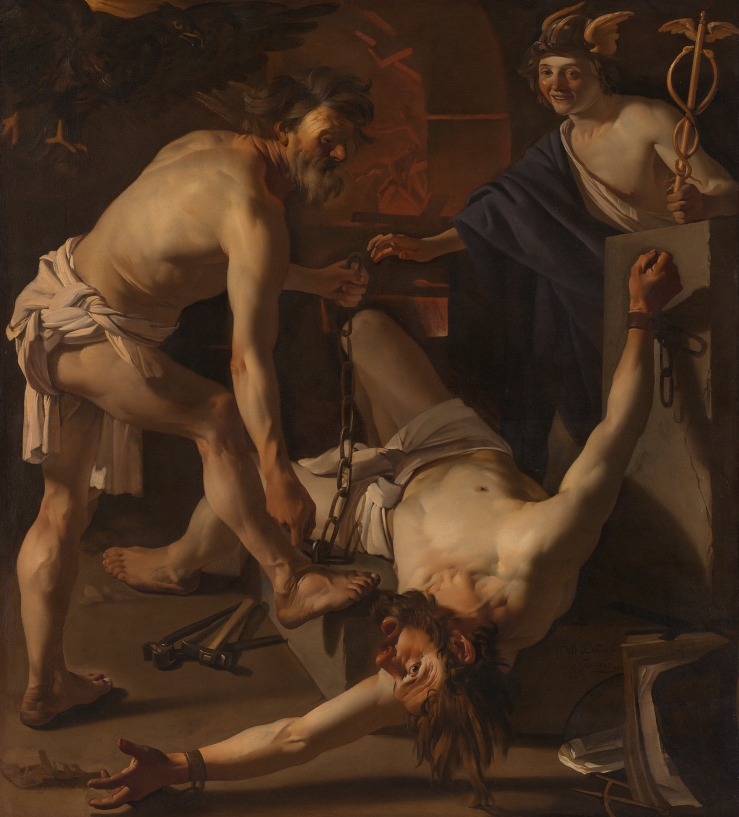
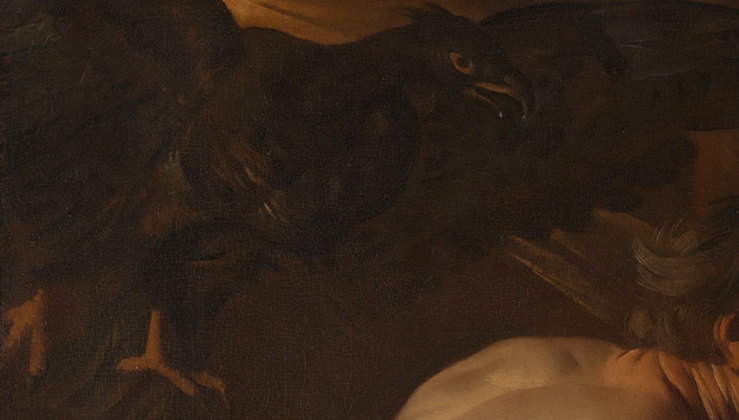
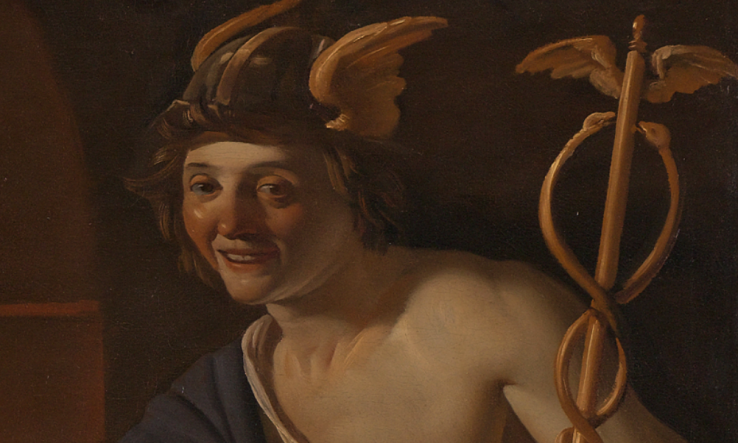
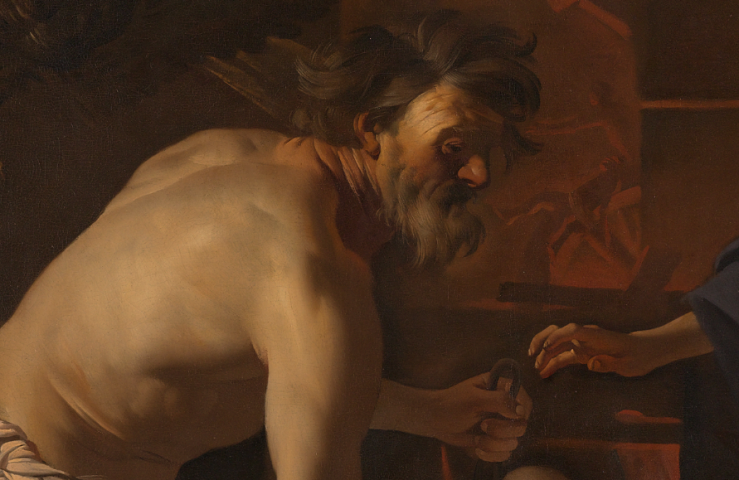
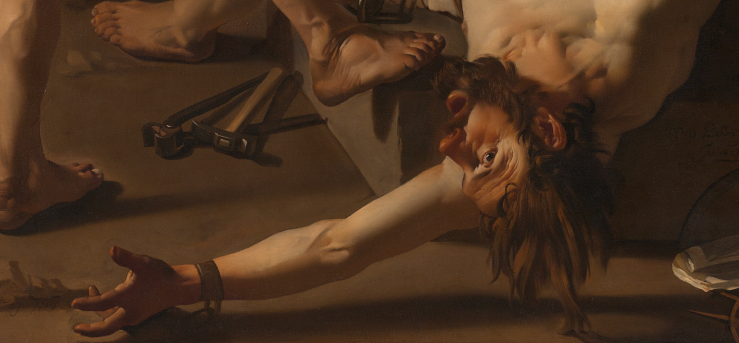
Prometheus Being Chained by Vulcan –Dirck van Baburen

Opnamedatum: 2008-09-05

Prometheus Being Chained by Vulcan, 1623 by Dirck van Baburen (c. 1595– 1624)

Screenshot 2018-09-01 at 11.11.19 AMScreenshot 2018-09-01 at 11.11.38 AMScreenshot 2018-09-01 at 11.12.01 AMScreenshot 2018-09-01 at 11.12.19 AM