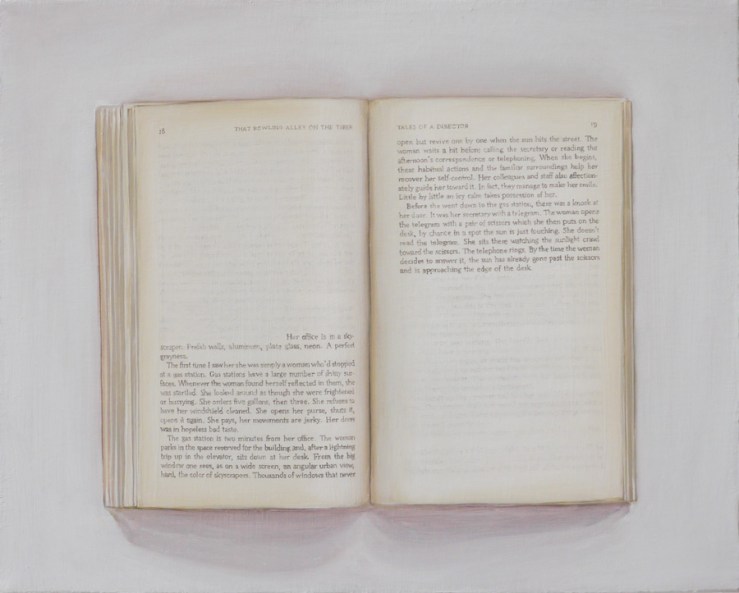
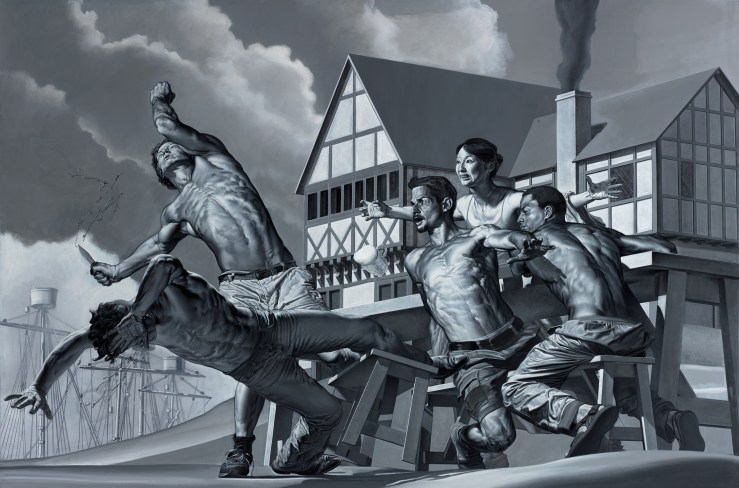
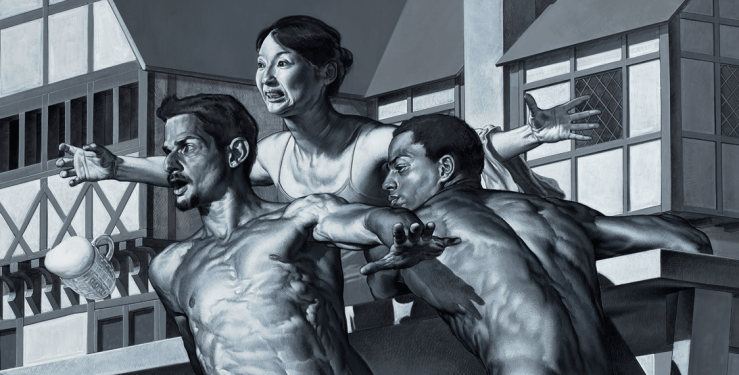
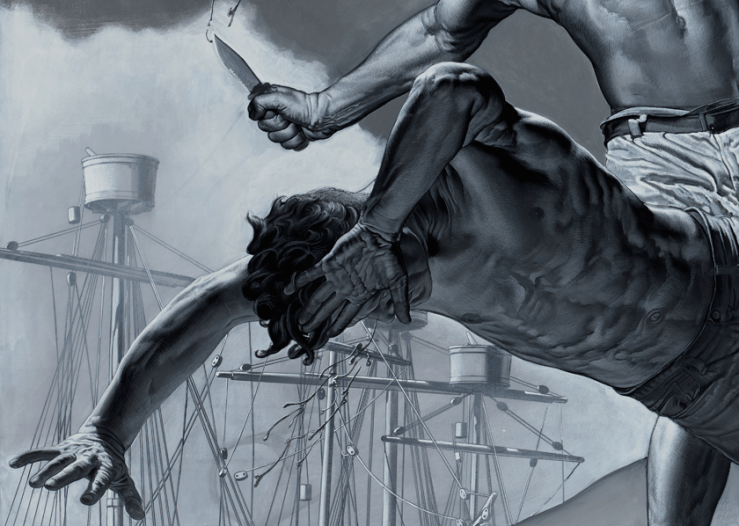
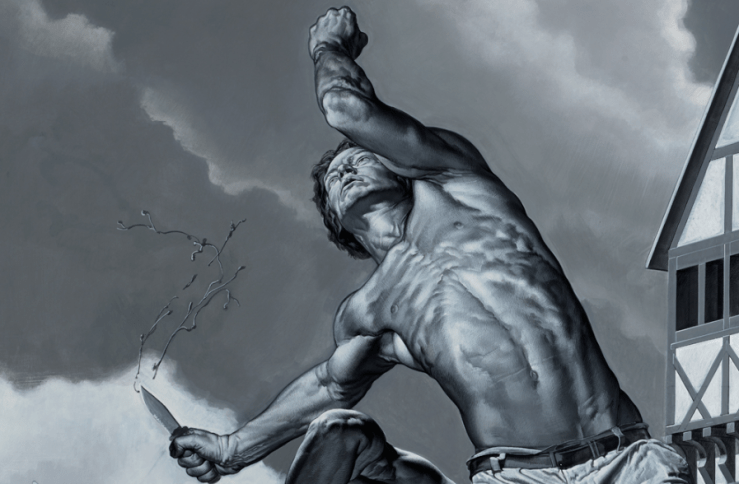
Two Telegrams (Antonioni) — Jen Mazza

MazzaScissorsWeb

Two Telegrams (Antonioni), 2013 by Jen Mazza (b. 1972)

Only the girl has woven a ruse in which she is seen beside her beloved

ddce8e97707db4e2ed8bffe1ab27356e

Under the orders of the Great Master, they’re embroidering the earth’s mantle, seas, mountains, and living things. Only the girl has woven a ruse in which she is seen beside her beloved.

c88dfd7bf5f2cdf78971920dbb659cc7

Remedios Varo’s description of her painting The Embroidering of the Earth’s Mantle (1961). From the collection Letters, Dreams & Other Writings. Translated by Margaret Carson. From Wakefield Press.

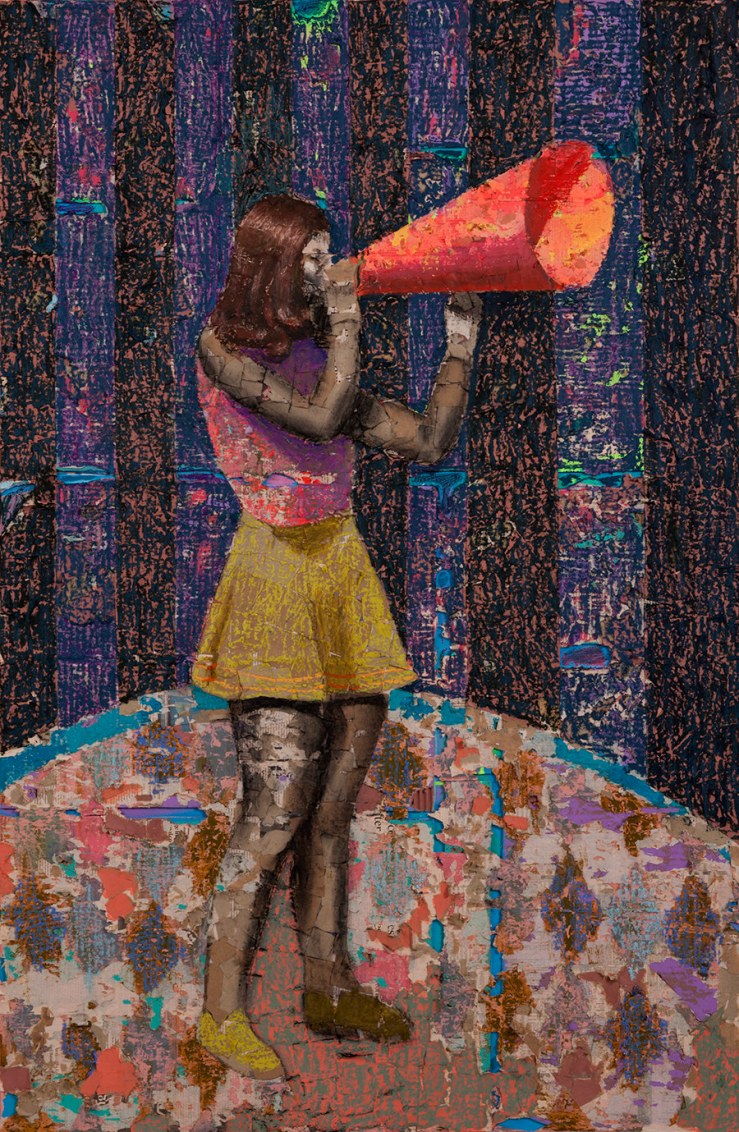
Figure with Horn — Derek Fordjour

772

Figure with Horn2017 by Derek Fordjour (b. 1974)

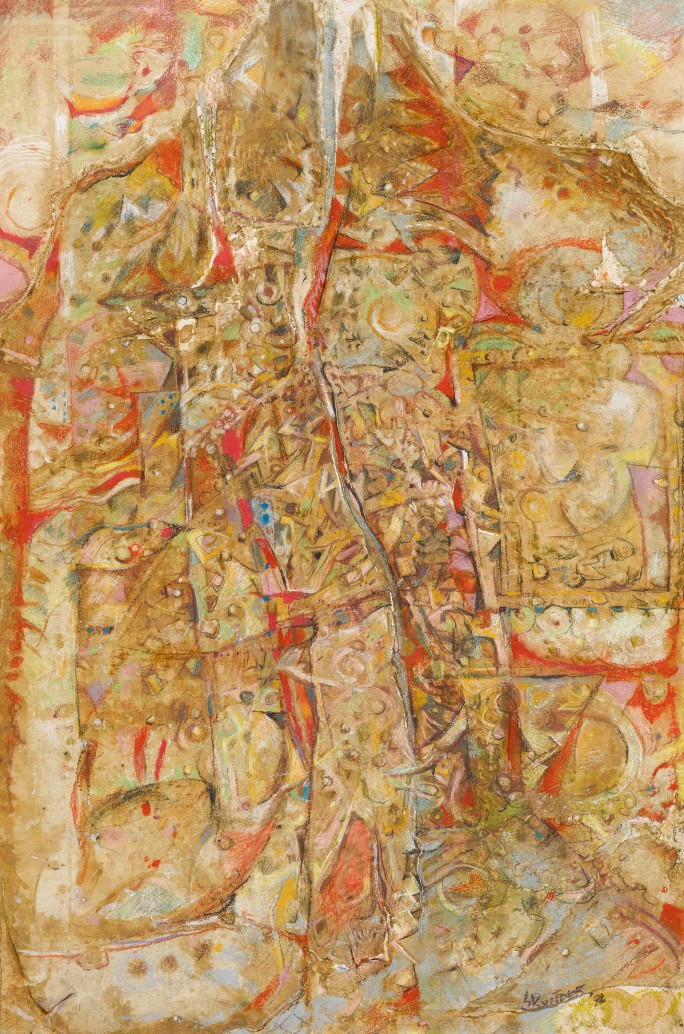
The Split — Alexander Boghossian

ab

The Split, 1992 by Alexander Boghossian (1937-2003)

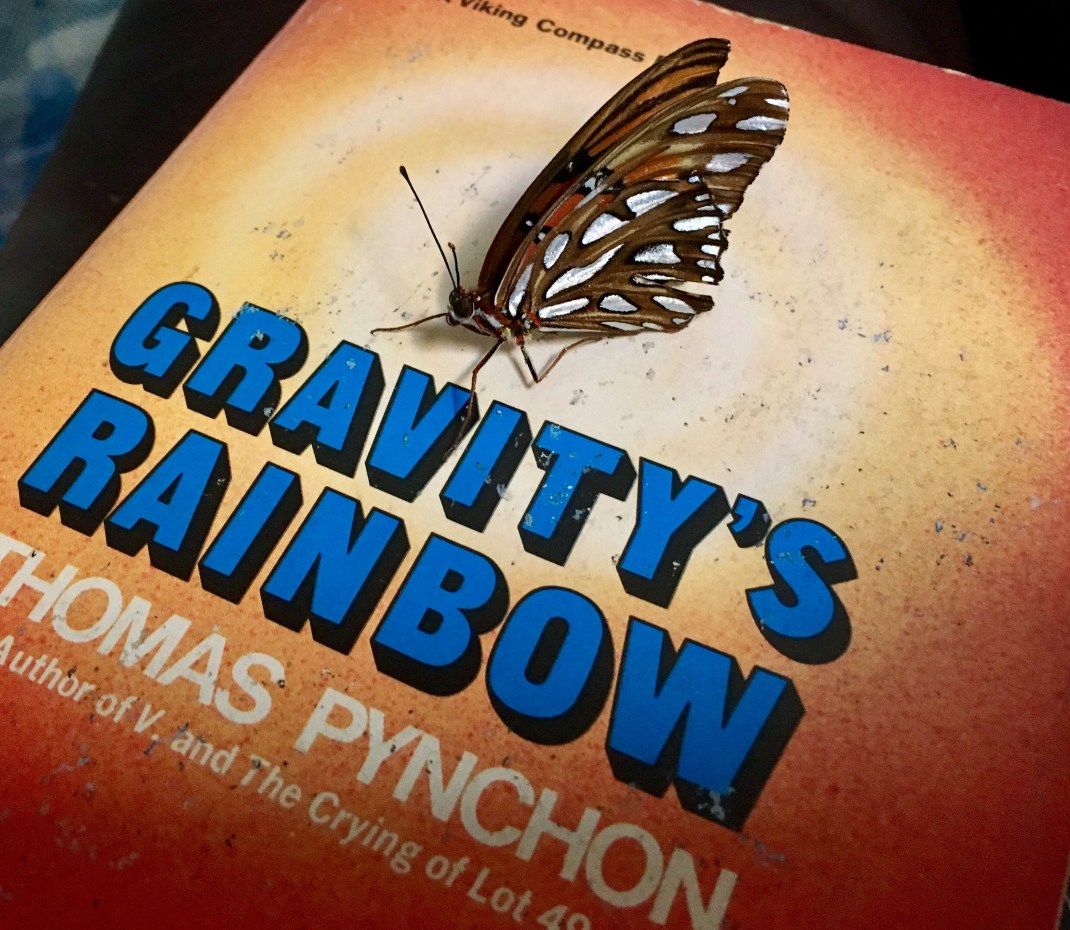
(Not Quite) All the Food in Thomas Pynchon’s Books

I was looking for something else when I found a fun article from six years ago in Bon Appétit. The article, by Nicole Villeneuve, is called “All the Food in Thomas Pynchon’s Books (and What It Means, Sorta),” and it riffs on most of the food in Pynchon’s oeuvre.

Here’s the section on “The Inedible,” which includes notes on two of my favorite scenes from Gravity’s Rainbow—–

The Inedible

“A lot of people who think they’re cooks but are clinically deluded,” says a mess hall manager in Vineland. Pynchon includes a lot of their misguided creations in his books, relishing the gross and inedible—the places where “even [the] Jell-O salads have scum on them.”

Maybe the most memorable example is the “English Candy Drill,” in which a parade of disgusting sweets are sampled, unwillingly, by Tyrone Slothrop, the protagonist (sorta) in Gravity’s Rainbow: rhubarb creams, cherry-quinine petit fours, eucalyptus-flavored fondant, and pepsin-flavored nougat, licorice drops with a “dribbling liquid center, which tastes like mayonnaise and orange peels” and “a hard sour gooseberry shell into a wet spurting unpleasantness of, he hopes it’s tapioca, little glutinous chunks of something all saturated with powdered cloves.”

Gravity’s Rainbow includes another scene that’s hard to stomach: As a culinary prank, Bodine and Roger hold a dinner party with an intentionally revolting menu: “snot soup,” “sum soufflé,” “vomit vichyssoise” and “wart waffles.” Needless to say, “A general loss of appetite reigns, not to mention overt nausea.”

It’s a fun article, like I said, but there are a few things missing. It notes Against the Day’s cult of mayonnaise but leaves out all the ketchup (ketjap) stuff in Mason & Dixon, as well as Mason & Dixon’s important core distinction between Grape People and Grain People:

“If this is as bad as it gets, why I can abide thah’. As long as the Spirits don’t run out.”

“Nor the Wine.”

“Wine.” Dixon is now the one squinting. Mason wonders what he’s done this time. ” ‘Grape or Grain, but ne’er the Twain,’ as me Great- Uncle George observ’d to me more than once,— ‘Vine with Corn, beware the Morn.’ Of the two sorts of drinking Folk this implies, than’ is, Grape People and Grain People, You will now inform rne of Your membership in the Brotherhood of the, eeh, Grape…? and that You seldom, if ever, touch Ale or Spirits, am I correct?”

“Happily so, I should imagine, as, given a finite Supply, there’d be more for each of us, it’s like Jack Sprat, isn’t it.”

“Oh, I’ll drink Wine if I must…?— and now we’re enter’d upon the Topick,— ”

“— and as we are in Portsmouth, after all,— there cannot lie too distant some Room where each of us may consult what former Vegetation pleases him?”

Dixon looks outside at the ebbing wintry sunlight. “Nor too early, I guess…?”

“We’re sailing to the Indies,— Heaven knows what’s available on Board, or out there. It may be our last chance for civiliz’d Drink.”

“Sooner we start, the better, in thah’ case…?”

Again, a fun article—but what other food bits are missing? (We can leave the coprophagia and urolagnia in Gravity’s Rainbow out, though).

“Slice ’em Down,” a short story by Langston Hughes

“Slice ’em Down”

by

Langston Hughes


In Reno, among the colored folks of the town, there are two main social classes: those who came to the city on a freight train, and those who did not. The latter, or cushion-riders, are sometimes inclined to turn flat noses high at those who rode the rods by way of entry to the city. Supercilious glances on the part of old settlers and chair-car arrivals toboggan down broad Negro noses at the black bums who, like white bums, both male and female, stream through Nevada on their way to or from the Coast, to remain awhile, if the law will let them in THE BIGGEST LITTLE CITY IN THE WORLD—RENO—according to the official sign in electric lights near the station.

But, of course, the rod-riders get off nowhere near the station. If they’re wise, bums from the East get off at Sparks, several miles from the famous mecca of unhappy wives, then they foot it into Reno. (Only passengers with tickets, coaches or Pullmans, can afford the luxury of alighting directly in front of any station, anywhere.)

Terry and Sling came in on a fast freight from Salt Lake. Before that they had come from Cheyenne. And before that from Chicago—and then the line went south and got lost somewhere in a tangle of years and cotton fields and God-knows-what fantasies of blackness. Continue reading ““Slice ’em Down,” a short story by Langston Hughes”

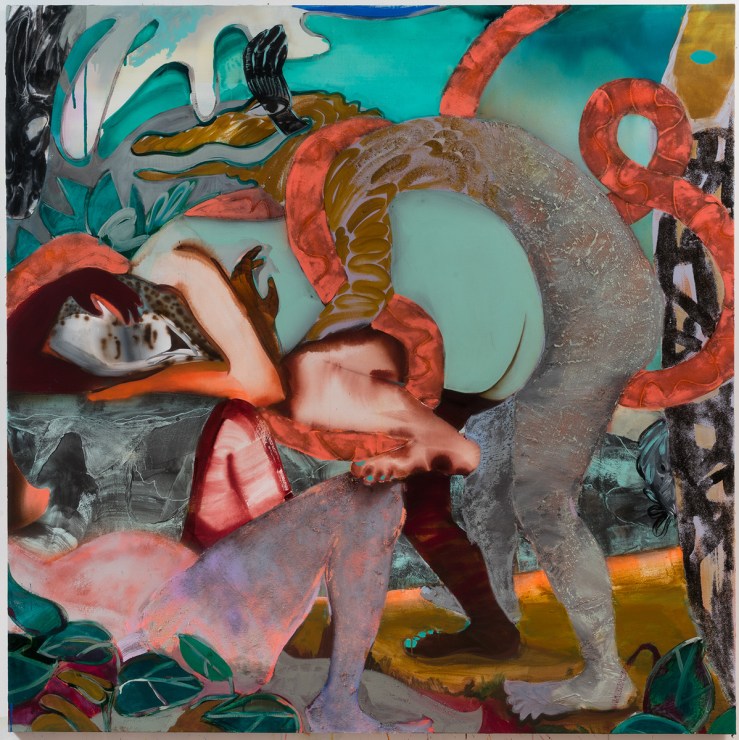
An Arm for an Eye — Elizabeth Glaessner

2017_an20arm20for20an20eye_72x72_0

An Arm for an Eye, 2017 by Elizabeth Glaessner (b. 1984)

We must not say so

Stupid poets!

img_2479

Via–

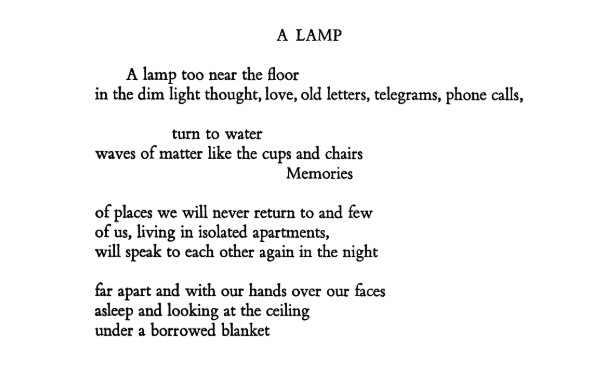
“A Lamp” — Tom Clark

tom clark

God’s spoilers (Gravity’s Rainbow)

What you felt stirring across the land… it was the equinox… green spring equal nights… canyons are opening up, at the bottoms are steaming fumaroles, steaming the tropical life there like greens in a pot, rank, dope-perfume, a hood of smell… human consciousness, that poor cripple, that deformed and doomed thing, is about to be born. This is the World just before men. Too violently pitched alive in constant flow ever to be seen by men directly. They are meant only to look at it dead, in still strata, transputrefied to oil or coal. Alive, it was a threat: it was Titans, was an overpeaking of life so clangorous and mad, such a green corona about Earth’s body that some spoiler had to be brought in before it blew the Creation apart. So we, the crippled keepers, were sent out to multiply, to have dominion. God’s spoilers. Us. Counterrevolutionaries. It is our mission to promote death. The way we kill, the way we die, being unique among the Creatures. It was something we had to work on, historically and personally. To build from scratch up to its present status as reaction, nearly as strong as life, holding down the green uprising. But only nearly as strong.

Only nearly, because of the defection rate. A few keep going over to the Titans every day, in their striving subcreation (how can flesh tumble and flow so, and never be any less beautiful?), into the rests of the folksong Death (empty stone rooms), out, and through, and down under the net, down down to the uprising.

In harsh-edged echo, Titans stir far below. They are all the presences we are not supposed to be seeing—wind gods, hilltop gods, sunset gods—that we train ourselves away from to keep from looking further even though enough of us do, leave Their electric voices behind in the twilight at the edge of the town and move into the constantly parted cloak of our nightwalk till

Suddenly, Pan—leaping—its face too beautiful to bear, beautiful Serpent, its coils in rainbow lashings in the sky—into the sure bones of fright—

Don’t walk home at night through the empty country. Don’t go into the forest when the light is too low, even too late. Don’t go into the forest when the light is too low, even too late in the afternoon—it will get you. Don’t sit by the tree like this, with your cheek against the bark.

From Thomas Pynchon’s Gravity’s Rainbow, pages 720-21.

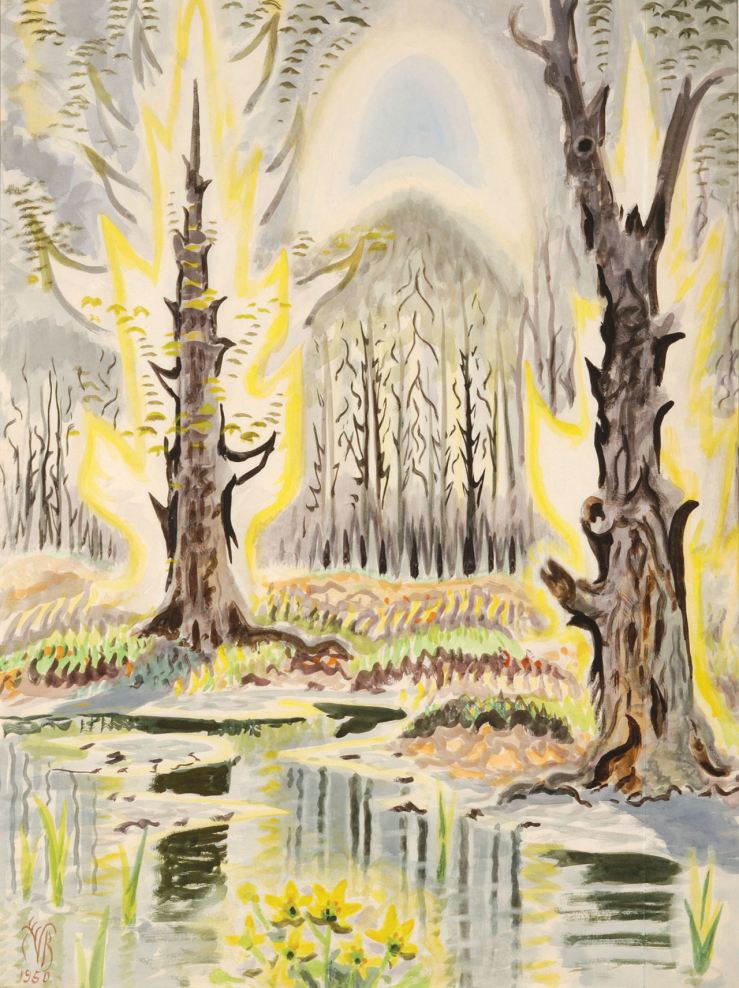
Glory of Spring (Radiant Spring) — Charles Burchfield

tumblr_o65tahvm7r1rkla8lo1_1280

 Glory of Spring (Radiant Spring), 1950 by Charles Burchfield (1893-1967)

The Spring Witch — George Wilson

SPRING WITCH

The Spring Witch, c. 1880 by George Wilson (1848-1890)

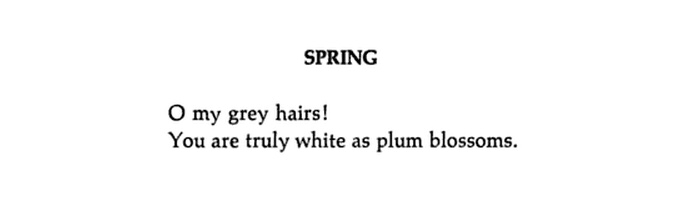
“Spring” — William Carlos Williams

Assassination #2: Marlowe — Nicola Verlato

58f16c_c6356aa92b1743b69f1dda0c224b9c42

Screenshot 2019-03-19 at 3.37.14 PMScreenshot 2019-03-19 at 3.37.29 PMScreenshot 2019-03-19 at 3.37.01 PM

Assassination #2: Marlowe, 2015 by Nicola Verlato (b. 1965)

The Hill: Hobbiton-across-the Water — J.R.R. Tolkien

the-hill-hobbiton-across-the-water

The Hill: Hobbiton-across-the Water, 1937 by J.R.R. Tolkien (1892–1973).

From The Morgan Library & Museum’s exhibition “Tolkien: Maker of Middle-earth.”

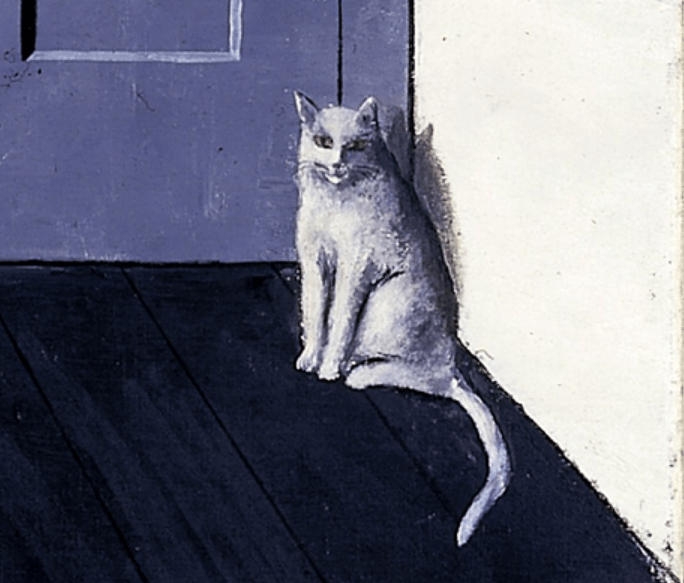
White Cat — Gertrude Abercrombie

1971.447.1_1.tifScreenshot 2019-03-18 at 4.08.04 PMScreenshot 2019-03-18 at 4.09.09 PMScreenshot 2019-03-18 at 4.09.29 PM

White Cat, 1938 by Gertrude Abercrombie (1909–1977)