Self-Portrait — Christian Schad

Self-Portrait, 1927 by Christian Schad (1894-1982)

Blog about some recent reading

I have a leak in my roof and I’ve canceled my Thanksgiving plans and I’m not sure what to do about the soft coup, but, books—

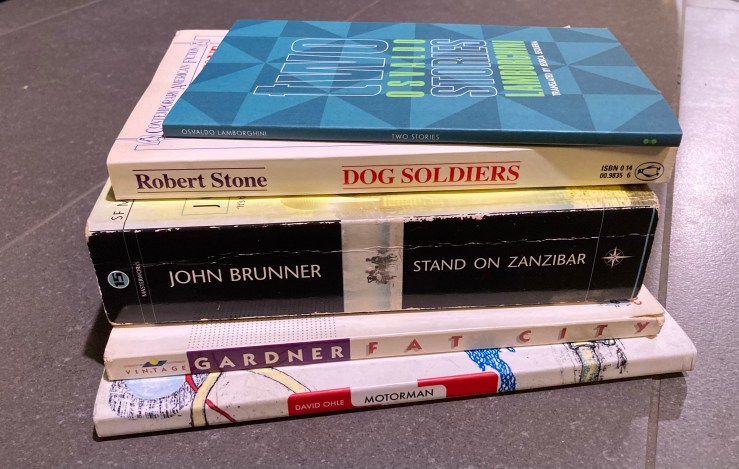
Top to bottom:

I’m still scratching my head about Two Stories by Osvaldo Lamborghini (translated by Jessica Sequeira). Sneaky strange stuff, prose-poem stuff like elastic concrete, or concrete elastic.

Started Robert Stone’s Dog Soldiers last night (on the late David Berman’s recommendation) and really digging it so far. Set at the end of the Vietnam War, it seems to be about a heroin deal going sideways. Maybe the CIA is involved, maybe not. Everyone’s a bit grimy. I guess it comes from the Hemingway tree, or really, maybe, the Stephen Crane tree—Denis Johnson’s tree, Leonard Gardner’s tree, Raymond Carver’s tree, etc. Reminds me a lot of Johnson’s Angels (and, to some extent, Tree of Smoke), but also Russell Banks’s 1985 novel Continental Drift, which I read years ago, hated, and still remember—which means I think it must be a really good novel?

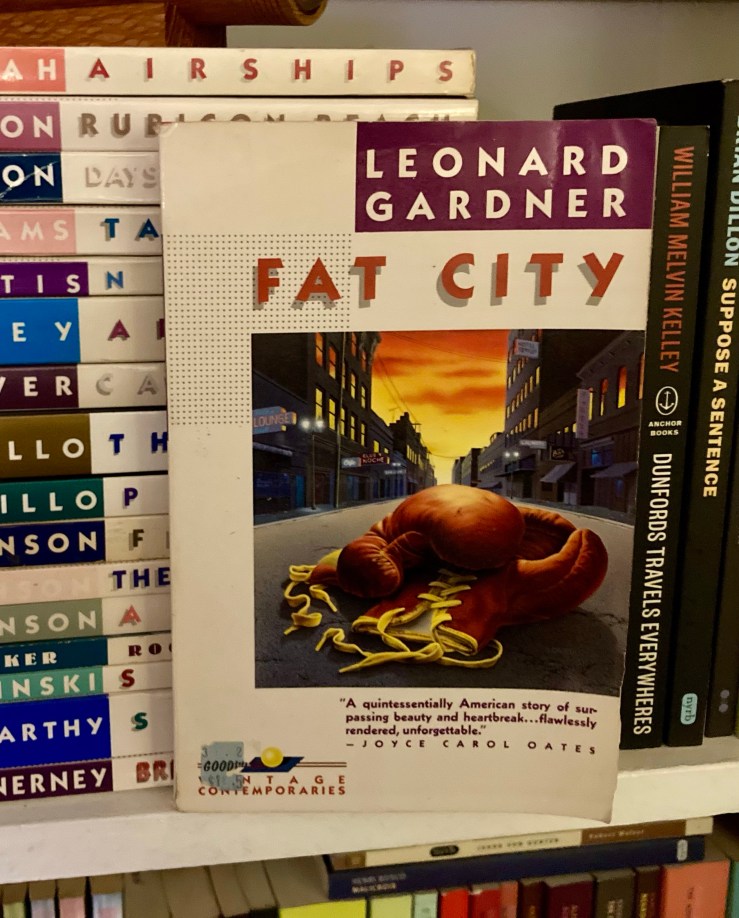
I wrote Top to bottom up at the top, but Leonard Gardner’s Fat City is in line with Stone’s Dog Soldiers—Stone’s losers, I guess. The book is about an “old” boxer (he’s not thirty) on the way out of his career and a young boxer on the rise. (Rise here is a really suspect term.) I really can’t believe I was 41 when I read this. I should’ve read it at 20. I wouldn’t have understood it the same way, of course, and the biggest sincerest compliment I can pin on the novel is that I would’ve loved it at 20 but I know that I would’ve appreciated it more 20 years later. There are plenty of novels that I read and think, Hmm, would’ve loved this years ago, but now, nah, but Fat City is wonderful. It’s a boxing story, sure, but it’s really a book about bodies breaking down, aging, getting stuck in dreams and fantasies. Gardner’s only novel (!) is simultaneously mock-tragic and real tragic, pathetic and moving, and very very moving. Great stuff.

John Brunner’s big fat dystopian novel Stand on Zanzibar frankly overwhelmed me and then sorta underwhelmed me there at the end. This sci-fi classic is a big weird shaggy dog that managed to predict the future in all kinds of ways, and it’s mean and funny, but it’s also bloated and booming, the kind of novel that sucks all the air out of the room. It’s several dozen essays dressed up as sci-fi adventure—not a bad deal in and of itself—but there’s very little space left for the reader.

David Ohle’s lean mean mutant Motorman is a dystopia carved from stranger stuff. Ohle’s cult novel leaves plenty of room for the reader to wonder and wander around in. Abject, spare, funny, and depressing, Motorman sputters and jerks on its own nightmare logic. Its hapless hero Moldenke anti-quests through an artificial world, tumbling occasionally into strange moments of agency, but mostly lost and unillusioned in a broken universe. I loved it.

After I finished it, I made a list with no name of books that are “like” Motorman in their “unalikeness” to other books:


“All art constantly aspires towards the condition of etc. etc.”

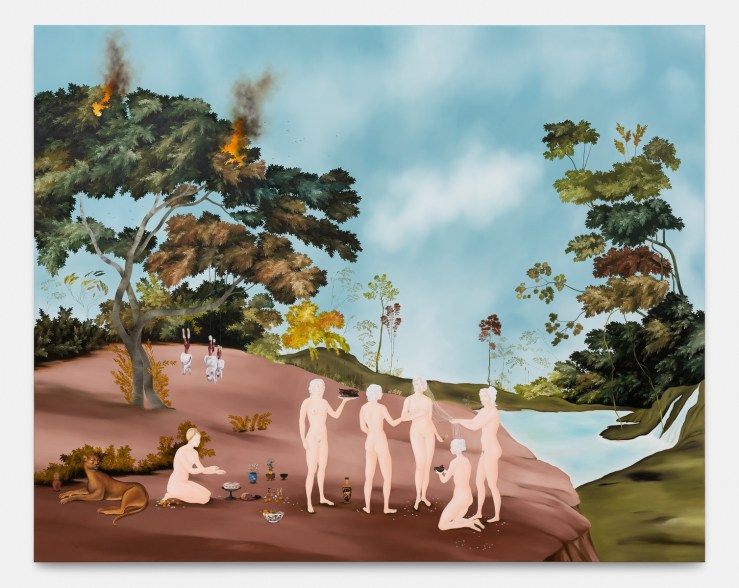
To the Last Syllable of Recorded Time — Sanam Khatibi

To the Last Syllable of Recorded Time, 2019 by Sanam Khatibi (b. 1979)

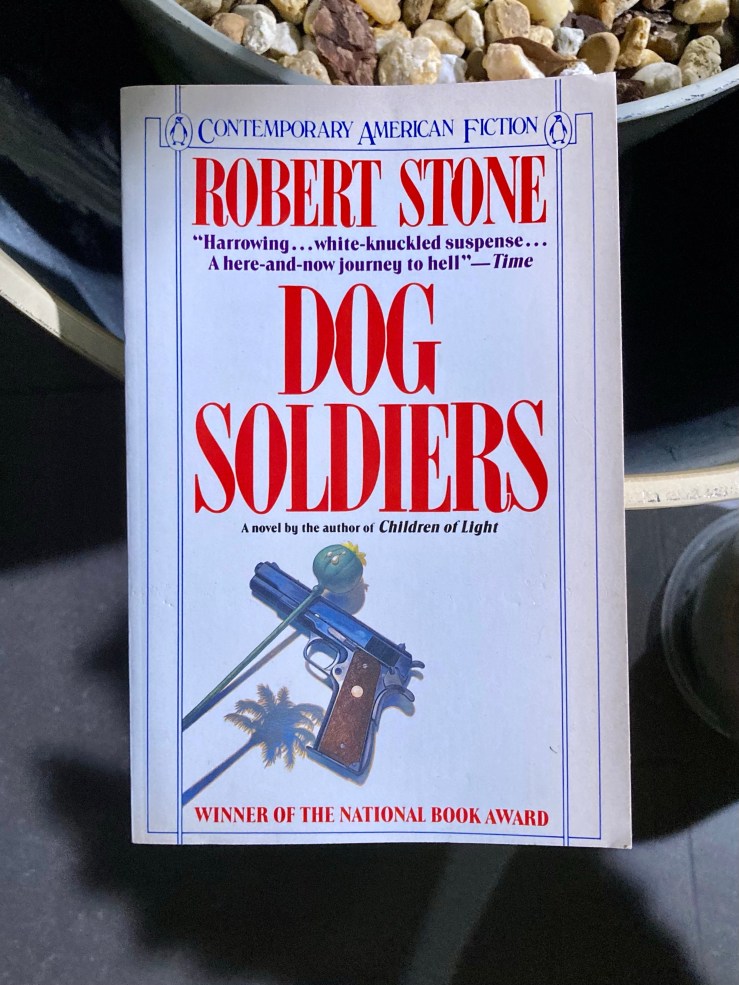
Robert Stone’s Dog Soldiers (Book acquired, 17 Nov. 2020)

I’ve been looking for a copy of Robert Stone’s 1974 novel Dog Soldiers for a little over a year now. By looking I mean scanning over the Robert Stone section (dude has his own little placard) of my beloved used bookshop, seeing literally dozens of copies for pretty much every Stone book except Dog Soldiers.

My interest in the novel I owe to the late great freight date David Berman, who reportedly repeatedly said it was his favorite novel. The guitarist William Tyler–whom I did not get to see play with Steven Gunn earlier this year, way back in March, way back in early COVID days—attests that Berman “told me his favorite novel was Dog Soldiers by Robert Stone.” I think I also heard that Dog Soldiers was Berman’s fave from the writer John Lingan, probably on twitter, although the detail is not included in his fantastic 2019 profile of Berman. And Berman mentioned the book in his Reddit AMA as part of his answer to book recommendations for someone starting college:

Poetics of Space by Gaston Bachelard

Dog Soldiers by Robert Stone

Anatomy of Melancholy by Robert Burton

Complete Emily Dickinson

Anyway…I found Dog Soldiers, finally, today. I stopped in quickly to pick up two novels for my son, whose reading virility is through the roof now—dude reads like 600 pages a week—and I had a few minutes before I needed to attend my carpool duties and, finally, today, I read Dog Soldiers. I think I’ll read it next, and maybe write something about it here—something not about Berman, but who knows.

Seated Woman — Rik Wouters

MSKG – Zittende vrouw bij het venster of Portret van Nel Duerinc

Seated Woman, 1915 by Rik Wouters (1882-1916)

“The Ball Poem” — John Berryman

“The Ball Poem”

by

John Berryman


What is the boy now, who has lost his ball.
What, what is he to do? I saw it go
Merrily bouncing, down the street, and then
Merrily over—there it is in the water!
No use to say ‘O there are other balls’:
An ultimate shaking grief fixes the boy
As he stands rigid, trembling, staring down
All his young days into the harbour where
His ball went. I would not intrude on him,
A dime, another ball, is worthless. Now
He senses first responsibility
In a world of possessions. People will take balls,
Balls will be lost always, little boy,
And no one buys a ball back. Money is external.
He is learning, well behind his desperate eyes,
The epistemology of loss, how to stand up
Knowing what every man must one day know
And most know many days, how to stand up
And gradually light returns to the street,
A whistle blows, the ball is out of sight.
Soon part of me will explore the deep and dark
Floor of the harbour . . I am everywhere,
I suffer and move, my mind and my heart move
With all that move me, under the water
Or whistling, I am not a little boy.

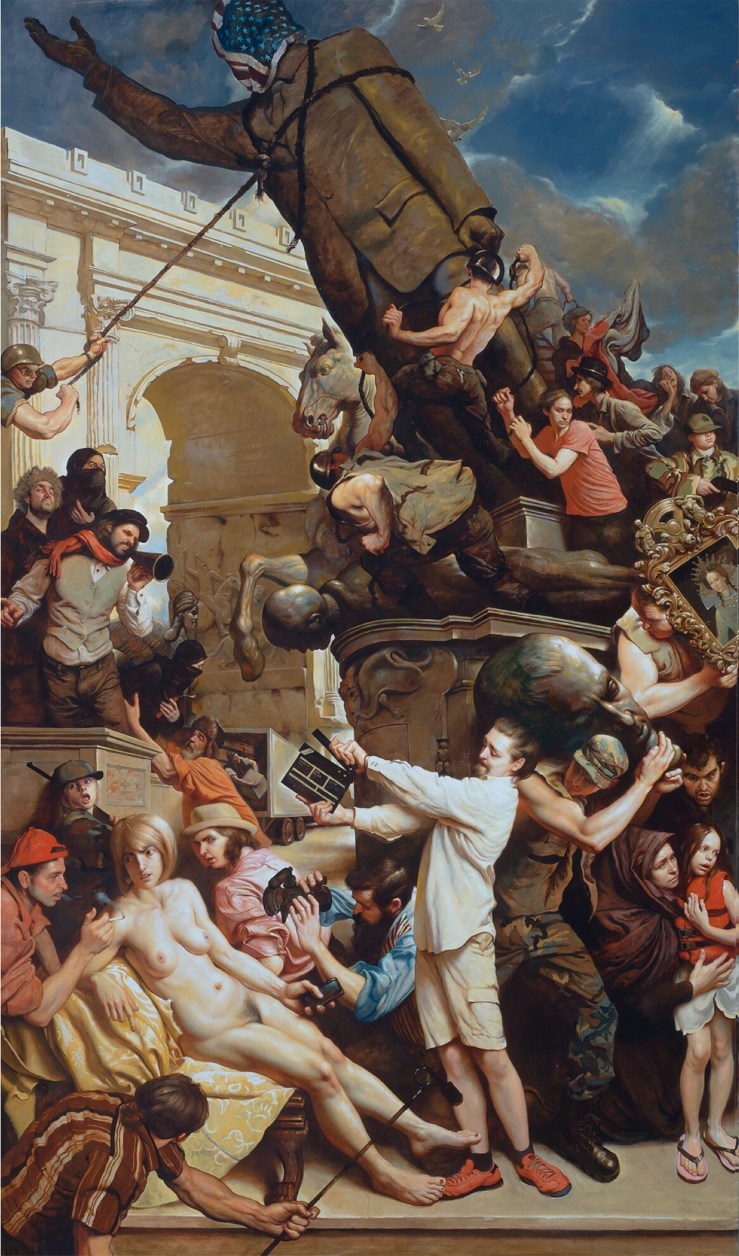
The Fall of Troy — Adam Miller

The Fall of Troy, 2019 by Adam Miller (b. 1979)

“On Rectification” — Anne Carson

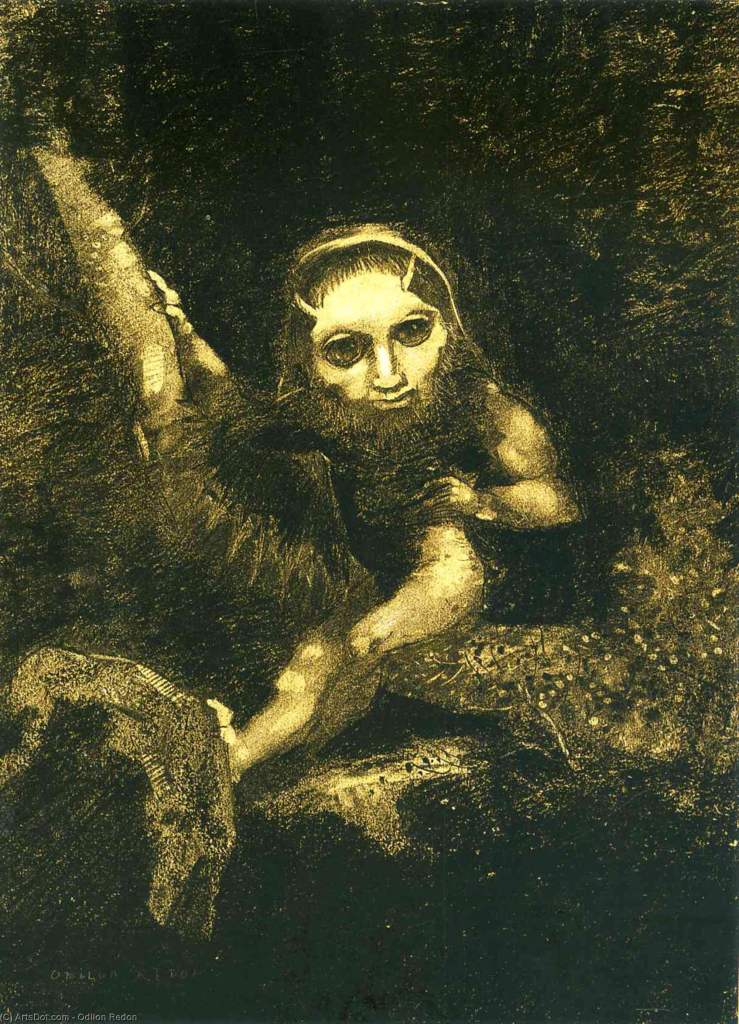
Caliban on a Branch — Odilon Redon

Caliban on a Branch, 1881 by Odilon Redon (1840-1916)

Leonard Gardner’s Fat City (Book acquired, 12 Nov. 2020)

I’ve been wanting to read Leonard Gardner’s Fat City for a while, and how could I pass up this Vintage Contemporaries edition?

I think I first heard of the book years ago in conjunction with its influence on Denis Johnson. In Salon, in 1996, Johnson wrote, or gushed, really–

Exactly which year of the 1960s the book came out, I can’t remember, but I remember well which year of my lifetime it was — I was discovering that it wasn’t a joke anymore, I was actually going to have to become a writer, I was too emotionally crippled for real work, there wasn’t anything else I could do — I was 18 or 19. Newsweek reviewed “Fat City,” a first novel by Leonard Gardner, in a tone that seemed to drop the usual hype — “It’s good. It really is.” I wanted to get a review like that.

I got the book and read about two Stockton, California boxers who live far outside the boxing myth and deep in the sorrow and beauty of human life, a book so precisely written and giving such value to its words that I felt I could almost read it with my fingers, like Braille.

The stories of Ernie Munger, a young fighter with frail but nevertheless burning hopes, and Billy Tully, an older pug with bad luck in and out of the ring, parallel one another through the book. Though the two men hardly meet, the tale blends the perspective on them until they seem to chart a single life of missteps and baffled love, Ernie its youth and Tully its future. I wanted to write a book like that.

My neighbor across the road, also a young literary hopeful, felt the same. We talked about every paragraph of “Fat City” one by one and over and over, the way couples sometimes reminisce about each moment of their falling in love.

And like most youngsters in the throes, I assumed I was among the very few humans who’d ever felt this way. In the next few years, studying at the Writer’s Workshop in Iowa City, I was astonished every time I met a young writer who could quote esctatically line after line of dialogue from the down-and-out souls of “Fat City,” the men and women seeking love, a bit of comfort, even glory — but never forgiveness — in the heat and dust of central California. Admirers were everywhere.

My friend across the road saw Gardner in a drugstore in California once, recognized him from his jacket photo. He was looking at a boxing magazine. “Are you Leonard Gardner?” my friend asked. “You must be a writer,” Gardner said, and went back to the magazine. I made him tell the story a thousand times.

Between the ages of 19 and 25 I studied Leonard Gardner’s book so closely that I began to fear I’d never be able to write anything but imitations of it, so I swore it off.

I haven’t owned a copy of “Fat City” in over 20 years, but I recently learned that the University of California Press is bringing out an edition this November, and I’ve ordered one.

When I was about 34 (the same age Gardner was when he published his), my first novel came out. About a year later I borrowed “Fat City” from the library and read it. I could see immediately that 10 years’ exile hadn’t saved me from the influence of its perfection — I’d taught myself to write in Gardner’s style, though not as well. And now, many years later, it’s still true: Leonard Gardner has something to say in every word I write.

I just finished John Brunner’s big baggy shaggy dog of a sci-fi novel, Stand on Zanzibar (reading David Ohle’s spare abject wild dystopian prose-poem Motorman, in between Zanzibar chunks)—I think Fat City might be a nice reset.

Watch a 1970 short documentary about Alice Coltrane

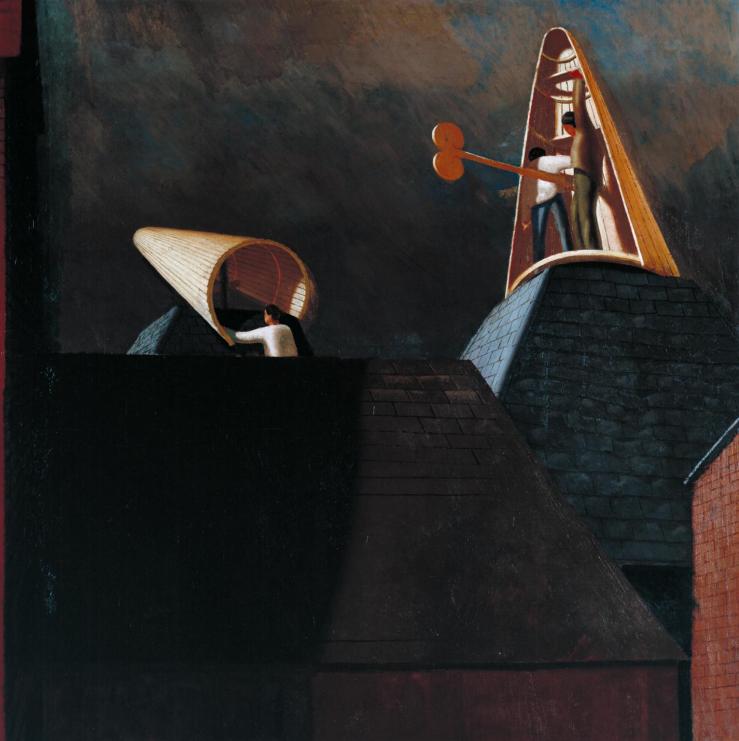
Mending Cowls, Cookham — Stanley Spencer

Mending Cowls, Cookham, 1915 by Stanley Spencer (1891–1959)

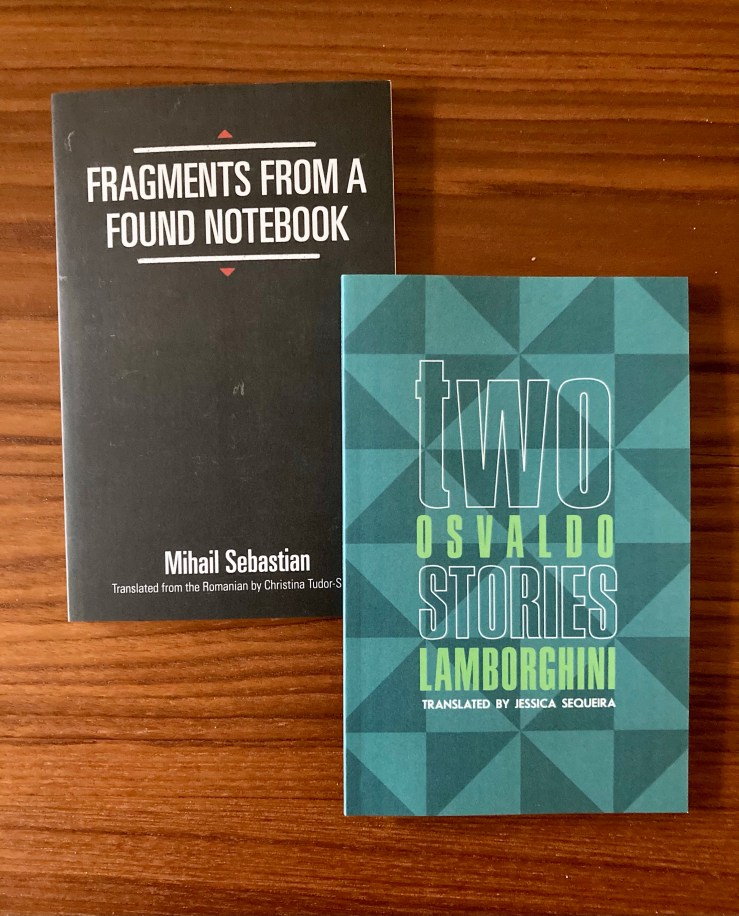
Osvaldo Lamborghini/Mihail Sebastian (Books acquired, 10 Nov. 2020)

Two new “objects” in translation from strangish newish indie Sublunary Editions arrived at Biblioklept World Headquarters the other day: Two Stories by Osvaldo Lamborghini (translated by Jessica Sequeira) and Fragments from a Found Notebook by Mihail Sebastian (translated by Christina Tudor-Sideri).

Intrigued by the three-word blurb from Roberto Bolaño (“It scares me”) on its back cover, I read the two stories in Lamborghini’s Two Stories. I skipped César Aira’s introduction—I always skip introductions—and then after a few baffling pages, I went back to the introduction. Aira’s introduction didn’t exactly explicate the text for me. It did, however, read like a few pages from a Bolaño novel, describing a strange heroic exotic Argentine writer, a poet-artist romantically disposed to self-exiles. (I actually did a basic internet search just to make sure it wasn’t like, an elaborate fake. It’s not. Lamborghini was real, although he could have been a Bolaño invention.)

The texts of Two Stories are not exactly surrealist, not exactly automatic writing…Sublunary publisher Joshua Rothes described Lamborghini as “…a surrealist white hole… like de Sade and Lautréamont were sucked in by the surrealists, and Lamborghini’s what came out the other side.” Sublunary’s blurb describes the stories collected here as “an accurate sample of his work in much the same way that a bucket of seawater is an accurate sample of the ocean.”

I also started in on Mihail Sebastian’s Fragments from a Forgotten Notebook. Again, the whole affair has that romantic-Bolañoesque tinge to it. Sebastian presents the Notebook as a literal found object. Is it? Or is it invention? Here’s Sublunary’s verb, which begins with Sebastian’s introduction:

“One November evening (in circumstances that would take too long to narrate here) I found in Paris, on the Mirabeau Bridge, a notebook with black, glossy, oilcloth covers, like the ones in which grocers used to keep accounts. There were exactly 126 pages—commercial paper—filled with small writing, streamlined, without erasures. A curious reading, tiring in places, obscure passages, notations that appeared foreign to me, in fact even absolutely contrasting.”

Presented here for the first time in English, the late Mihail Sebastian’s debut book, seldom mentioned by scholars or even the author himself, Fragments from a Found Notebook casts an important light on a young writer—later to be known primarily as a diarist and documentarian—struggling with the identity of the I at the tip of his pen.


DeLillo has since stayed small

Michael Gorra has a thoughtful essay on Don DeLillo’s late style in the latest issue of The New York Review of Books. Ostensibly a review of DeLillo’s latest, The Silence, Gorra’s essay considers DeLillo’s body of work against some of his peers and literary forebears, arguing that DeLillo’s finest novels were composed and published in his “full middle age”:

The core of DeLillo’s oeuvre is the series of five novels that began with The Names (1982) and ended with Underworld; the intervening volumes are White NoiseLibra, and Mao II (1991). Those books look permanent, with the last of them a summa; his early books in contrast seem preparatory, though they each have their admirers. To put it another way, DeLillo was born in 1936, and what matters are the novels he wrote in full middle age, with Underworld appearing when he was sixty. Dickens was dead by that age, Balzac too, but DeLillo has had a third act in the six short books he has written in the new century. These novels rarely take age itself as their topic, as both Saul Bellow and Philip Roth did in their own late work; yet still they are the product of age.

Gorra then points out that “DeLillo’s recent books are significantly different from the great novels of his middle age, and that difference is worth thinking about.” Gorra continues:

…after Underworld his sense of novelistic form, of what he needs to make a narrative, did change. Probably there was no good way to follow that novel, with its distorting size and scope, a book that began with Frank Sinatra and ended with the disposal of nuclear waste. How could one compete with that—compete with oneself? DeLillo wisely didn’t try. There would be no new plateaus, no arc of increasing achievement. Underworld’s successor, The Body Artist (2001), was deliberately slight, a novella-length exploration of the uncanny that makes me think of “Bartleby, the Scrivener.” It was as if a composer who’d only written symphonies had suddenly switched to a tinny atonal song, and DeLillo has since stayed small. His late books have been at most a quarter of Underworld’s length, with The Silence the shortest of them, and always with fewer characters and a more sharply limited focus.

There’s a thorough and very generous review of The Silence embedded in Gorra’s essay—he’s far, far more generous than I was toward the book (at one point Gorra attests that he “can’t tell the difference between a few randomly chosen sentences from his recent work and a passage from Libra. Reader, there’s a difference). And while his phrase “DeLillo has since stayed small” is not overtly pejorative, I think it nevertheless captures the general sense that DeLillo’s late works—or late style—simply does not meet the quality of his work in the eighties and nineties. (Gorra admits that “Cosmopolis seems to me almost unreadable” — I concur.)

Others have found crystalline beauty in DeLillo’s late work, and in The Silence in particular. I found it a depressing read, not for its content necessarily—okay, maybe for its content, but also for its form, its prose. I concur with the first sentence of Gorra’s conclusion, but not with the second:

Some pages in this book verge on self-parody, and I doubt it will draw any readers who haven’t already invested themselves in DeLillo’s work, in the half-century of risks his voice has taken. But those of us who have will find something poignant and terrible in this strange unbroken silence.

Read Michael Gorra’s essay on DeLillo, “The Sense of an Ending,” here.

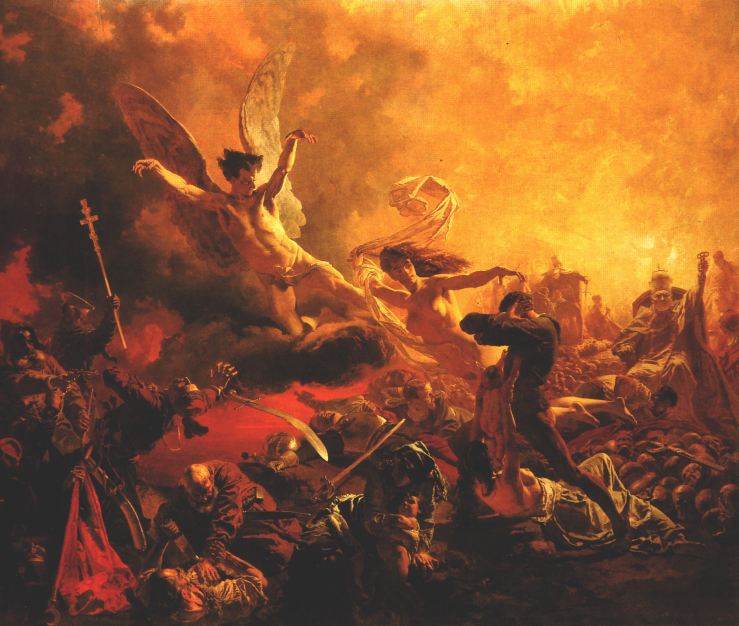
The Triumph of the Genius of Destruction — Mihály Zichy

The Triumph of the Genius of Destruction, 1878 by Mihály Zichy (1827–1906)

Goya’s The Disasters of War