The Robing of the Bride. The title of one of Max Ernst’s most mysterious paintings | J.G. Ballard

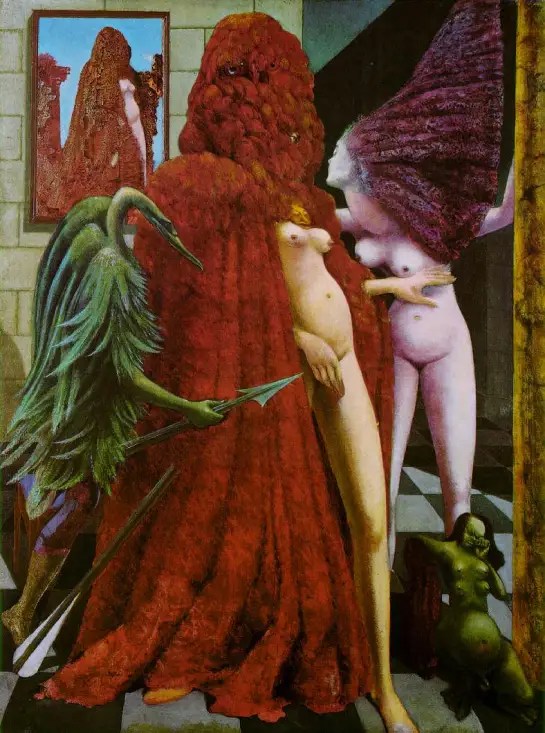
The Robing of the Bride.

The title of one of Max Ernst’s most mysterious paintings. An unseen woman is being prepared by two attendants for her marriage, and is dressed in an immense gown of red plumage that transforms her into a beautiful and threatening bird. Behind her, as if in a mirror, is a fossilized version of herself, fashioned from archaic red coral. All my respect and admiration of women is prompted by this painting, which I last saw at Peggy Guggenheim’s museum in Venice, stared at by bored students. Leaving them. I strayed into a private corridor of the palazzo, and a maid emerging through a door with a vacuum cleaner gave me a glimpse into a bedroom overlooking the Grand Canal. Sitting rather sadly on the bed was Miss Guggenheim herself, sometime Alice at the surrealist tea-party, a former wife of Max Ernst and by then an old woman. As she stared at the window I half-expected to see the bird costume on the floor beside her. She was certainly entitled to wear it.

From The Atrocity Exhibition by J.G. Ballard

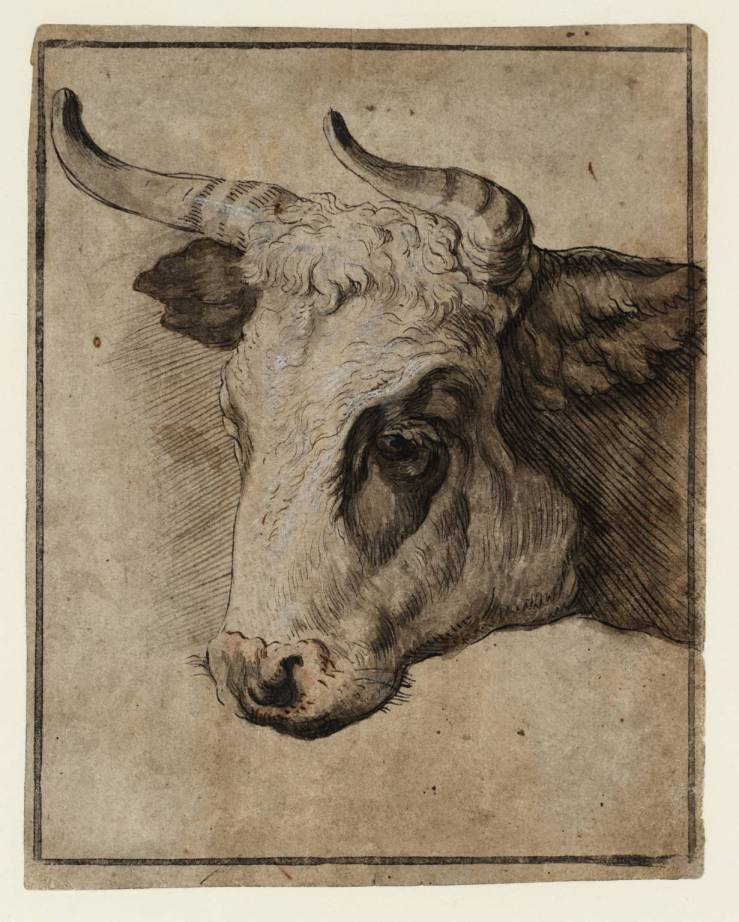
Side View of a Bull’s Head — Joseph Highmore

Side View of a Bull’s Head by Joseph Highmore (1692-1780)

List with no name #66

  1. The Slynx, Tatyana Tolstoya
  2. Nazi Literature in the Americas, Roberto Bolaño
  3. Parable of the Sower, Octavia Butler
  4. Telluria, Vladimir Sorokin
  5. The Road, Cormac McCarthy
  6. The Cities of Red Night, William S. Burroughs
  7. Harrow, Joy Williams
  8. Love in the Ruins, Walker Percy
  9. The Hospital Ship, Martin Bax
  10. Post-Exoticism in Ten Lessons, Lesson Eleven, Antoine Volodine
  11. Carmen Dog, Carol Emshwiller

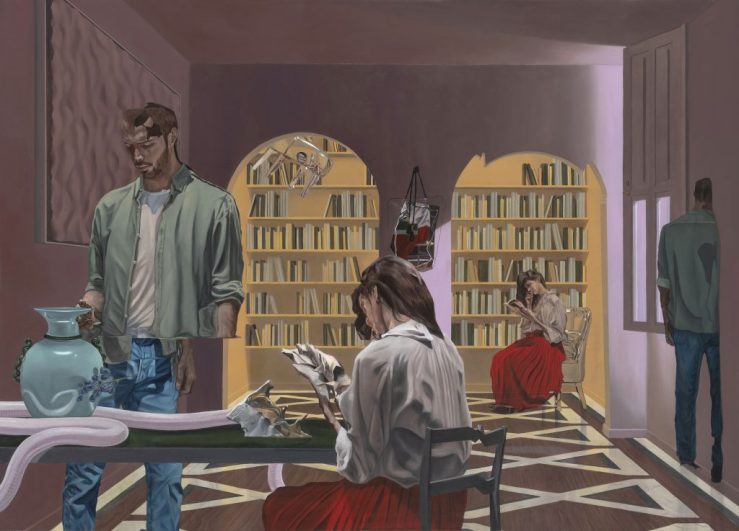
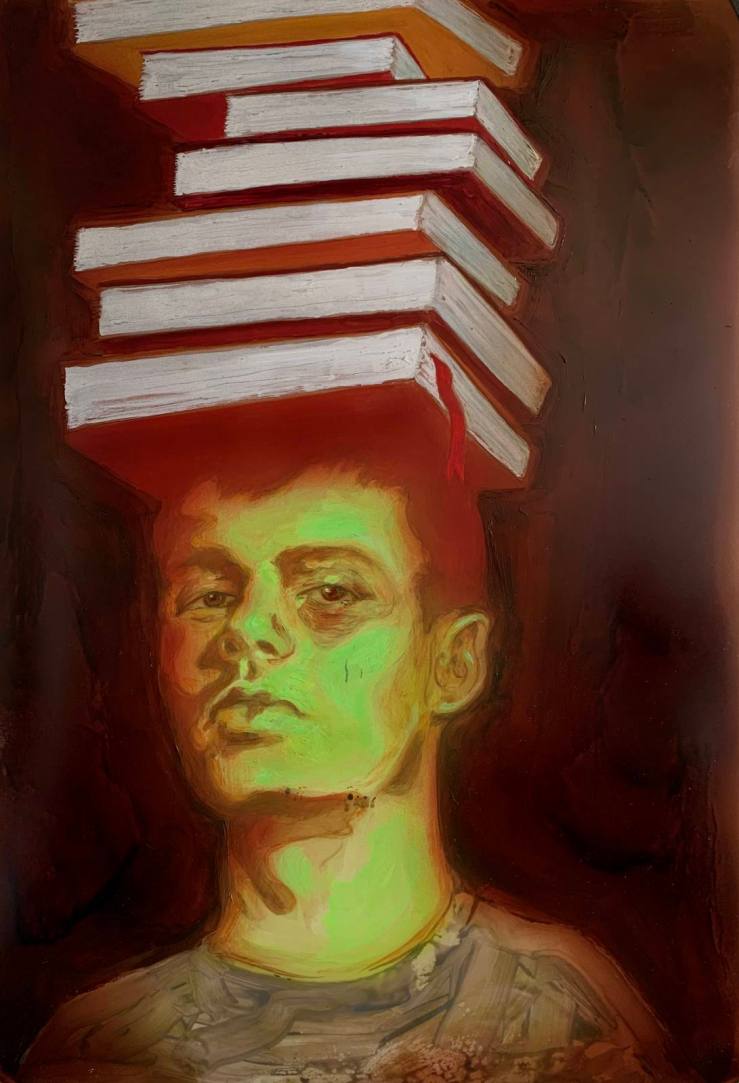
Reification #80 — Dario Maglionico 

Reification #80, 2021 by Dario Maglionico (b. 1986)

“Silvio Salvático” — Roberto Bolaño

“Silvio Salvático”

by

Roberto Bolaño

translated by Chris Andrews

from Nazi Literature in the Americas


SILVIO SALVÁTICO

Buenos Aires, 1901–Buenos Aires, 1994

As a young man Salvático advocated, among other things, the re-establishment of the Inquisition; corporal punishment in public; a permanent war against the Chileans, the Paraguayans, or the Bolivians as a kind of gymnastics for the nation; polygamy; the extermination of the Indians to prevent further contamination of the Argentinean race; curtailing the rights of any citizen with Jewish blood; a massive influx of migrants from the Scandinavian countries in order to effect a progressive lightening of the national skin color, darkened by years of promiscuity with the indigenous population; life-long writer’s grants; the abolition of tax on artists’ incomes; the creation of the largest air force in South America; the colonization of Antarctica; and the building of new cities in Patagonia.

He was a soccer player and a Futurist.

From 1920 to 1929, in addition to frequenting the literary salons and fashionable cafes, he wrote and published more than twelve collections of poems, some of which won municipal and provincial prizes. From 1930 on, burdened by a disastrous marriage and numerous offspring, he worked as a gossip columnist and copy-editor for various newspapers in the capital, hung out in dives, and practised the art of the novel, which stubbornly declined to yield its secrets to him. Three titles resulted: Fields of Honor (1936), about semi-secret challenges and duels in a spectral Buenos Aires; The French Lady (1949), a story of prostitutes with hearts of gold, tango singers and detectives; and The Eyes of the Assassin (1962), a curious precursor to the psycho-killer movies of the seventies and eighties.

He died in an old-age home in Villa Luro, his worldly possessions consisting of a single suitcase full of books and unpublished manuscripts.

His books were never republished. His manuscripts were probably thrown out with the trash or burned by the orderlies.

You who saw it all, or saw flashes and fragments

Lovers — Ilya Milstein

Lovers, 2019 by Ilya Milstein

Oasis — Benny Andrews

Oasis, 1989 by Benny Andrews (1930-2006)

Posted in Art

Joe the Dead belongs to a select breed of outlaws known as the NOs, natural outlaws dedicated to breaking the so-called natural laws of the universe | William S. Burroughs

  Joe the Dead belongs to a select breed of outlaws known as the NOs, natural outlaws dedicated to breaking the so-called natural laws of the universe foisted upon us by physicists, chemists, mathematicians, biologists and, above all, the monumental fraud of cause and effect, to be replaced by the more pregnant concept of synchronicity.

Ordinary outlaws break man-made laws. Laws against theft and murder are broken every second. You only break a natural law once. To the ordinary criminal, breaking a law is a means to an end: obtaining money, removing a source of danger or annoyance. To the NO, breaking a natural law is an end in itself: the end of that law.

Ordinary outlaws specialize their trades, in accordance with their inclinations and aptitudes—or they did at one time. Many of the old-time criminal types are endangered species now. Consider the Murphy Man. How many even know what a Murphy Man is? Your Murphy Man steers the mark to a nonexistent whore, having located an apartment building without a doorman and with the front door unlocked.

“Looking for some action, friend?”

“Well, uh, yes . . .”

The Murphy Man makes a phone call: it’s all set up. He leads the mark to the apartment building entrance.

“Go up one flight, first door on your left, 1A. Prime grade, friend, and she’s ready and waiting on you. You pay me now, so there won’t be any arguments.”

Only a black man can have the real Murphy Man voice— cool, insinuating, familiar—and the real Murphy Man face— sincere, unflappable, untrustworthy.

And practitioners of the Hype or the Bill, a short-change routine. You start by paying for a two-bit item with a twenty-dollar bill. You get the change on the counter, then you tell the clerk, “I must have been dreaming—I don’t mean to take all your small change. Here, give me ten for this” and count the ones back, minus the five. Or something like that. It’s hard to get a conviction on the Bill, because nobody can explain exactly what happened.

The basic principle can be found in a sketch by Edgar Allan Poe on nineteenth-century hustlers who were known as Diddlers. The diddler walks into a tobacco store and asks for a plug of tobacco. When the plug is on the counter, he changes his mind.

“Give me a cigar instead.” He takes the cigar and starts to walk out.

“Wait a minute. You didn’t pay for the cigar.”

“Of course not. I traded it against the tobacco plug.”

“Don’t recall you paid me for that either.”

“Paid you for it! Why, there it is! None of your tricks on traveling men.”

Unobtrusive and insistent, practitioners of the Bill are often addicts.

I wonder if there are any hype men left? Like Yellow Kid Weil and the Big Store: he would set up a prop brokerage office or bookmaking parlor and fleece his customers for several days before vanishing one night with the boodle. Also noteworthy is the sordid yachting swindle, practiced at one time by a certain well-known cult leader who shall be nameless. They’re going to buy a boat together, sail the South Seas . . . this swindle requires that mark and swindler live in the same trailer, get drunk together every night and lay the same whore. Yellow Kid Weil would have been scandalized. “Never drink with a savage,” was one of his rules.

The old-time bank robbers, the burglars who bought jewelry-store insurance inventories and knew exactly what they were looking for, the pickpockets trained from early childhood—they say the best ones come from Colombia—where are they now? The Murphy Men, the hype artists, the Big Store? Gone, all gone.

From William S. Burroughs’ last novel The Western Lands.

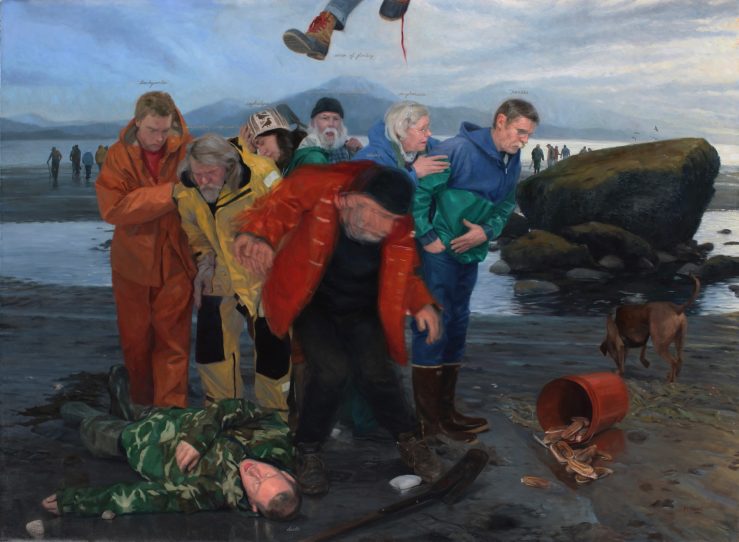
Symptoms of Paralytic Shellfish Poisoning — David Pettibone

Symptoms of Paralytic Shellfish Poisoning, 2020 by David Pettibone (b. 1980)

Poised — Anthony Goicolea

Poised, 2017 by Anthony Goicolea (b. 1971)

“The River of Bees” — W.S. Merwin

“The River of Bees”

by

W.S. Merwin


In a dream I returned to the river of bees
Five orange trees by the bridge and
Beside two mills my house
Into whose courtyard a blindman followed
The goats and stood singing
Of what was older

Soon it will be fifteen years

He was old he will have fallen into his eyes

I took my eyes
A long way to the calendars
Room after room asking how shall I live

One of the ends is made of streets
One man processions carry through it
Empty bottles their
Image of hope
It was offered to me by name

Once once and once
In the same city I was born
Asking what shall I say

He will have fallen into his mouth
Men think they are better than grass

I return to his voice rising like a forkful of hay

He was old he is not real nothing is real
Nor the noise of death drawing water

We are the echo of the future

On the door it says what to do to survive
But we were not born to survive
Only to live

Basement Scene with Conduit — Rhys Ziemba

Basement Scene with Conduit by Rhys Ziemba

A few sentences on every Thomas Pynchon novel to date

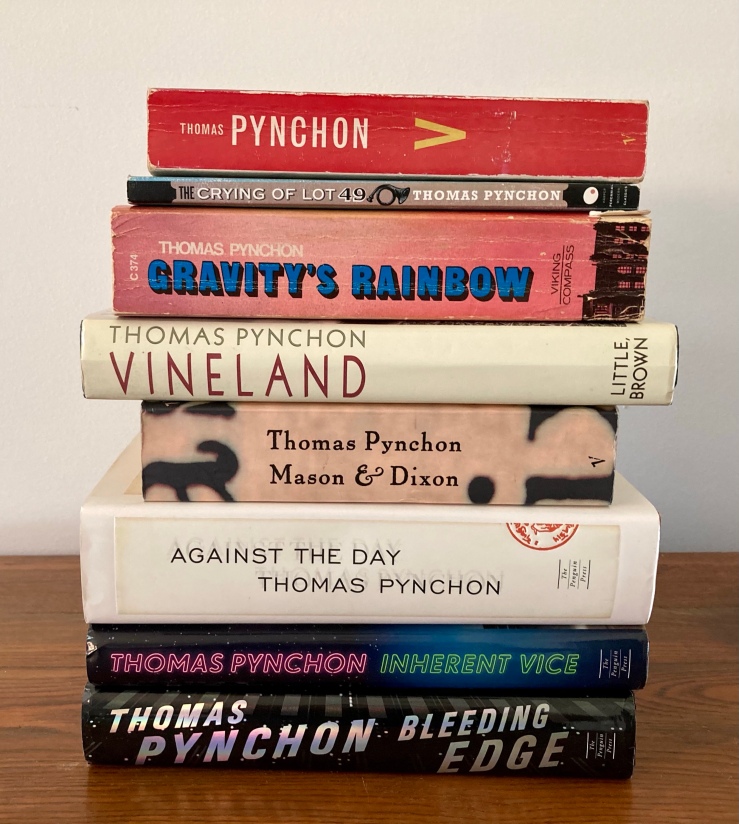
Today, 8 May 2022, is Thomas Ruggles Pynchon’s 85th birthday. Some of us nerds celebrate the work of one of the world’s greatest living authors with something called Pynchon in Public Day. In the past I’ve rounded up links to Pynchon stuff on Biblioklept and elsewhere. To celebrate, here are short riffs on Pynchon’s eight novels:

V. (1963)

I reread Pynchon’s first novel for the first time last year and found it far more achieved than I had remembered. For years I’ve always recalled it as a dress rehearsal for the superior and more complex Gravity’s Rainbow. And while V. certainly points in GR’s direction, even sharing some characters, it’s nevertheless its own entity. I first read V. as a very young man, and as I recall, thought it scattershot, zany, often very funny, but also an assemblage of set pieces that fail to cohere. Rereading it two decades later I can see that there’s far more architecture to its plot, a twinned, yoyoing plot diagrammed in the novel’s title. The twin strands allow Pynchon to critique modernism on two fronts, split by the world wars that mark the first half of the twentieth century. It’s a perfect starting point for anyone new to Pynchon, and its midpoint chapter, “Mondaugen’s Story,” is as good as anything else he’s written.

The Crying of Lot 49 (1966)

Pynchon’s shortest novel is not necessarily his most accessible: Crying is a dense labyrinth to get lost in. At times Pynchon’s second novel feels like a parody of L.A. detective noir (a well he’d return to in Inherent Vice), but there’s plenty of pastiche going on here as well. For example, at one point we are treated to a Jacobean revenge play, The Courier’s Tragedy, which serves as a kind of metatextual comment on the novel’s plot about a secret war between secret armies of…letter carriers. The whole mailman thing might seem ridiculous, but Pynchon’s zaniness is always doubled in sinister paranoia: The Crying of Lot 49 is a story about how information is disseminated, controlled, and manipulated. Its end might frustrate many readers. We never get to hear the actual crying of lot 49 (just as we never discover the “true” identity of V in V.): fixing a stable, centered truth is an impossibility in the Pynchonverse.

Gravity’s Rainbow (1973)

Unbelievably rich, light, dark, cruel, loving, exasperating, challenging, and rewarding, Pynchon’s third novel is one of a handful of books that end up on “difficult novel” lists that is actually difficult. The difficulty though has everything to do with how we expect a novel to “happen” as we read—Gravity’s Rainbow is an entirely new thing, a literature that responds to the rise of mass media as modernist painters had to respond to the advent of photography and moving pictures. The key to appreciating and enjoying Gravity’s Rainbow, in my estimation, is to concede to the language, to the plasticity of it all, with an agreement with yourself to immediately reread it all.

Vineland (1990)

It took Pynchon a decade and a half to follow up Gravity’s Rainbow. I was a boy when Vineland came out—it was obviously nowhere on my radar (I think my favorite books around this time would probably have been The Once and Future King, The Lord of the Rings trilogy, and likely a ton of Dragonlance novels). I do know that Vineland was a disappointment to many fans and critics, and I can see why. At the time, novelist David Foster Wallace neatly summed it up in a letter to novelist Jonathan Franzen: “I get the strong sense he’s spent 20 years smoking pot and watching TV.” Vineland is angry about the Reagan years, but somehow not angry enough. The novel’s villain Brock Vond seems to prefigure the authoritarian police detective Bigfoot Bjornsen of Inherent Vice, but Pynchon’s condemnation of Vond never quite reconciles with his condemnation of the political failures of the 1960s.  Vineland is ultimately depressing and easily my least-favorite Pynchon novel, but it does have some exquisite prose moments.

Mason & Dixon (1997)

If Mason & Dixon isn’t Pynchon’s best book, it has to be 1A to Gravity’s Rainbow’s 1. The novel is another sprawling epic, a loose, baggy adventure story chronicling Charles Mason and Jeremiah Dixon’s Enlightenment effort to survey their bit of the Western World. Mason & Dixon presents an initial formal challenge to its reader: the story is told in a kind of (faux) 18th-century vernacular. Diction, syntax, and even punctuation jostle the contemporary ear. However, once you tune your ear to the (perhaps-not-quite-so-trustworthy) tone of Rev. Wicks Cherrycoke (who tells this tall tall tale), Mason & Dixon somehow becomes breezy, jaunty, even picaresque. It’s jammed with all sorts of adventures: the talking Learned English Dog, smoking weed with George Washington, Gnostic revelations, Asiatic Pygmies who colonize the missing eleven days lost when the British moved from the Julian to the Gregorian calendar…Wonderful stuff. But it’s really the evocation of a strange, hedged, incomplete but loving friendship that comes through in Mason & Dixon.

Against the Day (2006)

Oof. She’s a big boy. At over a thousand pages, Against the Day is Pynchon’s longest novel. Despite its size, I think Against the Day is the best starting point for Pynchon. It offers a surprisingly succinct and clear summation of his major themes, which might be condensed to something like: resist the military-industrial-entertainment-complex, while also showing off his rhetorical power. It’s late period Pynchon, but the prose is some of his strongest stuff. The songs are tight, the pastiche is tighter, and the novel’s epic sweep comes together in the end, resolving its parodic ironies with an earnest love that I believe is the core of Pynchon’s worldview. I forgot to say what it’s about: It’s about the end of the nineteenth century, or, more accurately, the beginning of the twentieth century.

Inherent Vice (2009)

Inherent Vice is a leaner work than its two predecessors, but could stand to be leaner still. The book pushes towards 400 pages but would probably be stronger at 200—or 800. I don’t know. In any case, Inherent Vice is a goofy but sinister stoner detective jaunt that frags out as much as its protagonist, PI Doc Sportello. Paul Thomas Anderson’s film adaptation finds its way through those fragments to an end a bit different from Pynchon’s original (which is closer to an echo of the end of The Crying of Lot 49)—PTA’s film finds its emotional resolution in the restoration of couple—not the main couple, but adjacent characters—an ending that Pynchon pulled in his first novel V.

Bleeding Edge (2013)

While Bleeding Edge was generally well received by critics, it’s not as esteemed as his major works. I think that the novel is much, much better than its reputation though (even its reputation among Pynchon fans). Pynchon retreads some familiar plot territory—this is another detective novel, like Crying and Inherent Vice—but in many ways he’s doing something wholly new here: Bleeding Edge is his Dot Com Novel, his 9/11 Novel, and his New York Novel. It’s also probably his domestic novel, and possibly (dare I?) his most autobiographical, or at least autobiographical in the sense of evoking life with teenagers in New York City, perhaps drawing on material from his own life with wife and son in the city. It’s good stuff, but I really hope we get one more.

[Ed. note–Biblioklept ran a version of this post on 8 May 2021.]
The Mother Conspiracy (Gravity’s Rainbow)

Otto is earnestly explaining his views on the Mother Conspiracy. It’s not often a sympathetic girl will listen. The Mothers get together once a year, in secret, at these giant conventions, and exchange information. Recipes, games, key phrases to use on their children. “What did yours use to say when she wanted to make you feel guilty?”

“‘I’ve worked my fingers to the bone!’” sez the girl.

“Right! And she used to cook those horrible casseroles, w-with the potatoes, and onions—”

“And ham! Little pieces of ham—”

“You see, you see? That can’t be accidental! They have a contest, for Mother of the Year, breast-feeding, diaper-changing, they time them, casserole competitions, ja—then, toward the end, they actually begin to use the children. The State Prosecutor comes out on stage. ‘In a moment, Albrecht, we are going to bring your mother on. Here is a Luger, fully loaded. The State will guarantee you absolute immunity from prosecution. Do whatever you wish to do—anything at all. Good luck, my boy.’ The pistols are loaded with blanks, natürlich, but the unfortunate child does not know this. Only the mothers who get shot at qualify for the finals.

Here they bring in psychiatrists, and judges sit with stopwatches to see how quickly the children will crack. ‘Now then, Olga, wasn’t it nice of Mutti to break up your affair with that long-haired poet?’ ‘We understand your mother and you are, ah, quite close, Hermann. Remember the time she caught you masturbating into her glove? Eh?’ Hospital attendants stand by to drag the children off, drooling, screaming, having clonic convulsions. Finally there is only one Mother left on stage. They put the traditional flowered hat on her head, and hand her the orb and scepter, which in this case are a gilded pot roast and a whip, and the orchestra plays Tristan und Isolde.

From Thomas Pynchon’s novel Gravity’s Rainbow.

Sink and Mirror — Antonio López García

Sink and Mirror, 1967, by Antonio López García (b. 1936)

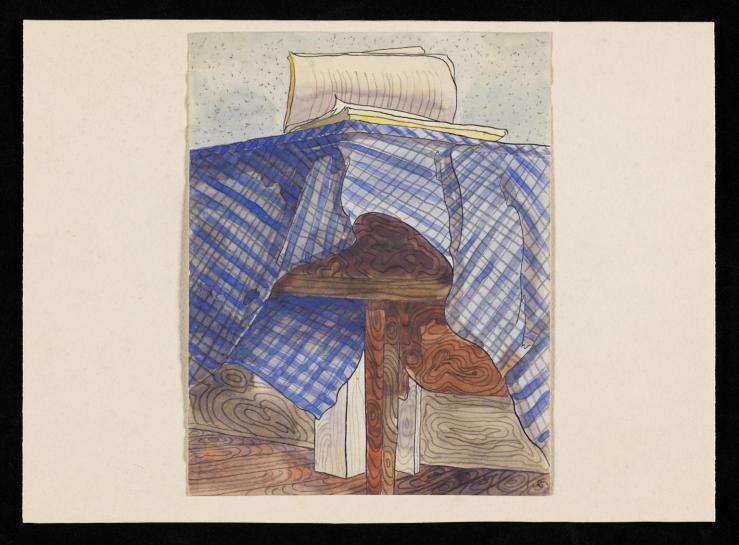
Open Book on Tablecloth — Ithell Colquhoun

Open Book on Tablecloth, c.1927-30 by Ithell Colquhoun (1906-1988)