“The Quarterback Speaks to His God,” a story by Herbert Wilner


“The Quarterback Speaks to His God”

by

Herbert Wilner


Bobby Kraft, the heroic old pro, lies in his bed in the grip of medicines relieving his ailing heart. Sometimes he tells his doctor your pills beat my ass, and the doctor says it’s still Kraft’s choice; medicine or open heart surgery. Kraft shuts up.

He wasn’t five years out of pro football, retired at thirty-six after fourteen years, when he got the rare viral blood infection. Whatever they were, the damn things ate through his heart like termites, leaving him with pericarditis, valve dysfunction, murmurs, arrhythmia, and finally, congestive failure. The physiology has been explained to him, but he prefers not to understand it. Fascinated in the past by his strained ligaments, sprained ankles, torn cartilage, tendinitis, he now feels betrayed by his heart’s disease.

“You want to hear it?” Dr. Felton once asked, offering the earpieces of the stethoscope.

Kraft recoiled.

“You don’t want to hear the sound of your own heart?”

Sitting on the examining table, Kraft was as tall as the short doctor, whose mustache hid a crooked mouth.

“Why should I?” Kraft said. “Would you smile in the mirror after your teeth got knocked out?”

This morning in bed, as with almost every third morning of the past two years, Kraft begins to endure the therapeutic power of his drugs. He takes diuretics: Edecrin, or Lasix, or Dyazide, or combinations. They make him piss and piss, relieving for a day or two the worst effects of the congesting fluids that swamp his lungs and gut. He’s been told the washout dumps potassium, an unfortunate consequence. The depletions cramp his muscles, give him headaches, sometimes trigger arrhythmias. They always drive him into depressions as deep as comas. He blames himself.

“It has nothing to do with will power,” Dr. Felton explained. “If you ran five miles in Death Valley in August, you’d get about the same results as you do from a very successful diuresis.”

To replenish some of his losses, Kraft stuffs himself with bananas, drinks orange juice by the pint, and takes two tablespoons a day of potassium chloride solution. To prevent and arrest the arrhythmia, he takes quinidine, eight pills a day, 200 mg per pill. To strengthen the enlarged and weakened muscle of his heart wall, he takes digoxin. Together they make him nauseous, gassy, and distressed. He takes anti-nausea pills and chews antacids as though they were Life Savers. Some nights he takes Valium to fall asleep. If one doesn’t work, he takes two.

“I can’t believe it’s me,” he protests to his wife, Elfi. “I never took pills, I wouldn’t even touch aspirins. There were guys on coke, amphetamines, Novocaine. I wouldn’t touch anything. Now look at me. I’m living in a drugstore.”

His blurred eyes sweep the squads of large and small dark labeled bottles massed on his chest of drawers. His wife offers little sympathy.

“Again and again the same thing with you,” she’ll answer in her German accent. “So go have the surgery already, you coward ox.”

Coward? Him? Bobby Kraft? Continue reading ““The Quarterback Speaks to His God,” a story by Herbert Wilner”
The spectator, at this point, is certain to wonder whether he must now endure a football game in print | Don DeLillo

(The spectator, at this point, is certain to wonder whether he must now endure a football game in print — the author’s way of adding his own neat quarter-notch to the scarred bluesteel of combat writing. The game, after all, is known for its assault-technology motif, and numerous commentators have been willing to risk death by analogy in their public discussions of the resemblance between football and war. But this sort of thing is of little interest to the exemplary spectator. As Alan Zapalac says later on: “I reject the notion of football as warfare. Warfare is warfare. We don’t need substitutes because we’ve got the real thing.” The exemplary spectator is the person who understands that sport is a benign illusion, the illusion that order is possible. It’s a form of society that is rat free and without harm to the unborn; that is organized so that everyone follows precisely the same rules; that is electronically controlled, thus reducing human error and benefiting industry; that roots out the inefficient and penalizes the guilty; that tends always to move toward perfection. The exemplary spectator has his occasional lusts, but not for warfare, hardly at all for that. No, it’s details he needs — impressions, colors, statistics, patterns, mysteries, numbers, idioms, symbols. Football, more than other sports, fulfills this need. It is the one sport guided by language, by the word signal, the snap number, the color code, the play name. The spectator’s pleasure, when not derived from the action itself, evolves from a notion of the game’s unique organic nature. Here is not just order but civilization. And part of the spectator’s need is to sort the many levels of material: to allot, to compress, to catalogue. This need leaps from season to season, devouring much of what is passionate and serene in the spectator. He tries not to panic at the final game’s final gun. He knows he must retain something, squirrel some food for summer’s winter. He feels the tender need to survive the termination of the replay. So maybe what follows is a form of sustenance, a game on paper to be scanned when there are stale days between events; to be propped up and looked at — the book as television set — for whatever is in here of terminology, pattern, numbering. But maybe not. It’s possible there are deeper reasons to attempt a play-by-play. The best course is for the spectator to continue forward, reading himself into the very middle of that benign illusion. The author, always somewhat corrupt in his inventions and vanities, has tried to reduce the contest to basic units of language and action. Every beginning, it is assumed, must have a neon twinkle of danger about it, and so grandmothers, sissies, lepidopterists and others are warned that the nomenclature that follows is often indecipherable. This is not the pity it may seem. Much of the appeal of sport derives from its dependence on elegant gibberish. And of course it remains the author’s permanent duty to unbox the lexicon for all eyes to see — a cryptic ticking mechanism in search of a revolution.)

From Don DeLillo’s 1972 novel End Zone.

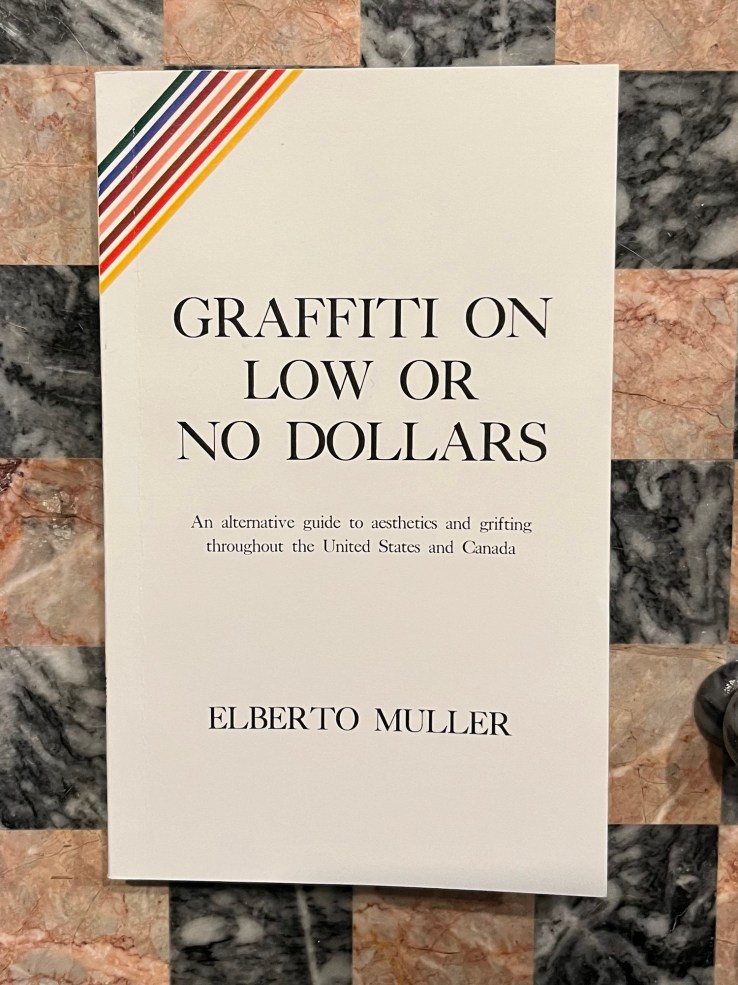
Elberto Muller’s Graffiti on Low or No Dollars (Book subtitled “An alternative guide to aesthetics and grifting throughout the United States and Canada,” Feb. 2024)

Digging Elberto Muller’s Graffiti on Low or No Dollars. Mast Books’ blurb

Muller cut his teeth riding freights across America, doing graffiti, creating zines, molding three-dimensional graffiti mosaics and has recently finished his novel: Graffiti on Low or No Dollars. His Huck Finn approach and penchant for freedom from an ordinary life is translated through his art. The work is incredibly honest and reminiscent of Daniel Johnston at times with some of the subjects being tackled a painful reflection of our society today. In the same breath his art can make you smile with all of its crassness and glory.

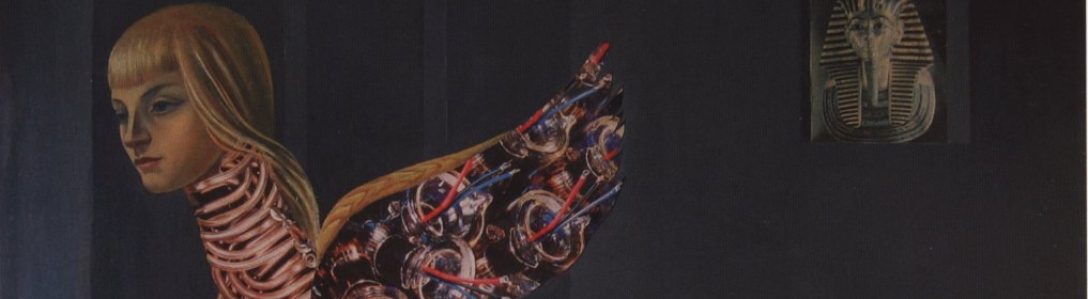
Advancing Impulses — Mildred Thompson

Advancing Impulses, 1997 by Mildred Thompson (1936-2003)

“Florida Road Workers” — Langston Hughes

“Florida Road Workers”

by

Langston Hughes


Hey, Buddy!
Look at me!

I’m makin’ a road
For the cars to fly by on,
Makin’ a road
Through the palmetto thicket
For light and civilization
To travel on.

I’m makin’ a road
For the rich to sweep over
In their big cars
And leave me standin’ here.

Sure,
A road helps everybody.
Rich folks ride —
And I get to see ’em ride.
I ain’t never seen nobody
Ride so fine before.

Hey, Buddy, look!
I’m makin’ a road!

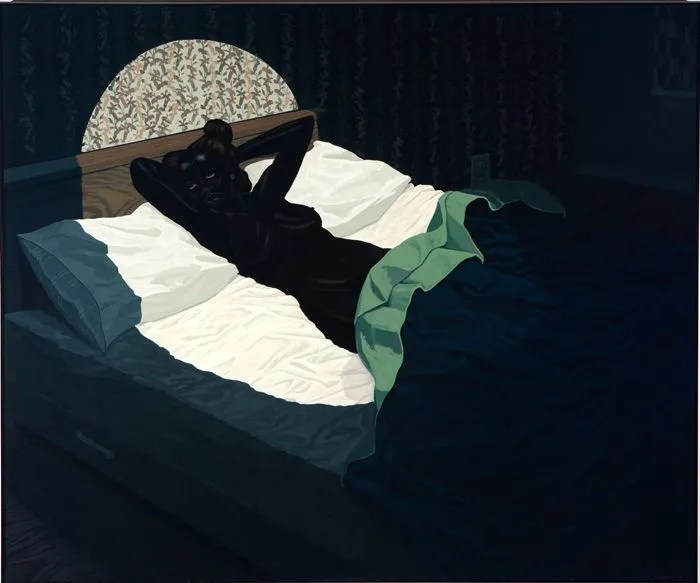
Nude (Spotlight) — Kerry James Marshall

Nude (Spotlight), 2009 by Kerry James Marshall (b. 1955)

“The Temptation of St. Anthony,” a short story by Donald Barthelme

“The Temptation of St. Anthony”

by

Donald Barthelme


YES, THE saint was underrated quite a bit, then, mostly by people who didn’t like things that were ineffable. I think that’s quite understandable—that kind of thing can be extremely irritating, to some people. After all, everything is hard enough without having to deal with something that is not tangible and clear. The higher orders of abstraction are just a nuisance, to some people, although to others, of course, they are quite interesting. I would say that on the whole, people who didn’t like this kind of idea, or who refused to think about it, were in the majority. And some were actually angry at the idea of sainthood—not at the saint himself, whom everyone liked, more or less, except for a few, but about the idea he represented, especially since it was not in a book or somewhere, but actually present, in the community. Of course some people went around saying that he “thought he was better than everybody else,” and you had to take these people aside and tell them that they had misperceived the problem, that it wasn’t a matter of simple conceit, with which we are all familiar, but rather something pure and mystical, from the realm of the extraordinary, as it were; unearthly. But a lot of people don’t like things that are unearthly, the things of this earth are good enough for them, and they don’t mind telling you so. “If he’d just go out and get a job, like everybody else, then he could be saintly all day long, if he wanted to”—that was a common theme. There is a sort of hatred going around for people who have lifted their sights above the common run. Probably it has always been this way.

For this reason, in any case, people were always trying to see the inside of the saint’s apartment, to find out if strange practices were being practiced there, or if you could discern, from the arrangement of the furniture and so on, if any had been, lately. They would ring the bell and pretend to be in the wrong apartment, these people, but St. Anthony would let them come in anyhow, even though he knew very well what they were thinking. They would stand around, perhaps a husband-and-wife team, and stare at the rug, which was ordinary beige wall-to-wall carpet from Kaufman’s, and then at the coffee table and so on, they would sort of slide into the kitchen to see what he had been eating, if anything. They were always surprised to see that he ate more or less normal foods, perhaps a little heavy on the fried foods. I guess they expected roots and grasses. And of course there was a big unhealthy interest in the bedroom, the door to which was usually kept closed. People seemed to think he should, in pursuit of whatever higher goals he had in mind, sleep on the floor; when they discovered there was an ordinary bed in there, with a brown bedspread, they were slightly shocked. By now St. Anthony had made a cup of coffee for them, and told them to sit down and take the weight off their feet, and asked them about their work and if they had any children and so forth: they went away thinking, He’s just like anybody else. That was, I think, the way he wanted to present himself, at that time.

Later, after it was all over, he moved back out to the desert. Continue reading ““The Temptation of St. Anthony,” a short story by Donald Barthelme”