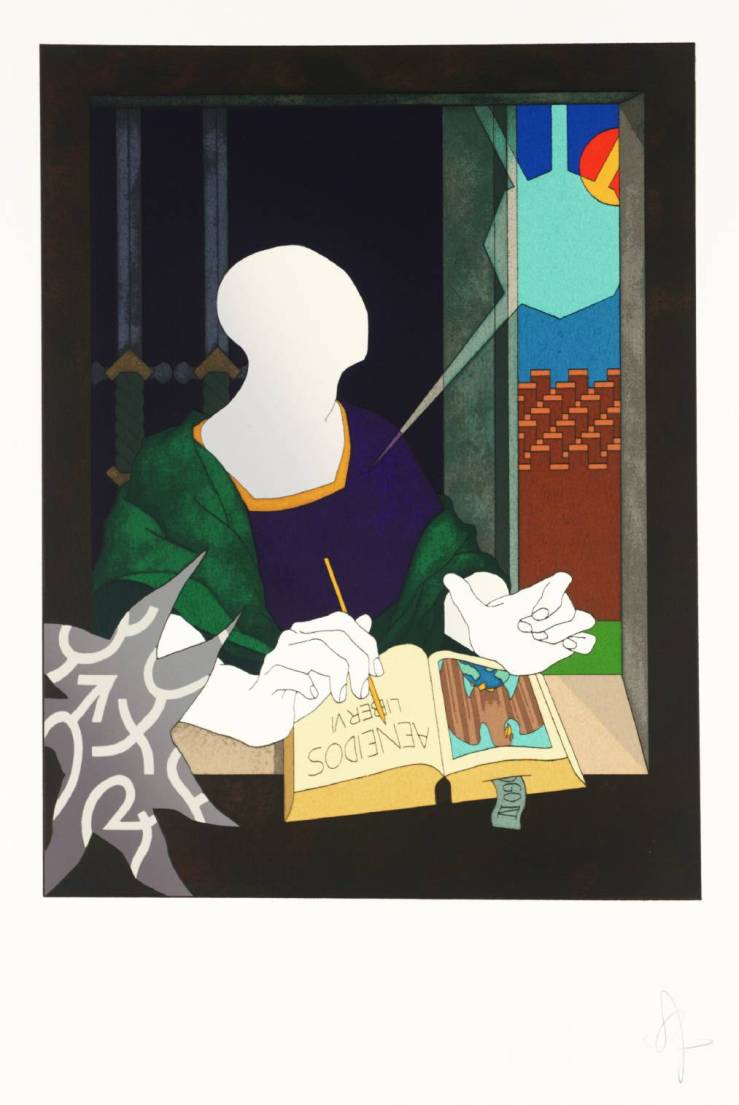
Canto II, 1982 by Tom Phillips (b. 1937). From the Dante’s Inferno series.

Canto II, 1982 by Tom Phillips (b. 1937). From the Dante’s Inferno series.
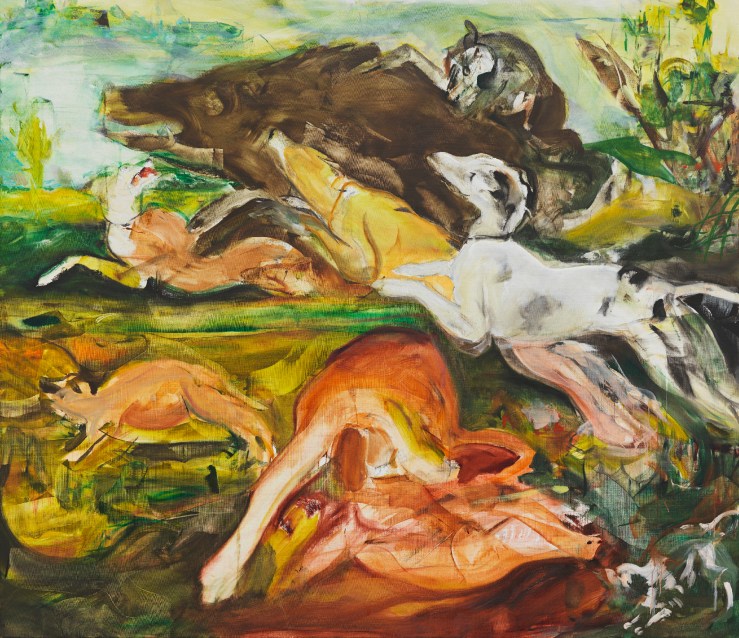
Hunt (After Frans Snyders), 2019 by Cecily Brown (b. 1969)
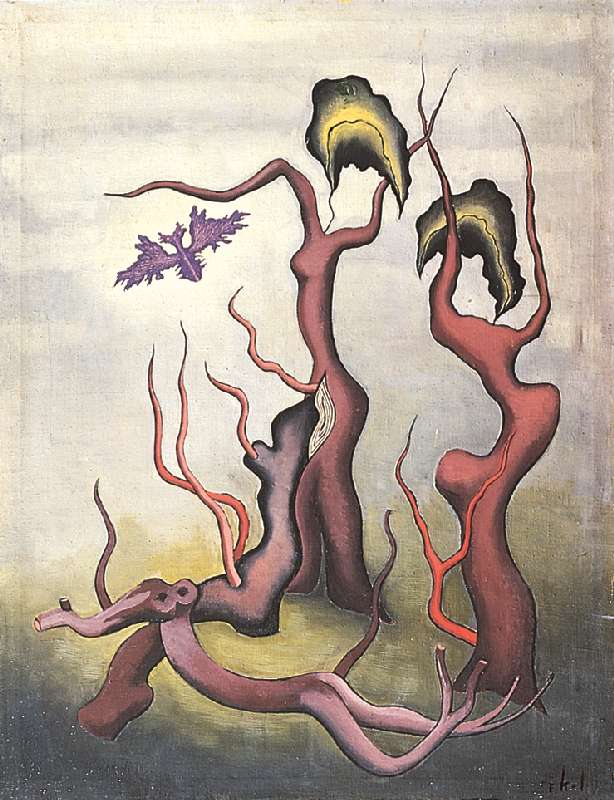
The Two Young Ladies, 1939 by Rita Kernn-Larsen (1904-1998
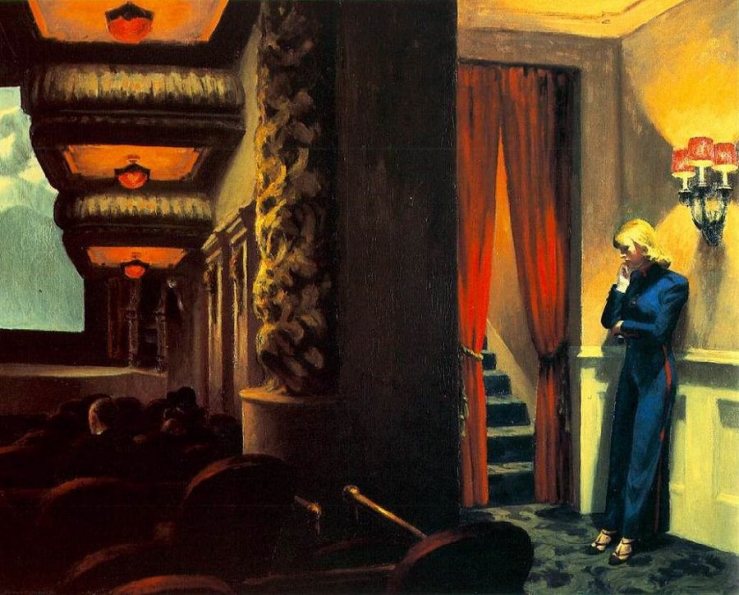
“Edward Hopper’s New York Movie”
by
Joseph Stanton
We can have our pick of seats.
Though the movie’s already moving,
the theater’s almost an empty shell.
All we can see on our side
of the room is one man and one woman—
as neat, respectable, and distinct
as the empty chairs that come
between them. But distinctions do not surprise,
fresh as we are from sullen street and subway
where lonelinesses crowded
about us like unquiet memories
that may have loved us once or known our love.
Here we are an accidental
fellowship, sheltering from the city’s
obscure bereavements to face a screened,
imaginary living,
as if it were a destination
we were moving toward. Leaning to our right
and suspended before us
is a bored, smartly uniformed usherette.
Staring beyond her lighted corner, she finds
a reverie that moves through
and beyond the shine of the silver screening.
But we can see what she will never see—
that she’s the star of Hopper’s scene.
For the artist she’s a play of light,
and a play of light is all about her.
Whether the future she is
dreaming is the future she will have
we have no way of knowing. Whatever
it will prove to be
it has already been. The usherette
Hopper saw might now be seventy,
hunched before a Hitachi
in an old home or a home for the old.
She might be dreaming now a New York movie,
Fred Astaire dancing and kissing
Ginger Rogers, who high kicks across New York
City skylines, raising possibilities
that time has served to lower.
We are watching the usherette, and the subtle
shadows her boredom makes across her not-quite-
impassive face beneath
the three red-shaded lamps and beside
the stairs that lead, somehow, to dark streets
that go on and on and on.
But we are no safer here than she.
Despite the semblance of luxury—
gilt edges, red plush,
and patterned carpet—this is no palace,
and we do not reign here, except in dreams.
This picture tells us much
about various textures of lighted air,
but at the center Hopper has placed
a slab of darkness and an empty chair.
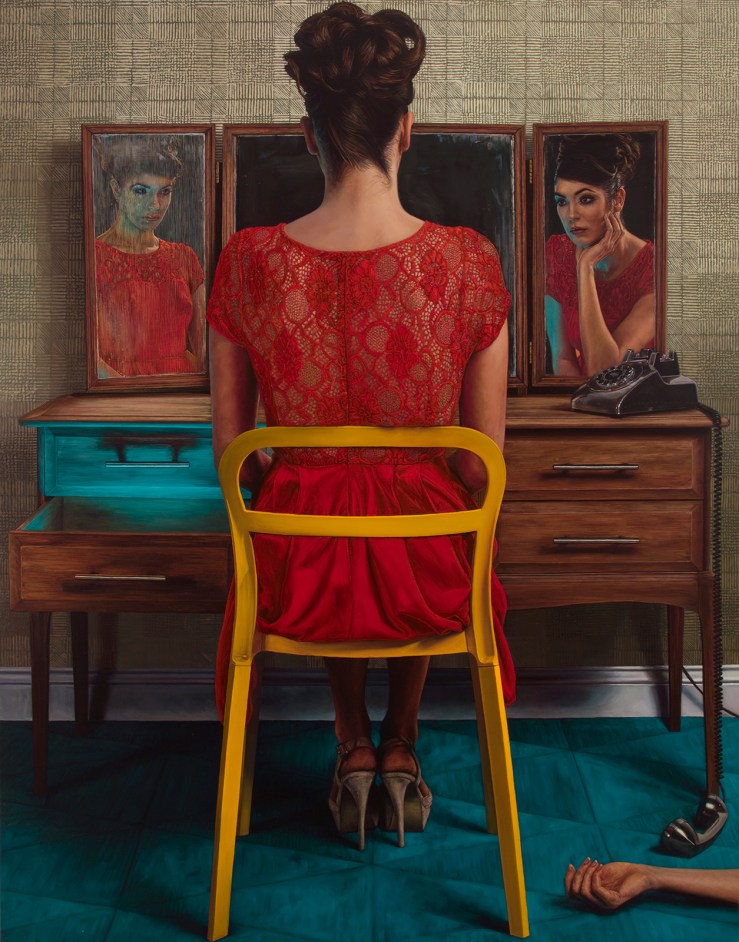 Entanglement, 2016 by Ian Cumberland (b. 1983)
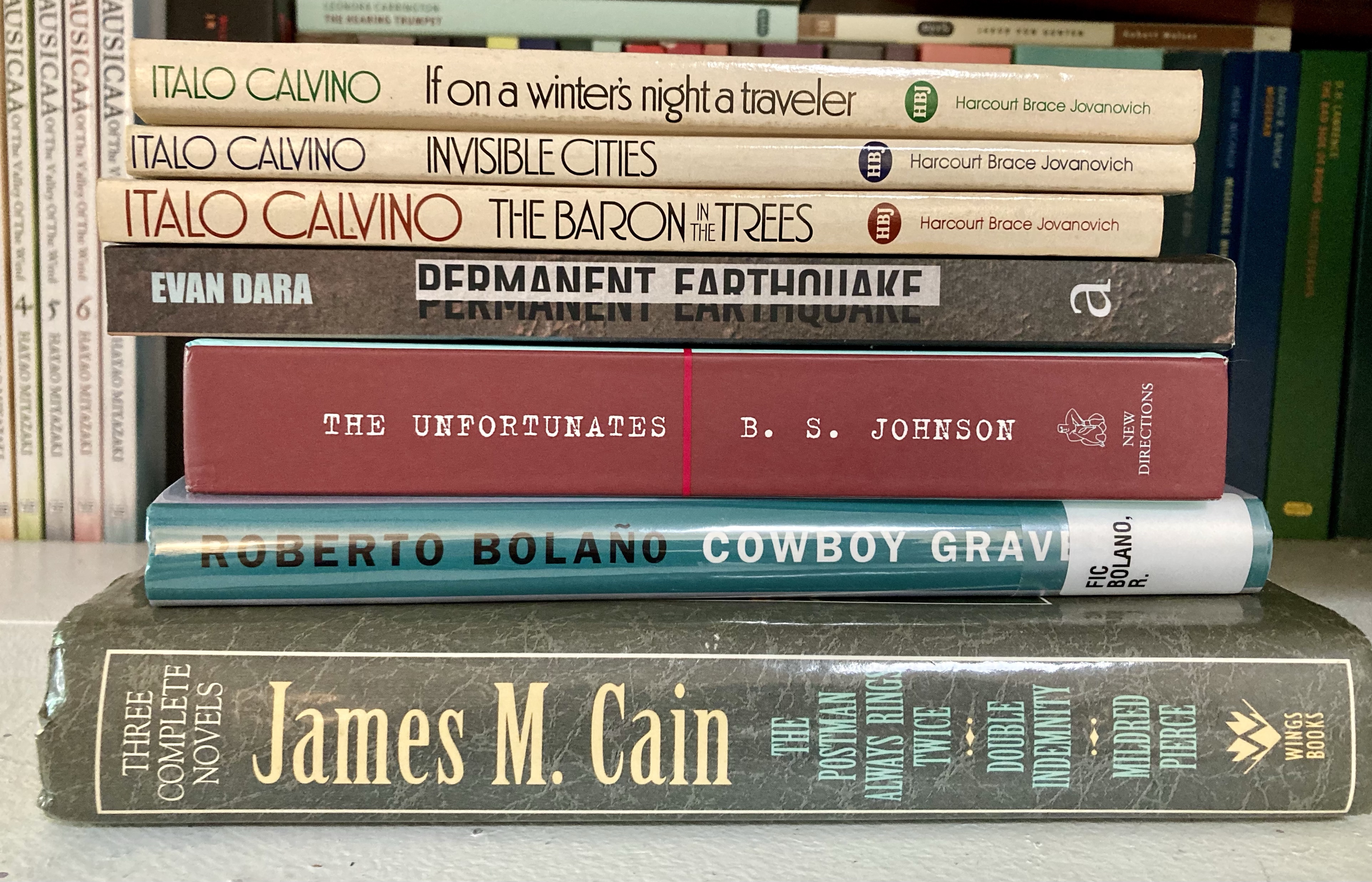
My James M. Cain discovery tour continued with Double Indemnity, which I loved loved loved. The novel’s terse, mean, a bit queasy, and zippy as hell. Over the July 4th weekend my uncle and I made plans to watch Billy Wilder’s 1944 film adaptation, but maybe heat and alcohol got in the way. I’ll get to it soon. (I stalled out in Mildred Pierce, although I did see that film—the 1945 one with Joan Crawford.)
I checked out Roberto Bolaño’s “newest” collection of novellas, Cowboy Graves, from the library. I’ll probably pick it up in paperback or used when I get the chance. It’s a fragmentary affair, and paradoxically seems more complete because of this. Other “unfinished” pieces like Woes of the True Policeman and The Spirit of Science Fiction felt like dress rehearsals to his big boys—The Savage Detectives and 2666—but the trio in Cowboy Graves fit neatly if weirdly into the Bolañoverse proper. Good stuff.
I tore through four novels by British wrtier B.S. Johnson earlier this year before taking up his most gimmicky work— his “book in a box,” 1969’s The Unfortunates. The book consists of 27 pamphlets. One is labeled “FIRST”, another “LAST,” but it’s up to the reader to shuffle and go for it. I think there is a reason most novels are not composed in this format. If you are intrested in Johnson, check out Christie Malry’s Own Double-Entry or Albert Angelo.
I will give Evan Dara’s new novel Permanent Earthquake a proper review when I finish it. I will simply state here that finishing it has been a slog. This may be a rhetorical conceit–the novel is about a world, or an island, which I suppose is its own world, in a state of permanent earthquake—or really the novel is about one dude in this world island of permanent earthquakes, trying to find a still spot. It’s clearly an allegory of late capitalist whatever butting up against climate disaster, and it’s very depressing, and it’s a slog slog slog. I think Dara is an important contemporary writer and I will do a better job assessing Permanent Earthquake when I finish it.
I picked up a used copy of Italo Calvino’s Cosmicomics a couple of weeks ago, largely because of its lovely cover. I’d read the book years ago, and mostly remember being amused and frustrated by it. Shelving it, I pulled out a trio of Calvino’s I hadn’t read in ages: Invisible Cities, If on a winter’s night a traveler, and The Baron in the Trees.
I started in on Invisible Cities (trans. William Weaver); I first read it on a train from Bangkok to Chiang Mai twenty years ago. My friend loaned it to me. He spent the night drinking with Germans; I read Calvino’s prose-poem-essay-cyle-thing over a few hours. Rereading it I found so much more—more humor, more humanity, more life. As a young man I think I demanded its philosophy, its semiotics, its brains. There’s more heart there than I remembered.
I then took up If on a winter’s night a traveler (trans William Weaver). I realized that I’d never read the novel just to read it—I read it as an undergrad and then as a grad student, and both times, like a character in the novel, I read it looking for bits of evidence to support an idea I already had. Winter’s night is a bit too long; its metatextual postmodernism starts to wear thin—you can almost open the novel at random to find it describing itself—but it is probably the best postmodernist example of a novel about reading a novel I can think of. (It’s also hornier than I remember.)
And so well now I’m in the middle of Calvino’s much-earlier novel, The Baron in the Trees (trans. Archibald Colquhoun). The story of a rebellious young aristocrat who vows to live in the trees and never set foot on ground again, Baron burns with a focused narrative heat absent in Calvino’s later more self-consciously postmodern work. It’s not exactly a picaresque, but it’s still one damn thing happening after another, and I love it.

So well my grandmother has Alzheimer’s and we’ve had to move her to a memory care facility and pack up all the many many things in her house and so on and etc., the house she’s lived in forever, or at least for close to what I conceive of as forever, and it’s been painful and I’m not writing about it here or now, but she was a reader, still is a reader, although she doesn’t remember what she reads, although I guess I don’t remember most of what I read, but I do remember the feeling of reading a certain book, or at least the feeling of the feeling of reading a certain book, but I don’t know what it’s like for her to read now, I just know that she loved reading—not the kind of stuff I like, but a reader nonetheless, and so well now anyway I have boxes and boxes of her books to go trade in for store credit at the local shop, a thing, the trading I mean, that I try to do slowly, one box (or sometimes bag) at a time, so as not to overburden the kindly bookbuyers, who seem to be always dealing with box after box after musty box of books obtained in similar situations (i.e., grandmothers, grandfathers, beloved old great uncles and strange wonderful aunts, you know the type, who, for whatever sad reason, no longer require books in such a volume)—and so like I don’t bring in but one or two bags or boxes at a time, a strategy that also gives me some small license to browse and browse and browse and
And so last Thursday I picked up Kobo Abe’s 1977 novel Secret Rendezvous. I’ve always wanted to read Abe—specificically his first novel, Inter Ice Age 4, but I’ve never found it. (I have found his most famous novel, Woman in the Dunes, but for whatever reason failed to pick it up.) Secret Rendezvous, in English translation by Juliet Winters Carpenter, seems to be a surrealistic tale of “a man’s desperate search for his vanished wife in a vast underground hospital.” The blurb on the back also mentions a test-tube baby, an impotent health administrator, and a nymphomaniac. Maybe I’ll read it next.
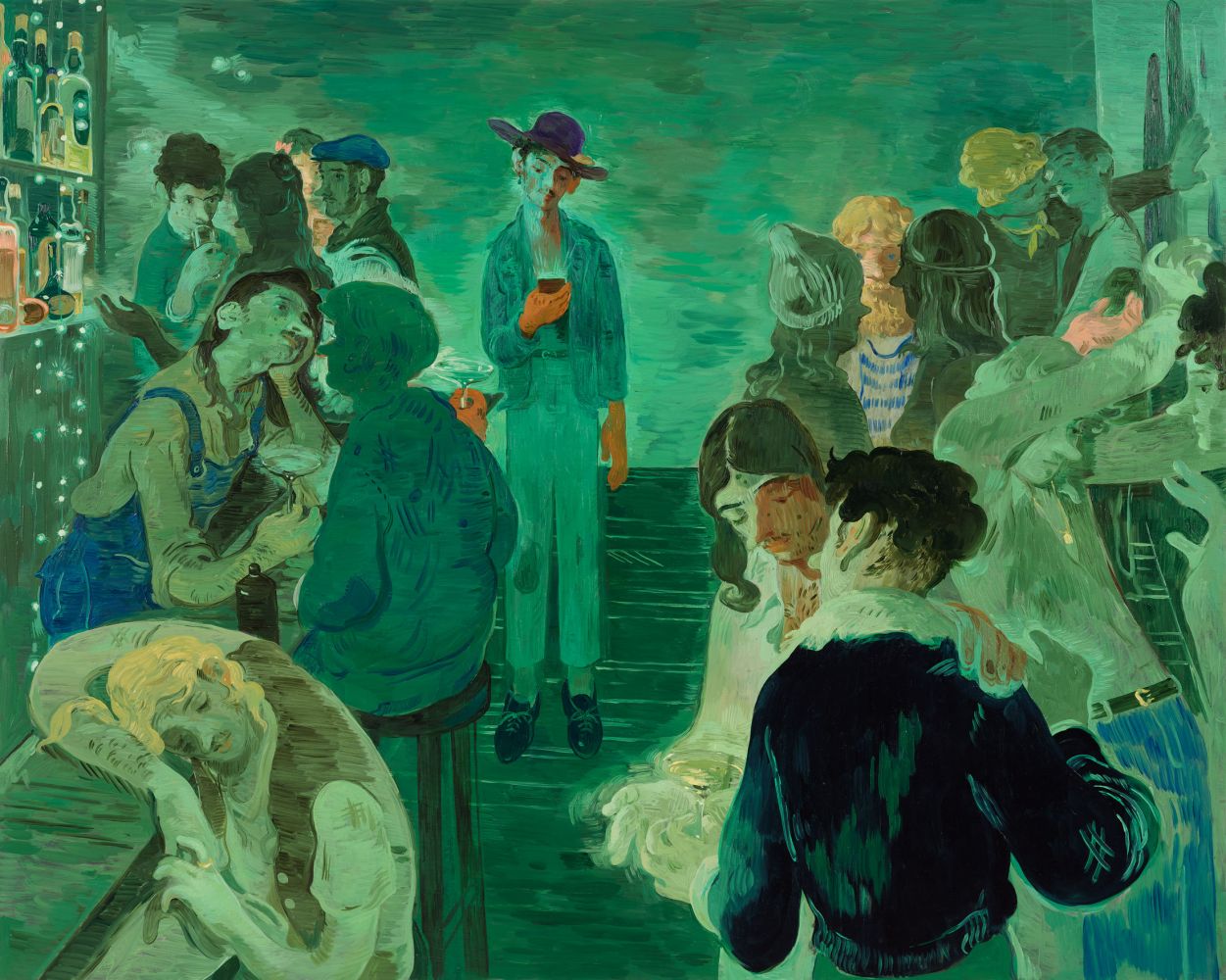
Bar Boy, 2020 by Salman Toor (b. 1983)
“Personal Poem”
by
Frank O’Hara
Now when I walk around at lunchtime
I have only two charms in my pocket
an old Roman coin Mike Kanemitsu gave me
and a bolt-head that broke off a packing case
when I was in Madrid the others never
brought me too much luck though they did
help keep me in New York against coercion
but now I’m happy for a time and interested
I walk through the luminous humidity
passing the House of Seagram with its wet
and its loungers and the construction to
the left that closed the sidewalk if
I ever get to be a construction worker
I’d like to have a silver hat please
and get to Moriarty’s where I wait for
LeRoi and hear who wants to be a mover and
shaker the last five years my batting average
is .016 that’s that, and LeRoi comes in
and tells me Miles Davis was clubbed 12
times last night outside birdland by a cop
a lady asks us for a nickel for a terrible
disease but we don’t give her one we
don’t like terrible diseases, then
we go eat some fish and some ale it’s
cool but crowded we don’t like Lionel Trilling
we decide, we like Don Allen we don’t like
Henry James so much we like Herman Melville
we don’t want to be in the poets’ walk in
San Francisco even we just want to be rich
and walk on girders in our silver hats
I wonder if one person out of the 8,000,000 is
thinking of me as I shake hands with LeRoi
and buy a strap for my wristwatch and go
back to work happy at the thought possibly so
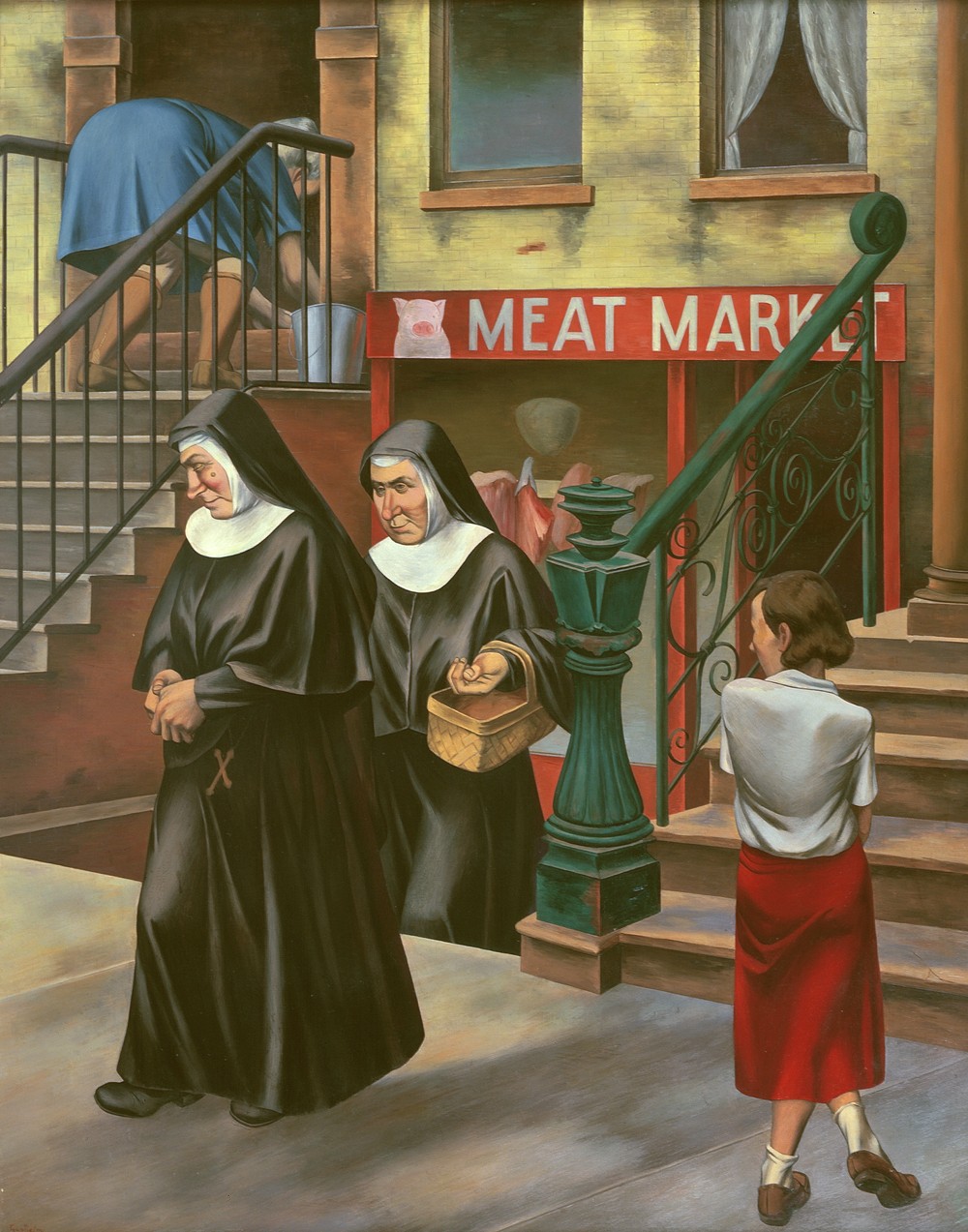
Sisters of Charity, 1937 by O. Louis Guglielmi (1906 – 1956)
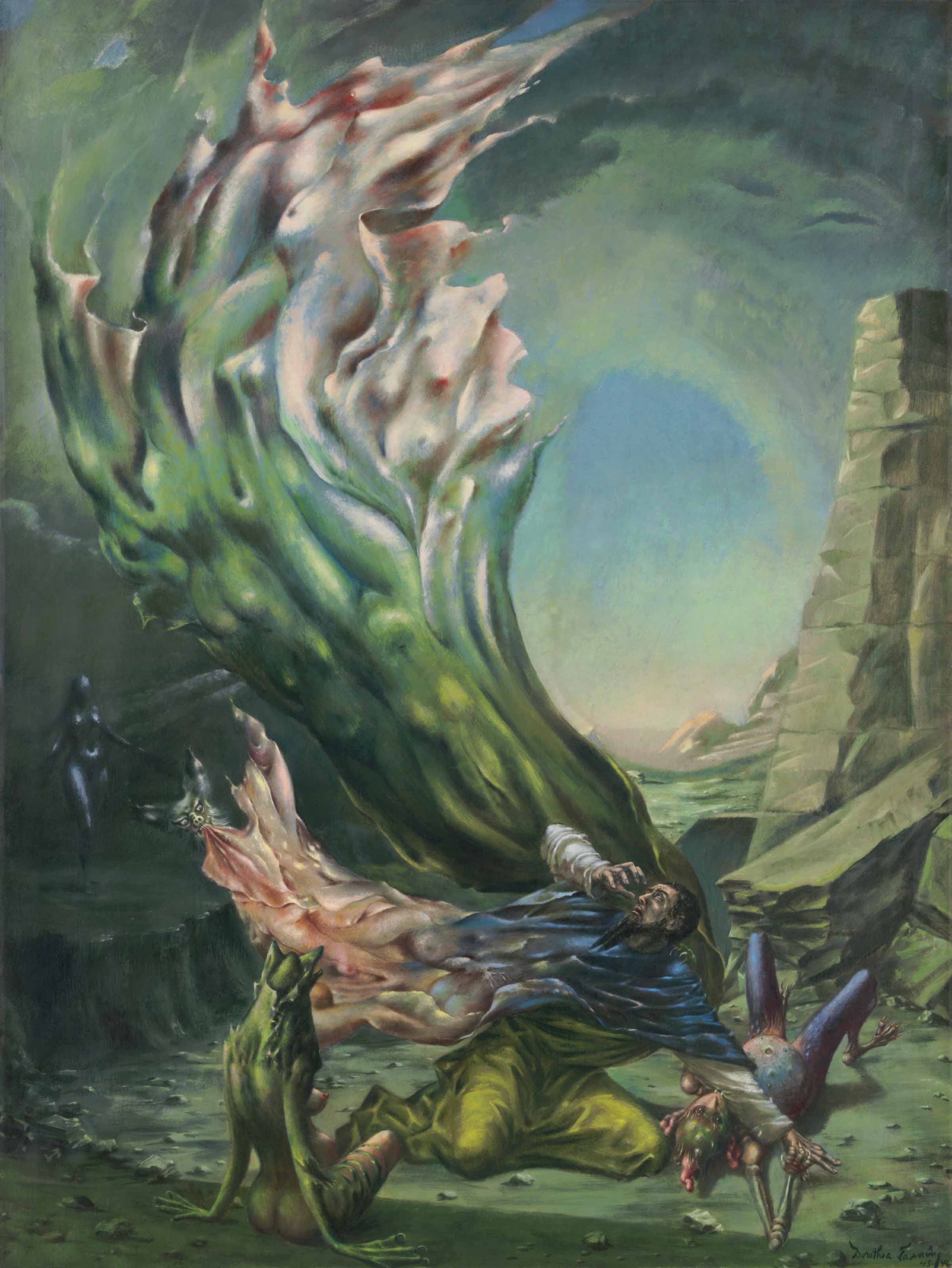
The Temptation of St. Anthony, 1946 by Dorothea Tanning (1910-2012)
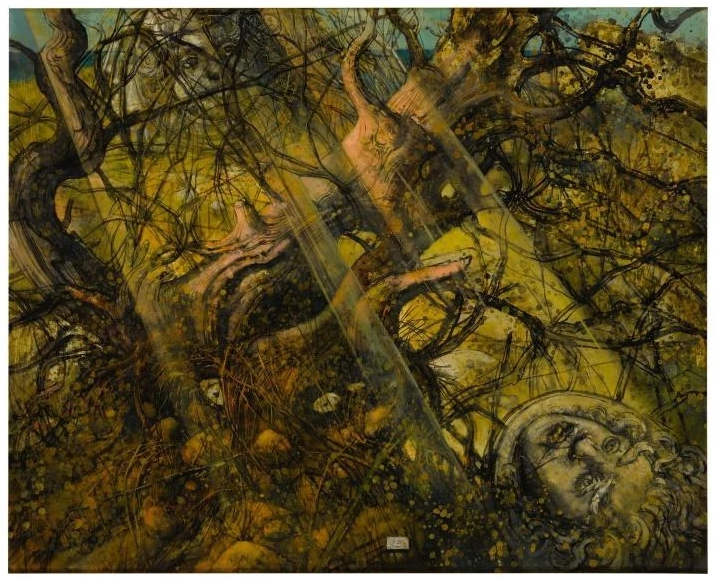
The Fallen Tree and Two Medusa Heads, 1969 by Eugène Berman (1899 – 1972)
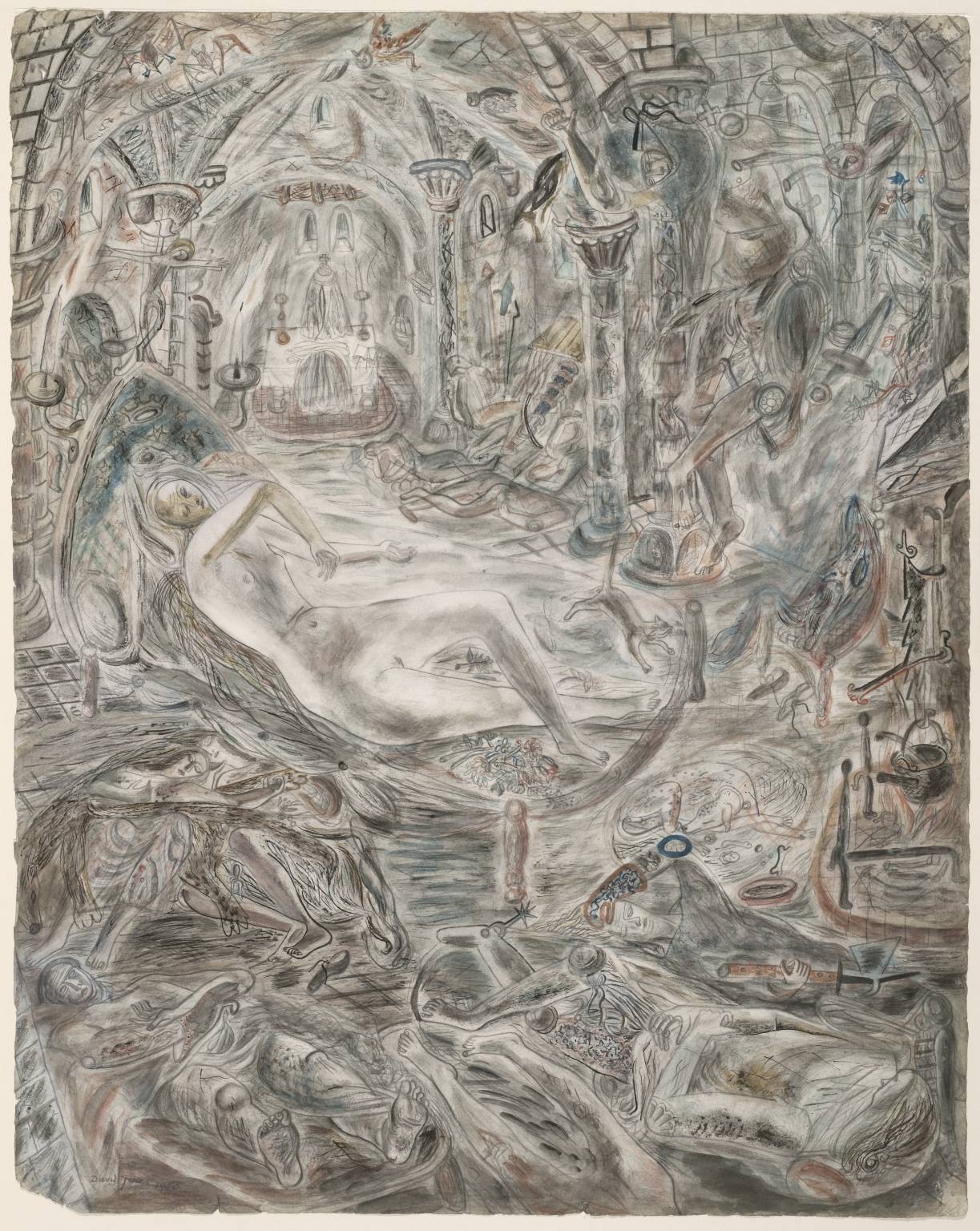
Guenever, 1940 by David Jones (1895-1974)
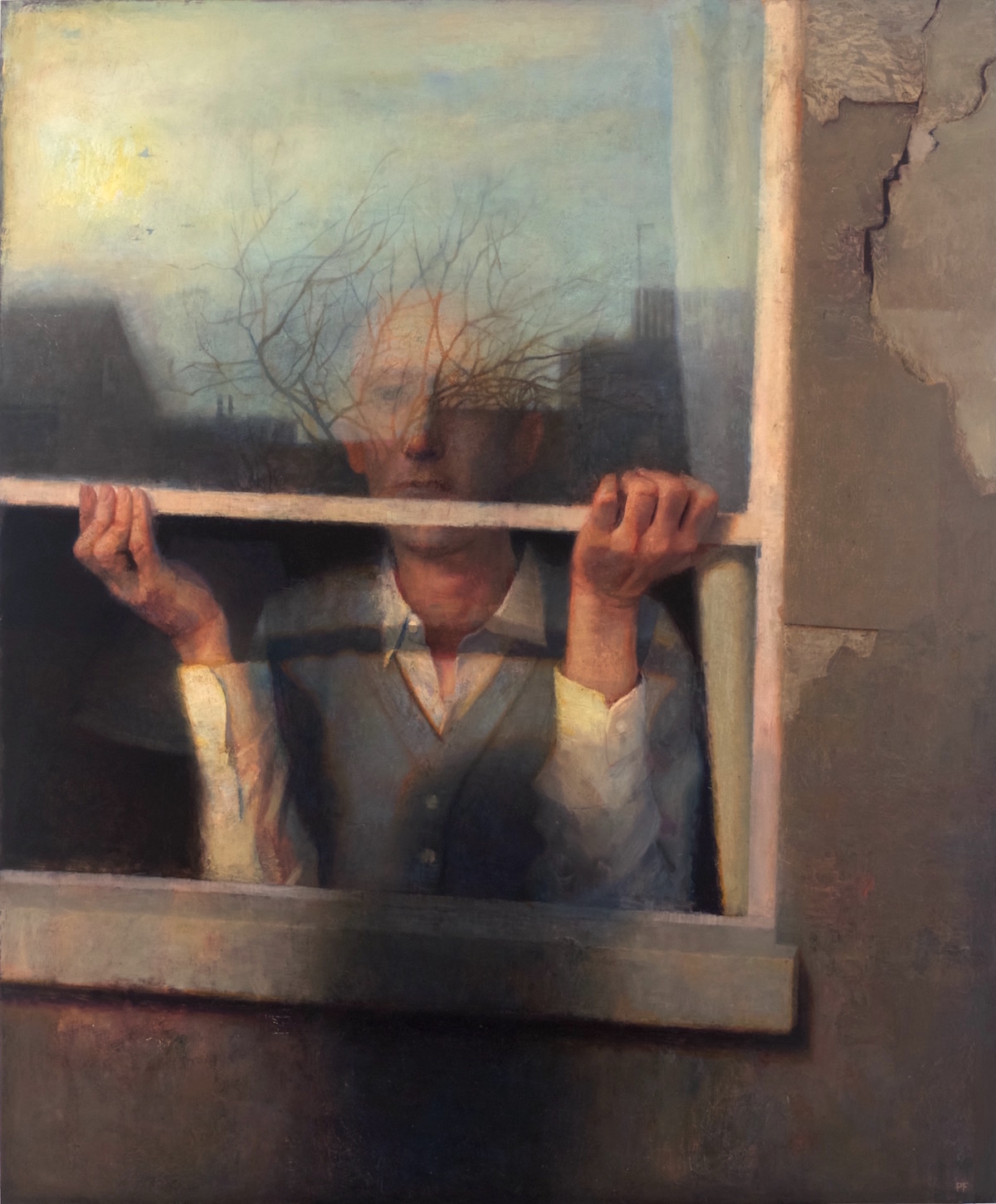
Window, 2020 by Paul Fenniak (b. 1965)
“Kong Looks Back on His Tryout with the Bears”
by
William Trowbridge
If it had worked out, I’d be on a train to Green Bay,
not crawling up this building with the Air Corps
on my ass. And if it weren’t for love, I’d drop
this shrieking little bimbo sixty stories
and let them take me back to the exhibit,
let them teach me to mambo and do imitations.
They tried me on the offensive line, told me
to take out the right cornerback for Nagurski.
Eager to please, I wadded up the whole secondary,
then stomped the line, then the bench and locker room,
then the east end of town, to the river.
But they were not pleased: they said I had to
learn my position, become a team player.
The great father Bear himself said that,
so I tried hard to know the right numbers
and how the arrows slanted toward the little o’s.
But the o’s and the wet grass and the grunts
drowned out the count, and the tight little cheers
drew my arrow straight into the stands,
and the wives tasted like flowers and raw fish.
So I was put on waivers right after camp,
and here I am, panty-sniffer, about to die a clown,
who once opened a hole you could drive Nebraska through.
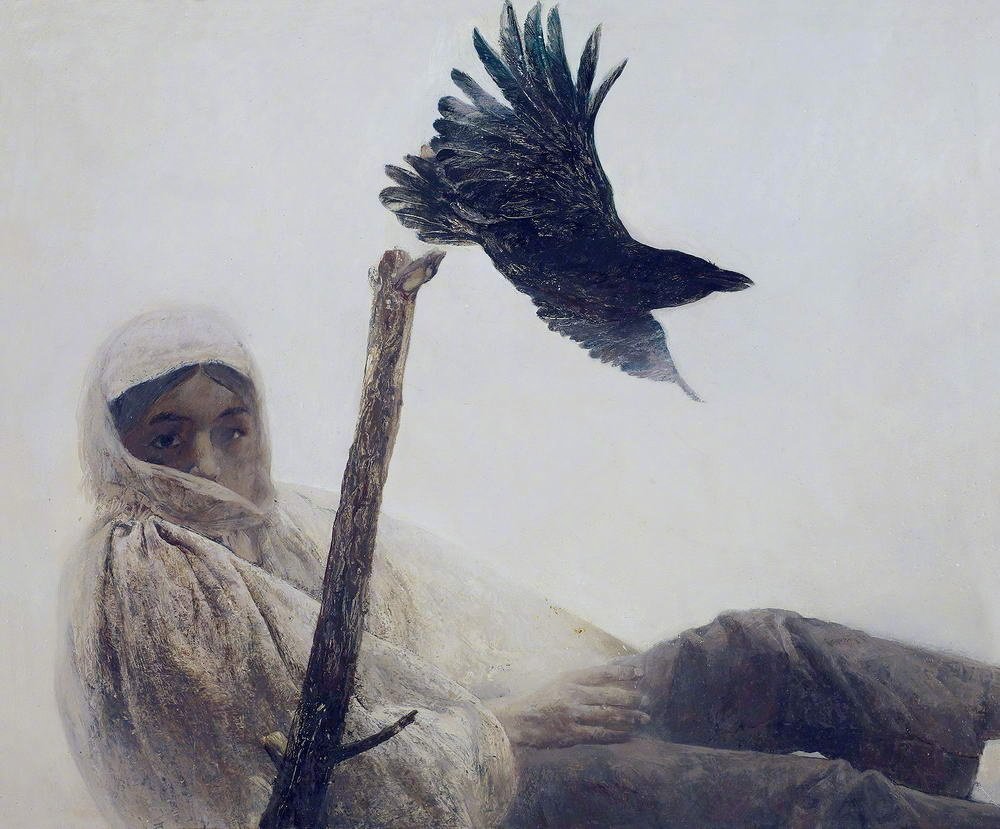
Startled Girl, 1985 by He Duoling (b. 1948)
 Biblioklept