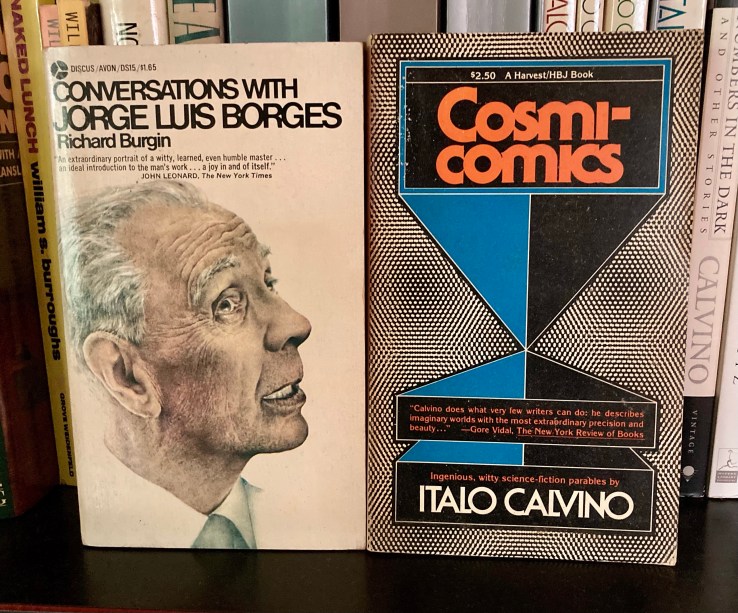
I’m a huge sucker for Avon-Bard massmarket paperbacks, so I couldn’t pass up Conversations with Jorge Luis Borges. (The conversations are with the late writer Richard Burgin.) I also picked up a nifty 1976 paperback of Italo Calvino’s Cosmicomics.
Here’s one of those cosmicomics, “All at One Point” (English translation by William Weaver):
“All at One Point”
by
Italo Calvino
Through the calculations begun by Edwin P. Hubble on the galaxies’ velocity of recession, we can establish the moment when all the universe’s matter was concentrated in a single point, before it began to expand in space.
Naturally, we were all there, —old Qfwfq said, — where else could we have been? Nobody knew then that there could be space. Or time either: what use did we have for time, packed in there like sardines?
I say “packed like sardines,” using a literary image: in reality there wasn’t even space to pack us into. Every point of each of us coincided with every point of each of the others in a single point, which was where we all were. In fact, we didn’t even bother one another, except for personality differences, because when space doesn’t exist, having somebody unpleasant like Mr. Pber^t Pber^d underfoot all the time is the most irritating thing.
How many of us were there? Oh, I was never able to figure that out, not even approximately. To make a count, we would have had to move apart, at least a little, and instead we all occupied that same point. Contrary to what you might think, it wasn’t the sort of situation that encourages sociability; I know, for example, that in other periods neighbors called on one another; but there, because of the fact that we were all neighbors, nobody even said good morning or good evening to anybody else.
In the end each of us associated only with a limited number of acquaintances. The ones I remember most are Mrs. Ph(i)Nk_0, her friend De XuaeauX, a family of immigrants by the name of Z’zu, and Mr. Pber^t Pber^d, whom I just mentioned. There was also a cleaning woman — “maintenance staff” she was called — only one, for the whole universe, since there was so little room. To tell the truth, she had nothing to do all day long, not even dusting — inside one point not even a grain of dust can enter — so she spent all her time gossiping and complaining.
Just with the people I’ve already named we would have been overcrowded; but you have to add all the stuff we had to keep piled up in there: all the material that was to serve afterwards to form the universe, now dismantled and concentrated in such a way that you weren’t able to tell what was later to become part of astronomy (like the nebula of Andromeda) from what was assigned to geography (the Vosges, for example) or to chemistry (like certain beryllium isotopes). And on top of that, we were always bumping against the Z’zu family’s household goods: camp beds, mattresses, baskets; these Z’zus, if you weren’t careful, with the excuse that they were a large family, would begin to act as if they were the only ones in the world: they even wanted to hang lines across our point to dry their washing.
But the others also had wronged the Z’zus, to begin with, by calling them “immigrants,” on the pretext that, since the others had been there first, the Z’zus had come later. This was mere unfounded prejudice — that seems obvious to me — because neither before nor after existed, nor any place to immigrate from, but there were those who insisted that the concept of “immigrant” could be understood in the abstract, outside of space and time.
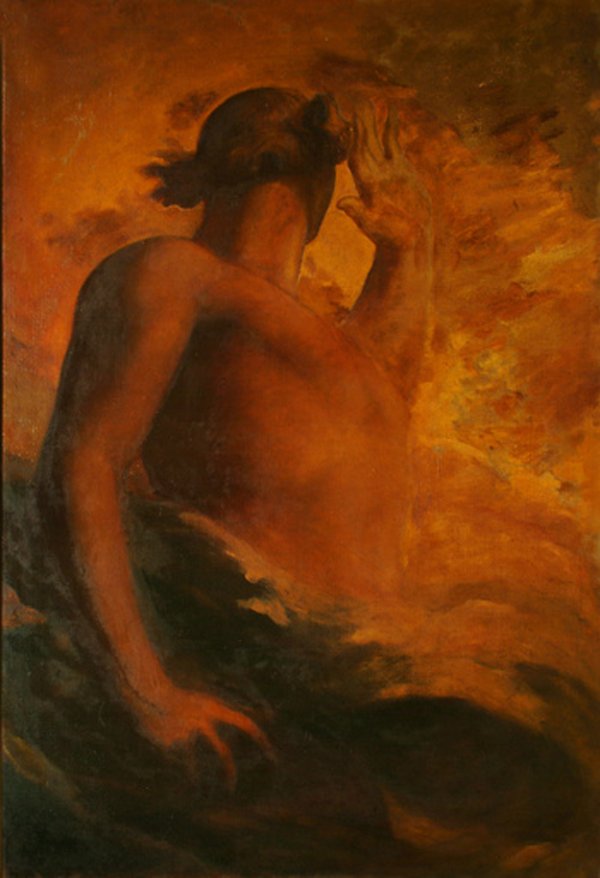
It was what you might call a narrow-minded attitude, our outlook at that time, very petty. The fault of the environment in which we had been reared. An attitude that, basically, has remained in all of us, mind you: it keeps cropping up even today, if two of us happen to meet — at the bus stop, in a movie house, at an international dentists’ convention — and start reminiscing about the old days. We say hello — at times somebody recognizes me, at other times I recognize somebody — and we promptly start asking about this one and that one (even if each remembers only a few of those remembered by the others), and so we start in again on the old disputes, the slanders, the denigrations. Until somebody mentions Mrs. Ph(i)Nk_0 — every conversation finally gets around to her — and then, all of a sudden, the pettiness is put aside, and we feel uplifted, filled with a blissful, generous emotion. Mrs. Ph(i)Nk_0, the only one that none of us has forgotten and that we all regret. Where has she ended up? I have long since stopped looking for her: Mrs. Ph(i)Nk_0, her bosom, her thighs, her orange dressing gown — we’ll never meet her again, in this system of galaxies or in any other.
Let me make one thing clear: this theory that the universe, after having reached an extremity of rarefaction, will be condensed again has never convinced me. And yet many of us are counting only on that, continually making plans for the time when we’ll all be back there again. Last month, I went into the bar here on the corner and whom did I see? Mr. Pber^t Pber^d. “What’s new with you? How do you happen to be in this neighborhood?” I learned that he’s the agent for a plastics firm, in Pavia. He’s the same as ever, with his silver tooth, his loud suspenders. “When we go back there,” he said to me, in a whisper, “the thing we have to make sure of is, this time, certain people remain out … You know who I mean: those Z’zus …”
I would have liked to answer him by saying that I’ve heard a number of people make the same remark, concluding: “You know who I mean … Mr. Pber^t Pber^d …”
To avoid the subject, I hastened to say: “What about Mrs. Ph(i)Nk_0? Do you think we’ll find her back there again?”
“Ah, yes … She, by all means …” he said, turning purple.
For all of us the hope of returning to that point means, above all, the hope of being once more with Mrs. Ph(i)Nk_0. (This applies even to me, though I don’t believe in it.) And in that bar, as always happens, we fell to talking about her, and were moved; even Mr. Pber^t Pber^d’s unpleasantness faded, in the face of that memory.
Mrs. Ph(i)Nk_0’s great secret is that she never aroused any jealousy among us. Or any gossip, either. The fact that she went to bed with her friend, Mr. De XuaeauX, was well known. But in a point, if there’s a bed, it takes up the whole point, so it isn’t a question of going to bed, but of being there, because anybody in the point is also in the bed. Consequently, it was inevitable that she should be in bed also with each of us. If she had been another person, there’s no telling all the things that would have been said about her. It was the cleaning woman who always started the slander, and the others didn’t have to be coaxed to imitate her. On the subject of the Z’zu family — for a change! — the horrible things we had to hear: father, daughters, brothers, sisters, mother, aunts: nobody showed any hesitation even before the most sinister insinuation. But with her it was different: the happiness I derived from her was the joy of being concealed, punctiform, in her, and of protecting her, punctiform, in me; it was at the same time vicious contemplation (thanks to the promiscuity of the punctiform convergence of us all in her) and also chastity (given her punctiform impenetrability). In short, what more could I ask?
And all of this, which was true of me, was true also for each of the others. And for her: she contained and was contained with equal happiness, and she welcomed us and loved and inhabited all equally.
We got along so well all together, so well that something extraordinary was bound to happen. It was enough for her to say, at a certain moment: “Oh, if I only had some room, how I’d like to make some noodles for you boys!” And in that moment we all thought of the space that her round arms would occupy, moving backward and forward with the rolling pin over the dough, her bosom leaning over the great mound of flour and eggs which cluttered the wide board while her arms kneaded and kneaded, white and shiny with oil up to the elbows; we thought of the space that the flour would occupy, and the wheat for the flour, and the fields to raise the wheat, and the mountains from which the water would flow to irrigate the fields, and the grazing lands for the herds of calves that would give their meat for the sauce; of the space it would take for the Sun to arrive with its rays, to ripen the wheat; of the space for the Sun to condense from the clouds of stellar gases and burn; of the quantities of stars and galaxies and galactic masses in flight through space which would be needed to hold suspended every galaxy, every nebula, every sun, every planet, and at the same time we thought of it, this space was inevitably being formed, at the same time that Mrs. Ph(i)Nk_0 was uttering those words: “… ah, what noodles, boys!” the point that contained her and all of us was expanding in a halo of distance in light-years and light-centuries and billions of light-millennia, and we were being hurled to the four corners of the universe (Mr. Pber^t Pber^d all the way to Pavia), and she, dissolved into I don’t know what kind of energy-light-heat, she, Mrs. Ph(i)Nk_0, she who in the midst of our closed, petty world had been capable of a generous impulse, “Boys, the noodles I would make for you!,” a true outburst of general love, initiating at the same moment the concept of space and, properly speaking, space itself, and time, and universal gravitation, and the gravitating universe, making possible billions and billions of suns, and of planets, and fields of wheat, and Mrs. Ph(i)Nk_0, scattered through the continents of the planets, kneading with floury, oil-shiny, generous arms, and she lost at that very moment, and we, mourning her loss.

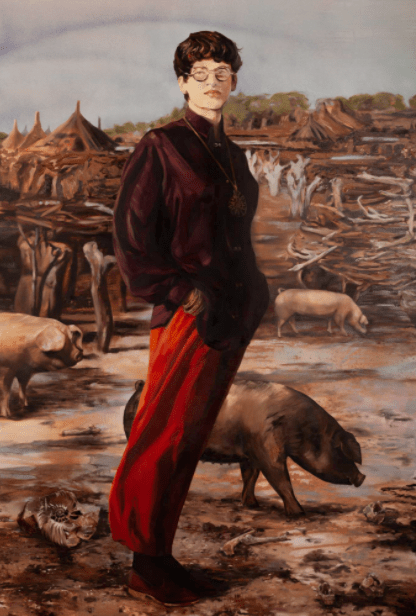
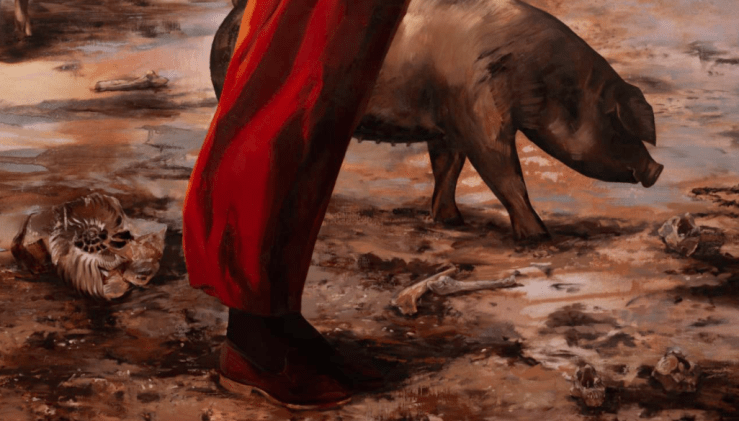
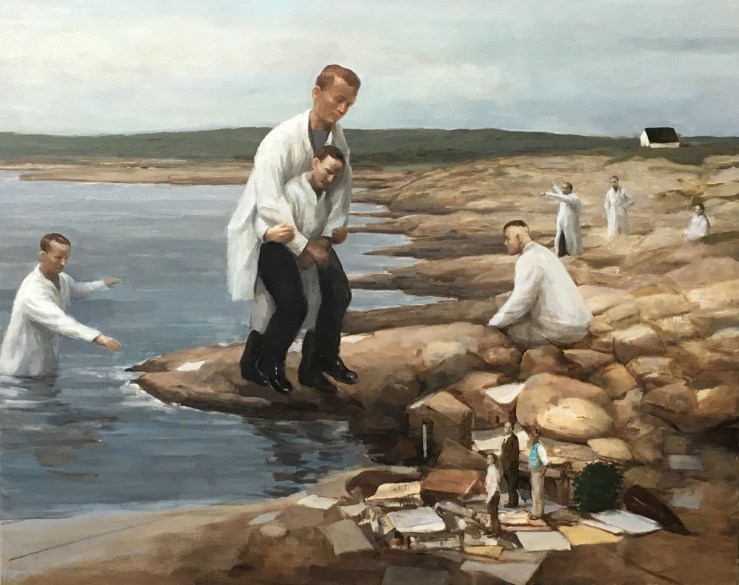
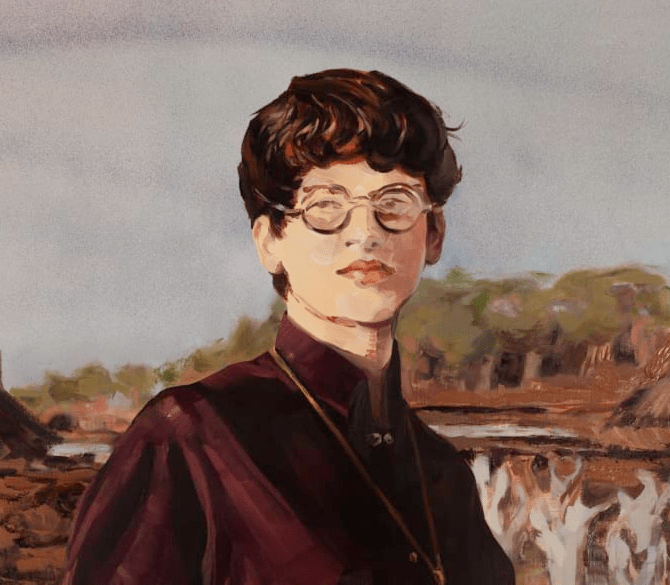 The Paleontologist, 2019 by Paulina Olowska (b. 1976)




 Biblioklept