I. In this riff: Ch. 55, 56, and 57 of Moby-Dick.
Each of these chapters concerns graphic—artistic and scientific—depictions of whales. Ishmael dwells mostly upon the failure of artists to truthfully represent the whale, but also concedes that the task is near impossible. Nevertheless, Ish attests that he “shall ere long paint to you as well as one can without canvas, something like the true form of the whale as he actually appears to the eye of the whaleman…”
II. Ch. 55, “Of the Monstrous Pictures of Whales.”
Ishmael avers that erroneous depictions of whales are likely based in antiquity: “It may be that the primal source of all those pictorial delusions will be found among the oldest Hindoo, Egyptian, and Grecian sculptures.” He goes on,
Now, by all odds, the most ancient extant portrait anyways purporting to be the whale’s, is to be found in the famous cavern-pagoda of Elephanta, in India. …The Hindoo whale referred to, occurs in a separate department of the wall, depicting the incarnation of Vishnu in the form of leviathan, learnedly known as the Matse Avatar. But though this sculpture is half man and half whale, so as only to give the tail of the latter, yet that small section of him is all wrong. It looks more like the tapering tail of an anaconda, than the broad palms of the true whale’s majestic flukes.
I couldn’t locate an image of Ish’s Elaphanta icon, but here’s an unsigned depiction of Vishnu in this form from an 1816 portfolio of “deities, mendicants and ritual scenes such as a wedding and cremation.”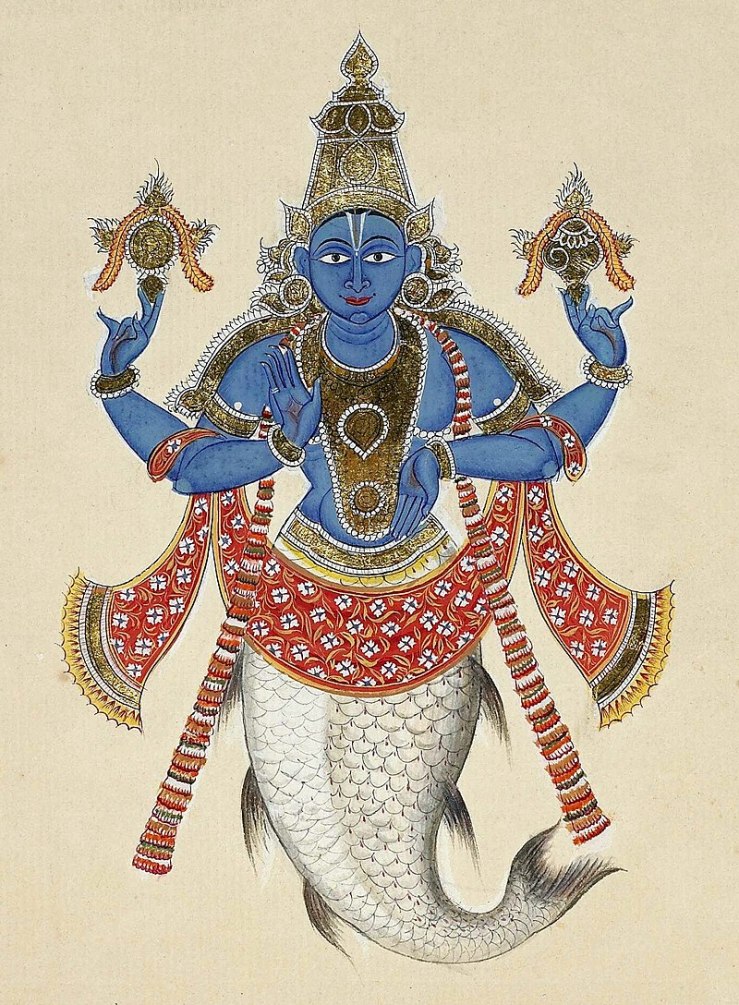
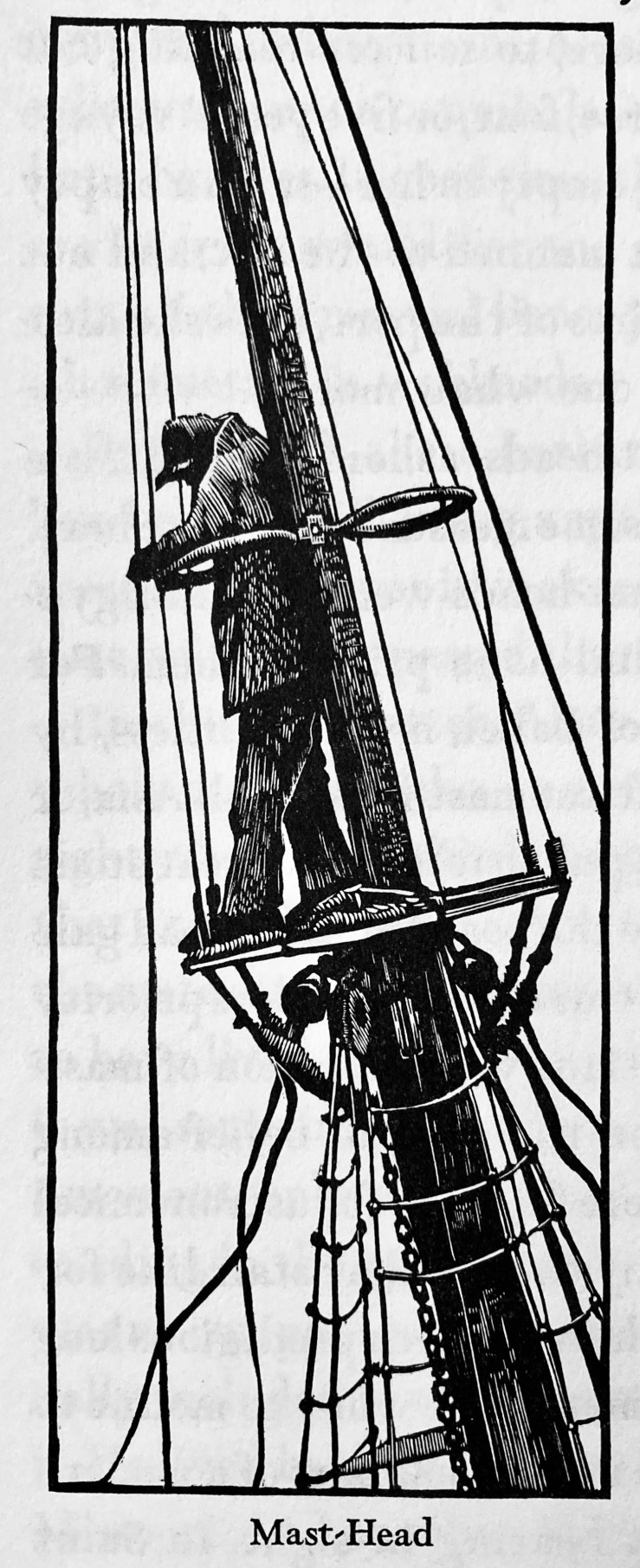
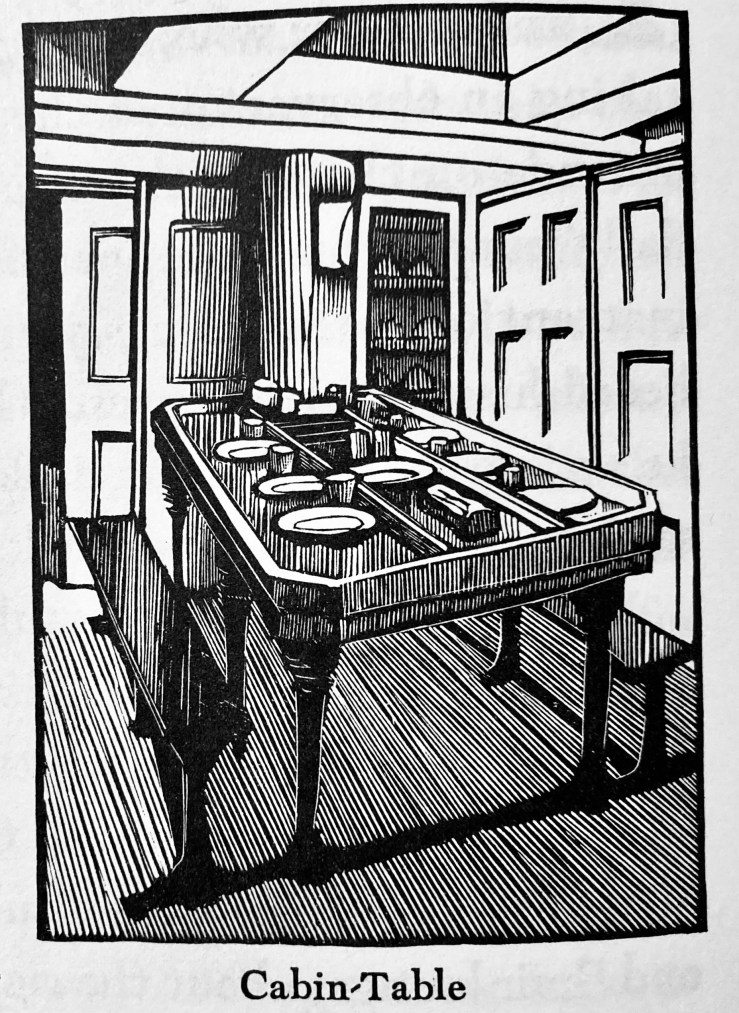
III. (Barry Moser, who illustrated the edition of Moby-Dick I’m rereading, wisely stayed away from most of these “picture” episodes.)
IV. Let us continue:
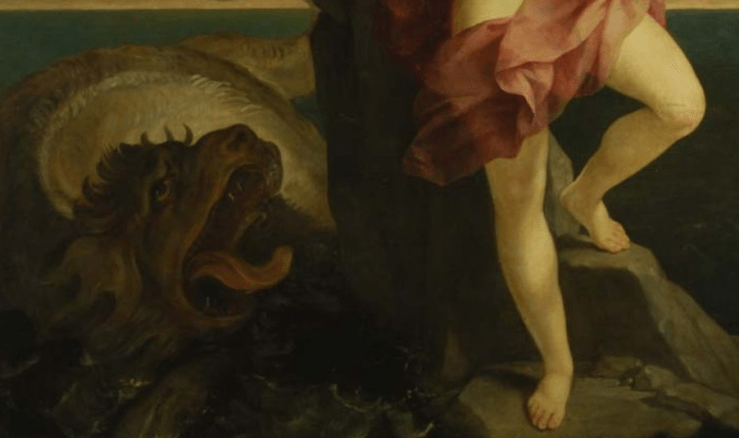
It is Guido’s picture of Perseus rescuing Andromeda from the sea-monster or whale. Where did Guido get the model of such a strange creature as that?
–and–
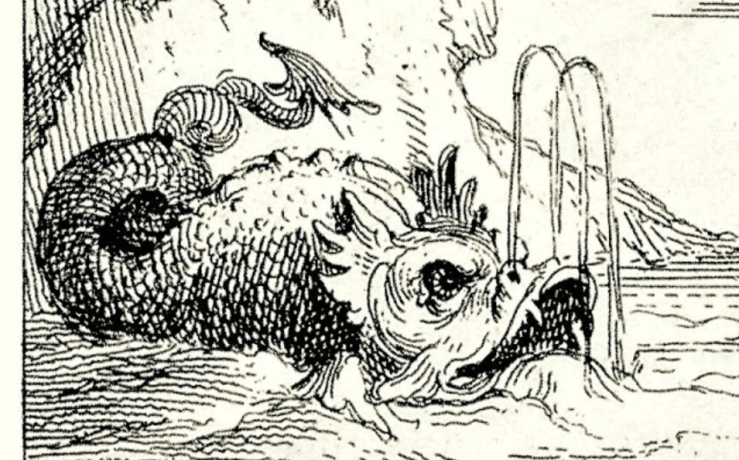
Nor does Hogarth, in painting the same scene in his own “Perseus Descending,” make out one whit better.
–and–
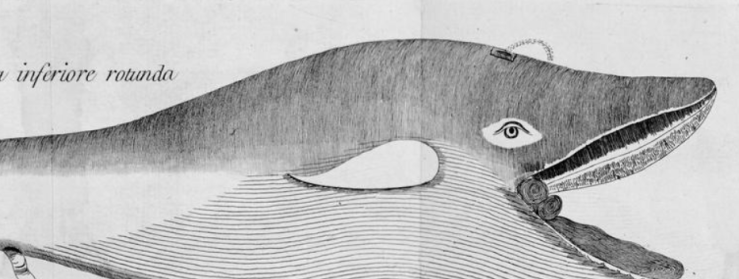
Then, there are the Prodromus whales of old Scotch Sibbald
–and—
Jonah’s whale, as depicted in the prints of old Bibles and the cuts of old primers.
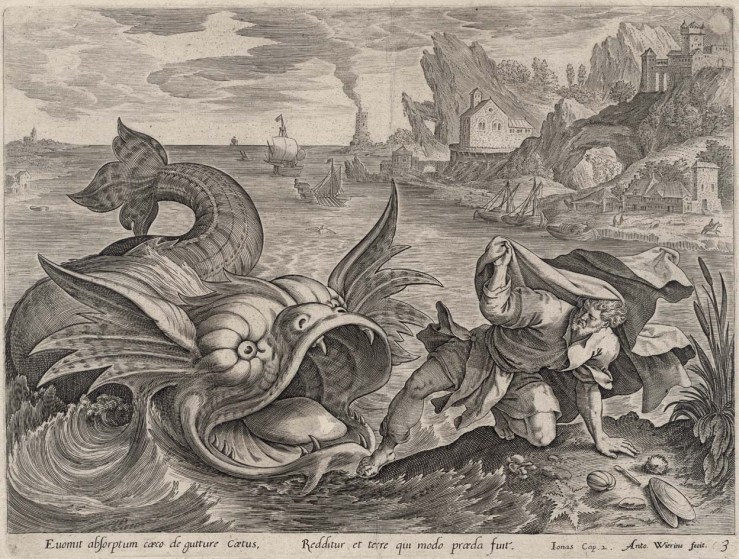 Jonah, 1585 by Antonius Wierix
–and–
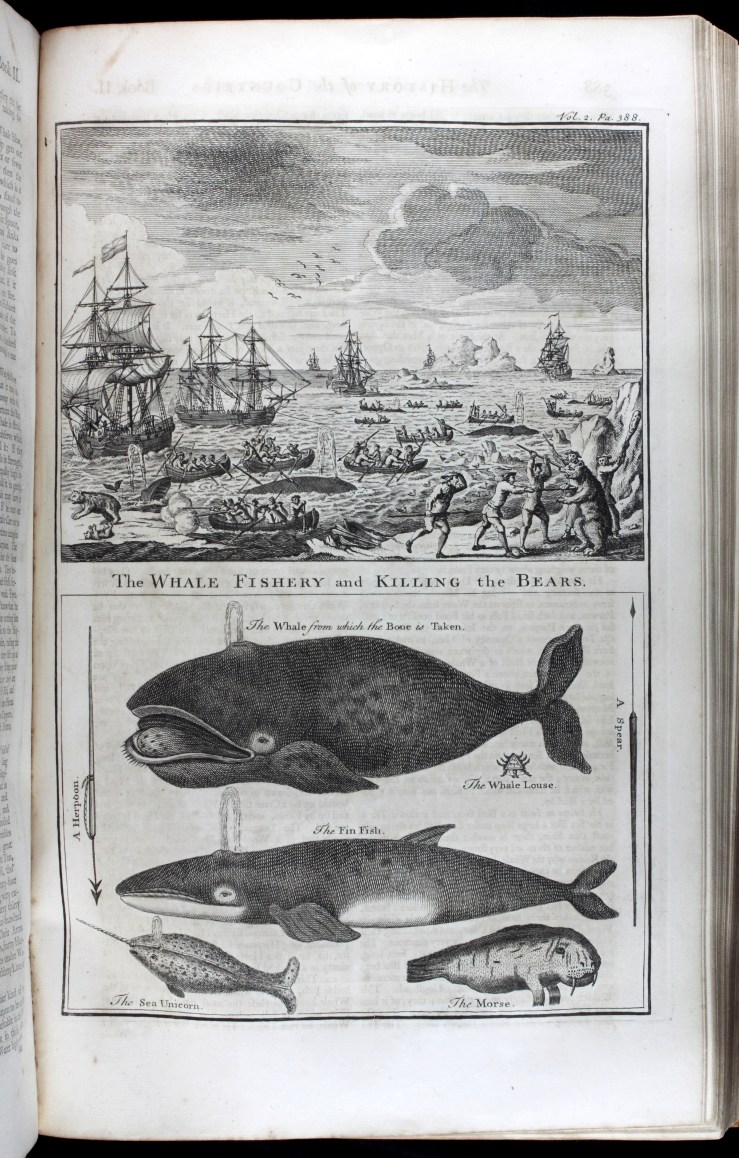
In old Harris’s collection of voyages there are some plates of whales extracted from a Dutch book of voyages, A.D. 1671, entitled “A Whaling Voyage to Spitzbergen in the ship Jonas in the Whale, Peter Peterson of Friesland, master.” In one of those plates the whales, like great rafts of logs, are represented lying among ice-isles, with white bears running over their living backs. In another plate, the prodigious blunder is made of representing the whale with perpendicular flukes.
–and–
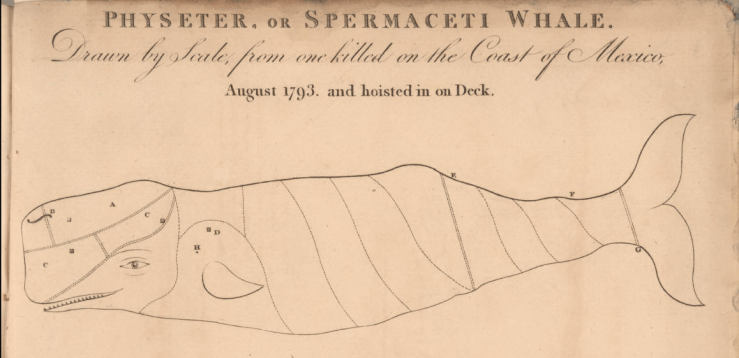
Then again, there is an imposing quarto, written by one Captain Colnett, a Post Captain in the English navy, entitled “A Voyage round Cape Horn into the South Seas, for the purpose of extending the Spermaceti Whale Fisheries.” In this book is an outline purporting to be a “Picture of a Physeter or Spermaceti whale, drawn by scale from one killed on the coast of Mexico, August, 1793, and hoisted on deck.”
–and–
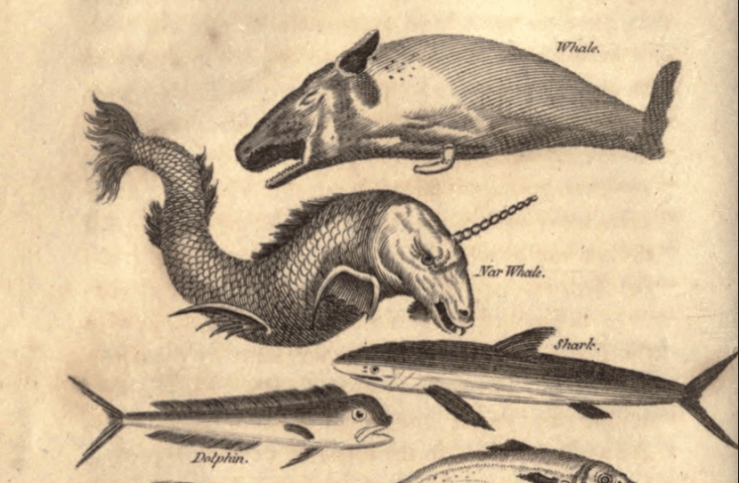
Look at that popular work “Goldsmith’s Animated Nature.” In the abridged London edition of 1807, there are plates of an alleged “whale” and a “narwhale.” I do not wish to seem inelegant, but this unsightly whale looks much like an amputated sow; and, as for the narwhale, one glimpse at it is enough to amaze one, that in this nineteenth century such a hippogriff could be palmed for genuine upon any intelligent public of schoolboys.
–and–
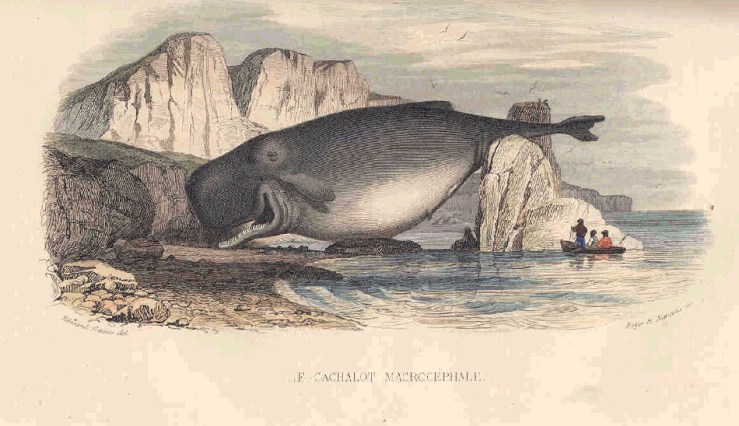
Then, again, in 1825, Bernard Germain, Count de Lacépède, a great naturalist, published a scientific systemized whale book, wherein are several pictures of the different species of the Leviathan.
–and–
But the placing of the cap-sheaf to all this blundering business was reserved for the scientific Frederick Cuvier, brother to the famous Baron. In 1836, he published a Natural History of Whales, in which he gives what he calls a picture of the Sperm Whale. Before showing that picture to any Nantucketer, you had best provide for your summary retreat from Nantucket. In a word, Frederick Cuvier’s Sperm Whale is not a Sperm Whale, but a squash.
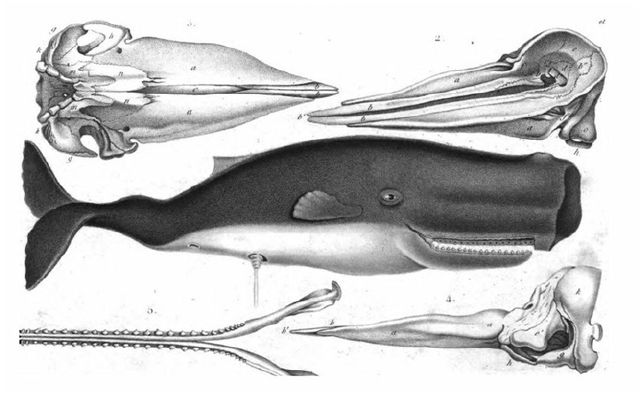
V. Ishmael then forgives these artists’ failures:
But these manifold mistakes in depicting the whale are not so very surprising after all. Consider! Most of the scientific drawings have been taken from the stranded fish; and these are about as correct as a drawing of a wrecked ship, with broken back, would correctly represent the noble animal itself in all its undashed pride of hull and spars. …The living whale, in his full majesty and significance, is only to be seen at sea in unfathomable waters; and afloat the vast bulk of him is out of sight…
VI. Ishmael then reminds us that the whale is a sort of metaphysical thing: “For it is one of the more curious things about this Leviathan, that his skeleton gives very little idea of his general shape,” unlike, say, Jeremy Bentham.
VII. Ishmael’s first pictorial chapter ends his chapter with a warning of sorts:
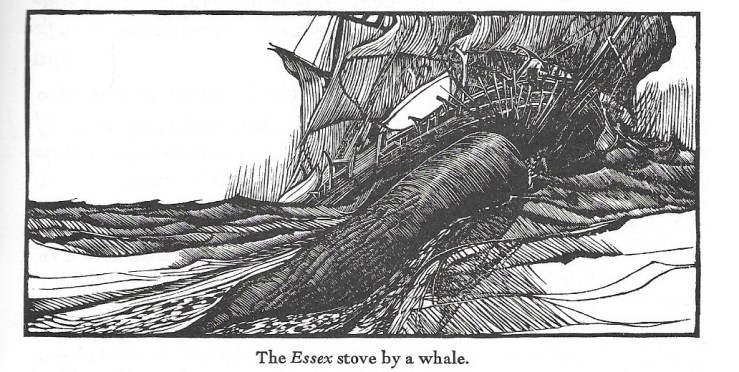
For all these reasons, then, any way you may look at it, you must needs conclude that the great Leviathan is that one creature in the world which must remain unpainted to the last. True, one portrait may hit the mark much nearer than another, but none can hit it with any very considerable degree of exactness. So there is no earthly way of finding out precisely what the whale really looks like. And the only mode in which you can derive even a tolerable idea of his living contour, is by going a whaling yourself; but by so doing, you run no small risk of being eternally stove and sunk by him. Wherefore, it seems to me you had best not be too fastidious in your curiosity touching this Leviathan.
Ishmael’s warning points—again—to The Pequod’s impending doom.
VIII. Ch. 56, “Of the Less Erroneous Pictures of Whales, and the True Pictures of Whaling Scenes.”
Ishmael:
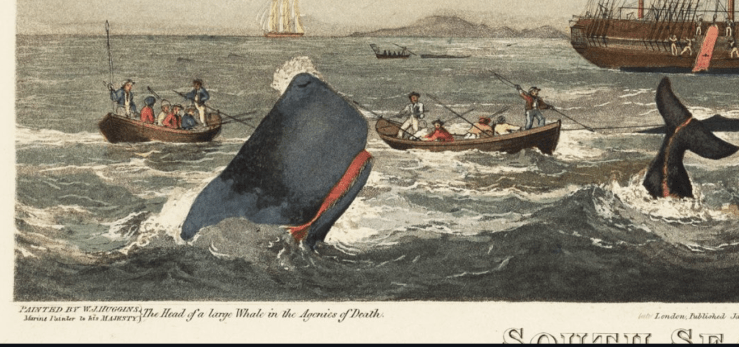
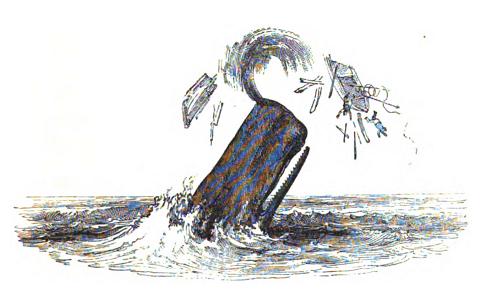
I know of only four published outlines of the great Sperm Whale; Colnett’s, Huggins’s, Frederick Cuvier’s, and Beale’s. In the previous chapter Colnett and Cuvier have been referred to. Huggins’s is far better than theirs; but, by great odds, Beale’s is the best.
Here is a detail from W.J. Huggin’s South Sea Whale Fishery (1825):
–and from Beale’s volume—
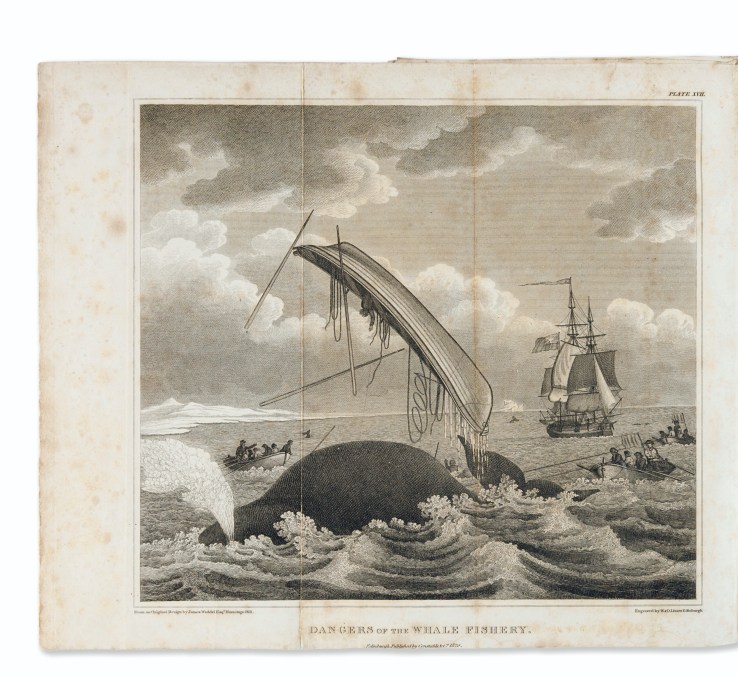
Ishmael then mentions William Scoresby, whose disastrous depictions also likely helped inform the imagery at the climax of Moby-Dick:
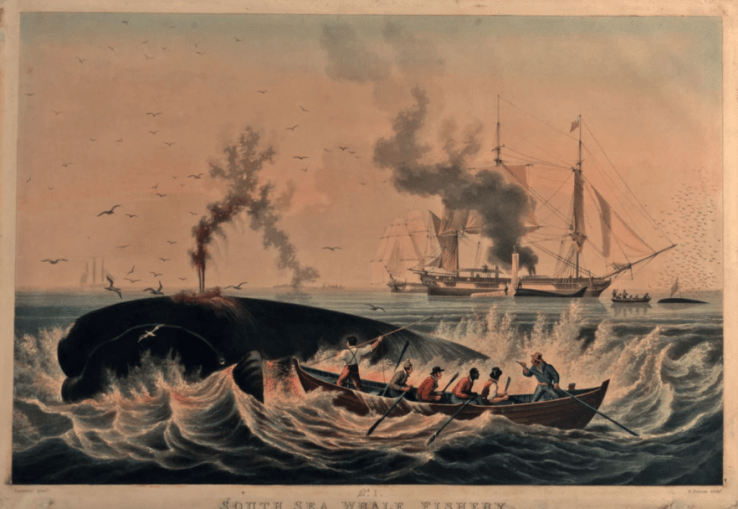
Ishmael is also very fond of two engravings from Ambroise Lous Garneray, the second of which he describes thus—
In the second engraving, the boat is in the act of drawing alongside the barnacled flank of a large running Right Whale, that rolls his black weedy bulk in the sea like some mossy rock-slide from the Patagonian cliffs. His jets are erect, full, and black like soot; so that from so abounding a smoke in the chimney, you would think there must be a brave supper cooking in the great bowels below. Sea fowls are pecking at the small crabs, shell-fish, and other sea candies and maccaroni, which the Right Whale sometimes carries on his pestilent back. And all the while the thick-lipped leviathan is rushing through the deep, leaving tons of tumultuous white curds in his wake, and causing the slight boat to rock in the swells like a skiff caught nigh the paddle-wheels of an ocean steamer. Thus, the foreground is all raging commotion; but behind, in admirable artistic contrast, is the glassy level of a sea becalmed, the drooping unstarched sails of the powerless ship, and the inert mass of a dead whale, a conquered fortress, with the flag of capture lazily hanging from the whale-pole inserted into his spout-hole.
I think it must be this–
IX. Ch. 57, “Of Whales in Paint; in Teeth; in Wood; in Sheet-Iron; in Stone; in Mountains; in Stars.”
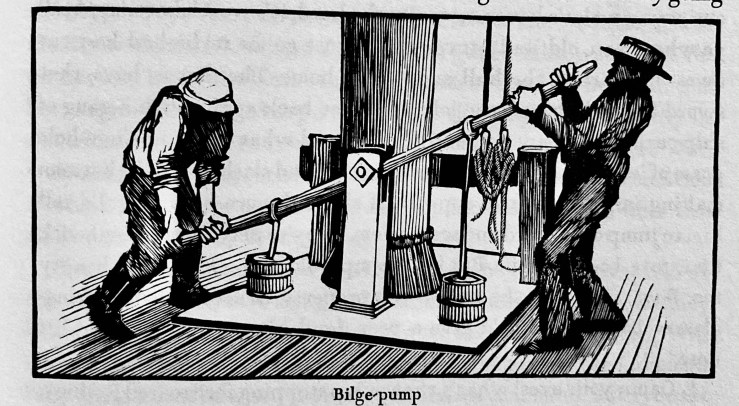
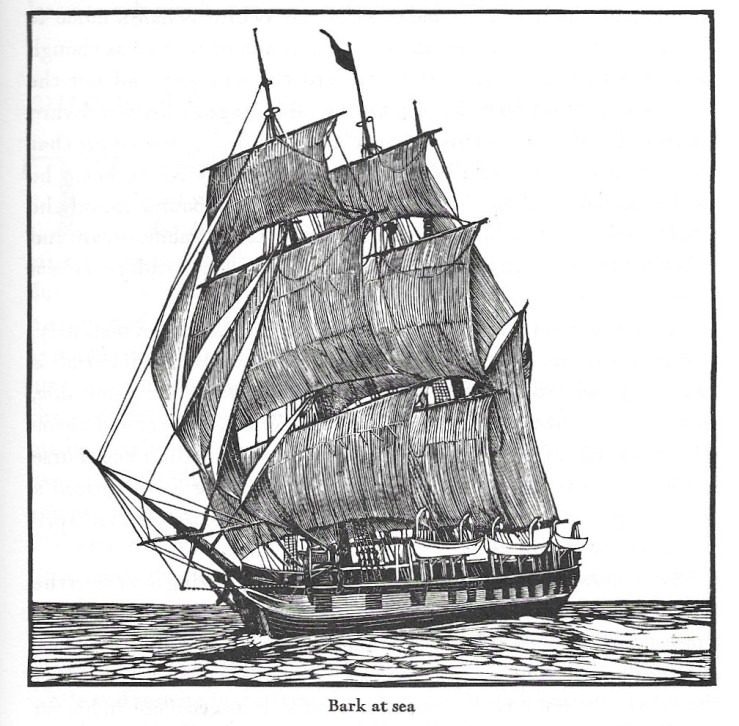
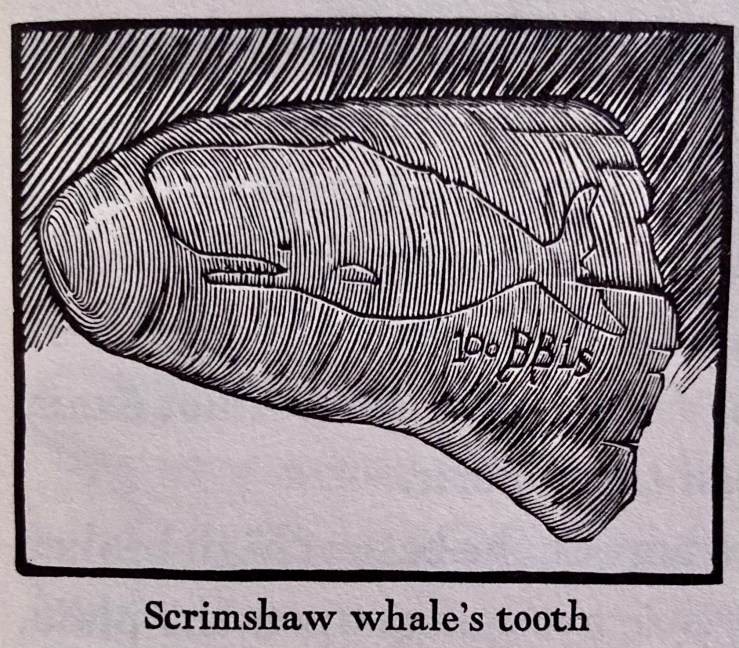
I wrote above that Barry Moser pretty much stays out of these pictorial chapters, but he does include this lovely little illustration in Ch. 57:
On scrimshaw:
Throughout the Pacific, and also in Nantucket, and New Bedford, and Sag Harbor, you will come across lively sketches of whales and whaling-scenes, graven by the fishermen themselves on Sperm Whale-teeth, or ladies’ busks wrought out of the Right Whale-bone, and other like skrimshander articles, as the whalemen call the numerous little ingenious contrivances they elaborately carve out of the rough material, in their hours of ocean leisure.
(So I just spent the last half hour looking for this tiny little scrimshaw pocket knife I bought when I was ten years old in Honolulu — it was the winter of 1989 and we were going home-not-really-home to Florida for Christmas from Dunedin, New Zealand. We got to spend a few days in Honolulu and I bought a “scrimshaw” knife in the market. “Like Moby-Dick,” my father said, or something like that. I know the knife is here somewhere, in some box or crate, squirreled away, more beautiful in my mind’s eye than an iPhone pic could capture.)
X. These three chapters end with Ishmael’s reaffirmation to go a’whaliln’ — to see for himself, and not through, to quote Walt Whitman, “take things at second or third hand, not look through the eyes of the dead, nor feed on the spectres in books.”
Our boy Ish ends the chapter horny for life:
With a frigate’s anchors for my bridle-bitts and fasces of harpoons for spurs, would I could mount that whale and leap the topmost skies, to see whether the fabled heavens with all their countless tents really lie encamped beyond my mortal sight!