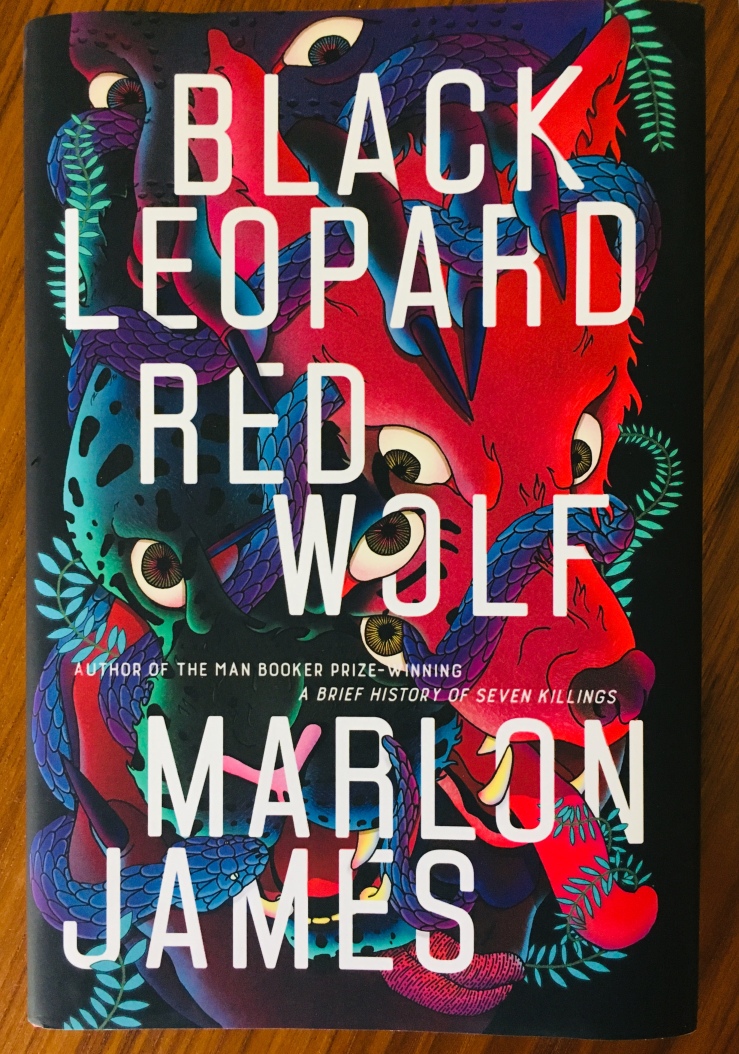
I was skeptical about Marlon James’s new novel Black Leopard, Red Wolf when it came out earlier this year in hardback. The novel had plenty of buzz and a big blurb from Neil Gaiman on the back—two things that often turn me off. I was also a bit skeptical about some of the novel’s marketing hype. James referred to his novel as an “African Game of Thrones,” and a lot of folks ran with that tag. James has since professed in an interview that this comparison was a joke.
A friend had read something about the book and texted me questions about it, so I thought, Hey, why not go to my favorite source of literary criticism: What did people who really hated this book have to say about it? And as usual, the one-star reviews at Amazon did not disappoint. Indeed, I was a bit optimistic about Black Leopard, Red Wolf after seeing this curve:

Just look at that! Amazon stats for big publisher/big buzz books tend to be suspiciously positive, but here I saw a sign of something that intrigued me—a book that a lot of people either loved or hated. And some of those one-star reviews?
Filled with gratuitous and rampant cursing, sexuality, violence and brutality. Too much even for fans of dark fantasy. I could not finish it.
…Confusing, nasty, all-over-the-place, just plain LOST. Sorry, but this needs a particular kind of person to stomach or understand.
…If you don’t mind being confused and unsure of the direction of a story, this book is for you. You must have patience to read this book.
…sounds like it was written by someone on hallucinogens.
I knew at this point I wouldn’t wait for the paperback.
If James’s comparing Black Leopard, Red Wolf to Game of Thrones was a joke, it’s a pretty good one, the kind of joke that could sell a lot of copies of his novel to fantasy fans who want a plot-driven tale. From the four baffling, surreal, vivid (and often lurid) chapters I’ve read so far, Black Leopard, Red Wolf isn’t really like Game of Thrones at all. There’s an opaqueness to James’s prose, a distancing effect to the language that alienates the reader in the most wonderful way. It’s all so terribly strange! Fans of plot-centric fantasy where the author explains and explicates what’s happening will likely be very quickly bothered by what James is doing here.
So far, Black Leopard, Red Wolf is first-person narrative of a man who may or may not be named Tracker, who is telling his story—or rather, many, many stories—to someone called Inquisitor (shades of One Thousand and One Nights?). These stories flow and roil into and out of each other. The minute James lets us find our bearings a bit, we’re out into new territory—one moment fighting “Omoluzu…Roof walkers” who seem to exist on a tangential plane to our own, and not long after running through a jungle of giant trees with a shapeshifting Leopard who leads us to a village of cursed children. Black Leopard, Red Wolf overflows with energy: the novel is kinetic, bright, and sharp, but also dark, eerie, and upsetting—it’s abject, puzzling, slippery. I love it so far.
The novel completely won me over on its tenth page, with this wild episode:
I kept walking until I came to an old woman by a river with a tall stick sitting at the banks. Her hair white at the sides, her head bald at the top. Her face had lines like paths in the forest and her yellow teeth meant her breath was foul. The stories say she rises each morning youthful and beautiful, blooms full and comely by midday, ages to a crone by nightfall, and dies at midnight to be born again the next hour. The hump in her back was higher than her head, but her eyes twinkled, so her mind was sharp. Fish swam right up to the point of the stick but never went beyond.
“Why have you come to this place?” she asked.
“This is the way to Monono,” I said.
“Why have you come to this place? A living man?”
“Life is love and I have no love left. Love has drained itself from me, and run to a river like this one.”
“It’s not love you have lost, but blood. I will let you pass. But when I lay with a man I live without dying for seventy moons.”
So I fucked the crone. She lay on her back by the bank, her feet in the river. She was nothing but bones and leather, but I was hard for her and full with vigor. Something was swimming between my legs that felt like fishes. Her hand touched my chest and my white clay stripes turned into waves around my heart. I thrust in and out of her, unnerved by her silence. In the dark I felt she was getting younger even though she was getting older. Flame spread inside me, spread to the tips of my fingers and the tip of me inside her. Air gathered around water, water gathered around air and I yelled, and pulled out, and rained on her belly, her arms, and her breasts. A shudder ran through me five times. She was still a crone, but I was not angry. She scooped my rain off her chest and flicked it off in the river. At once fish leapt up and dived in, leapt up again. This was a night when dark ate the moon, but the fishes had a light within them. The fishes had the head, arms, and breasts of women.
“Follow them,” she said.
I followed them through day and night, and day again. Sometimes the river was as low as my ankle. Sometimes the river was as high as my neck. Water washed all the white from my body, leaving just my face. The fish- women, womenfish, took me down the river for days and days and days until we came to a place I cannot describe. It was either a wall of river, which stood firm even though I could push my hand through it, or the river had bent itself downward and I could still walk, my feet touching the ground, my body standing without falling.
So the narrator ejaculates on a witch, she flicks his semen into a river, and the fish who eat it turn into mermaids who lead him to the land of the dead. There, he accomplishes on of the earliest quests in this very-questy novel. Instead of my describing the quest, I’ll point you instead to the publisher’s website–you can read the full first chapter there.
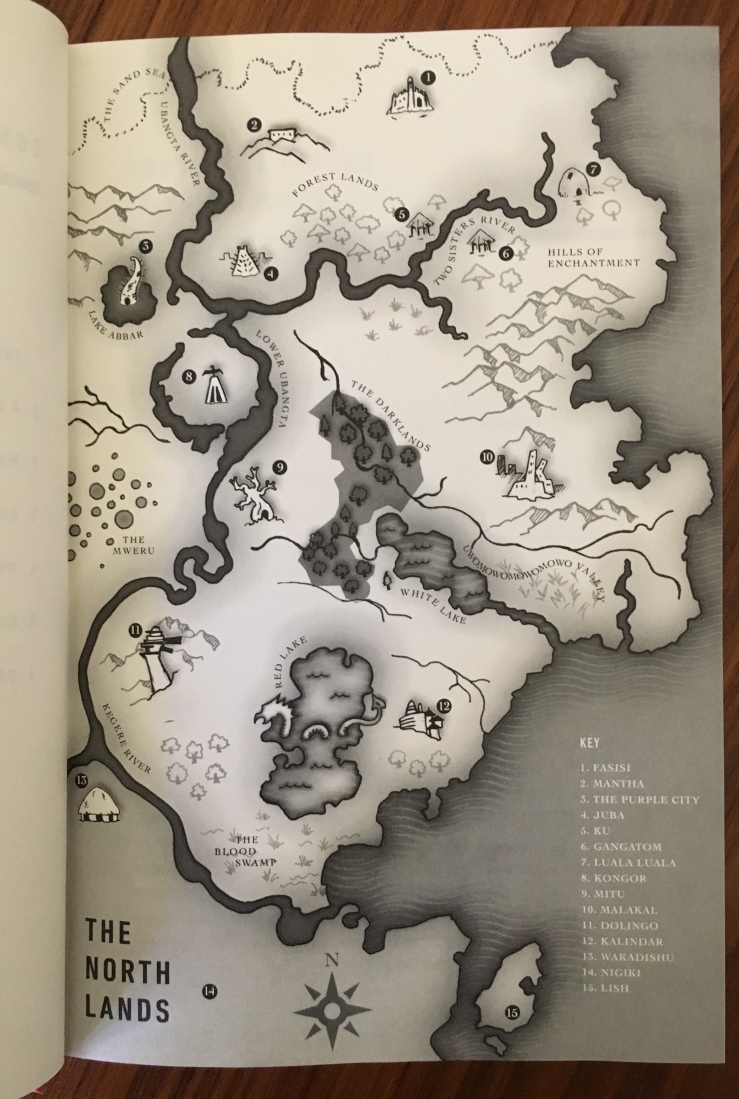
Did I mention that Black Leopard, Red Wolf has maps in it? Black Leopard, Red Wolf has maps in it.
More to come in the future. For now, I’m really digging the novel’s surreal, lurid thrusts into wild territory.