August 11th.–This morning, it being cloudy and boding of rain, the clouds had settled upon the mountains, both on the summits and ridges, all round the town, so that there seemed to be no way of gaining access to the rest of the world, unless by climbing above the clouds. By and by they partially dispersed, giving glimpses of the mountain ramparts through their obscurity, the separate clouds lying heavily upon the mountain’s breast. In warm mornings, after rain, the mist breaks forth from the forests on the ascent of the mountains, like smoke,–the smoke of a volcano; then it soars up, and becomes a cloud in heaven. But these clouds to-day were real rain-clouds. Sometimes, it is said, while laboring up the mountain-side, they suddenly burst, and pour down their moisture in a cataract, sweeping all before it.
Every new aspect of the mountains, or view from a different position, creates a surprise in the mind.
Scenes and characters–A young country fellow, twenty or thereabouts, decently dressed, pained with the toothache. A doctor, passing on horseback, with his black leather saddle-bags behind him, a thin, frosty-haired man. Being asked to operate, he looks at the tooth, lances the gum, and the fellow being content to be dealt with on the spot, he seats himself in a chair on the stoop with great heroism. The doctor produces a rusty pair of iron forceps; a man holds the patient’s head; the doctor perceives that, it being a difficult tooth to get at, wedged between the two largest in his jaws, he must pull very hard; and the instrument is introduced. A turn of the doctor’s hand; the patient begins to utter a cry, but the tooth comes out first, with four prongs . The patient gets up, half amazed, pays the doctor ninepence, pockets the tooth, and the spectators are in glee and admiration.
There was a fat woman, a stage-passenger to-day,–a wonder how she could possibly get through the door, which seemed not so wide as she. When she put her foot on the step, the stage gave a great lurch, she joking all the while. A great, coarse, red-faced dame. Other passengers,–three or four slender Williamstown students, a young girl, and a man with one leg and two crutches.
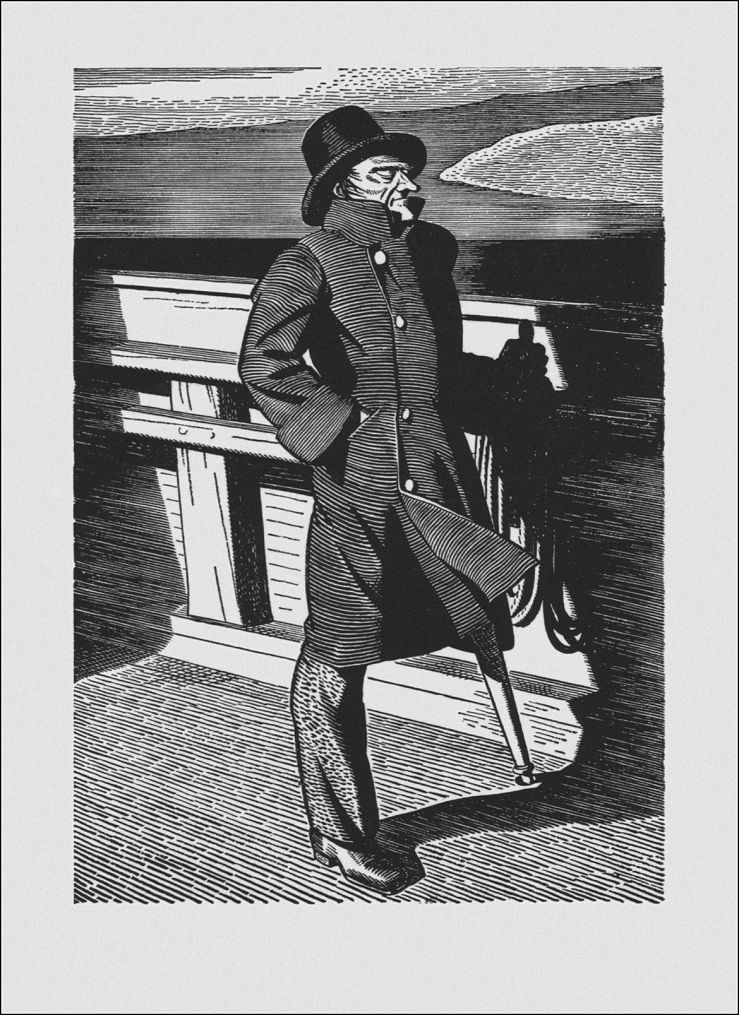
One of the most sensible men in this village is a plain, tall, elderly person, who is overseeing the mending of a road,–humorous, intelligent, with much thought about matters and things; and while at work he has a sort of dignity in handling the hoe or crowbar, which shows him to be the chief. In the evening he sits under the stoop, silent and observant from under the brim of his hat; but, occasion calling, he holds an argument about the benefit or otherwise of manufactories or other things. A simplicity characterizes him more than appertains to most Yankees.
A man in a pea-green frock-coat, with velvet collar. Another in a flowered chintz frock-coat. There is a great diversity of hues in garments. A doctor, a stout, tall, round-paunched, red-faced, brutal-looking old fellow, who gets drunk daily. He sat down on the step of our stoop, looking surly, and speaking to nobody; then got up and walked homeward, with a morose swagger and a slight unevenness of gait, attended by a fine Newfoundland dog.
A barouche with driver returned from beyond Greenfield or Troy empty, the passengers being left at the former place. The driver stops here for the night, and, while washing, enters into talk with an old man about the different roads over the mountain.
People washing themselves at a common basin in the bar-room! and using the common hair-brushes! perhaps with a consciousness of praiseworthy neatness!
A man with a cradle on his shoulder, having been cradling oats. I attended a child’s funeral yesterday afternoon. There was an assemblage of people in a plain, homely apartment. Most of the men were dressed in their ordinary clothes, and one or two were in shirtsleeves. The coffin was placed in the midst of us, covered with a velvet pall. A bepaid clergyman prayed (the audience remaining seated, while he stood up at the head of the coffin), read a passage of Scripture and commented upon it. While he read and prayed and expounded there was a heavy thunderstorm rumbling among the surrounding hills, and the lightning flashed fiercely through the gloomy room; and the preacher alluded to GOD’S voice of thunder.
It is the custom in this part of the country–and perhaps extensively in the interior of New England–to bury the dead first in a charnel-house, or common tomb, where they remain till decay has so far progressed as to secure them from the resurrectionists. They are then reburied, with certain ceremonies, in their own peculiar graves.
O. E. S—-, a widower of forty or upwards, with a son of twelve and a pair of infant twins. He is a sharp, shrewd Yankee, with a Yankee’s license of honesty. He drinks sometimes more than enough, and is guilty of peccadilloes with the fair sex; yet speaks most affectionately of his wife, and is a fond and careful father. He is a tall, thin, hard-featured man, with a sly expression of almost hidden grave humor, as if there were some deviltry pretty constantly in his mind,–which is probably the case. His brother tells me that he was driven almost crazy by the loss of his wife. It appears to me that men are more affected by the deaths of their wives than wives by the deaths of their husbands. Orrin S—- smokes a pipe, as do many of the guests.
A walk this forenoon up the mountain ridge that walls in the town towards the east. The road is cut zigzag, the mountain being generally as steep as the roof of a house; yet the stage to Greenfield passes over this road two or three times a week. Graylock rose up behind me, appearing, with its two summits and a long ridge between, like a huge monster crouching down slumbering, with its head slightly elevated. Graylock is properly the name for the highest elevation. It appeared to better advantage the higher the point from which I viewed it. There were houses scattered here and there up the mountain-side, growing poorer as I ascended; the last that I passed was a mean log-hut, rough, rude, and dilapidated, with the smoke issuing from a chimney of small stones, plastered with clay; around it a garden of beans, with some attempt at flowers, and a green creeper running over the side of the cottage. Above this point there were various excellent views of mountain scenery, far off and near, and one village lying below in the hollow vale.
Having climbed so far that the road seemed now to go downward, I retraced my steps. There was a wagon descending behind me; and as it followed the zigzag of the road I could hear the voices of the men high over my head, and sometimes I caught a glimpse of the wagon almost perpendicularly above me, while I was looking almost perpendicularly down to the log-hut aforementioned. Trees were thick on either hand,–oaks, pines, and others; and marble occasionally peeped up in the road; and there was a lime-kiln by the wayside, ready for burning.
Graylock had a cloud on his head this morning, the base of a heavy white cloud. The distribution of the sunshine amid mountain scenery is very striking; one does not see exactly why one spot should be in deep obscurity while others are all bright. The clouds throw their shadows upon the hill-sides as they move slowly along,–a transitory blackness.
I passed a doctor high up the road in a sulky, with his black leather saddle-bags.
Hudson’s Cave is formed by Hudson’s Brook. There is a natural arch of marble still in one part of it. The cliffs are partly made verdant with green moss, chiefly gray with oxidation; on some parts the white of the marble is seen; in interstices grow brake and other shrubs, so that there is naked sublimity seen through a good deal of clustering beauty. Above, the birch, poplars, and pines grow on the utmost verge of the cliffs, which jut far over, so that they are suspended in air; and whenever the sunshine finds its way into the depths of the chasm, the branches wave across it. There is a lightness, however, about their foliage, which greatly relieves what would otherwise be a gloomy scene. After the passage of the stream through the cliffs of marble, the cliffs separate on either side, and leave it to flow onward; intercepting its passage, however, by fragments of marble, some of them huge ones, which the cliffs have flung down, thundering into the bed of the stream through numberless ages. Doubtless some of these immense fragments had trees growing on them, which have now mouldered away. Decaying trunks are heaped in various parts of the gorge. The pieces of marble that are washed by the water are of a snow-white, and partially covered with a bright green water-moss, making a beautiful contrast.
Among the cliffs, strips of earth-beach extend downward, and trees and large shrubs root themselves in that earth, thus further contrasting the nakedness of the stone with their green foliage. But the immediate part where the stream forces its winding passage through the rock is stern, dark, and mysterious.
Along the road, where it runs beneath a steep, there are high ridges, covered with trees,–the dew of midnight damping the earth, far towards midnoon. I observed the shadows of water-insects, as they swam in the pools of a stream. Looking down a streamlet, I saw a trunk of a tree, which has been overthrown by the wind, so as to form a bridge, yet sticking up all its branches, as if it were unwilling to assist anybody over.
Green leaves, following the eddies of the rivulet, were now borne deep under water, and now emerged. Great uprooted trees, adhering midway down a precipice of earth, hung with their tops downward.
There is an old man, selling the meats of butternuts under the stoop of the hotel. He makes that his station during a part of the season. He was dressed in a dark thin coat, ribbed velvet pantaloons, and a sort of moccasons, or shoes, appended to the legs of woollen stockings. He had on a straw hat, and his hair was gray, with a long, thin visage. His nuts were contained in a square tin box, having two compartments, one for the nuts, and another for maple sugar, which he sells in small cakes. He had three small tin measures for nuts,–one at one cent, others at two, four, and six cents; and as fast as they were emptied, he filled them again, and put them on the top of his box. He smoked a pipe, and talked with one man about whether it would be worth while to grow young again, and the duty of being contented with old age; about predestination and freewill and other metaphysics. I asked him what his sales amounted to in the course of a day. He said that butternuts did not sell so well as walnuts, which are not yet in season; that he might to-day have sold fifty cents’ worth; of walnuts, never less than a dollar’s worth, often more; and when he went round with a caravan, he had sold fifteen dollars’ worth per day, and once as much as twenty dollars’ worth. This promises to be an excellent year for walnuts. Chestnuts have been scarce for two or three years. He had one hundred chestnut-trees on his own land, and last year he offered a man twenty-five cents if he would find him a quart of good chestnuts on them. A bushel of walnuts would cost about ten dollars. He wears a pair of silver-rimmed spectacles.
A drunken fellow sat down by him, and bought a cent’s worth of his butternuts, and inquired what he would sell out to him for. The old man made an estimate, though evidently in jest, and then reckoned his box, measures, meats, and what little maple sugar he had, at four dollars. He had a very quiet manner, and expressed an intention of going to the Commencement at Williamstown to-morrow; His name, I believe, is Captain Gavett.