The Wandering Moon — William Blake

the-wandering-moon-1820

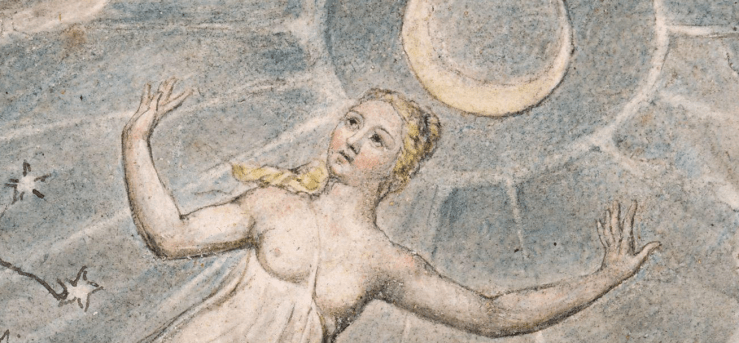
The Wandering Moon, 1820 by William Blake (1757-1827)

Screenshot 2018-07-20 at 12.50.15 PM

Girl Reading — Richard Diebenkorn

Screenshot 2018-07-20 at 9.36.07 AM

Girl Reading, 1961 by Richard Diebenkorn (1922 – 1993)

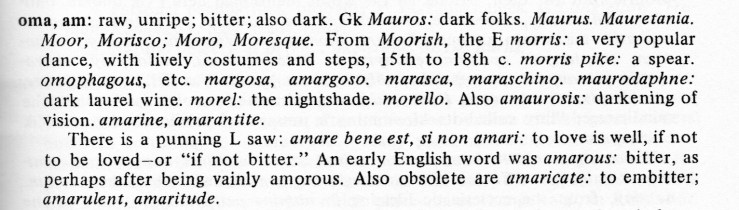
oma, am: raw, unripe; bitter; also dark.

img_9946

From Joseph T. Shipley’s The Origin of English Words: A Discursive Dictionary of Indo-European Roots.

My story is the amazing truth | Denis Johnson

This one speaker Howard had us all frozen up, we listened to him stock-still for forty-five minutes. He started out simple, comes out of high-school, tries the infantry, finds the service kind of boring without a war. Drinking on leave and weekends. Gets his discharge, goes to Santa Rosa Community College. Going for a business degree. Drinking on weekends.  Itchy and discontented. One night, he has this friend who’s a cop in SR, guy says, ride along with us and get a taste. He says two hours into the ride I’m feeling like I never felt. These guys tell a citizen what to do, he better do it. They give orders and they’re obeyed and I never knew how bad I wanted that. Zip into the Santa Rosa police training program, then I’m a cop, got three girlfriends, one black, one Asian, one white, cruising in a squad car all night long, kicking ass, busting heads, top of the world, man.  One year in I’ve got a sweet little wife and a six-week baby daughter. Two years in they put me on Narcotics and Vice, undercover. My job is to hang out in bars and party like Nero. Can I do that?  Hell, what do they think I’ve been doing every free minute anyhow?  And will I buy drugs?  Gee, okay, I’ll give it a shot. And Howard, they say, listen, sometimes in the course of your duties you will have a line of coke laid out before you and in the course of your duties you’ll just have to put your head down there and suck it up. It’s part of the ride, okay Howard?  Yeah, I say, part of the ride, and inside of six months I’m the biggest coke-head, the biggest dealer, and the crookedest cop in Northern California. I did armed robberies on dealers and drugstores up and down Highway 101. I had seven girlfriends and I was pimping every one.  My sweet little wife divorced me and took my daughter and I never even noticed. The force gave me a thousand a month to buy coke in little bags and turn them in, and I had thirty thousand under my bed in a shoebox next to three or four kilos of coke the force would never see. I’d wake up in the afternoon and fare forth and wreak havoc. I murdered three guys I still claim the world is better off without, but I’m not the judge though, am I?  But I sure thought I was. I took the lives of other human beings. I thought I was God. I looked in the mirror and said so — looked in the mirror and said, You are God. When God decided to prove me wrong, it all came down like a mountain of dogshit on my head. They rolled me up and socked me with so many charges, including at one point second degree murder, that if they stacked them up and ran me through I’d be doing time a hundred years past my natural death. I’m lying in jail and that cell is sucking the drugs and the fight and the soul right out me and giving it to God and God is squeezing it in his fingers, man, every last fiber of my soul in the almighty grip of the truth. And the truth is that everything I’ve done, every thought I’ve thought, every moment I’ve lived, is shit turned to dust and dust blown away. God, I said, fuck it, I’m not even gonna pray. Squeeze my guts till you get tired, that’s all I want now, because at least it’s real, it’s true, it’s got something to do with you. So then I think I died. I think I died in jail. My life itself just left me, and who you see before you now is someone else. So I wandered like a ghost through the court system and came out with a sentence of ten years. Did seven, one day at a time. Prayed every day and every night, but only one prayer:  Squeeze till you get tired, Lord. Kill me, Lord, I don’t care, as long as it’s you who kills me. Just got out eight days ago, and rehab is part of my parole. And nothing to show for thirty-six years on this earth.  Except that God is closer to me than my next breath. And that’s all I’ll ever need or want. If you think I’m bullshitting, kiss my ass. My story is the amazing truth.

From Denis Johnson’s short story “The Starlight on Idaho.”

Gleaming Connection — Wiley Wallace

wallace2

Triptych of Saints — Sergio Padovani

trittico-delle-sante

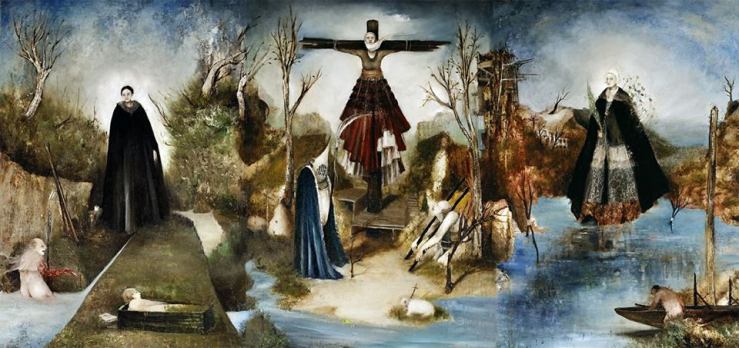
Triptych of Saints by Sergio Padovani (b. 1972)

Destruction — Thomas Cole

Cole_Thomas_The_Course_of_Empire_Destruction_1836

Destruction (From The Course of Empire series), 1836 by Thomas Cole (1801-1848)

The Singers — Odd Nerdrum

the-singers

The Singers, 1984 by Odd Nerdrum (b. 1944)

The Elephant Man (Summer Film Log)

5059

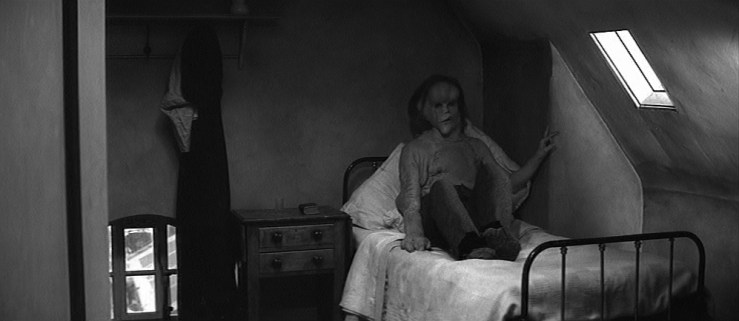
I watched David Lynch’s film The Elephant Man (1980) last night for the first time in at least a decade (likely more than a decade). The Elephant Man is not my favorite Lynch film to rewatch, perhaps because it is his most realistic film despite its fantastic touches.

The Elephant Man is emotionally devastating, propelled by naturalistic performances unusual in Lynch’s oeuvre. Lynch teases the titular elephant man’s hideous countenance for the first fifteen or so minutes of the film, but when we finally see John Merrick (played by an unrecognizable John Hurt), we feel only pity for his circumstance and contempt for a world that can’t accept him.

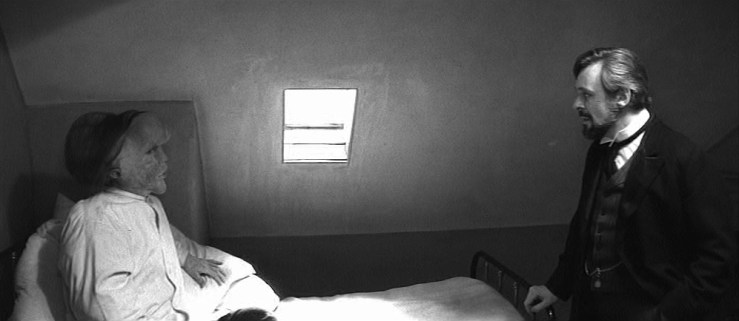
Dr. Treves (Anthony Hopkins) shares that mix of pity and contempt. Treves is the surgeon who moves Merrick from his freakshow prison to a respectable London hospital, where the young man can finally find some measure of comfort in his own skin. Away from his former handler, the sadistic Mr. Bytes (Freddie Jones), young Merrick quickly becomes an aesthete, the toast of London society.
2159

Merrick’s hospital suite becomes an artiste’s garret, where he builds a model of a nearby cathedral and takes tea with a famous actress. However, a cruel night porter named Jim (Michael Elphick) intrudes into this peace, selling tipsy gawkers tickets to see the elephant man in his new minor paradise. While Jim’s invasions are horrifying, more subtly terrible is the notion that Dr. Treves himself is simply recapitulating the freakshow, only this time to a “higher society” — a sin that Ms. Mothershead, the ward’s head nurse, warns Treves against. She serves as the moral anchor of the film, proclaiming that care and attention—bathing, feeding, cleaning—are the truest forms of “love.”

Despite its subject matter, The Elephant Man is possibly Lynch’s most straightforward, even traditional film (this estimation includes The Straight Story (1999)). The plot is ultimately a character study of a lonely man who craves not wholesale acceptance or dramatic love but simple friendship. The emotional crux of The Elephant Man rests in Treves’ reticence to truly befriend his patient, a reticence Lynch refuses to resolve.
2659

We feel pity for Merrick, but as his social status swells into a surreal ironic infamy, we feel a second pity—the fame goes to his head. Hurt portrays these strange emotional swings through thick layers of makeup, aided by Lynch’s impeccable framing and Freddie Francis’ dreamy black and white cinematography. (Francis served as cinematographer on Lynch’s next film, 1984’s Dune, as well as the aforementioned The Straight Story). Lynch’s sound design is haunting, but not as proficient as later efforts—too reliant on flange and echo, the sound design often subtracts through addition.

3859

Visually, The Elephant Man plants seeds for any number of Lynchian set pieces to come. The nightworld Lynch creates for poor Merrick to endure repeats throughout his oeuvre, notably in Blue Velvet (1986), Lost Highway (1997) and Twin Peaks (1990-2017). Michael Elphick’s night porter Jim is particularly sinister, a proto-Frank Booth. Freddie Jones’ Mr. Bytes is a loathsome first copy of Baron Harkonnen from Dune. It’s all quite horrifying.

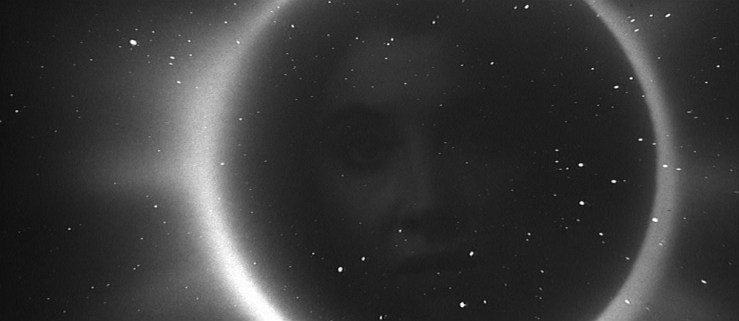
Lynch always tempers the dark with the light. The subtle supernatural touches in The Elephant Man—halos and orbs, night spectacles, bewitched paintings—are motifs that repeat throughout his work. So much of The Elephant Man’s DNA is in Twin Peaks, and perhaps my favorite thing about watching it—aside from the rich blacks and grays and lights—was how much it evoked for me Part 8 of Twin Peaks: The Return—the best thing I saw on a screen last year.
6059

Lynch finds light in life’s grotesque pageant, and this strange light is what colors The Elephant Man as such an intensely meaningful film. Merrick is more than a freak, but also more than a human—Lynch refuses to show his title character’s humanity as a series of banal platitudes. Such a representation would not be true to human nature. And in the end, The Elephant Man is about human nature, or, more importantly, one real fantastic unreal human.


How I watched it: On a big TV via a streaming service, very late at night. I am indebted to the archive Film Grab as the source of the images used in this post.

“Breughel” — Aldous Huxley

Screenshot 2018-07-16 at 7.52.38 PM

“Breughel”

by

Aldous Huxley

from Along the Road, 1925


Most of our mistakes are fundamentally grammatical. We create our own difficulties by employing an inadequate language to describe facts. Thus, to take one example, we are constantly giving the same name to more than one thing, and more than one name to the same thing. The results, when we come to argue, are deplorable. For we are using a language which does not adequately describe the things about which we are arguing.

The word “painter” is one of those names whose indiscriminate application has led to the worst results. All those who, for whatever reason and with whatever intentions, put brushes to canvas and make pictures, are called without distinction, painters. Deceived by the uniqueness of the name, aestheticians have tried to make us believe that there is a single painter-psychology, a single function of painting, a single standard of criticism. Fashion changes and the views of art critics with it. At the present time it is fashionable to believe in form to the exclusion of subject. Young people almost swoon away with excess of aesthetic emotion before a Matisse. Two generations ago they would have been wiping their eyes before the latest Landseer. (Ah, those more than human, those positively Christ-like dogs—how they moved, what lessons they taught! There had been no religious painting like Landseer’s since Carlo Dolci died.)

These historical considerations should make us chary of believing too exclusively in any single theory of art. One kind of painting, one set of ideas are fashionable at any given moment. They are made the basis of a theory which condemns all other kinds of painting and all preceding critical theories. The process constantly repeats itself. Continue reading ““Breughel” — Aldous Huxley” →

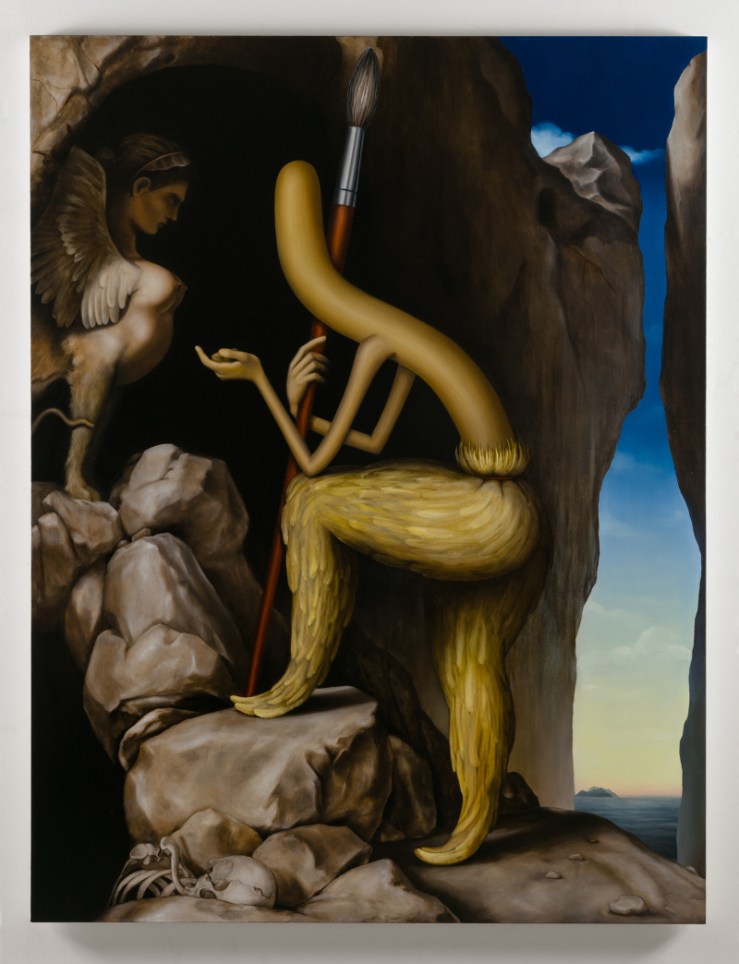
The Riddle — Emily Mae Smith

emsmith_2017_070_021_theriddle_800

The Riddle, 2017 by Emily Mae Smith (b. 1979)

LAWN — Joe Houston

houston_lawn_website

LAWN, 1989 by Joe Houston (b. 1962)

The Misfortunes of Silenus (Detail) — Pierro di Cosimo

Screenshot 2018-07-05 at 8.48.35 PM

The Misfortunes of Silenus (detail), c. 1500 by Pierro di Cosimo (1462-1522)

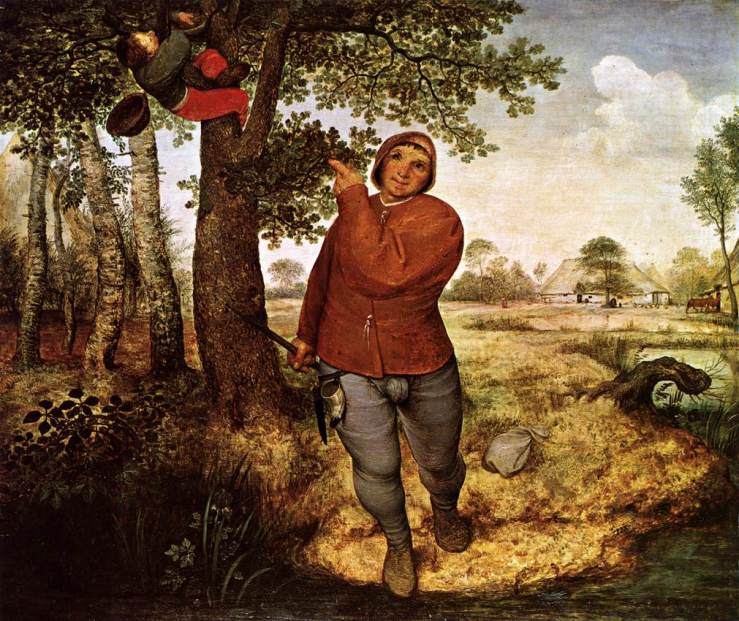
The Peasant and the Birdnester — Pieter Bruegel the Elder

the-peasant-and-the-birdnester

The Peasant and the Birdnester, 1568 by Pieter Bruegel the Elder (c. 1525-1569)

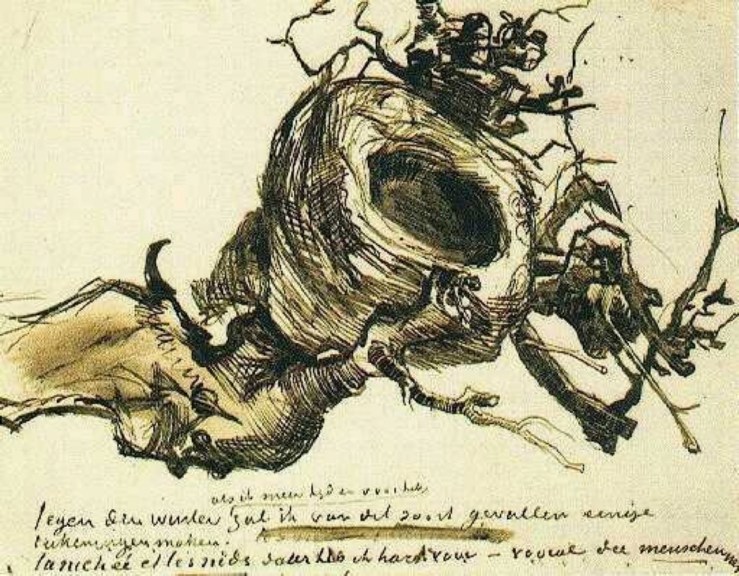
Bird’s Nest — Vincent van Gogh

bird-s-nest-18851

Bird’s Nest, 1885 by Vincent van Gogh (1843-1890)

Sometimes not so adequate | Nathaniel Hawthorne’s journal entry for July 14th, 1850

Lenox, July 14th.–The tops of the chestnut-trees have a whitish appearance, they being, I suppose, in bloom. Red raspberries are just through the season.

Language,–human language,–after all, is but little better than the croak and cackle of fowls and other utterances of brute nature,–sometimes not so adequate.

Nathaniel Hawthorne’s journal entry for July 14th, 1850. From Passages from the American Note-Books.

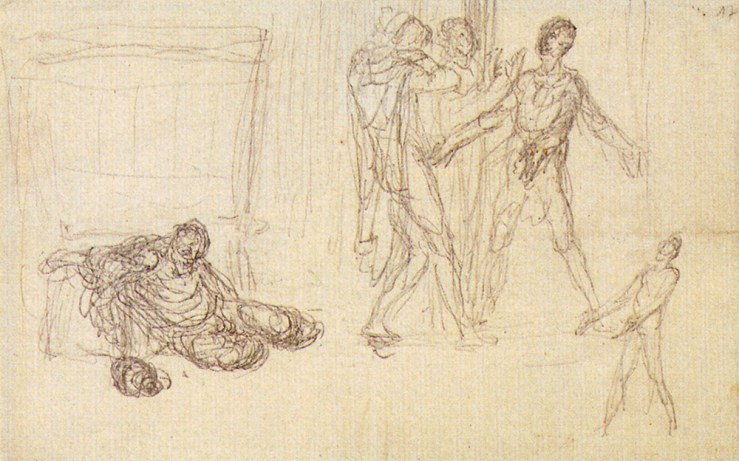
The Drunkenness of Noah — Jean-Francois Millet

the-drunkeness-of-noah

The Drunkenness of Noah (sketch) by Jean-Francois Millet (1814-1875)