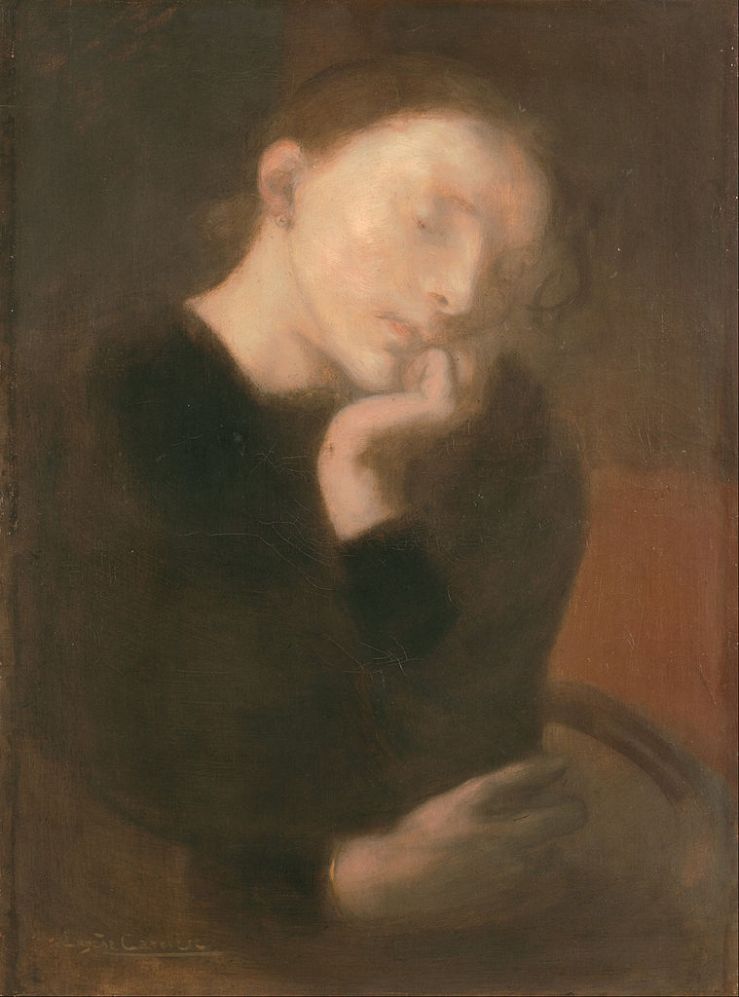
The Waiting Room — George Tooker

1969-47-43_1a

The Waiting Room, 1959 by George Tooker (1920-2011)

Crux Mystica — Agostino Arrivabene

crux-mystica-2017ba

Crux Mystica, 2017 by Agostino Arrivabene (b. 1967)

William H. Gass reads from his novel Middle C

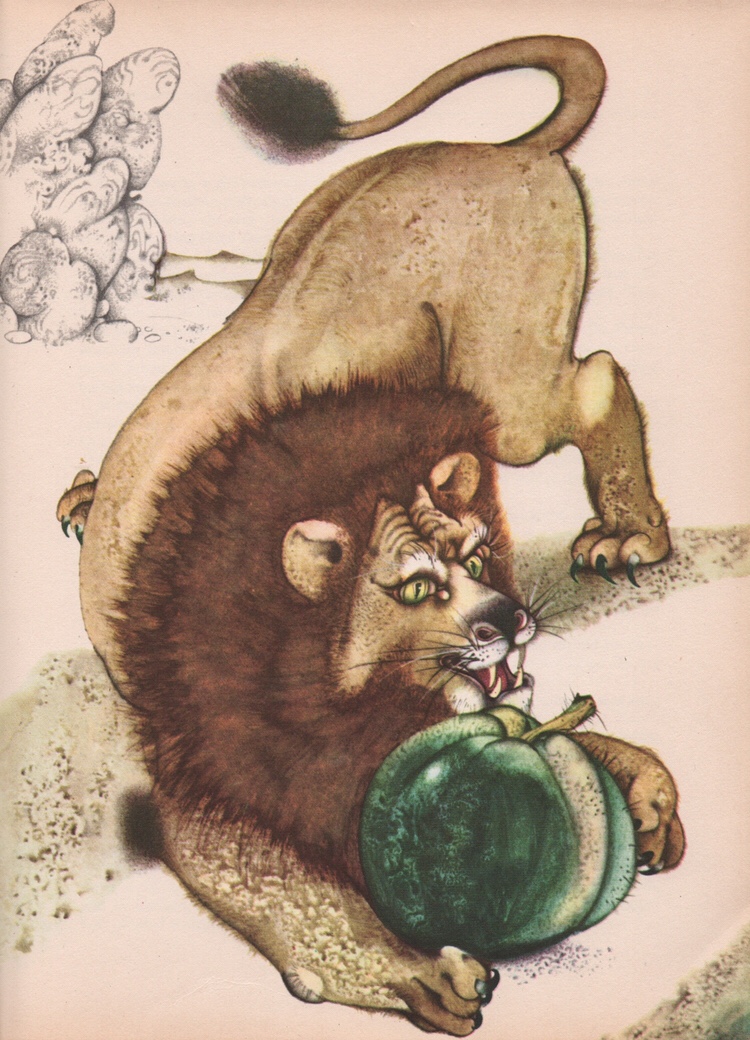
Animal Kingdom — Stella Snead

194620animal20kingdom

Animal Kingdom, 1946 by Stella Snead (1910-2006)


Nemesis (The Great Fortune) — Albrecht Durer

nemesis-the-great-fortune-1503

Nemesis (The Great Fortune), 1503 by Albrecht Durer (1471-1528)

Untitled (Lights) — William Eggleston

william-eggleston-untitled-c-1971-73-lights

Untitled, c. 1971-1973 by William Eggleston (b. 1939)

Censer — Martin Schongauer

censer

Censer, 1485 by Martin Schongauer (c. 1448-1491)

The School of Vanity — Jane Graverol

196720the20school20of20vanity20collage

The School of Vanity, 1967 by Jane Graverol (1909-1984)

The Tree of Wisdom — Wolfgang Grässe

199020the20tree20of20wisdom

The Tree of Wisdom, 1990 by Wolfgang Grässe (1930-2008)

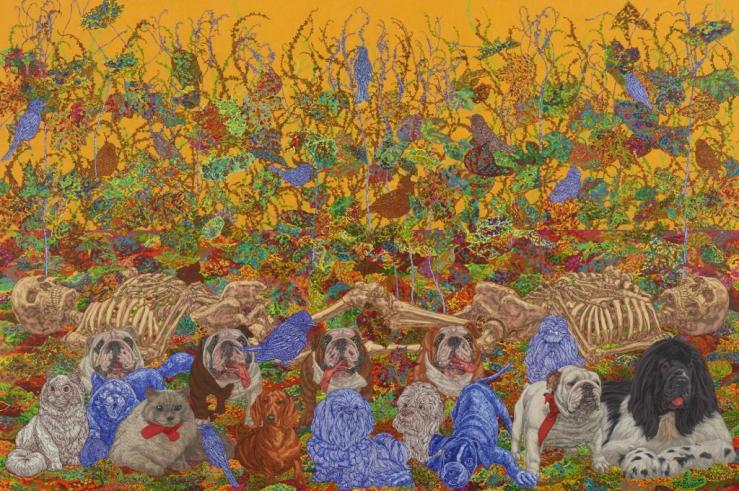
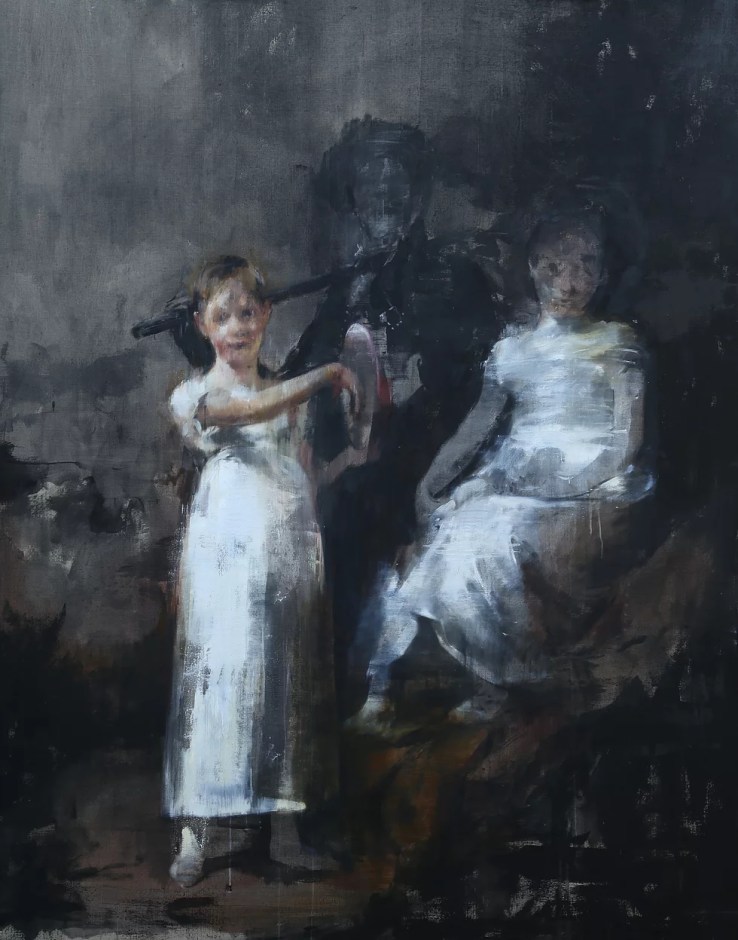
The Cave — Nicola Verlato

tumblr_ozcla7ohxz1res2syo1_1280Screenshot 2017-12-09 at 10.20.18 PMScreenshot 2017-12-09 at 10.20.02 PMScreenshot 2017-12-09 at 10.19.29 PMScreenshot 2017-12-09 at 10.21.57 PM

The Cave, 2017 by Nicola Verlato (b. 1965)

William H. Gass on postmodernism

William Gass: I don’t know whether The Tunnel’s hole is a trope for the Postmodern because I never understood Postmodernism. I’m not a Postmodernist. I only understand that term as it is used in architecture, where it makes some sense to me, and I don’t find the movement of much interest even there, simply eclectic and superficial. My work is probably best characterized as late or decayed Modern end of the road sort of thing, last gasp. All of my principles and models and so forth come from modernism. People may call The Tunnel Postmodern because of certain elements—visual, mostly—but everything I do has been done previously by other people. Even the dislocation and fragmentation is old stuff. Labels reflect the desire many people apparently have to give new life to old ways by conferring upon them new names. All kinds of exciting things are going on in the novel all over the world, and no one work puts an end to the production of another kind.

Jan Castro: Maybe we should trade our definitions of Postmodern. My definition, based on studying a bit with Sartre scholar Michel Rybalka, is the French idea, drawing from the range of sources that have existed both in modernist and in premodernist literatures. Modernism is a fairly strong rejection of the past whereas postmodernism recycles the past without taking it too seriously. According to my definition, you would be in the camp. You evidently have a different definition.

WG: Modernists all rode the recycling bike. The modernist tradition certainly rejects certain parts of the past, but only certain parts. Even when you have someone like Ezra Pound saying “make it new,” he’s going back to Provençal troubadours, to the Greeks. At the same time he’s saying this, he’s off stealing something from Confucius. So you can call, let’s say, Picasso modern, but he’s borrowing from Japanese, African, or other sources. This always takes place. What is important is not whether you are looking back (you had better), but how and for what reason. When you go back as a modernist in architecture, you’re going back to see, for instance, in Palladio, what you can discover about the very foundation of architecture. You can find in an earlier writer like Sterne, the very foundations of fiction—its possibilities. You don’t reach back to imitate them, to use Sterne like little signatures later on so people will say “Sterne!” When an architect suddenly starts using columns or round windows or friezes to remind us of the past, he’s probably only employing pastiche. But to go back to somebody with the idea of discovering what the art is all about, not by copying their style or mode, but by discovering the fundamental principles which they may help you to wield, that is what modernists tried to do at their best. Corbusier goes back to earlier principles to find out what architecture is all about, not to dance the Palladian polka.

I find Postmodernists rarely interested in fundamental things, but only interested in finding qualities of the past which they can decorate a modernist shed with. Most Postmodern buildings are merely modernist buildings wearing a different skirt, to switch the image. There are a few exceptions. Sterling’s Museum in Stuttgart, for example, is a triumph.

So when one returns to an earlier model, it’s not to copy something, it’s to refine the essence of the whole task. You know Cervantes understood fiction more deeply than almost anybody. You go back to find out what he knew if you can. That’s one more reason why certain people like Calvino or Borges or Beckett are so wonderful. They’re wondering what’s fundamental to their art. I undercut certain traditional forms in order to discover that beneath those superficial forms there is something that my novel, as crazy at it may appear, can share with a very well-mannered Jane Austen novel. We’re doing the same thing, basically.

JC: You have been put into the Postmodern camp by your friend Heide Ziegler.

WG: Yes, Heide certainly does, and most critics do. But when a number of us—John Barth and John Hawkes and I—were in Germany some years ago, and the Germans kept calling us postmodernists, we all rejected the label.

From an interview with William H. Gass published in Bomb #51, Spring 1995.

Self-Portrait — William H. Gass

gass_01_body

A reading madman about to lose his soul to the seductions of a sentence | William H. Gass

Stendhal’s The Red and the Black

Boston, 1943. I am about to go down to the submarine base to test out for the school there. I have come into possession of the Liveright Black and Gold edition. (What a wonderful series. I loved them all. There was Jules Romain’s The Body’s Rapture, a kooky, overwrought book, I know now, but it was sex, and it was French. There was Remy de Gourmont’s The Natural Philosophy of Love, more sex, more French. There was Balzac’s The Physiology of Marriage, more sex, more French. There was Stendhal’s own On Love, ditto. There was The Collected Works of Pierre Loüys, double dots, double ditto. There was Alexandre Dumas’s The Journal of Madame Giovanni, which was simply French, a disappointment. And The Red and the Black, like checker squares.) Anyway, I am lining up New London in my train table’s sights, and scanning the novel I have bought because of the series it is in, thinking that I’m not going to like climbing a rope through all that water, and thinking that the first chapter, a description of a small town, is commonplace, ho-hum, and will I be put in a pressure chamber at sub school like a canned tomato? When suddenly, I am suckered into Stendhal, and no longer read words (against all the rules of right reading I will later give myself), but barrel along like my own train, a runaway, holding my breath oftener and oftener, aware only of a insistently increasing tension, and it is not because I am underwater; it is because I am inside the magic of this narrative master. The Charterhouse of Parma would do exactly the same thing to me, except that I didn’t let a sub school come between us, but covered its lengthy length as nearly in one sitting as might be managed, snacking at the edge of it as though it were on a TV tray. That sort of gluttonous read is rare, and never happens to me now, when I read, because I read to write or teach or otherwise to talk, and not because I am a reading madman about to lose his soul to the seductions of a sentence.

From William H. Gass’s “Fifty Literary Pillars,” part of A Temple of Texts (2006). The essay in question is not so much an essay as it is/was a catalog to “inaugurate the International Writers Center” at Washington University.

The last sentence is what matters most to me; when I read it I nodded, or maybe didn’t nod, maybe just acquiesced in some other way, physically.

Who wouldn’t love to read like that again?

(Maybe persons young enough to not know that they are in fact reading like madpersons, seduced, etc.).

I tip my glass for gluttonous reads.

I would love to be a reading madman again, and not one who reads to write or read or otherwise talk.


William H. Gass reads from The Tunnel

Why are works of art so socially important? | William H. Gass

Why are works of art so socially important? Not for the messages they may contain, not because they expose slavery or cry hurrah for the worker, although such messages in their place and time might be important, but because they insist more than most on their own reality; because of the absolute way in which they exist. Certainly, images exist, shadows and reflections, fakes exist and hypocrites, there are counterfeits (quite real) and grand illusions – but it is simply not true for the copies are as real as their originals, that they meet all of the tests which I suggested earlier. Soybean steak, by God, is soybean steak, and a pious fraud is a fraud. Reality is not a matter of fact, it is an achievement; and it is rare – rarer, let me say – than an undefeated football season. We live, most of us, amidst lies, deceit, and confusions. A work of art may not utter the truth, but it must be honest. It may champion a cause we deplore, but like Milton’s Satan, it must in itself be noble; it must be all there. Works of art confront us the way few people dare to: completely, openly, at once. They construct, they comprise, our experience; they do not deny or destroy it; and they shame us, we fall so short of the quality of their Being. We live in Lafayette or Rutland – true. We take our breaths. We fornicate and feed. But Hamlet has his history in the heart and none of us will ever be as real as vital, as complex and living as he is – a total creature of the stage. 

From William H. Gass’s essay “The Artist and Society” (1968). Collected in Fiction and the Figures of Life.

The aim of the artist | William H. Gass

The aim of the artist ought to be to bring into the world objects which do not already exist there, and objects which are especially worthy of love. We meet people, grow to know them slowly, settle on some to companion our life. Do we value our friends for their social status, because they are burning in the public blaze? do we ask of our mistress her meaning? calculate the usefulness of our husband or wife? Only too often. Works of art are meant to be lived with and loved, and if we try to understand them, we should try to understand them as we try to understand anyone—in order to know them better, not in order to know something else.

–From William H. Gass’s essay “The Artist and Society” (1968). Collected in Fiction and the Figures of Life.

“Tea” — Wallace Stevens

Screenshot 2017-07-23 at 9.39.40 AM