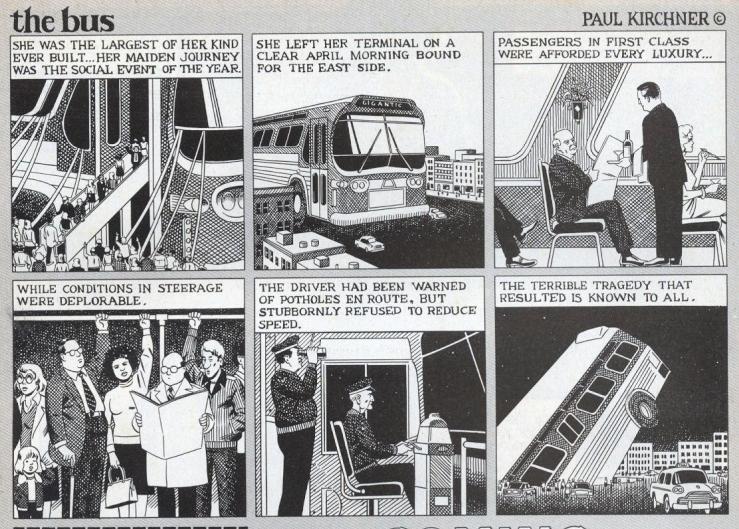
The Bus — Paul Kirchner

CHA1bA6 - Imgur

Still Life with Peppers — Ralph Goings

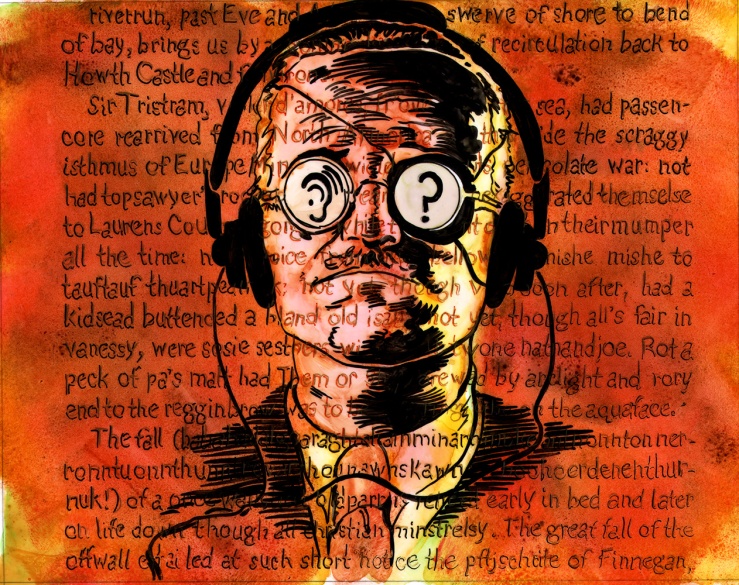
The Great Serpent holding its own tail in its mouth (Gravity’s Rainbow)

Kekulé dreams the Great Serpent holding its own tail in its mouth, the dreaming Serpent which surrounds the World. But the meanness, the cynicism with which this dream is to be used. The Serpent that announces, “The World is a closed thing, cyclical, resonant, eternally-returning,” is to be delivered into a system whose only aim is to violate the Cycle. Taking and not giving back, demanding that “productivity” and “earnings” keep on increasing with time, the System removing from the rest of the World these vast quantities of energy to keep its own tiny desperate fraction showing a profit: and not only most of humanity—most of the World, animal, vegetable and mineral, is laid waste in the process. The System may or may not understand that it’s only buying time. And that time is an artificial resource to begin with, of no value to anyone or anything but the System, which sooner or later must crash to its death, when its addiction to energy has become more than the rest of the World can supply, dragging with it innocent souls all along the chain of life. Living inside the System is like riding across the country in a bus driven by a maniac bent on suicide… though he’s amiable enough, keeps cracking jokes back through the loudspeaker, “Good morning folks, this is Heidelberg here we’re coming into now, you know the old refrain, ‘I lost my heart in Heidelberg,’ well I have a friend who lost both his ears here! Don’t get me wrong, it’s really a nice town, the people are warm and wonderful—when they’re not dueling. Seriously though, they treat you just fine, they don’t just give you the key to the city, they give you the bung-starter!” u.s.w. On you roll, across a countryside whose light is forever changing—castles, heaps of rock, moons of different shapes and colors come and go. There are stops at odd hours of the mornings, for reasons that are not announced: you get out to stretch in lime-lit courtyards where the old men sit around the table under enormous eucalyptus trees you can smell in the night, shuffling the ancient decks oily and worn, throwing down swords and cups and trumps major in the tremor of light while behind them the bus is idling, waiting—passengers will now reclaim their seats and much as you’d like to stay, right here, learn the game, find your old age around this quiet table, it’s no use: he is waiting beside the door of the bus in his pressed uniform, Lord of the Night he is checking your tickets, your ID and travel papers, and it’s the wands of enterprise that dominate tonight… as he nods you by, you catch a glimpse of his face, his insane, committed eyes, and you remember then, for a terrible few heartbeats, that of course it will end for you all in blood, in shock, without dignity—but there is meanwhile this trip to be on… over your own seat, where there ought to be an advertising plaque, is instead a quote from Rilke: “Once, only once…” One of Their favorite slogans. No return, no salvation, no Cycle—that’s not what They, nor Their brilliant employee Kekulé, have taken the Serpent to mean. No: what the Serpent means is—how’s this—that the six carbon atoms of benzene are in fact curled around into a closed ring, just like that snake with its tail in its mouth, GET IT?

From pages 412-13 of Thomas Pynchon’s novel Gravity’s Rainbow.

“The Banjo Player” — Fenton Johnson

Screenshot 2015-05-02 at 8.59.16 AM

The Second of May, 1808: The Charge of the Mamelukes — Francisco Goya

The Changeling — Henry Fuseli

“All art constantly aspires towards the condition of music”

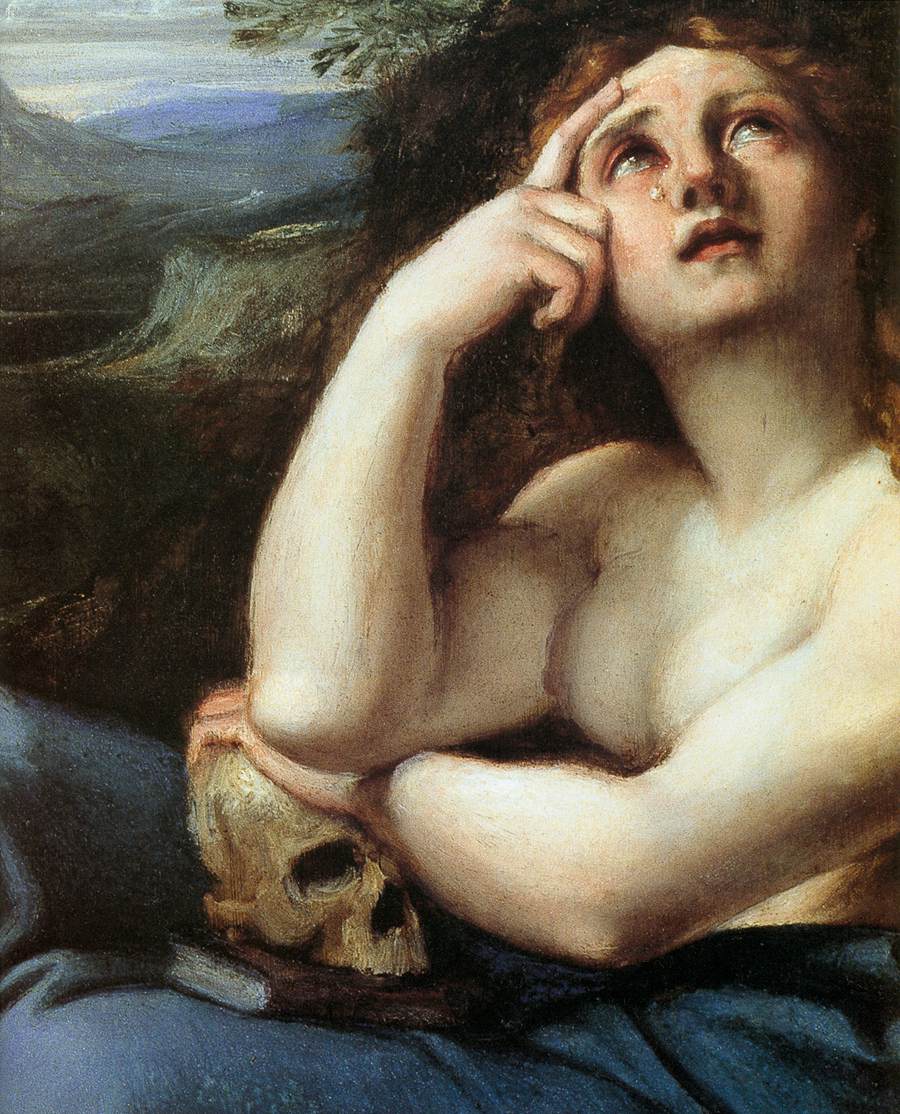
Cain Flying before Jehovah’s Curse — Fernand Cormon

Maypole (The Wicker Man)

May Day, Central Park — Maurice Prendergast

Interior with a Cactus — Carl Larsson

“The Hedgehog, the Fox and His Seventy-Seven Brains”

image

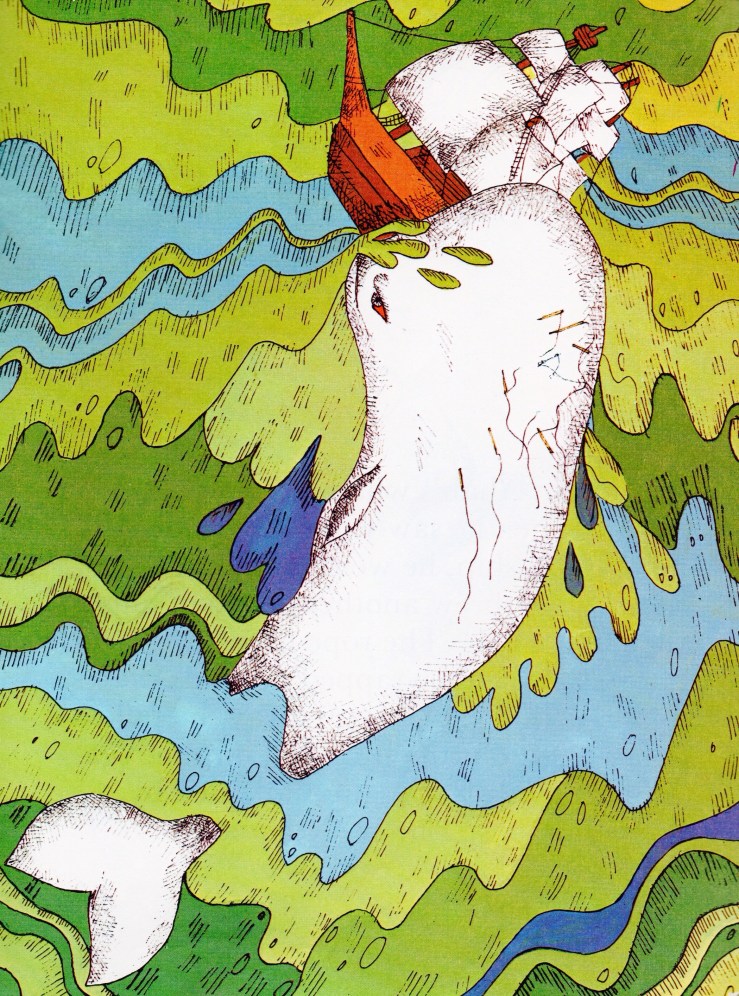
A Serbian fairy tale retold by Alena Benesova and translated into English by Ruth Shepherd. The marvelous illustration is by Karel Franta. From Animal Fairy Stories.


History is an attempt to make the past seem stable (William Carlos Williams)

Screenshot 2015-04-30 at 2

Study of the Graduations of Shadows on Spheres — Leonardo da Vinci

Kant’s coffee

At the beginning of the last year of his life, he fell into a custom of taking, immediately after dinner, a cup of coffee, especially on those days when it happened that I was of his party. And such was the importance that he attached to his little pleasure that he would even make a memorandum beforehand, in the blank paper book that I had given him, that on the next day I was to dine with him, and consequently “that there was to be coffee.” Sometimes in the interest of conversation, the coffee was forgotten, but not for long. He would remember and with the querulousness of old age and infirm health would demand that coffee be brought “upon the spot.” Arrangements had always been made in advance, however; the coffee was ground, and the water was boiling: and in the very moment the word was given, the servant shot in like an arrow and plunged the coffee into the water. All that remained, therefore, was to give it time to boil up. But this trifling delay seemed unendurable to Kant. If it were said, “Dear Professor, the coffee will be brought up in a moment,” he would say, “Will be! There’s the rub, that it only will be.” Then he would quiet himself with a stoical air, and say, “Well, one can die after all; it is but dying; and in the next world, thank God, there is no drinking of coffee and consequently no waiting for it.”

When at length the servant’s steps were heard upon the stairs, he would turn round to us, and joyfully call out: “Land, land! my dear friends, I see land.”

This anecdote of Thomas de Quincey’s is from William H. Ukers’s All About Coffee (1922). Ukers introduces the quote: “In his old age, Immanuel Kant, the great metaphysician, became extremely fond of coffee; and Thomas de Quincey relates a little incident showing Kant’s great eagerness for the after-dinner cup.”

Bouquet of Violets — Edouard Manet