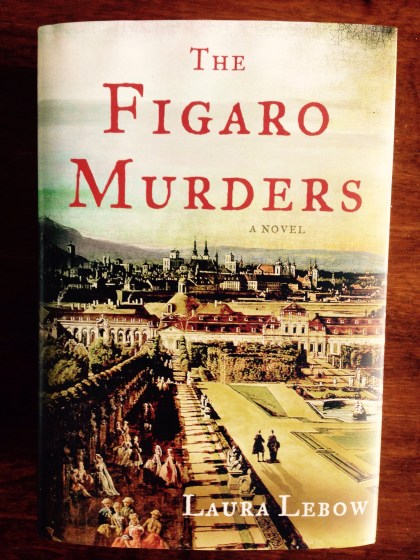
The Figaro Murders (Book acquired some time in February, 2015)

IMG_5571

Laura Lebow’s mystery The Figaro Murders is new in hardback from Macmillan’s Minotaur imprint. Their blurb:

In 1786 Vienna, Lorenzo Da Ponte is the court librettist for the Italian Theatre during the height of the enlightened reign of Emperor Joseph II. This exalted position doesn’t mean he’s particularly well paid, or even out of reach of the endless intrigues of the opera world. In fact, far from it.

One morning, Da Ponte stops off at his barber, only to find the man being taken away to debtor’s prison. Da Ponte impetuously agrees to carry a message to his barber’s fiancée and try to help her set him free, even though he’s facing pressures of his own. He’s got one week to finish the libretto for The Marriage of Figaro for Mozart before the opera is premiered for the Emperor himself.
Da Ponte visits the house where the barber’s fiancée works–the home of a nobleman, high in the Vienna’s diplomatic circles–and then returns to his own apartments, only to be dragged from his rooms in the middle of the night. It seems the young protégé of the diplomat was killed right about the time Da Ponte was visiting, and he happens to be their main suspect. Now he’s given a choice–go undercover into the household and uncover the murderer, or be hanged for the crime himself.
Brilliantly recreating the cultural world of late 18th century Vienna, the epicenter of the Enlightenment, Lebow brings to life some of the most famous figures of music, theatre, and politics.

“Our April Letter” — F. Scott Fitzgerald

This is April again. Roller skates rain slowly down the street
Your voice far away on the phone
Once I would have jumped like a clown through a hoop—
but
“Then the area of infection has increased? …oh …What can I expect after all—I’ve had worse shocks.
Anyhow, I know and that’s something.” (Like hell it is, but it’s what you say to an X-ray doctor.)
Then the past whispering faint now on another phone:
“Is there any change?”
“Little or no change”
“I see”
The roller skates rain down the streets,
The black cars shine between the leaves,
Your voice far away:
“I am going with my daughter to the country. My husband left today. . . No he knows nothing.”
“Good”.
I have asked a lot of my emotions—one hundred and twenty stories, The price was high, right up with Kipling, because there was one little drop of something not blood, not a tear, not my seed, but me more intimately than these, in every story, it was the extra I had. Now it has gone and I am just like you now.
Once the phial was full—here is the bottle it came in.
Hold on there’s a drop left there. . . No, it was just the way the light fell
But your voice on the telephone. If I hadn’t abused words so what you said might have meant something.
But one hundred and twenty stories
April evening spreads over everything, the purple blur left by a child who has used the whole paint-box.

“Our April Letter” is from F. Scott Fitzgerald’s Notebooks.


A Lady with a Cat — Giovanni Boldini

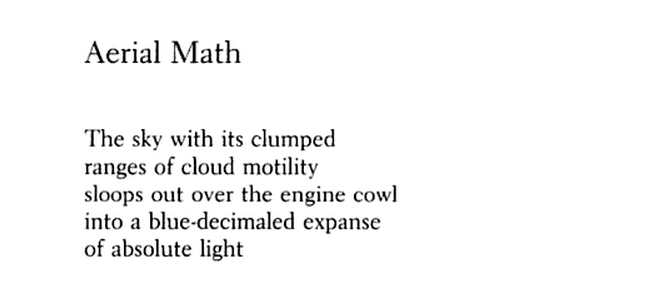
“Aerial Math” — Tom Clark

Screenshot 2015-03-31 at 4.03.24 PM

A universal sense of guilt or an attitude of universal accusation (Italo Calvino)

…if it is impossible today for anyone to feel innocent, if in whatever we do or say we can discover a hidden motive – that of a white man,or a male, or the possessor of a certain income, or a member of a given economic system, or a suffer from a certain neurosis – this should not induce in us either a universal sense of guilt or an attitude of universal accusation.

When we become aware of our disease or of our hidden motives, we have already begun to get the better of them. What matters is the way in which we accept our motives and live through the ensuing crisis. This is the only chance we have of becoming different from the way we are – that is, the only way of starting to invent a new way of being.

From Italo Calvino’s essay “Right and Wrong Uses of Political Uses of Literature.” The essay was delivered as a lecture–in English–in 1976. (Translation credit for the volume the essay is collected in, The Uses of Literature, goes to Patrick Creagh).

The Eternal Evidence — Rene Magritte

Geoff Dyer’s Another Great Day at Sea (Book acquired, 3.26.2015)

IMG_5682

Another Great Day at Sea, Geoff Dyer’s account of life (okay, two weeks of life) on board a U.S. aircraft carrier, is new in trade paperback next week from Random House. Their blurb:

As a child Geoff Dyer spent long hours making and blotchily painting model fighter planes. So as an adult, naturally he jumped at the chance to spend a week onboard the aircraft carrier the USS George H.W. Bush. Part deft travelogue, part unerring social observation, and part finely honed comedy, Another Great Day at Sea is the inimitable Dyer’s account of his time spent wandering the ship’s maze of walkways, hatches, and stairs, and talking with the crew—from the Captain to the ship’s dentists. A lanky Englishman in a deeply American world, Dyer brilliantly records daily life aboard this floating fortress, revealing it to be a prism for understanding a society where discipline and conformity become forms of self-expression. At the same time we are reminded why Dyer is celebrated as one of the most original voices in contemporary literature.

Read an excerpt here.

Always eat grapes downwards (Samuel Butler)

Always eat grapes downwards—that is, always eat the best grape first; in this way there will be none better left on the bunch, and each grape will seem good down to the last.  If you eat the other way, you will not have a good grape in the lot.  Besides, you will be tempting Providence to kill you before you come to the best.  This is why autumn seems better than spring: in the autumn we are eating our days downwards, in the spring each day still seems “Very bad.”  People should live on this principle more than they do, but they do live on it a good deal; from the age of, say, fifty we eat our days downwards.

In New Zealand for a long time I had to do the washing-up after each meal.  I used to do the knives first, for it might please God to take me before I came to the forks, and then what a sell it would have been to have done the forks rather than the knives!

From Samuel Butler’s Note-Books

Landscape with Couple Walking and Crescent Moon — Vincent van Gogh

Brief internal feminist critique (perhaps) of Gravity’s Rainbow

tnagr

From page 507 of Thomas Pynchon’s novel Gravity’s Rainbow.

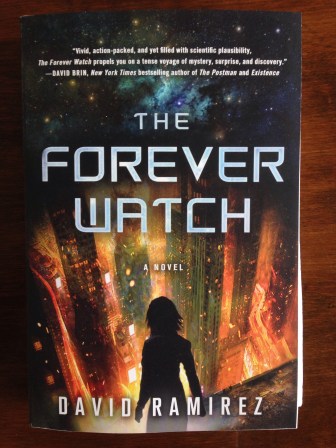
The Forever Watch (Book acquired some time in February, 2015)

IMG_5281Can’t seem to keep up with the review copies lately.

David Ramirez’s The Forever Watch is new from St. Martin’s Griffin imprint. Their blurb:

An exciting new novel from a bold up-and-coming sci fi talent, The Forever Watchis so full of twists and surprises it’s impossible to put down.
All that is left of humanity is on a thousand-year journey to a new planet aboard one ship, The Noah, which is also carrying a dangerous serial killer…
As a City Planner on the Noah, Hana Dempsey is a gifted psychic, economist, hacker and bureaucrat and is considered “mission critical.” She is non-replaceable, important, essential, but after serving her mandatory Breeding Duty, the impregnation and birthing that all women are obligated to undergo, her life loses purpose as she privately mourns the child she will never be permitted to know.
When Policeman Leonard Barrens enlists her and her hacking skills in the unofficial investigation of his mentor’s violent death, Dempsey finds herself increasingly captivated by both the case and Barrens himself. According to Information Security, the missing man has simply “Retired,” nothing unusual. Together they follow the trail left by the mutilated remains. Their investigation takes them through lost dataspaces and deep into the uninhabited regions of the ship, where they discover that the answer may not be as simple as a serial killer after all.

What they do with that answer will determine the fate of all humanity in David Ramirez’s thrilling page turner.

A Perfect Vacuum — Jeremy Geddes

Jeremy-Geddes-Levine-Exhale-AM-1-1

Art is jealous (Van Gogh)

I know it is late, but I really must write you a few lines. You are not here and I miss you, though I feel as if we were not so very far from each other.

I have just decided to pay no further heed to my indisposition, or rather to all that is left of it. Enough time has been lost and I must not neglect my work. Therefore, whether I am well or not, I shall again draw regularly from morn till night. I do not want anybody to be able again to say of my work: “Ah, those are all old drawings!”

…In my opinion my hands have grown too delicate; but what can I do? I shall go out again, even if it cost me a good deal; for my chief concern is that I should not neglect my work any longer. Art is jealous; she will not allow illness to take precedence of her. And I give in to her.

…Men like myself really have no right to be ill. But you must understand what my attitude is to Art. In order to attain to real Art one must work both hard and long. The thing I have set my mind upon as the goal of all my efforts is devilish difficult, and yet I do not think that I am aiming too high. I will make drawings that will amaze some people.

In short I will bring it to such a pitch, that they will say of my work: “The man feels deeply and he is subtle withal”; in spite of my so-called coarseness, do you understand? maybe precisely on that account. At present it sounds presumptuous to speak in this way; but it is for this very reason that I wish to put vigour into my work.

For what am I in the eyes of most people? A nonentity, or an oddity, or a disagreeable man, some one who neither has nor ever will have any place in society—in short something less than the least.

Well, granting that this is so, I should like to show by my work what the heart of such a nonentity, of such an insignificant man, conceals.

This is my ambition which for all that is the outcome more of love than of resentment, more of a feeling of peaceful serenity than of passion. And even though I often have to contend with all kinds of difficulties, yet I feel within me a calm, pure harmony and music.

Art requires resolute and unremitting industry, as well as incessant observation. By resolute industry I mean, in the first place, constant industry, as also the power of maintaining one’s own point of view against the assertions of others.

Latterly I have had precious little intercourse with other painters and have not felt any the worse for it. One should not pay so much heed to the teaching of painters as to the teaching of Nature. I can understand better now than I did six months ago that Mauve should have been able to say: “Do not speak to me about Dupré; speak to me rather about the edge of your ditch, or things of that sort.” It certainly sounds strange, but it is absolutely right. A feeling for things in themselves, for reality, is much more important than a sense of the pictorial. It is more fruitful and animating.

In regard to the difference between ancient and modern Art, I should like to say that I think modern painters are perhaps greater thinkers.

Rembrandt and Ruysdael seem to us great and sublime, just as they did to their contemporaries; but there is something more personal and more intimate in the modern painter, which makes a stronger appeal to us.

I made another study of the little child’s cradle to-day, and have put in colour here and there. I trust I may yet be able to draw the little cradle a hundred times over resolutely.
From a letter Vincent van Gogh wrote to his brother. Translated by Anthony Ludovici and collected in The Letters of a Post-Impressionist, Being the Familiar Correspondence of Vincent Van Gogh.

Study of Helen — Gustave Moreau

The Mother Conspiracy (Gravity’s Rainbow)

Otto is earnestly explaining his views on the Mother Conspiracy. It’s not often a sympathetic girl will listen. The Mothers get together once a year, in secret, at these giant conventions, and exchange information. Recipes, games, key phrases to use on their children. “What did yours use to say when she wanted to make you feel guilty?”

“‘I’ve worked my fingers to the bone!’” sez the girl.

“Right! And she used to cook those horrible casseroles, w-with the potatoes, and onions—”

“And ham! Little pieces of ham—”

“You see, you see? That can’t be accidental! They have a contest, for Mother of the Year, breast-feeding, diaper-changing, they time them, casserole competitions, ja—then, toward the end, they actually begin to use the children. The State Prosecutor comes out on stage. ‘In a moment, Albrecht, we are going to bring your mother on. Here is a Luger, fully loaded. The State will guarantee you absolute immunity from prosecution. Do whatever you wish to do—anything at all. Good luck, my boy.’ The pistols are loaded with blanks, natürlich, but the unfortunate child does not know this. Only the mothers who get shot at qualify for the finals.

Here they bring in psychiatrists, and judges sit with stopwatches to see how quickly the children will crack. ‘Now then, Olga, wasn’t it nice of Mutti to break up your affair with that long-haired poet?’ ‘We understand your mother and you are, ah, quite close, Hermann. Remember the time she caught you masturbating into her glove? Eh?’ Hospital attendants stand by to drag the children off, drooling, screaming, having clonic convulsions. Finally there is only one Mother left on stage. They put the traditional flowered hat on her head, and hand her the orb and scepter, which in this case are a gilded pot roast and a whip, and the orchestra plays Tristan und Isolde.

From Thomas Pynchon’s novel Gravity’s Rainbow.

Christ’s Entry into Jerusalem – Stanley Spencer

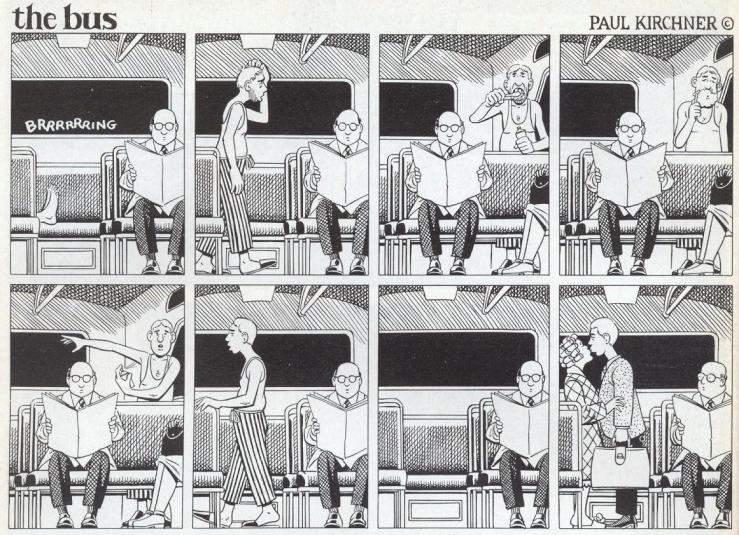
The Bus — Paul Kirchner

jMsHjMt - Imgur