Detail from the Portinari Triptych — Hugo van der Goes

christ

He’s making a list (The Far Side)

9 ways

Some content on this page was disabled on May 26, 2021 as a result of a DMCA takedown notice from Gary Larson. You can learn more about the DMCA here:

https://wordpress.com/support/copyright-and-the-dmca/

“Vanka” — Anton Chekhov

“Vanka”

by

Anton Chekhov

Nine-year-old Vanka Zhukov, who had been apprentice to the shoemaker Aliakhin for three months, did not go to bed the night before Christmas. He waited till the master and mistress and the assistants had gone out to an early church-service, to procure from his employer’s cupboard a small phial of ink and a penholder with a rusty nib; then, spreading a crumpled sheet of paper in front of him, he began to write.

Before, however, deciding to make the first letter, he looked furtively at the door and at the window, glanced several times at the sombre ikon, on either side of which stretched shelves full of lasts, and heaved a heart-rending sigh. The sheet of paper was spread on a bench, and he himself was on his knees in front of it.

“Dear Grandfather Konstantin Makarych,” he wrote, “I am writing you a letter. I wish you a Happy Christmas and all God’s holy best. I have no mamma or papa, you are all I have.”

Vanka gave a look towards the window in which shone the reflection of his candle, and vividly pictured to himself his grandfather, Konstantin Makarych, who was night-watchman at Messrs. Zhivarev. He was a small, lean, unusually lively and active old man of sixty-five, always smiling and blear-eyed. All day he slept in the servants’ kitchen or trifled with the cooks. At night, enveloped in an ample sheep-skin coat, he strayed round the domain tapping with his cudgel. Behind him, each hanging its head, walked the old bitch Kashtanka, and the dog Viun, so named because of his black coat and long body and his resemblance to a loach. Viun was an unusually civil and friendly dog, looking as kindly at a stranger as at his masters, but he was not to be trusted. Beneath his deference and humbleness was hid the most inquisitorial maliciousness. No one knew better than he how to sneak up and take a bite at a leg, or slip into the larder or steal a muzhik’s chicken. More than once they had nearly broken his hind-legs, twice he had been hung up, every week he was nearly flogged to death, but he always recovered. Continue reading ““Vanka” — Anton Chekhov”

Christmas Fortune Telling — Konstantin Makovsky

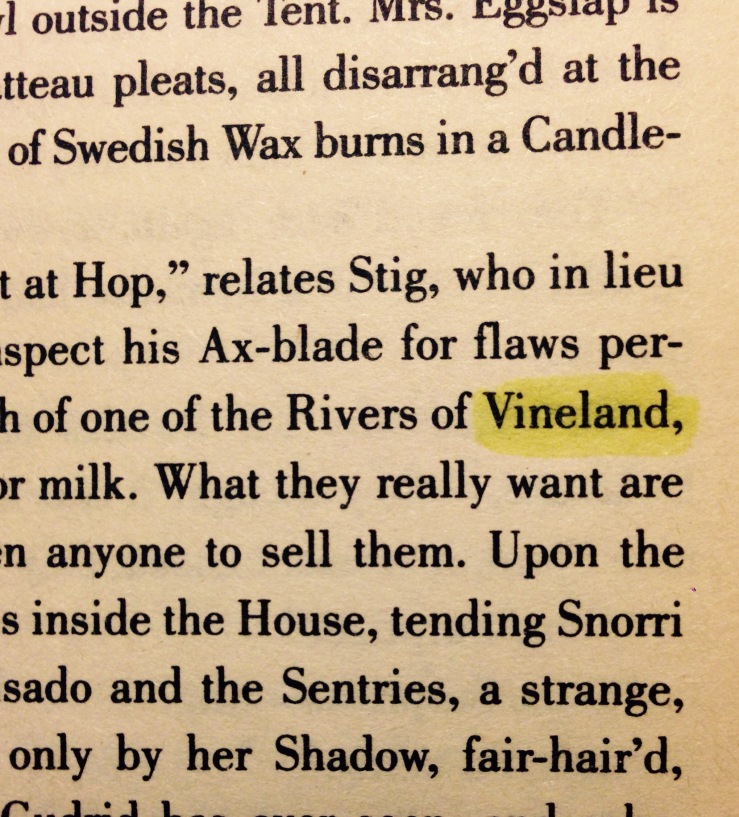
Vineland (Thomas Pynchon’s Mason & Dixon)

IMG_4503

From the beginning of ch. 66 of Mason & Dixon; see also.

Merry Christmas (Life in Hell)

IMG_0110.PNG


The Nursery (Christmas Stockings) — Stanley Spencer

Read “The Fir-Tree,” Hans Christian Andersen’s Depressing Story About the Existential Fate of a Christmas Tree

“The Fir-Tree” by Hans Christian Andersen

Far down in the forest, where the warm sun and the fresh air made a sweet resting-place, grew a pretty little fir-tree; and yet it was not happy, it wished so much to be tall like its companions— the pines and firs which grew around it. The sun shone, and the soft air fluttered its leaves, and the little peasant children passed by, prattling merrily, but the fir-tree heeded them not. Sometimes the children would bring a large basket of raspberries or strawberries, wreathed on a straw, and seat themselves near the fir-tree, and say, “Is it not a pretty little tree?” which made it feel more unhappy than before. And yet all this while the tree grew a notch or joint taller every year; for by the number of joints in the stem of a fir-tree we can discover its age. Still, as it grew, it complained, “Oh! how I wish I were as tall as the other trees, then I would spread out my branches on every side, and my top would over-look the wide world. I should have the birds building their nests on my boughs, and when the wind blew, I should bow with stately dignity like my tall companions.” The tree was so discontented, that it took no pleasure in the warm sunshine, the birds, or the rosy clouds that floated over it morning and evening. Sometimes, in winter, when the snow lay white and glittering on the ground, a hare would come springing along, and jump right over the little tree; and then how mortified it would feel! Two winters passed, and when the third arrived, the tree had grown so tall that the hare was obliged to run round it. Yet it remained unsatisfied, and would exclaim, “Oh, if I could but keep on growing tall and old! There is nothing else worth caring for in the world!” In the autumn, as usual, the wood-cutters came and cut down several of the tallest trees, and the young fir-tree, which was now grown to its full height, shuddered as the noble trees fell to the earth with a crash. After the branches were lopped off, the trunks looked so slender and bare, that they could scarcely be recognized. Then they were placed upon wagons, and drawn by horses out of the forest. “Where were they going? What would become of them?” The young fir-tree wished very much to know; so in the spring, when the swallows and the storks came, it asked, “Do you know where those trees were taken? Did you meet them?”

The swallows knew nothing, but the stork, after a little reflection, nodded his head, and said, “Yes, I think I do. I met several new ships when I flew from Egypt, and they had fine masts that smelt like fir. I think these must have been the trees; I assure you they were stately, very stately.”

“Oh, how I wish I were tall enough to go on the sea,” said the fir-tree. “What is the sea, and what does it look like?”

“It would take too much time to explain,” said the stork, flying quickly away.

“Rejoice in thy youth,” said the sunbeam; “rejoice in thy fresh growth, and the young life that is in thee.”

And the wind kissed the tree, and the dew watered it with tears; but the fir-tree regarded them not. Continue reading “Read “The Fir-Tree,” Hans Christian Andersen’s Depressing Story About the Existential Fate of a Christmas Tree”

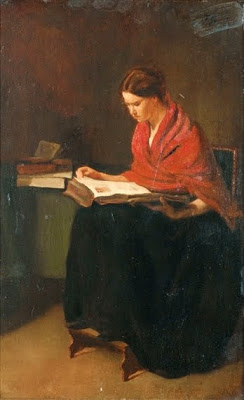
Seated Woman Reading — François Bonvin

Bonvin,  François Femme au chale rouge lisant

The Thurston Moore Apartment Tour, 1988


I don’t know.

Jeez.

All of this made me laugh. Thurston Moore avoids being interviewed by riffing on the objects of the apartment he shared with (his then-spouse) Kim Gordon. He talks about his label Ecstatic Peace. He shares the old zines he made. He refers to the Beastie Boys as “legendary jerks.” He praises Michael Gira of the Swans. He showcases his files. He tries to give the director or cameraperson (?) a Sly Stone record. He grips an SST coffee mug, which hey why don’t I own that? He frequently praises Raymond Pettibon. He frequently worries that Ms. Gordon wouldn’t want him to be showing all this shit off. He frequently gets facts wrong. (Nick Cave is well known to be Australian). He discusses his bookshelf. He literally shows his dirty laundry. He plays a little piano. His tongue is always in his cheek. He eats shoe grapes. He fibs drolly. He is charismatic. He calls a suspicious Lee Renaldo about “Sonic business.” (Mr. Renaldo is watching Spinal Tap; both agree it’s a “very sad film”). He makes a case for Sonic Youth as a kind of pre-internet curatorial force. He makes me laugh.

Ward in the Hospital at Arles — Vincent van Gogh

A Mason & Dixon Christmastide (Thomas Pynchon)

They discharge the Hands and leave off for the Winter. At Christmastide, the Tavern down the Road from Harlands’ opens its doors, and soon ev’ryone has come inside. Candles beam ev’rywhere. The Surveyors, knowing this year they’ll soon again be heading off in different Directions into America, stand nodding at each other across a Punch-bowl as big as a Bathing-Tub. The Punch is a secret Receipt of the Landlord, including but not limited to peach brandy, locally distill’d Whiskey, and milk. A raft of long Icicles broken from the Eaves floats upon the pale contents of the great rustick Monteith. Everyone’s been exchanging gifts. Somewhere in the coming and going one of the Children is learning to play a metal whistle. Best gowns rustle along the board walls. Adults hold Babies aloft, exclaiming, “The little Sausage!” and pretending to eat them. There are popp’d Corn, green Tomato Mince Pies, pickl’d Oysters, Chestnut Soup, and Kidney Pudding. Mason gives Dixon a Hat, with a metallick Aqua Feather, which Dixon is wearing. Dixon gives Mason a Claret Jug of silver, crafted in Philadelphia. There are Conestoga Cigars for Mr. Harland and a Length of contraband Osnabrigs for Mrs. H. The Children get Sweets from a Philadelphia English-shop, both adults being drawn into prolong’d Negotiations with their Juniors, as to who shall have which of. Mrs. Harland comes over to embrace both Surveyors at once. “Thanks for simmering down this Year. I know it ain’t easy.”
“What a year, Lass,” sighs Dixon.
“Poh. Like eating a Bun,” declares Mason.”

The last paragraphs of Ch. 52 of Thomas Pynchon’s novel Mason & Dixon.

The City Rises — Umberto Boccioni

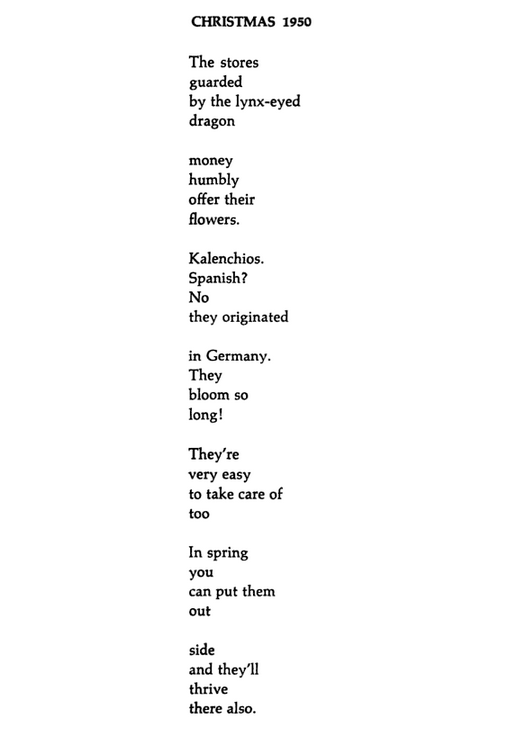
“Christmas 1950” — William Carlos Williams

wcw

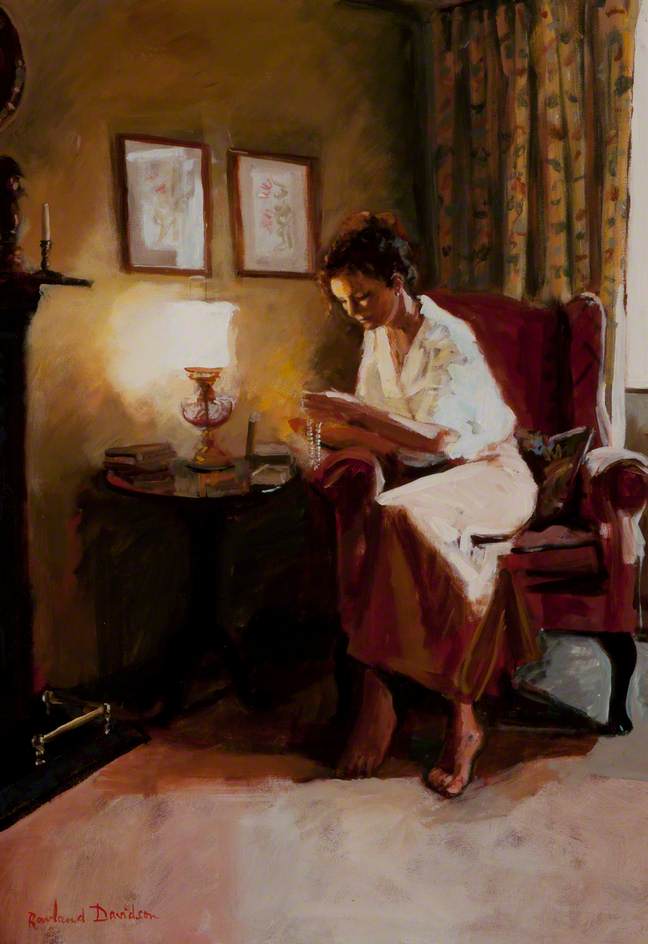
Lady Reading a Book by Lamplight — Rowland Davidson

(c) Rowland Davidson; Supplied by The Public Catalogue Foundation

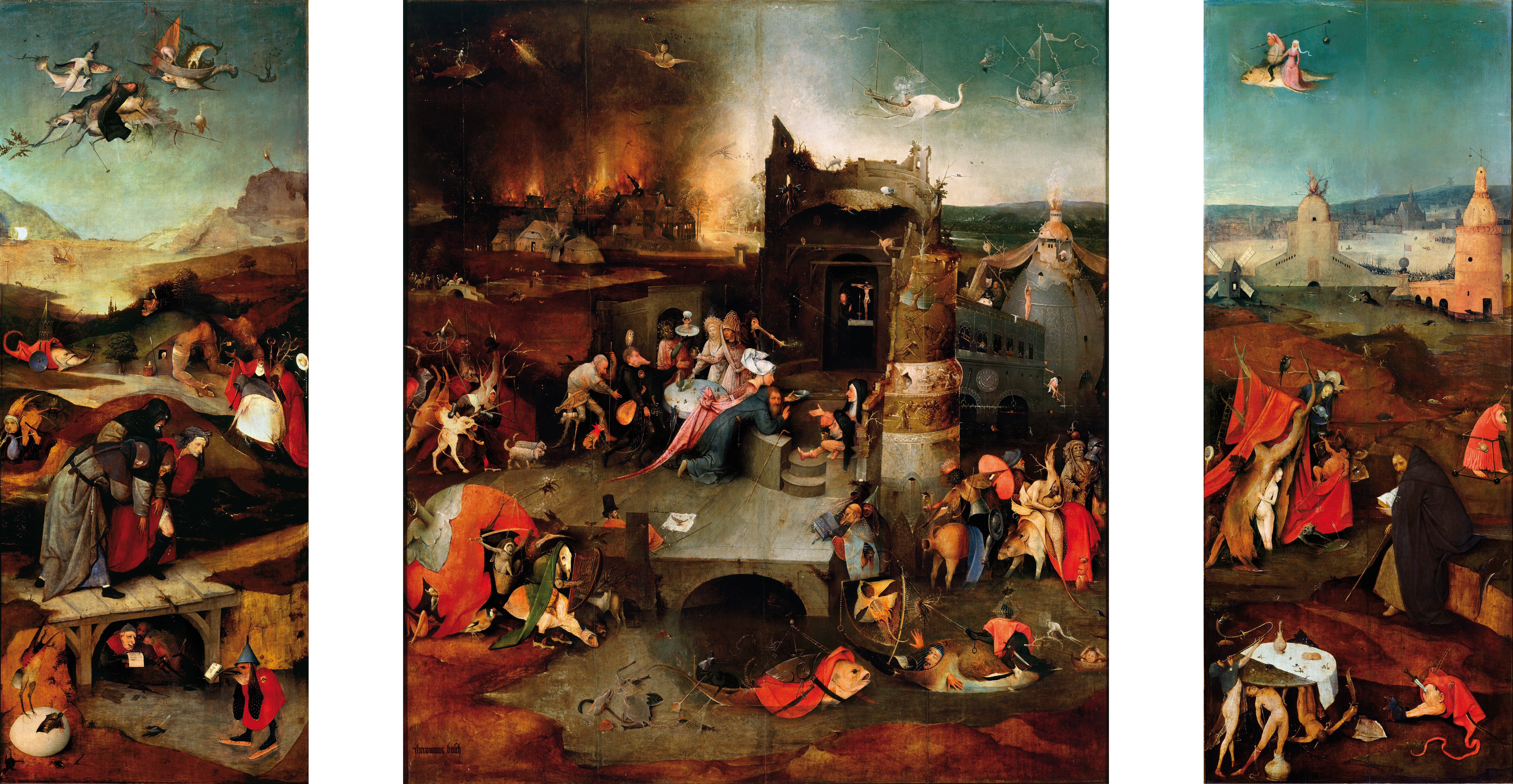
The Temptation of St. Anthony (Detail) — Hieronymus Bosch

12

There are a Mason and Dixon in Hell (Thomas Pynchon)

DePugh recalls a Sermon he once heard at a church-ful of German Mysticks. “It might have been a lecture in Mathematics. Hell, beneath our feet, bounded,— Heaven, above our pates, unbounded. Hell a collapsing Sphere, Heaven an expanding one. The enclosure of Punishment, the release of Salvation. Sin leading us as naturally to Hell and Compression, as doth Grace to Heaven, and Rarefaction. Thus— ”

Murmurs of,” ‘Thus’?”

“— may each point of Heaven be mapp’d, or projected, upon each point of Hell, and vice versa. And what intercepts the Projection, about mid-way (reckon’d logarithmickally) between? why, this very Earth, and our lives here upon it. We only think we occupy a solid, Brick-and-Timber City,— in Reality, we live upon a Map. Perhaps even our Lives are but representations of Truer Lives, pursued above and below, as to Philadelphia correspond both a vast Heavenly City, and a crowded niche of Hell, each element of one faithfully mirror’d in the others.”

“There are a Mason and Dixon in Hell, you mean?” inquires Ethelmer, “attempting eternally to draw a perfect Arc of Considerably Lesser Circle?”

“Impossible,” ventures the Revd. “For is Hell, by this Scheme, not a Point, without Dimension?”

“Indeed. Yet, suppose Hell to be almost a Point,” argues the doughty DePugh, already Wrangler material, “— they would then be inscribing their Line eternal, upon the inner surface of the smallest possible Spheroid that can be imagin’d, and then some.”

“More of these . . . ,” Ethelmer pretending to struggle for a Modifier that will not offend the Company, “curious Infinitesimals, Cousin.— The Masters at my Purgatory are bewitch’d by the confounded things. Epsilons, usually. Miserable little,”— Squiggling in the air, “sort of things. Eh?”

“See them often,” sighs DePugh, “this Session more than ever.”

“What puzzles me, DeP., is that if the volume of Hell may be taken as small as you like, yet the Souls therein must be ever smaller, mustn’t they,— there being, by now, easily millions”“there?”

“Aye, assuming one of the terms of Damnation be to keep just enough of one’s size and weight to feel oppressively crowded,— taking as a model the old Black Hole of Calcutta, if you like,— the Soul’s Volume must be an Epsilon one degree smaller,— a Sub-epsilon.”

“ ‘The Epsilonicks of Damnation.’ Well, well. There’s my next Sermon,” remarks Uncle Wicks.

“I observe,” Tenebræ transform’d by the pale taper-light to some beautiful Needlewoman in an old Painting, “of both of you, that your fascination with Hell is match’d only by your disregard of Heaven. Why should the Surveyors not be found there Above,”— gesturing with her Needle, a Curve-Ensemble of Embroidery Floss, of a nearly invisible gray, trailing after, in the currents rais’d by Talking, Pacing, Fanning, Approaching, Withdrawing, and whatever else there be to indoor Life,— “drifting about, chaining the endless airy Leagues, themselves approaching a condition of pure Geometry?”

“Tho’ for symmetry’s sake,” interposes DePugh, “we ought to say, ‘almost endless.’ ”

“Why,” whispers Brae, “whoever said anything had to be symmetrickal?” The Lads, puzzl’d, exchange a quick Look.”

From Ch. 49 of Thomas Pynchon’s novel Mason & Dixon.
The passage steps outside of the story that Reverend Cherrycoke is telling—a representation of Mason and Dixon—and into the “real” time of the narrative. Map and territory, spirit and substance. This particular passage echoes a complaint in Ch. 42 that “too much out here [i.e., the “New World”] fails to “mark the Boundaries between Reality and Representation.” Pynchon’s novel, I think, strives to measure (and break) the boundaries between reality and representation.