
“One Train May Hide Another”
by Kenneth Koch
(sign at a railroad crossing in Kenya)
In a poem, one line may hide another line,
As at a crossing, one train may hide another train.
That is, if you are waiting to cross
The tracks, wait to do it for one moment at
Least after the first train is gone. And so when you read
Wait until you have read the next line—
Then it is safe to go on reading.
In a family one sister may conceal another,
So, when you are courting, it’s best to have them all in view
Otherwise in coming to find one you may love another.
One father or one brother may hide the man,
If you are a woman, whom you have been waiting to love.
So always standing in front of something the other
As words stand in front of objects, feelings, and ideas.
One wish may hide another. And one person’s reputation may hide
The reputation of another. One dog may conceal another
On a lawn, so if you escape the first one you’re not necessarily safe;
One lilac may hide another and then a lot of lilacs and on the Appia Antica
one tomb
May hide a number of other tombs. In love, one reproach may hide
another,
One small complaint may hide a great one.
One injustice may hide another—one colonial may hide another,
One blaring red uniform another, and another, a whole column. One bath
may hide another bath
As when, after bathing, one walks out into the rain.
One idea may hide another: Life is simple
Hide Life is incredibly complex, as in the prose of Gertrude Stein
One sentence hides another and is another as well. And in the laboratory
One invention may hide another invention,
One evening may hide another, one shadow, a nest of shadows.
One dark red, or one blue, or one purple—this is a painting
By someone after Matisse. One waits at the tracks until they pass,
These hidden doubles or, sometimes, likenesses. One identical twin
May hide the other. And there may be even more in there! The
obstetrician
Gazes at the Valley of the Var. We used to live there, my wife and I, but
One life hid another life. And now she is gone and I am here.
A vivacious mother hides a gawky daughter. The daughter hides
Her own vivacious daughter in turn. They are in
A railway station and the daughter is holding a bag
Bigger than her mother’s bag and successfully hides it.
In offering to pick up the daughter’s bag one finds oneself confronted by
the mother’s
And has to carry that one, too. So one hitchhiker
May deliberately hide another and one cup of coffee
Another, too, until one is over-excited. One love may hide another love or
the same love
As when “I love you” suddenly rings false and one discovers
The better love fingering behind, as when “I’m full of doubts”
Hides “I’m certain about something and it is that”
And one dream may hide another as is well known, always, too. In the
Garden of Eden
Adam and Eve may hide the real Adam and Eve.
Jerusalem may hide another Jerusalem.
When you come to something, stop to let it pass
So you can see what else is there. At home, no matter where,
Internal tracks pose dangers, too: one memory
Certainly hides another, that being what memory is all about,
The eternal reverse succession of contemplated entities. Reading A
Sentimental Journey look around
When you have finished, for Tristram Shandy, to see
If it is standing there, it should be, stronger
And more profound and theretofore hidden as Santa Maria Maggiore
May be hidden by similar churches inside Rome. One sidewalk
May hide another, as when you’re asleep there, and
One song hide another song; a pounding upstairs
Hide the beating of drums. One friend may hide another, you sit at the
foot of a tree
With one and when you get up to leave there is another
Whom you’d have preferred to talk to all along. One teacher,
One doctor, one ecstasy, one illness, one woman, one man
May hide another. Pause to let the first one pass.
You think, Now it is safe to cross and you are hit by the next one. It can be
important
To have waited at least a moment to see what was already there.
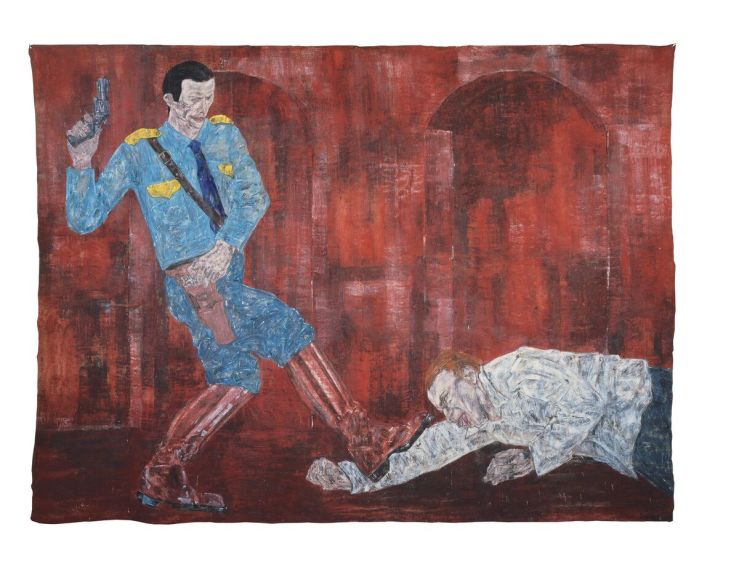 White Squad V




 In his
 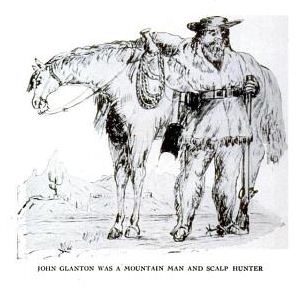 According to Chamberlain, John Glanton was born in South Carolina and migrated to Stephen Austin’s settlement in Texas. There he fell in love with an orphan girl and was prepared to marry her. One day while he was gone, Lipan warriors raided the area scalping the elderly and the children and kidnapping the women- including Glanton’s fiancee. Glanton and the other settlers pursued and slaughtered the natives, but during the battle the women were tomahawked and scalped. Legend has it, Glanton began a series of retaliatory raids which always yielded “fresh scalps.” When Texas fought for its independence from Mexico, Glanton fought with Col. Fannin, and was one of the few to escape the slaughter of that regiment at the hands of the Mexican Gen. Urrea- the man who would eventually employ Glanton as a scalp hunter. During the Range Wars, Glanton took no side but simply assassinated individuals who had crossed him. He was banished, to no avail, by Gen. Sam Houston and fought as a “free Ranger” in the war against Mexico. Following the war he took up the Urrea’s offer of $50 per Apache scalp (with a bonus of $1000 for the scalp of the Chief Santana). Local rumor had it that Glanton always “raised the hair” of the Indians he killed and that he had a “mule load of these barbarous trophies, smoke-dried” in his hut even before he turned professional.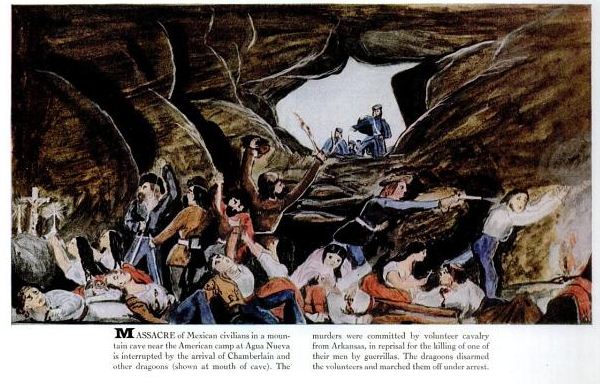
 It’s fascinating to note how much of the Judge is already there–the pedophilia, the marksmanship, the scholarship, and, most interesting of all, the lack of hair. Confession goes on to detail the killing, scalping, raping, and raiding spree that comprises the center of Blood Meridian. Chamberlain even describes the final battle with the Yumas, an event that signals the dissolution of the Glanton gang in McCarthy’s novel.
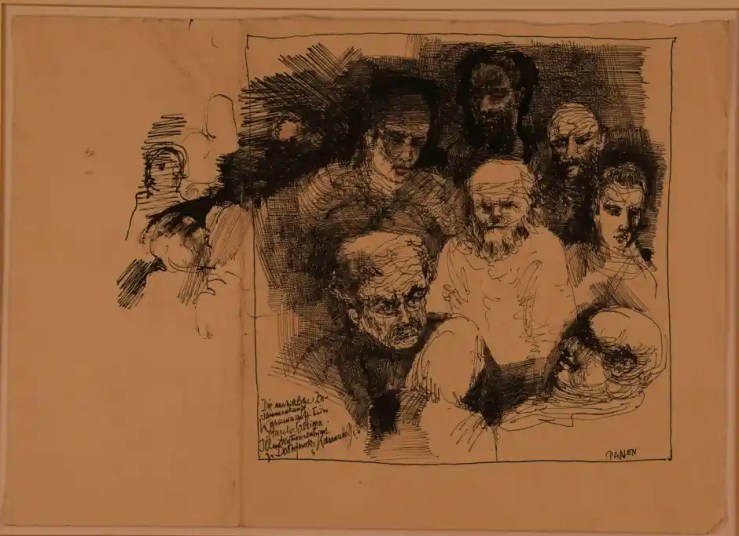
 Content aside, Chamberlain’s prose also seems to presage McCarthy’s prose. In his book
  You can view many of Chamberlain’s paintings and read an edit of his Confession in three editions of Life magazine from 1956, digitally preserved thanks to Google Books–here’s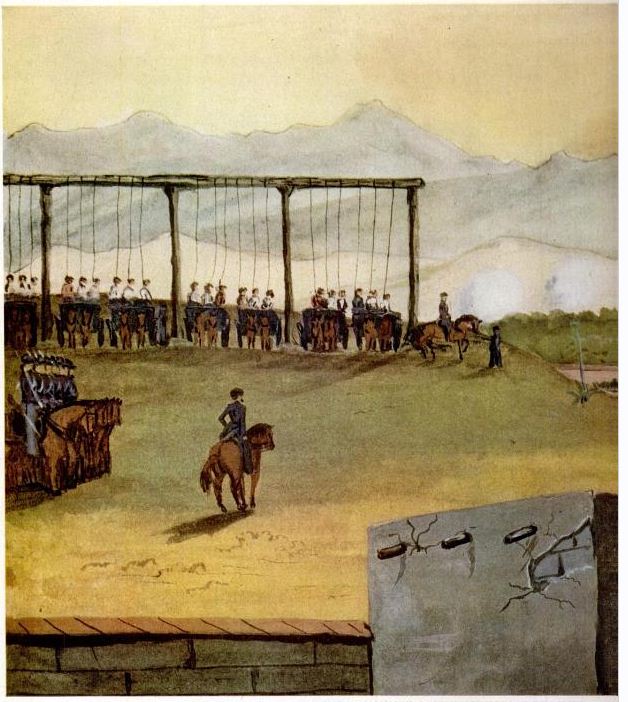
 Biblioklept