“Flavia and Her Artists” — Willa Cather

“Flavia and Her Artists”

by

Willa Cather    

As the train neared Tarrytown, Imogen Willard began to wonder why she had consented to be one of Flavia’s house party at all. She had not felt enthusiastic about it since leaving the city, and was experiencing a prolonged ebb of purpose, a current of chilling indecision, under which she vainly sought for the motive which had induced her to accept Flavia’s invitation. Continue reading ““Flavia and Her Artists” — Willa Cather” →

Letter from the Old Country — David Bekker

“All art constantly aspires towards the condition of music”

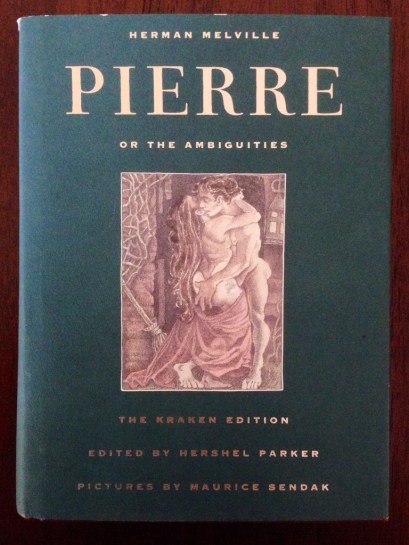
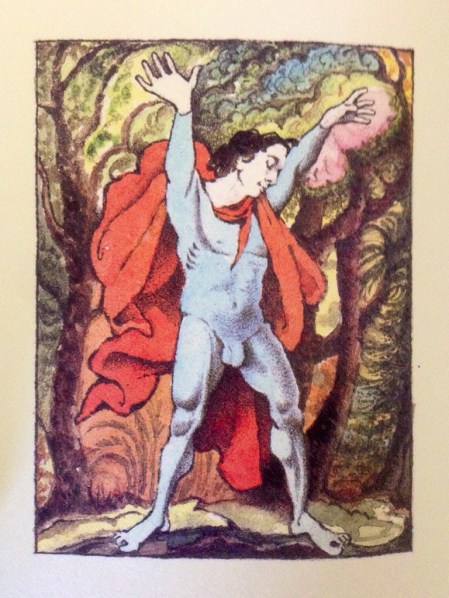
Maurice Sendak’s Erotic Illustrations for Herman Melville’s Pierre (Book Acquired, 5.09.2014)

20140520-162625-59185259.jpg

Pierre, Herman Melville’s follow up to Moby-Dick, was, without a doubt, the most challenging, perplexing, befuddling book I read in school. I still don’t get it.

Still, I love Melville, and I love Maurice Sendak, so when I saw this unused copy of the Kraken addition for half-cover price at my favorite local used bookshop, I couldn’t resist.

Sendak’s bawdy illustrations recall William Blake to me—great stuff—although I’ll probably read Moby-Dick or The Confidence Man again before I make time for Pierre.

Read more about this edition of Pierre here.

20140520-162627-59187043.jpg

20140520-162630-59190560.jpg Continue reading “Maurice Sendak’s Erotic Illustrations for Herman Melville’s Pierre (Book Acquired, 5.09.2014)” →

Bittersweet Reminiscences of The Life Aquatic

Aeneas and the Sibyl in the Underworld — Jan Brueghel the Elder

“Retaliation” — The Marquis de Sade

“Retaliation”

by

The Marquis de Sade

A worthy citizen of Picardy, the descendant perhaps of one of those illustrious troubadours from the banks of the Oise or the Somme whose sluggish existence has only been rescued from the shadows some ten or twelve years ago by a great writer of our time, a brave and honest citizen, I repeat, lived in the town of Saint-Quentin so famous for the great men it has given to literature. He lived there in honorable estate, himself, his wife and a cousin thrice removed, a nun of a convent in the town. The cousin thrice removed was a little brunette, bright-eyed, with a mischievous little face, a turned-up nose and a slender figure; she suffered under the weight of twenty-two years, and had been a nun for four of them. Sister Petronilla, for such was her name, had in addition a pretty voice and a much greater disposition for love than for religion. As for M. d’Esclaponville, as our citizen was called, he was a fine jovial fellow of about twenty-eight, who loved his cousin supremely and Mme d’Esclaponville nothing like so well, since he had been sleeping with her for ten years already, and a habit of ten years’ standing is quite fatal to the fires of hymen. Mme d’Esclaponville — for it is necessary to depict her, a writer would be despised if he did not portray people in an age where only pictures are required, and where even a tragedy would not be received unless the canvas-mongers found at least half a dozen subjects in it — Mme d’Esclaponville, as I was saying, was a somewhat insipid blonde, slightly washed-out, but very white-skinned, with pretty eyes, well-fleshed, and with those great chubby checks that are commonly described by the world as “a good squeeze.” Continue reading ““Retaliation” — The Marquis de Sade” →
The Library — Jacob Lawrence

The Encounter on 2 bis rue Perre — Victor Brauner

“Trapped by a Thing Called Love” | Dance Scene, Only Lovers Left Alive

The horrible secret of adulthood (Life in Hell)

horrible

Scrubwoman, Astor Library — John French Sloan

“As books multiply to an unmanageable excess, selection becomes more and more a necessity for readers” (Thomas De Quincey)

As books multiply to an unmanageable excess, selection becomes more and more a necessity for readers, and the power of selection more and more a desperate problem for the busy part of readers. The possibility of selecting wisely is becoming continually more hopeless as the necessity for selection is becoming continually more pressing. Exactly as the growing weight of books overlays and stifles the power of comparison, pari passu is the call for comparison the more clamorous; and thus arises a duty correspondingly more urgent of searching and revising until everything spurious has been weeded out from amongst the Flora of our highest literature, and until the waste of time for those who have so little at their command is reduced to a minimum. For, where the good cannot be read in its twentieth part, the more requisite it is that no part of the bad should steal an hour of the available time; and it is not to be endured that people without a minute to spare should be obliged first of all to read a book before they can ascertain whether in fact it is worth reading. The public cannot read by proxy as regards the good which it is to appropriate, but it can as regards the poison which it is to escape. And thus, as literature expands, becoming continually more of a household necessity, the duty resting upon critics (who are the vicarious readers for the public) becomes continually more urgent — of reviewing all works that may be supposed to have benefited too much or too indiscriminately by the superstition of a name. The praegustatores should have tasted of every cup, and reported its quality, before the public call for it; and, above all, they should have done this in all cases of the higher literature — that is, of literature properly so called.

From Thomas De Quincey’s essay “The Literature of Knowlege and the Literature of Power,” part of The Poetry of Pope.

He’s puffing like a grampus. / I don’t like talking in a vacuum.

20140519-133341-48821616.jpg

Malcolm X — Dave Sim

sim_malcolm_x