Woman Reading — Henri Matisse

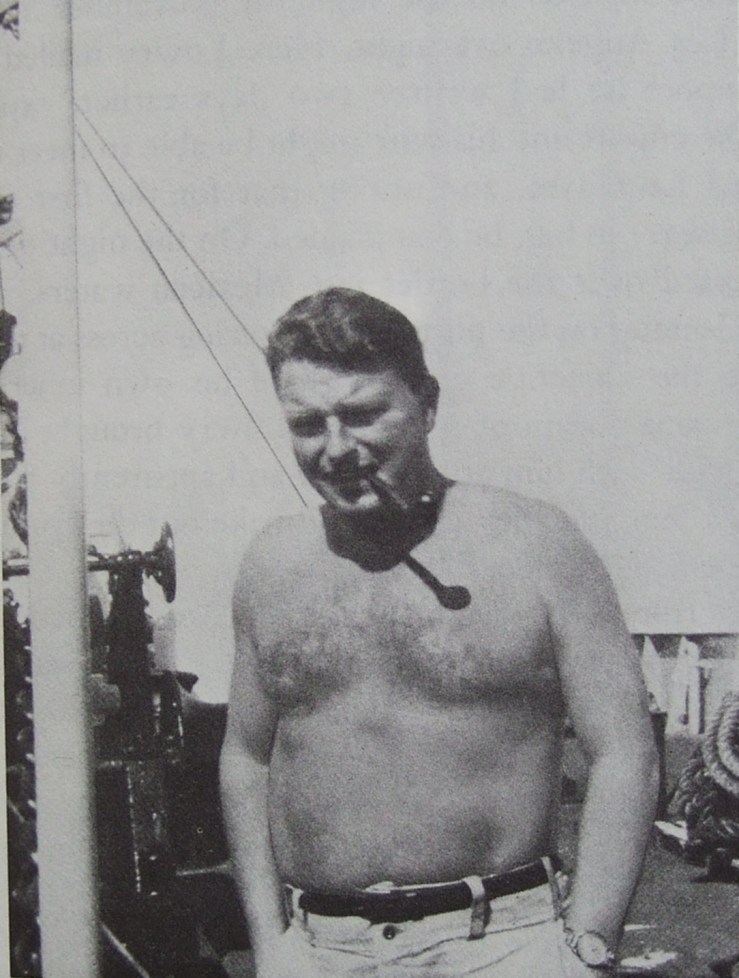
Topless Malcolm Lowry

Cathcart Street 038

(This pic seems like a good argument to read Under the Volcano, but here’s another one).

Hare — Albrecht Durer

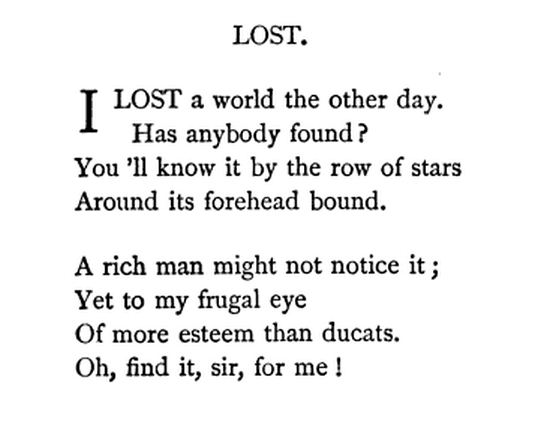
“I lost a World the other day” — Emily Dickinson

lost

Ghost Newspapers (The Far Side)

ghostnewspapers

Some content on this page was disabled on May 26, 2021 as a result of a DMCA takedown notice from Gary Larson. You can learn more about the DMCA here:

https://wordpress.com/support/copyright-and-the-dmca/

The Phantom Of Liberty — Luis Buñuel (Full Film)

“Eggs: An Easter Homily” — Robert Lynd

“Eggs: An Easter Homily” by Robert Lynd

Having decided to write on Easter, I took out a volume of The Encyclopædia Britannica in order to make up the subject of eggs, and the first entry under “Egg” that met my eye was:

“EGG, AUGUSTUS LEOPOLD (1816-1863), English painter, was born on the 2nd of May, 1816, in London, where his father carried on business as a gun-maker.”

I wish I had known about Augustus five years ago. I should like to have celebrated the centenary of an egg somewhere else than in a London tea-shop. Augustus Leopold Egg seems to have spent a life in keeping with his name. He was taught drawing by Mr Sass, and in later years was a devotee of amateur theatricals, making a memorable appearance, as we should expect of an Egg, in a play called Not so Bad as We Seem. He also appears to have devoted a great part of his life to painting bad eggs, if we may judge by the titles of his most famous pictures—Buckingham Rebuffed, Queen Elizabeth discovers she is no longer young, Peter the Great sees Catherine for the First Time, and Past and Present, a Triple Picture of a Faithless Wife. She was a lady, no doubt, who could not submit to the marriage yolk. Anyhow, she had a great fall, and Augustus did his best to put her together again. “Egg,” the Encyclopædia tells us finally, “was rather below the middle height, with dark hair and a handsome, well-formed face.” He seems to have been a man, take him for all in all: we shall not look upon his like again.

Even so, Augustus was not the only Egg. He was certainly not the egg in search of which I opened the Encyclopædia. The egg I was looking for was the Easter egg, and it seemed to be the only egg that was not mentioned. There were birds’ eggs, and reptiles’ eggs, and fishes’ eggs, and molluscs’ eggs, and crustaceans’ eggs, and insects’ eggs, and frogs’ eggs, and Augustus Egg, and the eggs of the duck-billed platypus, which is the only mammal (except the spiny ant-eater) whose eggs are “provided with a large store of yolk, enclosed within a shell, and extruded to undergo development apart from the maternal tissues.” I do not know whether it is evidence of the irrelevance of the workings of the human mind or of our implacable greed of knowledge, but within five minutes I was deep in the subject of eggs in general, and had forgotten all about the Easter variety. I found myself fascinated especially by the eggs of fishes. There are so many of them that one was impressed as one is on being told the population of London. “It has been calculated,” says the writer of the article, “that the number laid by the salmon is roughly about 1000 to every pound weight of the fish, a 15-lb. salmon laying 15,000 eggs. The sturgeon lays about 7,000,000; the herring 50,000; the turbot 14,311,000; the sole 134,000; the perch 280,000.” This is the sort of sentence I always read over to myself several times. And when I come to “the turbot, 14,311,000,” I pause, and try to picture to myself the man who counted them. How does one count 14,311,000? How long does it take? If one lay awake all night, trying to put oneself to sleep by counting turbots’ eggs instead of sheep, one would hardly have done more than make a fair start by the time the maid came in to draw the curtains and let in the sun on one’s exhausted temples. A person like myself, ignorant of mathematics, could not easily count more that 10,000 in an hour. This would mean that, even if one lay in bed for ten hours, which one never does except on one’s birthday, one would have counted only 100,000 out of the 14,311,000 eggs by the time one had to get up for breakfast. That would leave 14,211,000 still to be counted At this point, most of us, I think, would give it up in despair. After one horrible night’s experience, we would jump into a hot bath muttering: “Never again! Never again!” like a statesman who can’t think of anything to say, and send out for a quinine-and-iron tonic. Our friends meeting us later in the day would say with concern: “Hullo! you’re looking rather cheap. What have you been doing?”; and when we answered bitterly: “Counting turbots’ eggs,” they would hurry off with an apprehensive look on their faces. The naturalist, it is clear, must be capable of a persistence that is beyond the reach of most of us. I calculate that, if he were able to work for 14 hours a day, counting at the rate of 10,000 an hour, even then it would take him 122-214 days to count the eggs of a single turbot. After that, it would take a chartered accountant at least 122-214 days to check his figures. One can gather from this some idea of the enormous industry of men of science. For myself, I could more easily paint the Sistine Madonna or compose a Tenth Symphony than be content to loose myself into this universe of numbers. Pythagoras, I believe, discovered a sort of philosophy in numbers, but even he did not count beyond seven. Continue reading ““Eggs: An Easter Homily” — Robert Lynd” →
School of XVII Century — Andrei Ryabushkin

“Why I Write” — Barry Hannah

I always experience a mild depression whenever I type up what I have written. This act seems redundant. The work has already been done. I adore the praise of the public, no mistake. But the primary motive must be unpublic. Much more, I’d guess, the inner journey of the imagination itself. There is the ecstasy. The rest is simply good. Some money, a little fame. Not to be rolled over by time like a crab in the surf. Etcetera.

I write out of a greed for lives and language. A need to listen to the orchestra of living. It is often said that a writer is more alive than his peers. But I believe he might also be a sort of narcoleptic who requires constant waking up by his own imaginative work. He is closer to sleep and dream, and his memory is more haunted, thus more precise.

Read the rest of Barry Hannah’s essay “Why I Write” at The Oxford American.

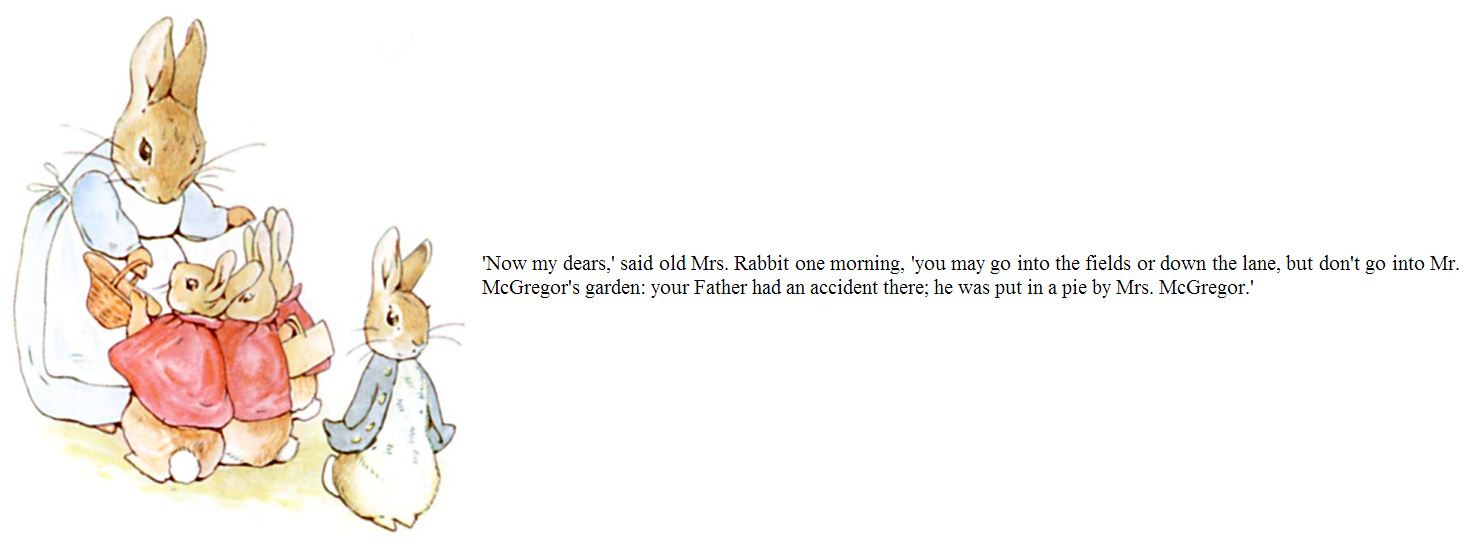
“Don’t go into Mr. McGregor’s garden: your Father had an accident there; he was put in a pie by Mrs. McGregor” (Beatrix Potter)

Capture

(Read The Tale of Peter Rabbit by Beatrix Potter).

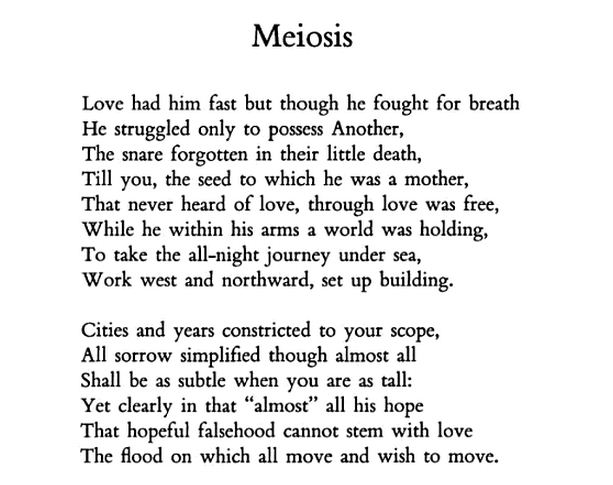
“Meiosis” — W.H. Auden

meiosis

Brown Hairstreak — Kit Williams

“The Easter Hare” and “The Easter Hare Family” by Margaret Arndt

“The Easter Hare”  by Margaret Arndt

It is curious how little children of one country know about the lives and interests of the children of another. Perhaps if English people would send their children over to Germany, instead of their journalists, singers, etc., the danger of an International war would be lessened. The children would be sure to fall in love with Germany; for it is the land above all others that appeals to children. Women are said to come first in America, children are certainly the first consideration in Germany. Froebel’s motto: “Come let us live with our children,” is nowhere better carried out.

A little English girl, named Patsie, came over to visit her German friends, Gretel and Barbara, shortly before Easter this year; and she was much surprised to find all the shop-windows filled with hares; hares made of chocolate, toy hares, hares with fine red coats on, hares trundling wheelbarrows or carrying baskets full of Easter eggs. Moreover there was no end to the picture post cards representing the hare in various costumes, and in some connection with Easter eggs. One of these post cards represented a hare crawling out of a large broken egg just like a chicken.

Patsie asked her little friends eagerly what this all meant.

“Who is the Hare?” she said. “I do so want to know all about him.”

“Why, of course, it is the Easter Hare,” they replied.

“Is it possible that you have not heard of him? O, you poor English children! Why, he brings us the eggs on Easter Sunday morning!” said Gretel.

“O don’t you know,” said Barbara, “he hides them in the garden, unless it rains or is very wet; then we have to stay in our bedrooms for fear of frightening him, and he lays them downstairs in the dining-room or drawing-room. However, this has only happened once since I was born, and I am nine years old; it mustbe always fine at Easter.”

“We have to let all the blinds down before he will come into our garden, he is so dreadfully nervous,” said Gretel. “Then he hides the eggs in the most unexpected places, we have to hunt and hunt a long time before we have found them all. Last year we discovered an egg some weeks afterwards; luckily it was a glass one filled with sweeties; for if it had been of chocolate, we could not have eaten it, after it had lain on the damp mould, where the snails and worms would have crawled over it. Some of the eggs are made of chocolate or marzipan or sugar, and some are real eggs coloured blue or red or brown, or even sometimes with pictures on them.”

“We had two dear little baskets with dollies in them, and a big Easter Hare made of gingerbread, as well as the eggs this year,” said Barbara. “We hunt and hunt in every corner of the garden, and then we divide our treasures afterwards on two plates, so that is quite fair.”

“You are lucky children, why does not the Hare come to England?” said Patsie. “I am sure little English children would appreciate him too!” Continue reading ““The Easter Hare” and “The Easter Hare Family” by Margaret Arndt” →

The Secret School — Nikolaos Gyzis

Werner Herzog Eats His Shoe

How to Look Younger (Peanuts)

younger

Rabbits under Moon — Hiroshige