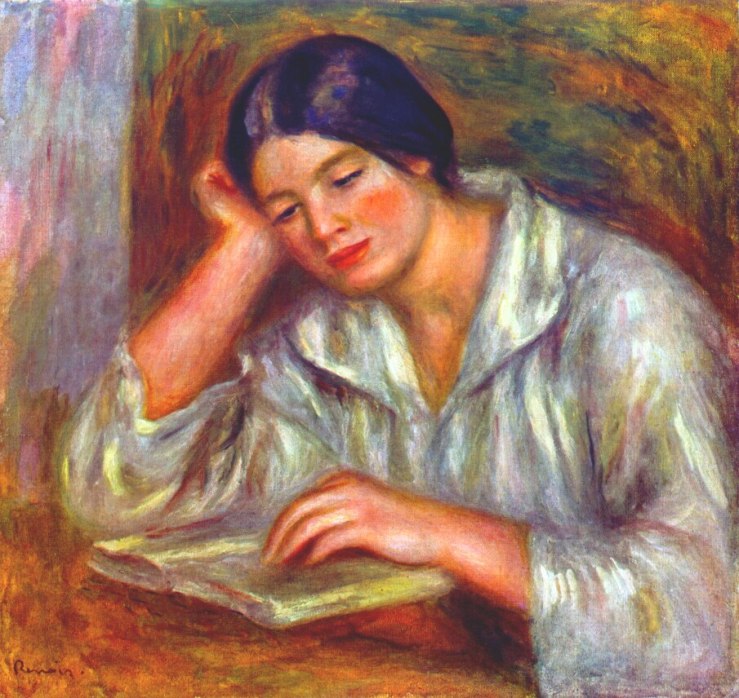
“The Incredible and Sad Tale of Innocent Eréndira and Her Heartless Grandmother” — Gabriel García Márquez”

“The Incredible and Sad Tale of Innocent Eréndira and Her Heartless Grandmother” by Gabriel García Márquez

Erendira was bathing her grandmother when the wind of her misfortune began to blow. The enormous mansion of moon like concrete lost in the solitude of the desert trembled down to its foundations with the first attack. But Erendira and her grandmother were used to the risks of the wild nature there, and in the bathroom decorated with a series of peacocks and childish mosaics of Roman baths they scarcely paid any attention to the caliber of the wind.

The grandmother, naked and huge in the marble tub, looked like a handsome white whale. The granddaughter had just turned fourteen and was languid, soft-boned, and too meek for her age. With a parsimony that had something like sacred rigor about it, she was bathing her grandmother with water in which purifying herbs and aromatic leaves had been boiled, the latter clinging to the succulent back, the flowing metal-colored hair, and the powerful shoulders which were so mercilessly tattooed as to put sailors to shame.

“Last night I dreamt I was expecting a letter,” the grandmother said.

Erendira, who never spoke except when it was unavoidable, asked:

“What day was it in the dream?”

“Thursday.”

“Then it was a letter with bad news,” Erendira said, “but it will never arrive.”

When she had finished bathing her grandmother, she took her to her bedroom. The grandmother was so fat that she could only walk by leaning on her granddaughter’s shoulder or on a staff that looked like a bishop’s crosier, but even during her most difficult efforts the power of an antiquated grandeur was evident. In the bedroom, which had been furnished with an excessive and somewhat demented taste, like the whole house, Erendira needed two more hours to get her grandmother ready. She untangled her hair strand by strand, perfumed and combed it, put an equatorially flowered dress on her, put talcum powder on her face, bright red lipstick on her mouth, rouge on her cheeks, musk on her eyelids, and mother-of-pearl polish on her nails, and when she had her decked out like a larger than life-size doll, she led her to an artificial garden with suffocating flowers that were like the ones on the dress, seated her in a large chair that had the foundation and the pedigree of a throne, and left her listening to elusive records on a phonograph that had a speaker like a megaphone. Continue reading ““The Incredible and Sad Tale of Innocent Eréndira and Her Heartless Grandmother” — Gabriel García Márquez””

The Love Letter — John William Godward

the-love-letter-1913

List with No Name #15

  1. Joseph Cornell’s boxes.
  2. Much of J.G. Ballard, especially the stuff in the ’70s and ’80s.
  3. The Residents.
  4. The films of the Brothers Quay.
  5. Charles Burns’s stuff.
  6. Wm. Burroughs, or the idea of Wm. Burroughs.
  7. Joseph Beuys and his goddamn fat and felt.

Watch Peter Greenaway’s Meredith Monk Documentary

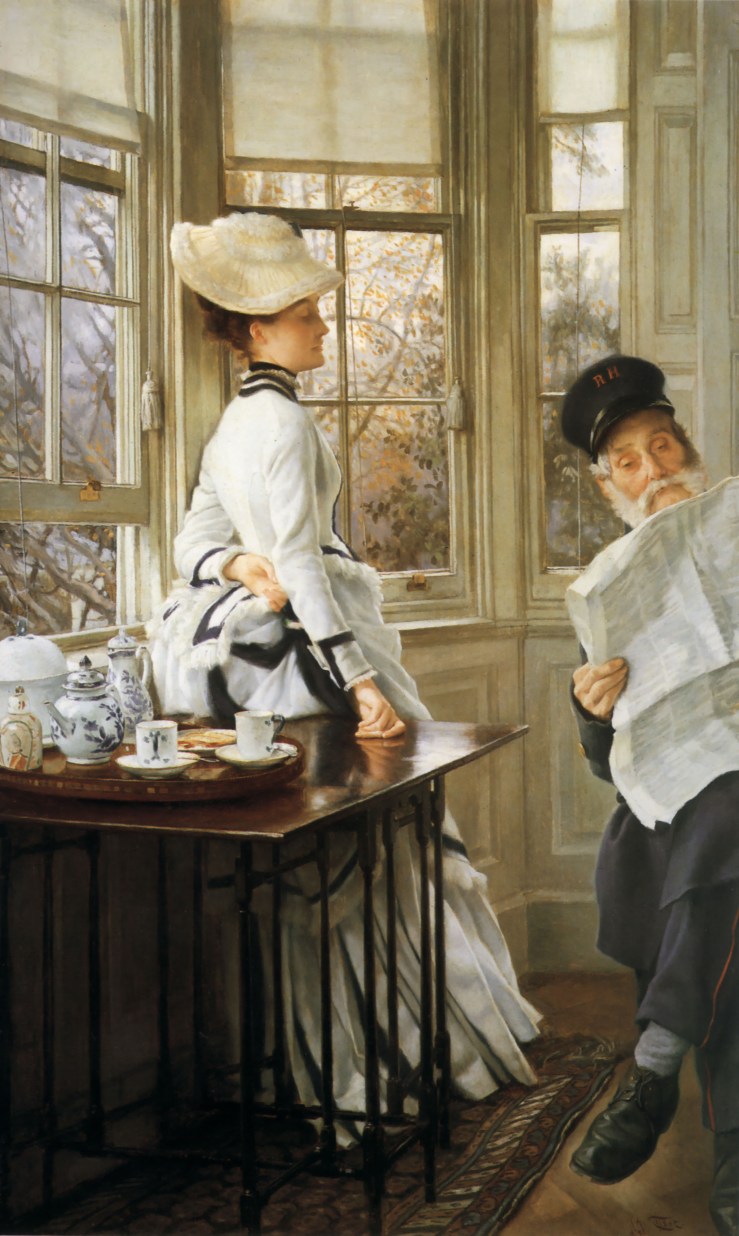
Charles Darwin — James Tissot

Boredom // F. Scott Fitzgerald

20130211-213526.jpg

Marvin Digs — Ralph Bakshi (Short Film)

T.S. Eliot Writes to F.Scott Fitzgerald

FABER AND GWYER LTD. Publishers 24 Russell Square, London, W.C.1. 31st December, 1925
F. Scott Fitzgerald, Esqre., % Charles Scribners & Sons, New York City.

Dear Mr. Scott Fitzgerald,
The Great Gatsby with your charming and overpowering inscription arrived the very morning that I was leaving in some haste for a sea voyage advised by my doctor. I therefore left it behind and only read it on my return a few days ago. I have, however, now read it three times. I am not in the least influenced by your remark about myself when I say that it has interested and excited me more than any new novel I have seen, either English or American, for a number of years.

When I have time I should like to write to you more fully and tell you exactly why it seems to me such a remarkable book. In fact it seems to me to be the first step that American fiction has taken since Henry James….

By the way, if you ever have any short stories which you think would be suitable for the Criterion I wish you would let me see them.

With many thanks, I am,
Yours very truly, T. S. Eliot

P.S. By a coincidence Gilbert Seldes in his New York Chronicle in the Criterion for January 14th has chosen your book for particular mention.


Portrait of James Joyce — Djuna Barnes

“Mrs. Bullfrog” — Nathaniel Hawthorne

“Mrs. Bullfrog” by Nathaniel Hawthorne

It makes me melancholy to see how like fools some very sensible people act in the matter of choosing wives. They perplex their judgments by a most undue attention to little niceties of personal appearance, habits, disposition, and other trifles which concern nobody but the lady herself. An unhappy gentleman, resolving to wed nothing short of perfection, keeps his heart and hand till both get so old and withered that no tolerable woman will accept them. Now this is the very height of absurdity. A kind Providence has so skilfully adapted sex to sex and the mass of individuals to each other, that, with certain obvious exceptions, any male and female may be moderately happy in the married state. The true rule is to ascertain that the match is fundamentally a good one, and then to take it for granted that all minor objections, should there be such, will vanish, if you let them alone. Only put yourself beyond hazard as to the real basis of matrimonial bliss, and it is scarcely to be imagined what miracles, in the way of recognizing smaller incongruities, connubial love will effect.

For my own part I freely confess that, in my bachelorship, I was precisely such an over-curious simpleton as I now advise the reader not to be. My early habits had gifted me with a feminine sensibility and too exquisite refinement. I was the accomplished graduate of a dry goods store, where, by dint of ministering to the whims of fine ladies, and suiting silken hose to delicate limbs, and handling satins, ribbons, chintzes calicoes, tapes, gauze, and cambric needles, I grew up a very ladylike sort of a gentleman. It is not assuming too much to affirm that the ladies themselves were hardly so ladylike as Thomas Bullfrog. So painfully acute was my sense of female imperfection, and such varied excellence did I require in the woman whom I could love, that there was an awful risk of my getting no wife at all, or of being driven to perpetrate matrimony with my own image in the looking-glass. Besides the fundamental principle already hinted at, I demanded the fresh bloom of youth, pearly teeth, glossy ringlets, and the whole list of lovely items, with the utmost delicacy of habits and sentiments, a silken texture of mind, and, above all, a virgin heart. In a word, if a young angel just from paradise, yet dressed in earthly fashion, had come and offered me her hand, it is by no means certain that I should have taken it. There was every chance of my becoming a most miserable old bachelor, when, by the best luck in the world, I made a journey into another state, and was smitten by, and smote again, and wooed, won, and married, the present Mrs. Bullfrog, all in the space of a fortnight. Owing to these extempore measures, I not only gave my bride credit for certain perfections which have not as yet come to light, but also overlooked a few trifling defects, which, however, glimmered on my perception long before the close of the honeymoon. Yet, as there was no mistake about the fundamental principle aforesaid, I soon learned, as will be seen, to estimate Mrs. Bullfrog’s deficiencies and superfluities at exactly their proper value.

The same morning that Mrs. Bullfrog and I came together as a unit, we took two seats in the stage-coach and began our journey towards my place of business. There being no other passengers, we were as much alone and as free to give vent to our raptures as if I had hired a hack for the matrimonial jaunt. My bride looked charmingly in a green silk calash and riding habit of pelisse cloth; and whenever her red lips parted with a smile, each tooth appeared like an inestimable pearl. Such was my passionate warmth that—we had rattled out of the village, gentle reader, and were lonely as Adam and Eve in paradise—I plead guilty to no less freedom than a kiss. The gentle eye of Mrs. Bullfrog scarcely rebuked me for the profanation. Emboldened by her indulgence, I threw back the calash from her polished brow, and suffered my fingers, white and delicate as her own, to stray among those dark and glossy curls which realized my daydreams of rich hair. Continue reading ““Mrs. Bullfrog” — Nathaniel Hawthorne”

The Love Letter — Eugene de Blaas

the-love-letter-1

The Sin of Harold Diddlebock — Preston Sturges (Full Film)

An Extract from an Extract from Flann O’Brien’s At Swim-Two-Birds

Title of Book referred to: The Athenian Oracle, being an Entire COLLECTION of all the Valuable QUESTIONS and ANSWERS in the old Athenian Mercuries intermixed with many CASES in Divinity, Hiftory, Philofophy, Mathematicks, Love, Poetry, never before publifhed.

Extract from Book referred to:

1. Whether it be poffible for a woman fo carnally to know a Man in her fleep as to conceive, for I am fure that this and no way other was I got with Child.

2. Whether it be lawful to ufe Means to put a ftop to this growing mifchief, and kill it in the Embryo; this being the only way to avert the Thunderclap of my Father’s Indignation.

To the firft Question, Madam, we are very pofitive, that you are luckily miftaken, for the thing is abfolutely impoffible if you know nothing of it; indeed, we had an account of a Widow that made fuch a pretence, and fhe might have better credit than a maid, who can have no plea but dead drunk, or in fome fwooning fit, and our Phyficians will hardly allow a poffibility of the thing then. So that you may fet your heart at reft, and think no more of the matter, unlefs for your diverfion.

As for the fecond Queftion, fuch practices are murder, and thofe that are fo unhappy as to come under fuch Circumftances if they ufe the forementioned means, will certainly one day find the remedy worfe than the Difeafe. There are wifer methods to be taken in fuch Cafes, as a fmall journey and a Confident. And afterwards, fuch a pious and good life as may redreff fuch an heavy miffortune.

Questions, a Selection of Further: Almond, why fo bitter being taken in the mouth, and yet the Oyl fo very fweet? Apprentice, reduced to want, how may he relieve himself? Blood, is the eating of it lawful? Baptifm, adminiftered by a Mid-wife or Lay Hand, is it lawful? Devil, why called Lucifer; and elfewhere the Prince of Darknefs? Eftate, gotten by felling lewd Books, can it profper? Eyes, what Method muft I take with ’em when weak? Horfe, with a round fundament, why does he emit a fquare Excrement? Happinefs, what is it? Lady, difturbed in her Bed, your thoughts of it? Light, is it a Body? Myftae or Cabalifts, what d’ye think of them? Marriage, is not the End of it, in a great Meafure, loft nowadays? Poem, by Mr. Tate? Virginity, is it a Vertue? Wind, what is it? Wife, is it lawful for a Man to beat her? Wife, if an ill one, may I pray that God wou’d take her to himfelf?

Conclusion of the foregoing.

From Flann O’Brien’s novel At Swim-Two-Birds.

Deer Hunters — Mu Pan

deer_hunters

(More/via).

Wong Kar Wai on Charlie Rose (2005)

Wolverine — Moebius

wolvie moe

“Imperfect Resume” — Flann O’Brien

Selection from Flann O’Brien’s novel At Swim-Two-Birds:

The following, imperfect resume or summary as it is, may be taken as a general indication of the scholarly trend of the conversation sustained without apparent effort by the three of them.

It is not generally known, observed Mr. Furriskey, that the coefficient of expansion of all gases is the same. A gas expands to the extent of a hundred and seventy-third part of its own volume in respect of each degree of increased temperature centrigrade. The specific gravity of ice is 0.92, marble 2.70, iron (cast) 7.20 and iron (wrought) 7.79. One mile is equal to 1.6093 kilometres reckoned to the nearest ten-thousandth part of a whole number.

True, Mr. Furriskey, remarked Mr. Paul Shanahan with a quiet smile that revealed a whiteness of the teeth, but a man who confines knowledge to formulae necessary for the resolution of an algebraic or other similar perplexity, the same deserves to be shot with a fusil, or old-fashioned light musket. True knowledge is unpractised or abstract usefulness. Consider this, that salt in solution is an excellent emetic and may be administered with safety to persons who are accustomed to eat poisonous berries or consume cacodyl, an evil-smelling compound of arsenic and methyl. A cold watch-key applied to the neck will relieve nose-bleeding. Banana-skins are invaluable for imparting a gloss to brown shoes.

To say that salt in solution, Lamont objected finely, is a pleasing emetic is a triviality related to inconsequent ephemera – the ever-perishing plasms of the human body. The body is too transient a vessel to warrant other than perfunctory investigation. Only in this regard is it important, that it affords the mind a basis for speculation and conjecture. Let me recommend to you, Mr. Shanahan, the truer spiritual prophylaxis contained in the mathematics of Mr. Furriskey. Ratiocination on the ordered basis of arithmetic is man’s passport to the infinite. God is the root of minus one. He is too great a profundity to be compassed by human cerebration. But Evil is finite and comprehensible and admits of calculation. Minus One, Zero and Plus One are the three insoluble riddles of the Creation.

Mr. Shanahan laughed in a cultured manner.

The riddle of the universe I might solve if I had a mind to, he said, but I prefer the question to the answer. It serves men like us as a bottomless pretext for scholarly dialectic.

Other points not unworthy of mention, mentioned Mr. Furriskey in an absent-minded though refined manner, are the following: the great pyramid at Gizeh is 450 feet high and ranks as one of the seven wonders of the world, the others being the hanging gardens of Babylon, the tomb of Mausolus in Asia Minor, the colossus of Rhodes, the temple of Diana, the statue of Jupiter at Olympia and the Pharos Lighthouse built by Ptolemy the First about three hundred and fifty years B.C. Hydrogen freezes at minus 253 degrees centigrade, equivalent to minus 423 on the Fahrenheit computation.

Everyday or colloquial names for chemical substances, observed Mr. Shanahan, cream of tartar – bitartate of potassium, plaster of Paris – sulphate of calcium, water – oxide of hydrogen. Bells and watches on board ship: first dog – 4 p.m. to 6 p.m., second dog – 6 p.m. to 8 p.m., afternoon-noon to 4 p.m. Paris, son of Priam, King of Troy, carried off the wife of Menelaus, King of Sparta and thus caused the Trojan War.

The name of the wife, said Lamont, was Helen. A camel is unable to swim owing to the curious anatomical distribution of its weight, which would cause its head to be immersed if the animal were placed in deep water. Capacity in electricity is measured by the farad; one microfarad is equal to one millionth of a farad. A carbuncle is a fleshy excrescence resembling the wattles of a turkey-cock. Sphragistics is the study of engraved seals.


Excellent, remarked Mr. Furriskey with that quiet smile which endeared him to everyone who happened to come his way, but do not overlook this, that the velocity of light in vacuo is 186,325 miles per second. The velocity of sound in air is 1,120 feet per second, in tin 8,150 feet per second, in walnut mahogany and heavy timbers 11,000 feet per second approximately; in firwood, 20,000 feet per second. Sine 15 degrees is equal to the root of six minus the root of two, the whole divided by four. Percentages of £1: 1-1/4 per cent, threepence; 5 per cent, one shilling; 12-1/2 percent, a half a crown. Some metric equivalents: one mile equals 1.6093 kilometres; one inch equals 2.54 centimetres; one ounce equals 28.352 grams. The chemical symbol of Calcium is Ca and of Cadmium, Cd. A Trapezoid may be defined as a four-sided figure capable of being transformed into two triangles by the means of a diagonal line.

Some curious facts about the Bible, Mr. Lamont mentioned politely, the longest chapter is Psalm 119 and the briefest, Psalm 117. The Apocrypha contains 14 Books. The first English translation was published in A.D. 1535.

Some notable dates in the history of the world, observed Mr. Shanahan, B.C. 753, foundation of Rome by Romulus, 490 B.C., Battle of Marathon, A.D. 1498, Vasco da Gama sailed around South Africa and reached India, 23 April 1564 Shakespeare was born.

It was then that Mr. Furriskey surprised and indeed, delighted his companions, not to mention our two friends, by a little act which at once demonstrated his resource and his generous urge to spread enlightenment. With the end of his costly malacca cane, he cleared away the dead leaves at his feet and drew the outline of three dials or clock-faces on the fertile soil in this fashion:

0 0 0 9 \ 1 1 9 9 1 8 \ 2 2 8 8 2 o o. o-,._ 7 3 3 \ 7 7 3 6 4 4 `6 6 4 5 5 5

How to read the gas-meter, he announced. Similar dials to these somewhat crudely depicted at my feet may be observed on any gas-meter. To ascertain the consumption of gas, one should procure pencil and paper and write down the figures nearest to the indicator on each dial – thus in the present hypothetical case 963. To this one should add two zeros or noughts, making the number 96,300. This is the answer and represents the consumption of gas in cubic feet. The reading of the electric-meter for the discovery of consumption in Kilowatt-hours is more intricate than the above and would require the help of six dials fox demonstration purposes – more indeed than I have room for in the space I have cleared of withered leaves, even assuming the existing dials could be adapted for the purpose.

Thereafter these three savant or wise men of the East began to talk together in a rapid manner and showered forth pearls of knowledge and erudition, gems without price, invaluable carbuncles of sophistry and scholastic science, thomistic maxims, intricate theorems in plane geometry and lengthy extracts from Kant’s Kritik der reinischen Vernunst. Frequent use was made of words unheard of by illiterates and persons of inferior education exempli gratia saburra or foul granular deposit in the pit of the stomach, tachylyte, a vitreous form of basalt, tapir, a hoofed mammal with the appearance of a swine, capon, castrated cock, triacontahedral, having thirty sides or surfaces and botargo, relish of mullet or tunny roe. The following terms relating to the science of medicine were used with surprising frequency videlicet thyme, exophthalmus, scirrhus, and mycetoma meaning respectively food when acted upon by gastric juices and converted into acid pulp, protrusion of the eye-ball, hard malignant tumour and fungoid disease of hand or foot. Aestho-therapy was touched upon and reference made to the duodenum, that is, the primary part of the small intestine, and the caecum or blind gut. Flowers and plants rarely mentioned in ordinary conversation were accorded their technical or quasi-botanical titles without difficulty or hesitation for instance now fraxinella species of garden dittany, canna plant with decorative blossoms, bifoliate of two leaves (also bifurcate forked), cardamom spice from the germinal capsules of certain East India plants, granadilla passion flower, knapweed hard-stemmed worthless plant, campanulla plant with bell-shaped blossoms, and dittany see fraxinella above. Unusual animals mentioned were the pangolin, chipmuck, echidna, babiroussa and bandicoot, of which a brief descriptive account would be (respectively), scabrous-spined scaly ant-eater, American squirrel aliter wood-rat, Australian toothless animal resembling the hedgehog, Asiatic wild-hog, large Indian insectivorous marsupial resembling the rat.