The Diabolical Diagram of Movie Monsters

Read “55 Miles to the Gas Pump,” a Lovely Horrific Short Story by Annie Proulx

“55 Miles to the Gas Pump” is a very short story by Annie Proulx.

Rancher Croom in handmade boots and filthy hat, that walleyed cattleman, stray hairs like the curling fiddle string ends, that warm-handed, quick-foot dancer on splintery boards or down the cellar stairs to a rack of bottles of his own strange beer, yeasty, cloudy, bursting out in garlands of foam, Rancher Croom at night galloping drunk over the dark plain, turning off at a place he knows to arrive at a canyon brink where he dismounts and looks down on tumbled rock, waits, then steps out, parting the air with his last roar, sleeves surging up, windmill arms, jeans riding over boot tops, but before he hits he rises again to the top of the cliff like a cork in a bucket of milk.

Mrs. Croom on the roof with a saw cutting a hole into the attic where she has not been for twelve years thanks to old Croom’s padlocks and warnings, whets to her desire, and the sweat flies as she exchanges the saw for a chisel and hammer until a ragged slab peak is free and she can see inside: just as she thought: the corpses of Mr. Croom’s paramours – she recognizes them from their photographs in the paper: MISSING WOMAN – some desiccated as jerky and much the same color, some moldy from lying beneath roof leaks, and, all of them used hard, covered with tarry handprints, the marks of boot heels, some bright blue with remnants of paint used on the shutters years ago, one wrapped in newspaper nipple to knee.

When you live a long way out you make your own fun.
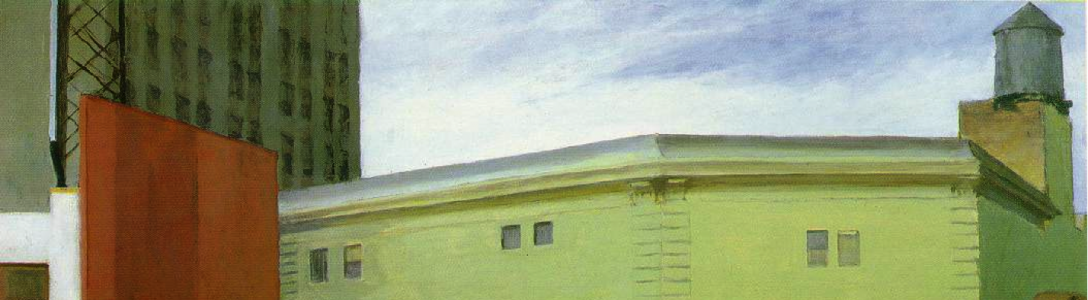
Woman Reading a Letter — Gabriel Metsu

Werner Herzog Talks About Filming Nosferatu the Vampyre

Two Witches — Hans Baldung

Demons Armed with Sticks (Detail from the Isenheim Altarpiece) — Matthias Grünewald

Edgar Allan Poe on Imaginative Capacity

(From “A Chapter of Suggestions”).

Poetry Reading — Milton Avery

Danse Macabre Scene / Jean Renoir’s The Rules of the Game

Dracula — Andy Warhol

Goya’s Witch/Clergy Axis (Robert Hughes)

In a disguised way, Goya in the Caprichos drew a parallel between witchcraft and the activities of the clergy. He stressed the resemblance between witches and friars in their obedience to the hierarchy of their calling, the younger deferring to the older. In plate 47, Obsequio al maestro (“Homage to the master”), an apparently senior witch looks down with stony disdain at another, who ois offering her (or him) the gift of a dead baby; the supplicant’s gesture reminds one of a groveling postulant kissing the cardinal’s ring. “Es muy justo,” runs the Prado text: “This is quite fair, they would be ungrateful disciples who failed to visit their professor, to whom they owe everything they know about their diabolical faculties.”

Plate 46, Correccion (“Correction”), shows a group of brujos, male witches, as seminarians, consulting “the great witch who runs the Barahona seminary” — whatever that institution may have been. Of course, Goya could not be too explicit about this: on the other side of any public criticism of clerical practices lay the ever-watchful eye of the Inquisition, which Goya had to be at pains to avoid.

—From Robert Hughes’s biography Goya.

“A Gordian Shape of Dazzling Hue” (Keats’s Lamia)

(Read the entirety of John Keats’s supernatural long poem Lamia as a free illustrated ebook).

Portrait of Madame Ginoux (L’Arlesienne) — Vincent van Gogh

Eraserhead — David Lynch

Witches in the Air — Francisco Goya

“Manifest Destiny” — Kate Beaton Does Robinson Crusoe

(More/via).

“Memory” — H.P. Lovecraft