Even though we’ve already been dead,
when I find two trays of Grateful Dead tapes
in a Missoula secondhand store,
I too feel bound in the stasis of cassette,
plastic cases scarred and cracked
like old scuba goggles. Some retain
the delicate peg that lets the door swing open;
some have broken, maybe from a fall
when someone slid too fast the van door open
in a hot parking lot. Could be no tragedy
made the tapes secondhand greater
than a lost interest. Used to listen to them,
the owner might say, the way you adjust
to walking past a grave. I love him, or her,
who has curated these happenings, although
the Dead’s not really my bag. I follow
other melodies and injured visions, draw
my cider from another press, a cooler lava.
I saw them once, summer of ’95 at RFK,
with my friend Jax. It was terrible,
a lot of twentieth-century business came due
at once. Bob Dylan opened unintelligible
and sleepy as if reaching from the frost
to make known “in life I was Bob Dylan.”
The Dead would play five more stands:
Auburn Hills, Pittsburgh, Noblesville,
Maryland Heights, Chicago, then done,
those last shows, autobiographies of indulgence.
Lightning struck by a branch. We left early.
Tapers caught every note of the show.
You can hear it forever at archive.org.
In my greatest period of disorientation,
the Dead, like death, seemed best avoided.
Yet I was the sort who might admit
a simplifying affection like the Dead.
I remember, coming down in a cornfield
near a creek at dawn, talking it out with Jason
whether those trees were weird, or that
weirdness took the form of trees,
and every woman I pursued
had a pet cat that made me sneeze.
They either liked the Dead or Neil
Diamond. Yet I would persevere,
like one with a disorder, hanging
in the doorway to their petite kitchens
while they ground coffee, or searched
the crisper for a roommate’s hidden beer.
I longed to become more elaborate,
my approaches too simple and still are,
ask anyone about pleasure’s light opera
and the children’s music of the first kiss,
the hair metal of the second. And now
I play the Dead around the house.
It’s children’s music. We play operettas, Pinafore, Penzance, for the same reasons,
because they are kind and almost meaningless.
I make few claims. What lasts is awkward
chance, like this thrift-store wrench
anthologized on pegboard, or smudges
on a yellow phone. I’m not buying
the tapes today. The price isn’t marked
and the clerk’s busy. I keep what marriage
and child need, a few books and held-back objects,
metal or paper, letters from old loves,
because letters are antique, and for
the limestone antiquity of those affections.
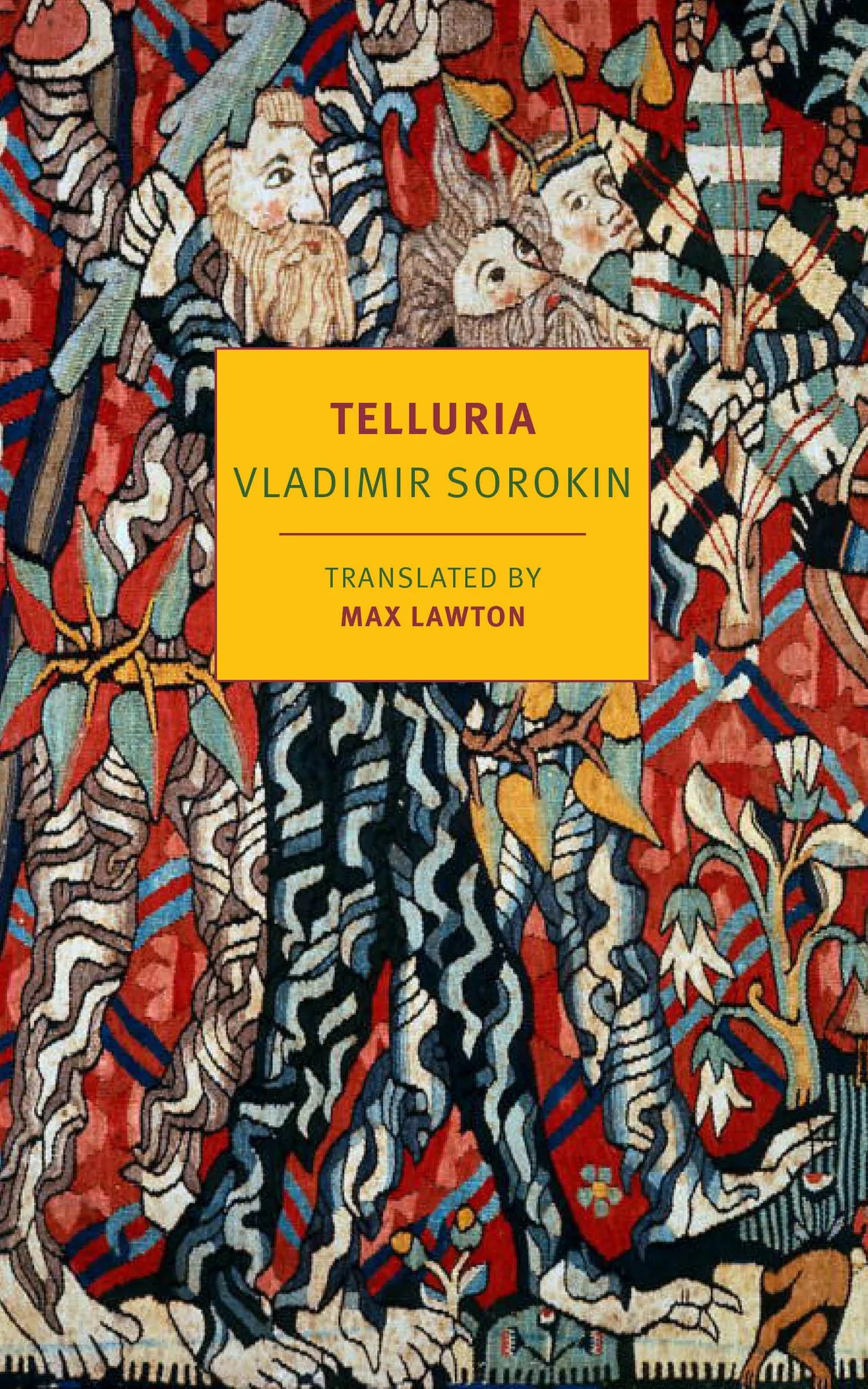
I recommend any new reader of Sorokin to immediately chase TELLURIA with THEIR FOUR HEARTS: those two combined give something like a complete picture of the master at work.
Here’s the back copy, which Max might’ve written:
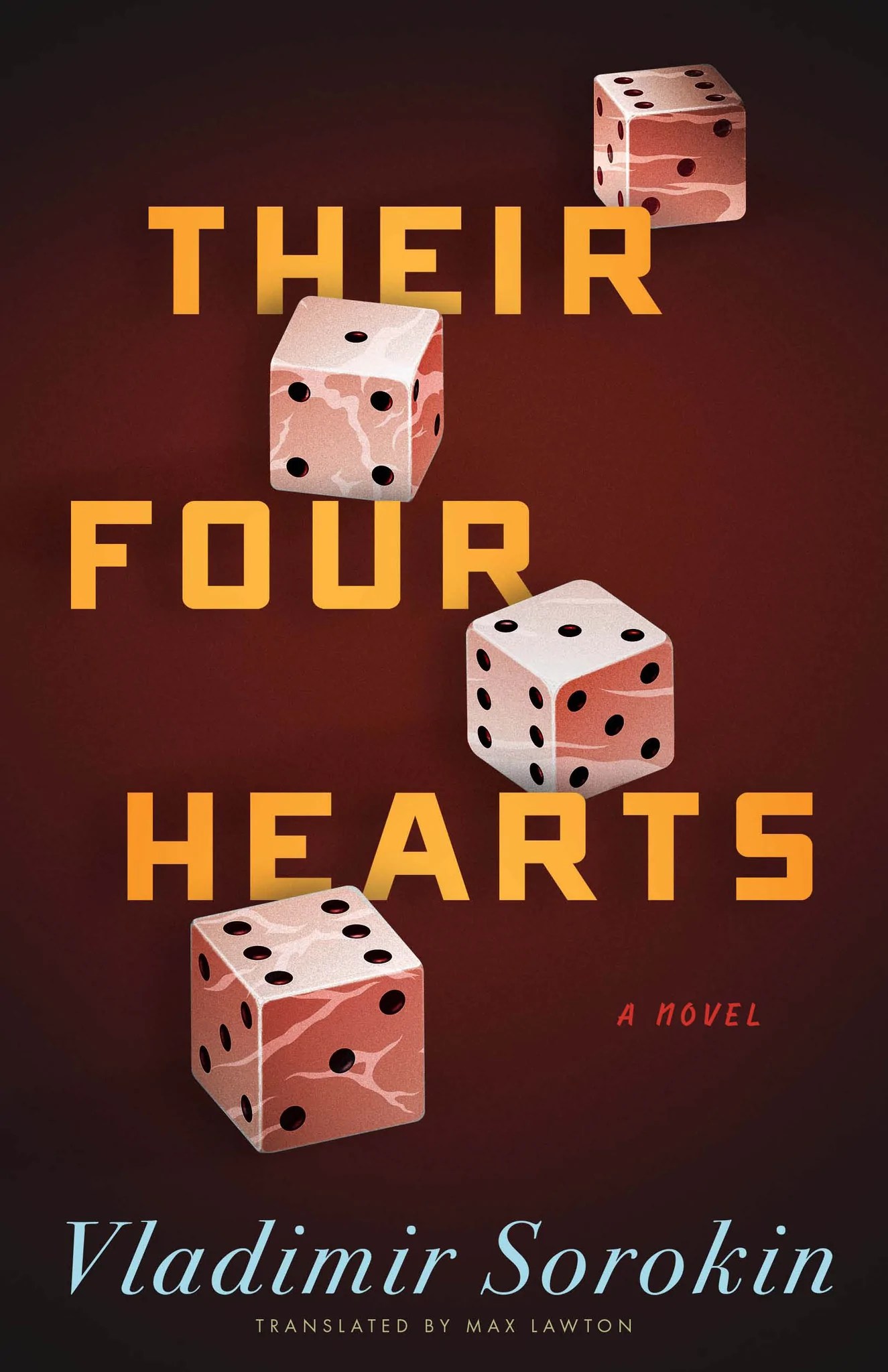
In many respects, Their Four Hearts is a book of endings and final things. Vladimir Sorokin wrote it in the year the Soviet Union collapsed and then didn’t write fiction for ten years after completing it––his next book being the infamous Blue Lard, which he wrote in 1998. Without exaggerating too much, one might call it the last book of the Russian twentieth century and Blue Lard the first book of the Russian twenty-first century. It is a novel about the failure of the Soviet Union, about its metaphysical designs, and about the violence it produced, but presented as God might see it or Bataille might write it.
Their Four Hearts follows the violent and nonsensical missions carried out by a group of four characters who represent Socialist Realist archetypes: Seryozha, a naive and optimistic young boy; Olga, a dedicated female athlete; Shtaube, a wise old man; and Rebrov, a factory worker and a Stakhanovite embodying Soviet manhood. However, the degradation inflicted upon them is hardly a Socialist Realist trope. Are the acts of violence they carry out a more realistic vision of what the Soviet Union forced its “heroes” to live out? A corporealization and desacralization of self-sacrificing acts of Soviet heroism? How the Soviet Union truly looked if you were to strip away the ideological infrastructure? As we see in the long monologues Shtaube performs for his companions––some of which are scatological nonsense and some of which are accurate reproductions of Soviet language––Sorokin is interested in burrowing down to the libidinal impulses that fuel a totalitarian system and forcing the reader to take part in them in a way that isn’t entirely devoid of aesthetic pleasure.
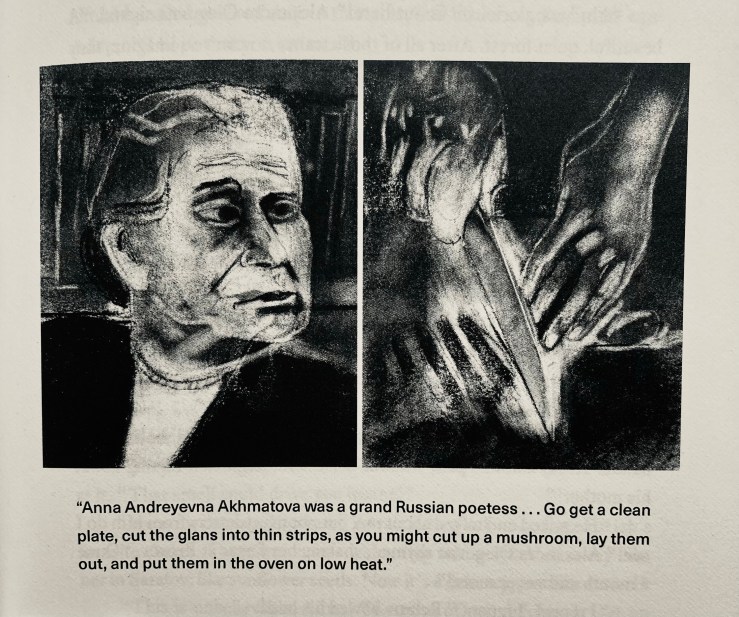
As presented alongside Greg Klassen’s brilliant charcoal illustrations, which have been compared to the work of Bruno Schulz by Alexander Genis and the work of Ralph Steadman as filtered through Francis Bacon by several gallerists, this angular work of fiction becomes a scatological storybook-world that the reader is dared to immerse themselves in.
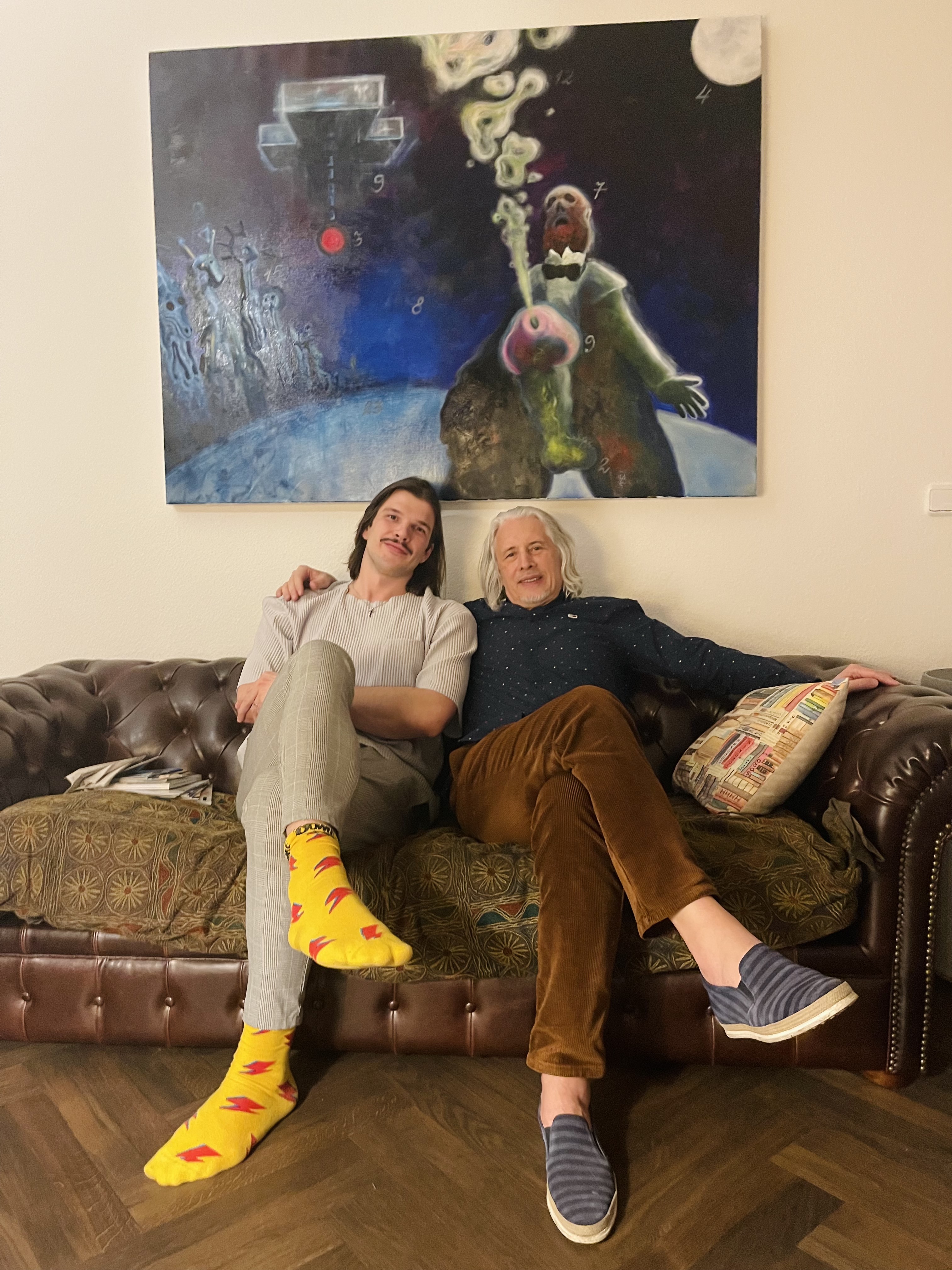
Max Lawton and Vladimir Sorokin, under a painting by Sorokin entitled Whether I Am a Trembling Creature. Photograph by Ecem Lawton.
My favorite book this year is Vladimir Sorokin’s novel Telluria, which is new in English thanks to NYRB and translator Max Lawton. I was deeply impressed with Lawton’s translation—lively, humorous, polyglossic, and lots of fucking fun. I was thrilled that Lawton agreed to an interview. We spent the last few weeks trading emails and also chatting via Twitter in what ended up being a very fun conversation for me.
While our interview takes Telluria as its starting point, Lawton talks at length about his other Sorokin translations, as well as forthcoming translations by Jonathan Littell, as well as his own fiction.
Biblioklept: Please: describe Telluria.
Max Lawton: TELLURIA is “Oxen of the Sun” as sci-fi novel, without any notion of a language’s generation—without any notion of “progress.” It is fractal and rhizome, scattered out over 50 chapters, with the only hint of redemption coming in a narcotic vision of Christ. TELLURIA is about pushing one’s mastery of style to the point where it begins to break down—in the mode of late Miles. It is at these moments of breaking down that something new begins to come into being. On the level of content, TELLURIA suggests that the small is always more charming—more desirable—than the master narrative. Nationalism, he suggests, can only be cute if it’s a doll-sized state that’s doing the nationalizing. Anything bigger is monstrous. The book, then, is an ode to difference. And a challenge to land-grabbing, logos-hijacking imperialists who believe in a single story. For Sorokin, the world is a million different textures, a million different languages, and no ONE can be said to triumph.
Biblioklept: I want to come back to notions of triumph and redemption later, particularly with the final chapter of Telluria in mind. But before we get in the weeds (a favorite place of mine), tell us a little bit about how you came to translate Sorokin. When did you first read him?
ML: I first read Sorokin after encountering a comparison made between him and Houellebecq in a review of ICE (probably in The New York Times). Angsty teen that I was, there could have been no higher praise. As it turned out, however, this was a red herring. Sorokin neither bore nor bears any resemblance to Houellebecq. Given that introduction, ICE was mostly confusing.
A few years after that, I dug into BLUE LARD in French, which was a truly formative reading experience. To read something so chilly, brutal, beautiful, and, most importantly, incomprehensible––it changed me entirely. I read it while teaching at a French immersion camp for children and a fellow counselor and I took to using neologisms from the book as slang between ourselves (“mais, c’est top-direct, mon brave!”). Embarrassing to think about now, but perhaps important.
During my four years of Russian study, then, at constant war with the thorniness of the language, Sorokin was the carrot on the stick that kept me going. All I wanted was to read him in the original. To read what hadn’t been translated. To translate him, perhaps. I bought BLUE LARD in Brighton Beach during a class field trip after one year of study and nearly wept when I tried to read it. It would take a great deal more work than I’d already done.
Immediately after college, my Russian good enough (I thought), I translated a big chunk of BLUE LARD and sent it to Sorokin. He liked it, impressed by whatever promise he saw in first swing, and we began to work together. It was then that I realized how ill-prepared I was for the job and, during the next few years at Oxford, Middlebury, and Columbia, I worked very hard to get my Russian up to snuff––to deserve the work I’d somehow lucked into.
Sorokin and I also began to become friends––a process that was crystallized by my first night in Russia: supper with Vladimir at Café Pushkin and a long stroll through the city.
For the next four years, we worked together relentlessly with no prospect of publication, emailing almost every day. I drafted four books before we eventually broke through with NYRB and Deep Vellum (which acquired Dalkey soon after we got in touch). While I would never recommend this approach to any other young translator, the drafts (fairly polished) helped get editors interested––no one really trusts the readers they hire to write reports about books in languages they can’t read…
Max Lawton. Photograph by Ecem Lawton.
Biblioklept: What I’ve read so far of Blue Lard has made my head spin. The idea of attempting it in a whole other alphabet seems unreal to me, so I could imagine going about translating it might be daunting at times–but also very rewarding.
When I was reading Telluria, I would often think, This seems like it would be really fun to translate! There’s all these different voices, registers, dialects, grammars, and so on bubbling along (I loved the centaur’s voice in particular).
ML: TELLURIA was a work that offered me immense freedom as I translated it. Sorokin’s conceit in writing the thing was not to symbolically represent a particular historical period or something like that, but to give voice to difference itself. 50 voices and 50 differences. Because of that, my task was monomaniacal in its complexity: to follow Sorokin out into deep waters of difference and, like him, give birth to 50 absolutely unique voices. I felt like a guitarist called up to play with Miles Davis on the DARK MAGUS tour. I had to be impenetrable where he was impenetrable, ungainly where he was ungainly, and senseless where he was senseless; anything less would have been a betrayal of what makes the book worth reading. As such, I appealed to Chaucer (for the centaur), Céline (for the bagmen), Turgenev translations (for the hunting), Faulkner and McCarthy (for the oral narratives about highly rural situations––what a blessing that we have a commensurate American tradition of SOUTHERN SKAZ FICTION able to render the Leskovian oral narratives that Sorokin fucks with), Ginsberg (for the “Howl” rip-off), Mervyn Peake (for the overripe fantasy-novel fun), and a great many others. Sometimes, Sorokin’s deranged signifiers come forth from very specific literary and historical phenomena. At others, he plays freely. In the former case, I tread very carefully (and Sorokin also watches my step). You’re right to say that TELLURIA was fun to translate for precisely that reason. And, indeed, BLUE LARD was also very fun to translate at certain points––dealing with the futuristic neologisms in the epistolary section and the Earthfuckers’ world––, but I had to tread carefully when dealing with the arch deconstructions of Soviet speech and the parodies of famous Russian writers.
Maybe the common trajectory of both Miles’s and Coltrane’s careers would be valuable to think of here. Playing in their early bands, you would have been constantly (and neurotically) thinking of the impending changes as you played. Later on, not so much… But that didn’t mean there wasn’t something rather precise at stake within the chaos… I too sometimes think and worry about impending changes––in THE NORM, certain sections of BLUE LARD, certain sections of MARINA’S 30TH LOVE… ––, whereas, at others, I am more free, but still after something very precise.
Biblioklept: Is Blue Lard the next one NYRB will publish?
ML: Yes, BLUE LARD is coming out in 2023, along with a collection of Soviet-themed short stories entitled DISPATCHES FROM THE DISTRICT COMMITTEE from Dalkey (the latter of which will also be illustrated by Greg Klassen).
Then THE NORM is coming out in 2024, along with ROMAN from Dalkey.
Then RED PYRAMID (selected stories) is coming out in 2025, along with MARINA’s 30TH LOVE from Dalkey. All dates are subject to change.
We have yet to place DOCTOR GARIN, THE SUGAR KREMLIN, MANARAGA, some of the short stories, and the complete plays. Sorokin is, thank God, still writing an awful lot. So there is much to look forward to.
In lining up this release schedule, our goal was to marry the extremity of Sorokin’s early work to the evenness and warmth of his later work. Leaving out either side of the equation creates an image that is simultaneously distorted and uninteresting. Insane, aberrant violence is just as valuable as Chekhovian sentence-surface.
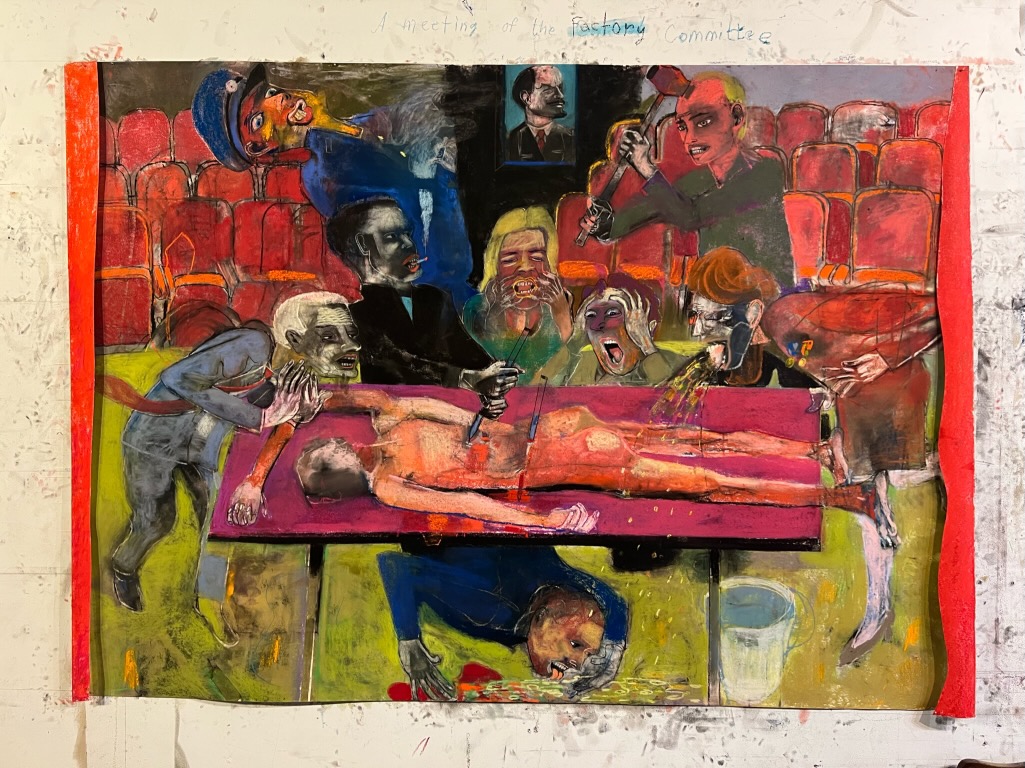
Greg Klassen, illustration for “A Hearing of The Factory Committee.” From Dispatches from the District Committee.
Biblioklept: Your use of the adjective “Chekhovian” in your last sentence prompts me to ask where you situate Sorokin within (or perhaps against) the Russian literary tradition. You were quoted in a recent New York Times profile as saying, “Sorokin has earned his place in the canon.” Can you expand on that? How do you believe Sorokin sees himself with respect to the history of Russian literature?
ML: Canon-formation doesn’t depend so much on author as on reception––and, since BLUE LARD, Sorokin has been very lucky in that regard. So, whereas many people once treated Sorokin’s work with a high degree of suspicion, they no longer have that luxury. His influence on younger writers, on philosophers, on philologists, on cinema, on popular thought… his unbelievable ability in having predicted what Russia’s become… beyond the question of quality, Sorokin is simply too important not to be read.
He also happens to be the best writer writing in Russian since Nabokov, but I digress…
In a certain respect, one might think of him as a Sadean trickster who, in the second half of his career, developed a Chekhovian or Zhivago-esque soul… I’m not sure how Sorokin himself would respond to such a characterization. He’s been a very religious dude since he started writing, but I know he’s also highly cognizant of the difference between DOCTOR GARIN (which I’m very excited to translate) and THEIR FOUR HEARTS. His early work has a highly destructive relationship to the canon. For example, here’s the back-cover text of DISPATCHES FROM THE DISTRICT COMMITTEE as I wrote it (which means this will double as a record of the censorship imposed upon me by Dalkey (just kidding Will and Chad!):
For the new to come into being, the old must be destroyed: burnt to the ground. Cultural stagnation and unreflective canon-worship are a sure recipe for aesthetic decay. In the career-spanning Soviet-themed stories that make up DISPATCHES FROM THE DISTRICT COMMITTEE (many of which are drawn from his legendary collection MY FIRST WORKING SATURDAY), Sorokin eviscerates the old, the dull, and the calcified with a feces-dipped dagger. Once upon a time, it seemed that the coprophagia, necrophilia, grievous bodily harm, Joycean gibberish, transgressive sexuality, and aberrant Bataillean metaphysics that make up these stories might be a satanic incantation uttered to bring a New Russia into being. Alas, they’ve now become a monument to that which never was: a rune etched in PUS, SHIT, CUM, and LARD.
Sorokin’s later work still has this pus-, shit-, and cum-drenched side to it, but paired with a deep sort of Christian warmth––as in the chapter in TELLURIA that describes the man who spent a great deal of time with the apostles by way of tellurium-wedges. I can’t help but see Sorokin himself in that man. The latter mode of Christian mysticism is, of course, more in line with the Russian canon as a whole, but what happens when you combine it with the former impulse I describe in the back-cover text?
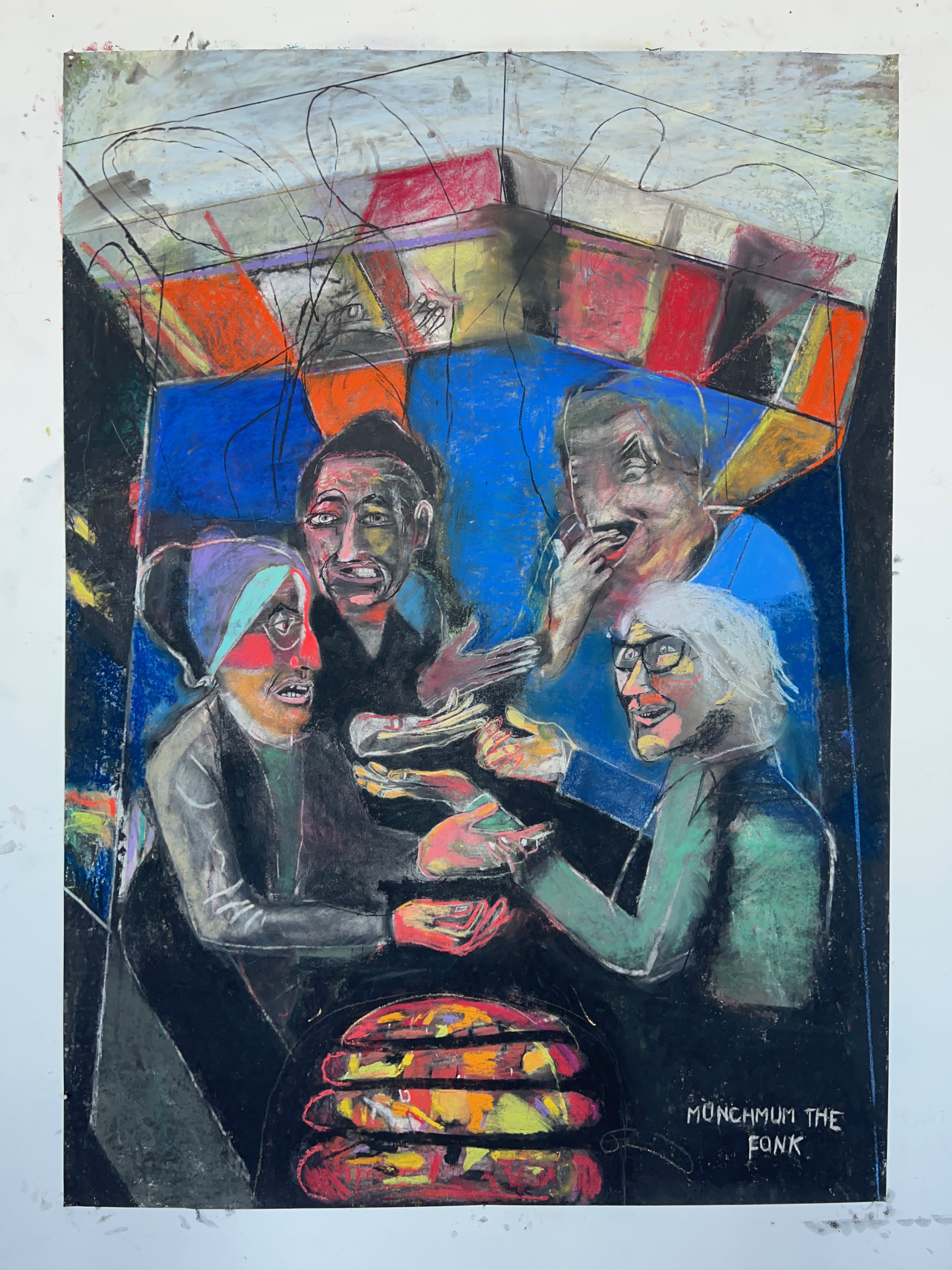
Greg Klassen, illustration for “Geologists.” From Dispatches from the District Committee.
Biblioklept: So, you’ve now brought up that particular late chapter of Telluria twice, where an exhausted man returns to his family after a long philosophical quest for meaning—the chapter ends in an affirmation, one delivered via a tellurium nail trip.
Many of the characters seek similar confirmations or comforts when they have tellurium nails hammered into their heads by the professional “carpenters” who are almost something like a class of monks. Other voices in the book search for escape or novelty via tellurium—not necessarily transcendence.
Do you think that the returning father in the particular chapter you’ve mentioned embodies a moral vision in Sorokin’s work?
And what do you make of the final chapter, where the driver — the same one we’ve seen earlier in the novel, if I’m not mistaken? — goes alone into the woods to make a new and solitary life for himself: “Seemed like my hands’d been longin’ for carpenters’ work,” he declares, before hewing logs and building a cabin.
ML: As for Sorokin’s moral compass, it’s hard to say. It seems to me that Sorokin mostly portrays God by way of His absence. THEIR FOUR HEARTS is a particularly striking example of this. But there’s also a strain of more old-fashioned Russian mysticism (which I’ve alluded to above) sometimes at play. The religious chapter is a good example of this (the Jesus trip), as is the hankering for a more simple rural life—the plagal cadence with which the novel comes to an end. That ending is a near-perfect rhyme with another Sorokin story called “The Governor,” which I’d be happy to send you. This longing for rural Russian Orthodoxy is often submitted to the same brutal criticism as everything else in his work is (like in ROMAN and THE NORM, in which Sorokin destroys his own personal ideal, just as the Bolsheviks destroyed the great cathedrals of Moscow).
At what point does violence intersect with God? If one were to strip out the explicitly religious and moral moments, what would it look like for a kind religious man to submit what he considers his highest impulses to a brutal species of live surgery—sort of like in the underwhelming [David Cronenberg film] CRIMES OF THE FUTURE? I don’t have the answer to this question. But it’s the same ambiguity that exists between Sorokin’s dissidence and his apolitical aestheticism: the driving enigma of his work.
Biblioklept:Telluria might be many English-language readers’ first introduction to Sorokin. How representative do you think it is of his work as a whole—thematically, formally, linguistically…?
ML: As I suggest above, TELLURIA is the work of a kinder and more gentle Sorokin—a Sorokin whose masterpiece is DOCTOR GARIN. His early work is far more likely to call forth an affective bodily rejection to the content that’s been read (a good, honest response to any work of literature: vomiting).
More than anything else, the early Sorokin responds to a single dictate: in an interview he gave when he was younger, he complains that Tolstoy was such a consummate God of his own creation in WAR AND PEACE that he should also have included descriptions of how Natasha Rostova shits and fucks—of how her sweaty underarms smell at the end of long balls. This is the mission of much of Sorokin’s early work: to become the God of every level of his literary creation.
The later Sorokin operates in a more logocentric world—one in which the body is not quite so overwhelmingly present (though it’s certainly still there…).
I recommend any new reader of Sorokin to immediately chase TELLURIA with THEIR FOUR HEARTS: those two combined give something like a complete picture of the master at work.
Biblioklept: In Telluria and Blue Lard, certain words and phrases are italicized, quoted, or capitalized—and particular voices tend to showcase this kind of emphasized phrasing more than others. Is this part of your translation technique? Something original to Sorokin’s typographic style?
ML: For the most part, I adhere quite rigidly to Sorokin’s own typographical choices. This is true without exception when it comes to boldface, quotes, and capital letters. However, the italics seem to play a more complex role in Sorokin’s voice. Sometimes, they’re merely used to indicate a sort of fantastical technology or a new concept. In those cases, I don’t fiddle. At other moments, they represent a kind of ironical intonation. Or… maybe not ironical. Let’s say: a very Sorokinian tone. As such, when this tone appears in the translation in a way that it didn’t in the original, I think the italics can be used as a powerful tool to smooth out some of the weirdnesses that might otherwise have been bothersome in the new text.
However, I use this technique sparingly. It’s something of an emergency fix––mimicking Sorokin’s sometimes overripe and ironical tone when normal language disappears in the interstitial moment between the two languages…
I’m generally very devoted to Sorokin’s original, but in spirit rather than letter. The experience of reading my translations should be much like that of reading Sorokin in the original; this goal necessitates creative solutions that are not––though fools may call them––mistranslations.
As a footnote: though my own fiction generally couldn’t be more different from Sorokin’s, I did take the italics and run with ’em––a feature of my style for which I’m also indebted to Will Self’s style in the Technology Trilogy––UMBRELLA, SHARK, and PHONE (three of my all-time favorites).
Biblioklept: I’m also curious about the footnotes in Telluria, which give a gloss for certain non-English words and phrases (usually Chinese). Are those Sorokin’s or yours?
ML: All of the footnotes dealing with other languages are Sorokin’s, all of the ones dealing with Russian are mine (I think there are two of the latter).
Biblioklept: There’s no introduction composed for Telluria, which is unusual for NYRB classics. Do you have any insight on that editorial choice?
ML: For a little while, I was rather taken up by the notion (one held very dearly by Vladimir) that the book should speak for itself entirely––without the intercession of any scholar or critic. Part of this has to do with the weird stranglehold held by Slavic scholars over the words of the writers they purport to explain to the world. In no other comparable world literature do scholars demand such a high degree of compliance from their authors. Sorokin has often complained to me that “Slavicists always want the forewords and never the afterwords.” And is it so insane that he should want the first word of the book to be… the first word of the book?
In this context, Sorokin and I love to bring up the anecdote of Pound showing Mussolini the Cantos and being so utterly delighted when il Duce exclaimed, “ma questo è divertente!”
This, then, is what the ideal reader of Sorokin’s work should immediately exclaim upon reading the first few lines of his texts. And his reader will surely not have such an unmediated reaction if, on the first page, he meets, not with the words of the author, but with a tangled gristle-bit of academic jargon:
TELLURIA exists in the interstitial space between the ultra-left Hegelian notion of the state’s disintegration as reinterpreted by Marx, but without reference to the monetary policy predominantly worked out in the initial chapters of DAS KAPTIAL, whereas the aberrant references to rightist dogma serve to underpin the fundamentally ambiguous approach to polyphony-as-palimpsest in the context of a global carnival utterly distinct from Dostoevskian scandal.
However, I’ve since softened.
Sorokin’s stuff could use a little explanation and, especially if we get interesting writers to engage with and write on Sorokin, the benefits of such critical apparati far outweigh the downsides. As such, Will Self will be introducing two of the coming short-story collections, Blake Butler will be introducing another, and I can’t yet reveal the other INCREDIBLE writers we have lined up.
Introductions dope enough to make the ideal reader also exclaim “ma questo è divertente!”
Biblioklept: I totally get Sorokin’s point. When I set out to read a book by an author I love or watch a film by filmmakers I love, I like to go in cold—no summaries or trailers. But the key there is that I already love (or pick your verb) the creator in question, which means at some point there’s already been an introduction. For a lot of us that’s as simple as a friend whose taste we trust (like my friend who insisted we see Fargo in the theater), or maybe a teacher who can present a frame for us to better understand the work (I can’t imagine reading The Sound and The Fury without at least a fuzzy precis). For the record, I think Telluria works great without an introduction, because the book’s shape (or “plot,” such as it is), reveals itself in the reading. And the reading is delicious. I do think though that Blue Lard might benefit from a brief introduction, so I’ll offer my unasked-for services: “This shit is wild. Just go for it. Don’t try to make it do what you think a novel should be doing. Just go with it.”
ML: BLUE LARD is about that state of confusion—ontological and linguistic—as it unfurls. To introduce the text beyond something like your pithy statement above might be a disservice to the book. The reader should be confused and it should hurt—then feel fucking good. This isn’t gloppy OLDOSEX; when reading Sorokin, we’re fucking nostrils with forked dicks (or—getting our nostrils fucked by the same).
The book’s real introduction is the Nietzsche quote at the beginning.
Does FINNEGANS WAKE need an introduction? Is one even possible?
I loved BLUE LARD when I first read it precisely because I had no point of reference for understanding it. Much like SCHATTENFROH (another text I’m working on).
Biblioklept: The Michael Lentz novel, right? Tell us about that one.
ML: Oh man… where to start. The book is a brick. The densest thing I’ve translated and among the densest things I’ve ever read. It’s a story about a Father. And Nazi Germany. And the Baroque (as such). And a chair. And online torture vids. It’s written in a very alienating mode. Like chewing on the blackest of black bread. And yet there’s something so enticing about the damn thing. As with BLUE LARD, a cliff face made of only black ice. I want to climb it, want not to slip, but the sliding down once I’ve lost hold is part of the pleasure. I’m honored to be working with the mighty Matthias Friedrich on this. Without him, I fear my German wouldn’t be quite up to the task.
I’m close online pals with Andrei of THE UNTRANSLATED and SCHATTENFROH is one of a few books he’s proselytized that I’m sampling. I’ll do the first that gets picked up. The others are: Moresco’s GAMES OF ETERNITY trilogy (with the great Francesco Pacifico on board as editor), Laiseca’s LOS SORIAS (would like an editor for this as well––ideally a Hispanophone translator from English into Spanish), and Goldshtein’s REMEMBER FAMAGUSTA. These books are not the easiest of reading (and they’re long––hence: expensive for me (us) to translate). If you’d like to see one of these samples, just ask! Especially if you work at a publishing house!
And there are more possible future plans in the works as well…
Biblioklept: You’re also translating titles by Jonathan Littell. Can you tell us a little about those?
ML: So I’ve just finished his short book on a Belgian Nazi entitled THE DAMP AND THE DRY (turned it in today). Despite all my little polemics with the notion of a Skeleton Key, one might be forgiven for reading THE DAMP AND THE DRY as a Skeleton Key for THE KINDLY ONES (one of my 30 fave books, for sure).
AN OLD STORY is the real juicy bit: a novel, 300-some pages of metaphysics in superposition—war, sex, death, solitude, orgy, pegging, self-dissection… as if Sade had happened to write the best nouveau roman ever put to page. The book absolutely rules. My first time through, I read it in a day. Vomiting, weeping, and throbbingly erect for ten hours straight.
It’s a great experience to work with Jonathan who edits my work a lot, as compared to Vladimir who just hands me the wheel. Two different styles, both with downsides and benefits.
I also want to translate a few old Russian novels: PETER THE FIRST by Alexei Nikolaevich Tolstoy, IT’S ME, EDDIE by Eduard Limonov, THE SILVER PRINCE by Alexei Konstantinovich Tolstoy, THE LESSER DEMON by Fyodor Sologub, and A HUNTER’S SKETCHES by Ivan Turgenev. And am determined to do two novels by the great Turkish novelist Oğuz Atay, working with the formidable Ralph Hubbell (whose translation of Atay’s stories coming out next year from NYRB is a must-read––WAITING FOR THE FEAR). And… and… maybe a few things by Céline, working with Iain Sinclair, one of my favorite novelists. And the three insanely fucked volumes of MICROFICTIONS––the most contemporary of abjectness in 10 frames or less, but 500 times––1000 pages per book. And Guyotat’s late novels––would kill to do those. And be killed by doing them. And… and…
Enough for now. Enough to keep me busy for decades. But also some things I’m not allowed to talk about.
Biblioklept:An Old Story sounds to be cut from the same cloth as The Kindly Ones, which I loved too. You mentioned your own fiction—can you touch on that some?
ML: The cool thing is how different UVH [Une vielle histoire; An Old Story] is from THE KINDLY ONES. It shows the extent to which Jonathan has legs as a writer. To do something that doesn’t deal in history or linear narrative AT ALL, then to succeed no less spectacularly than in THE KINDLY ONES… well, it rocks to have done something that dope.
My own fiction is difficult to talk about. Until it’s published, it really is unbecomingly vain to wax eloquent on the subject. I can say that I have two collections of intertwined stories (THE WORLD vols. 1+2)––tangled up in the same way A HUNTER’S SKETCHES and THE ATROCITY EXHIBITION are––and a novel (PROGRESS). In the interests of being as objective and unannoying as possible, here’s the synopsis of PROGRESS agents and publishers get:
It’s October, 2020. On a Saturday night, a college sophomore and his best friend engage in a radical act of sexual experimentation with their female acquaintance. The next day, a prolonged series of crashes heard through a dormitory window heralds the end of something. In simple terms: all wheels stop spinning and all screens stop shining. Afraid of this new world and the people they share a city with, the two boys make the precipitous decision to begin walking from their place of study in NYC to the narrator’s home in Ohio. As they walk, the formerly platonic contours of their relationship give way to something else. Maneuvering across the concrete skin of America, the boys slumber in the empty belly of a dead country in blissful ignorance of the threat hanging over them.
Opening as a campus novel, morphing into a melancholy psychogeographic exploration of a country-carcass, and ending as a psychedelic vision of the end of history, Progress is about what happens when rules change. Conceived of and started before the pandemic, this novel is a particularly relevant read in our current historical moment. Written with the chilly object-fixation of Peter Handke and the wry humor of Will Self, Progress is also deeply indebted to Vladimir Sorokin’s shamanistic and scatological engagements with Russian history. To put it another way: Progress is The Road meets Call Me By Your Name with a dash of Dhalgren. It is a transmission both awful and enormous from the heart of our new American age.
It’s not for me to say if it’s good or not. Hopefully it sees the light of day soon, then the Owl of Minerva shall get to flying… Greg Klassen will be illustrating both volumes of stories and I hope my friend Zoe Guttenplan, an amazing book designer who will be doing hyper-Soviet designs for four (or more) of the coming Sorokin books, will be doing abstract, pornographic photo-art to accompany them as well. PROGRESS will be simple in its publication: a normal book with only text. I want both volumes of THE WORLD to be hyper-decadent editions. Coming soon. I hope.
As it happens, Zoe might also be snapping pics for an article Will Self and I will hopefully be co-writing next year around Bloomsday… a throwback to a more Gonzo style of journalism… all I can say…
Greg Klassen, illustration for “My First Working Saturday.” From Dispatches from the District Committee.
Biblioklept: Have you ever stolen a book?
ML: For my translation process, digital texts are a necessity. They really do save me a lot of time. As such, the ready availability of Russian novels in PDF form on the internet has been an occasional boon to my work. However, I always then buy the physical copy too (if I don’t have it already).
Digital without physical is like body without soul. Feeling the translated pages tick up from 0 is also something I can’t do without (their almost furred texture on my right thumb as I flip through ‘em).
But I’ve never stolen a physical book. Never even lost a library book. A boring dude who saves his wildest transgressions for the printed page.
Max Lawton is not a boring dude. (Stealing books does not make you interesting, kids. Unless it does.)
Max Lawton is a translator, novelist, and musician. He received his BA in Russian Literature and Culture from Columbia University and his MPhil from Queen’s College, Oxford, where he wrote a dissertation comparing Céline and Dostoevsky. He has translated many books by Vladimir Sorokin and is currently translating works by Jonathan Littell. Max is also the author of a novel and two collections of stories currently awaiting publication. He is writing his doctoral dissertation on phenomenology and the twentieth-century novel at Columbia University, where he also teaches Russian. He is a member of four heavy-music groups.
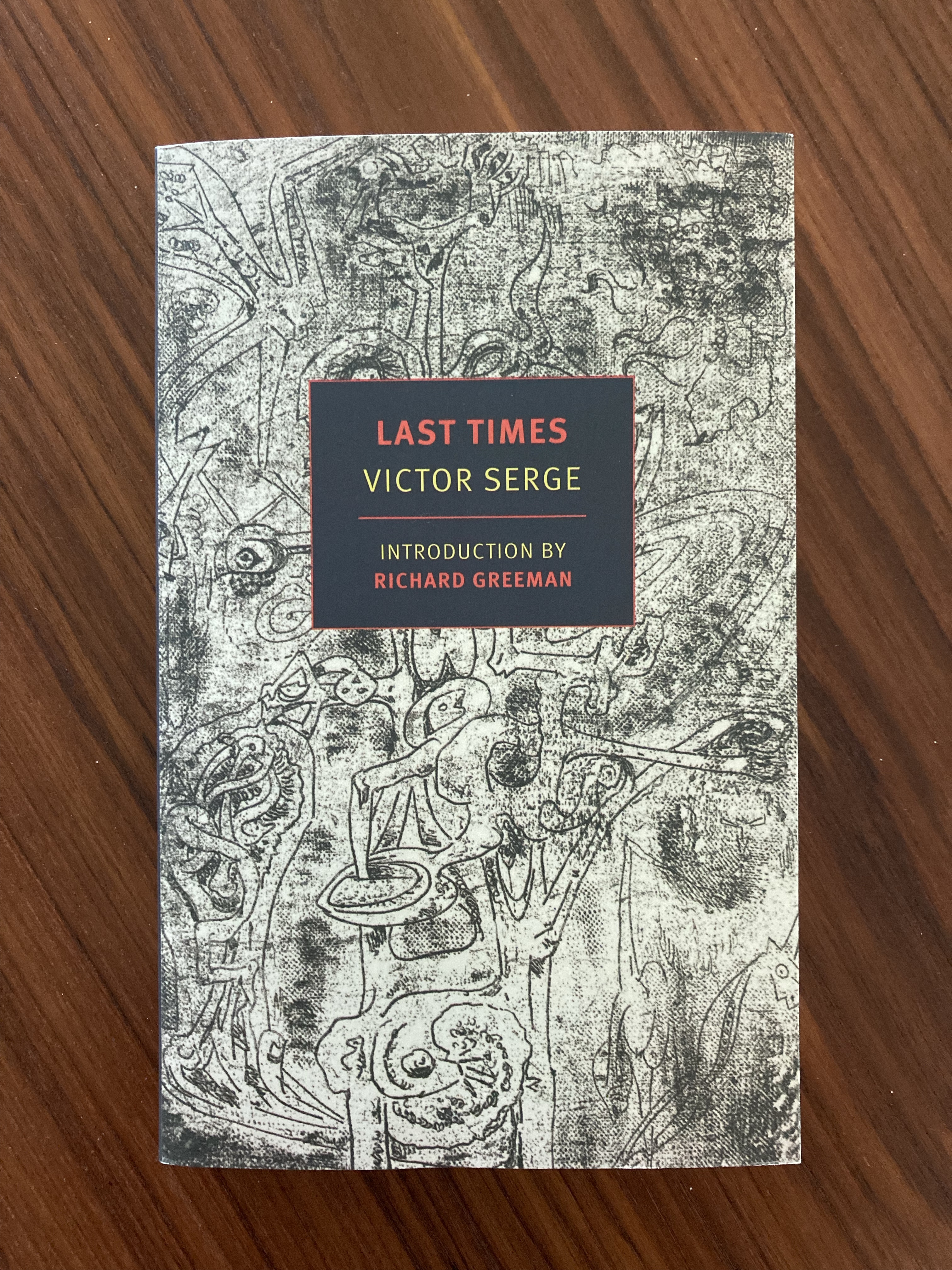
Victor Serge’s Last Times is out later this month from NYRB, in the original translation Ralph Manheim. NYRB’s blurb:
Last Times, Victor Serge’s epic novel of the fall of France, is based—like much of his fiction—on firsthand experience. The author was an eyewitness to the last days of Paris in June 1940 and joined the chaotic mass exodus south to the unoccupied zone on foot with nothing but his manuscripts. He found himself trapped in Marseille under the Vichy government, a persecuted, stateless Russian, and participated in the early French Resistance before escaping on the last ship to the Americas in 1941.
Exiled in Mexico City, Serge poured his recent experience into a fast-moving, gripping novel aimed at an American audience. The book begins in a near-deserted Paris abandoned by the government, the suburbs already noisy with gunfire. Serge’s anti-fascist protagonists join the flood of refugees fleeing south on foot, in cars loaded with household goods, on bikes, pushing carts and prams under the strafing Stukas, and finally make their way to wartime Marseille. Last Times offers a vivid eyewitness account of the city’s criminal underground and no less criminal Vichy authorities, of collaborators and of the growing resistance, of crowds of desperate refugees competing for the last visa and the last berth on the last—hoped-for—ship to the New World.
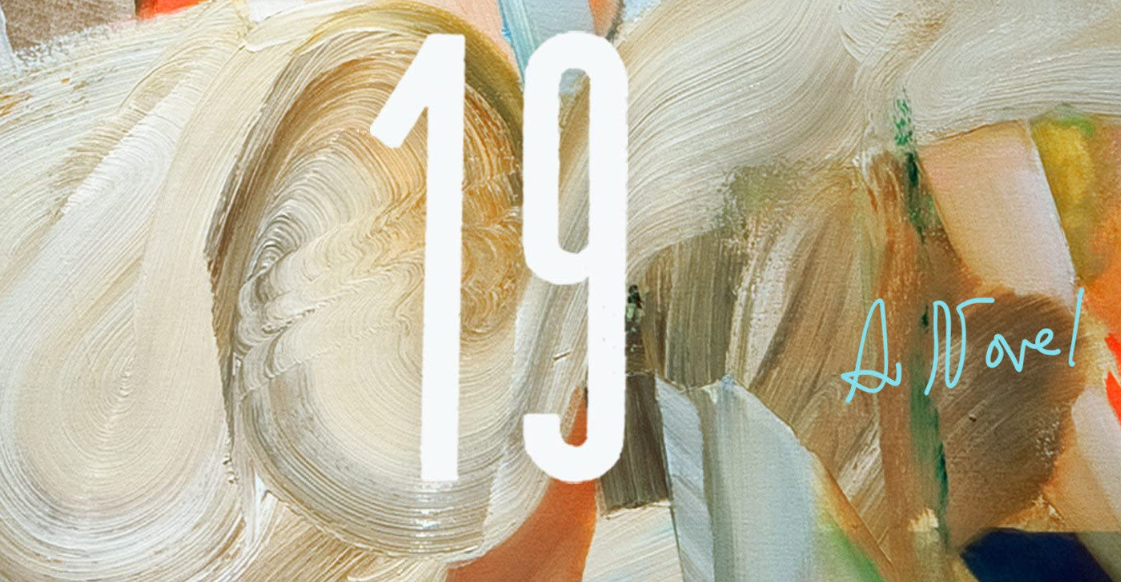
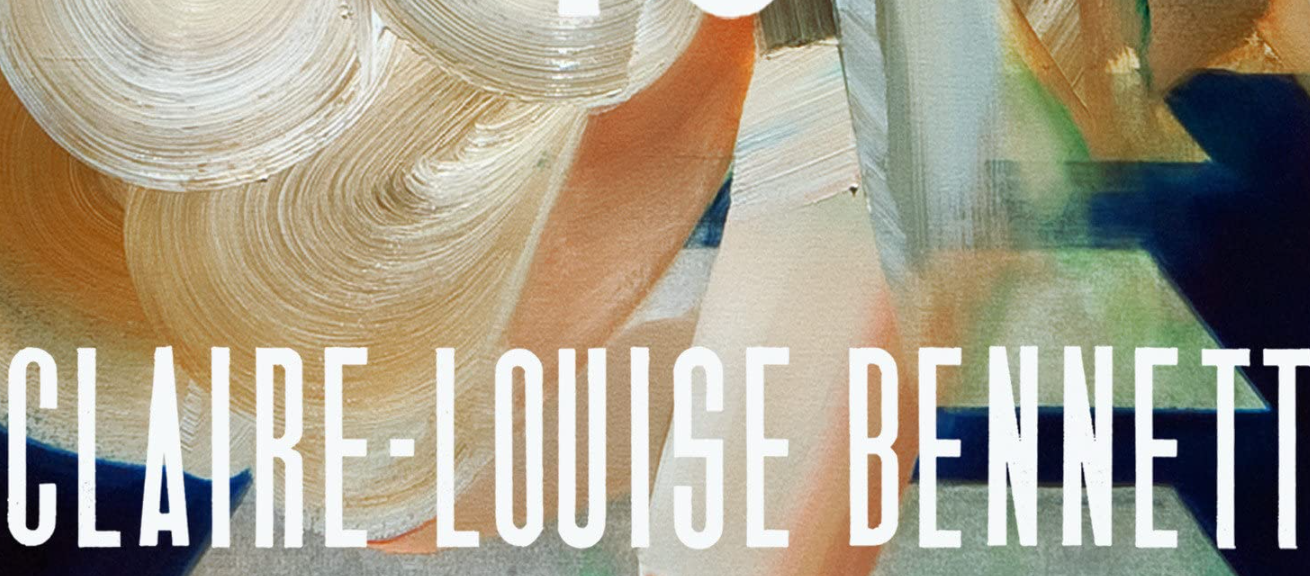
I finished the audiobook of Claire-Louise Bennett’s second book Checkout 19 a few minutes ago, or really, a few minutes before I started writing this blog.
Bennett reads the book herself.
Sometimes listening to an author read their own writing is revelatory; the author imposes a performance that the prose alone, particularly the syntax, couldn’t conjure in your mind’s ear. There’s more to the work than you’d imagined. (And then, later, when you settle down, maybe you realize: there’s less.)
And sometimes hearing the author read their own work is painful. It’s not the writer’s fault, necessarily, but they shouldn’t be encouraged to visit microphones. They ham it up, or their restraint cools the prose, or, maybe they’re just nervous. They wrote the book to be read, not audited, maybe.
The other category of audiobooks read by their authors, or one of the other categories of audibooks read by their authors, is in my estimation the optimal experience: The writer reads their book in the most natural of manners, as if reading something they’d worked on for months or years or whatever into a digital audio file was just a natural thing, a normal thing, and that the author, the reader—the author is the reader, now, of her own work—the author can read her own work without a veil of artifice, without a smirk, without hedging.
Claire-Louise Bennett’s reading of Claire-Louise Bennett’s book Checkout 19 falls into this third category. The experience is unforced, an adjective that I don’t know what to do with now that I’ve written it. I’ll retreat to summary and description for a moment then:the audiobook of Claire-Louise Bennett’s Checkout 19, as read by Claire-Louise Bennett, is not quite seven hours long. It is divided into seven chapters, and, generally, very generally speaking, offers a kind of early autobiography through reading and writing. It is a kind of Künstlerroman, a word I learned in college which is not really useful here. In more contemporary terms it might be called autofiction, although I don’t know what that means either.
The chapters of Checkout 19 circulate not circularly in an elliptical rhythm, tracing and retracing foundational moments in Bennett’s, or Bennett’s narrator’s, life.
(I don’t believe for a minute that anything in Checkout 19 is false, even the embellishments, even possible lies.)
These moments are primarily connected to reading and writing, and something that I loved about Checkout 19 was how often Bennett concretized how physical and temporal reading and writing are: How we remember not just what or why we read or wrote, but also where, and when, and how: Where did we find spaces to carve out our own little stories? What were the beautiful covers of books we failed to read yet nevertheless lugged around with us? Why are some pens suited for drawing but not writing?
We get Bennett’s narrator sussing out the world of letters from a young age. Her Roald Dahl is the same Roald Dahl who wrote her mother’s copy of Switch Bitch, but he’s not the same Roald Dahl. Later, a boyfriend worries that Sylvia Plath and Anne Sexton might not be good for her, and tries to keep them from her. He’s the same boyfriend who gets way too into Bukowski, embarrassing really. And even later (as a sort of capping grace on this motif in the story) Bennett’s narrator reclaims Anaïs Nin from freshman dorms everywhere, declaring her a talent to be reread later. Bennett’s book made me want to revisit Anaïs Nin, who I’ll admit I’ve compartmentalized along with Plath, Sexton, and Bukowski as writers I read in college.
There are lots of other books that pop up, full lists at times, canon-making, frankly (enough to make me order a physical copy of the book), but E.M. Forster’s A Room with a View, which I have never read, is a major touchstone. Checkout 19 didn’t make me want to read A Room with a View, but I did relate very strongly to a moment when Bennett’s narrator admits to misremembering a key detail in the narrative in a way that fundamentally impacts her life.
Bennett also weaves and estimable biography of the avant garde writer Ann Quin into Checkout 19, which I hope will lead lots of people to read the novels of the avant garde writer Ann Quin. (Start with Berg.)
What else, what else? So much else—boyfriends and obsessions, mean girls and chronic boredoms, a Russian magician, bearing Nietzsche books, a hanged man at the children’s park. Bennett smuggles in a magnificent, strange story in, the life of one Tarquin Superbus, who acquires an impossible library only to find every book blank and null. Only Tarquin Superbus’s mentor assures him that there’s a magic sentence hiding somewhere in there—he just needs to hunt for it. The story is like something from Eco or Calvino, and I would’ve lapped up more of it.
What else, what else? There were parts that cracked me up to no end, as when the narrator lends her copy of a Paul Bowles novel—must’ve been The Sheltering Sky—to a guy who had had some flowers he’d bought for himself ruined while attempting to bicycle them home. She witnesses a car drive over the flowers and sees her friend, or acquaintance maybe, upset, and decides to loan him the Bowles novel when she meets him at the pub, but he’s too caught up in the story of his destroyed flowers to really take note, and he doesn’t even open the book—which Bennett’s narrator had purchased in Morocco or Algeria (look, I can’t remember right now, I don’t have a physical copy)—and he doesn’t even open The Sheltering Sky (it couldn’t have been Let It Come Down, right?), he just keeps retelling the story of his flowers destroyed, ever more tragic. Worst of all, he hates that she’s already witnessed the flowers’ ruin: he can’t tell his tragedy. She never gets the book back. And isn’t that always the way?
If you read and loved Bennett’s first book Pond like I did, you’ve probably already read Checkout 19 or put it into some stack to get to. If you haven’t read Pond, read Pond—and then check out Checkout 19. Great stuff.
Near the middle of Herman Melville’s 1855 novella Benito Cereno, our erstwhile protagonist Captain Amasa Delano encounters an old sailor tying a strange knot:
For intricacy, such a knot he had never seen in an American ship, nor indeed any other. The old man looked like an Egyptian priest, making Gordian knots for the temple of Ammon. The knot seemed a combination of double-bowline-knot, treble-crown-knot, back-handed-well-knot, knot-in-and-out-knot, and jamming-knot.
At last, puzzled to comprehend the meaning of such a knot, Captain Delano addressed the knotter:—
“What are you knotting there, my man?”
“The knot,” was the brief reply, without looking up.
“So it seems; but what is it for?”
“For some one else to undo,” muttered back the old man…
This knot serves as a metaphor for the text of Benito Cereno itself. We readers (along with our hapless surrogate Captain Delano) are the ones tasked with unknotting the text’s central mystery.
Part of the great pleasure of reading Benito Cereno for the first time rests in Melville’s slow-burning buildup to the eventual unknotting. I was fortunate enough to have been ignorant of the plot (and eventual revelation) of Benito Cereno when I first read it over a dozen or so years ago (although even then I cottoned on to what was really happening earlier than Captain Delano did). I read the novella again last week and marveled at Melville’s narrative control, enjoying it anew by seeing it anew.
Benito Cereno is a sharply-drawn tale about the limits of first-person consciousness and the cultural blinders we wear that prevent us from seeing what is right in front of us. The book subtly critiques the notion of a naturally-ordered morality in which every person has a right and fitting place, whether that be a place of power or a place of servitude. Melville shows the peril and folly of intrinsically believing in the absolute rightness of such a system. There is comfort in belief, but unquestioning belief makes us radically susceptible to being wrong. When we most believe ourselves right is often when we are the most blinded to the reality around us. We cannot see that we cannot see. And Benito Cereno is about how we see—about how we know what we know. Melville’s novella is also about how seeing entails not seeing, and, further, not seeing what we are not seeing—all that we do not know that we do not know. Melville makes his readers eventually see these unknown unknowns, and, remarkably, shows us that they were right before our eyes the entire time.
Forgive me—much of the previous paragraph is far too general. I want you to read Benito Cereno but I don’t want to spoil the plot. Let’s attempt summation without revelation: The novella is set in 1799 off the coast of Chile. Amasa Delano, captain of the American sealing vessel the Bachelor’s Delight, spies a ship floating adrift aimlessly, apparently in distress. Captain Delano boards one of his whale boats and heads to the San Dominick, a Spanish slaving ship, and quickly sees that the enslaved Africans on board dramatically outnumber the Spanish sailors. Delano offers aid to the San Dominick’s captain, Benito Cereno, who tells Delano that most of the Spanish crew perished in a fever (along with the “owner” of the slaves, Alexandro Aranda). Benito Cereno himself seems terribly ill and not entirely fit to command, so Delano waits aboard the San Dominick while his men fetch food and water from the Bachelor’s Delight. In the meantime, he tours the ship and talks with Benito Cereno and Cereno’s enslaved valet Babo.
Delano is frequently troubled by what he sees on the ship, but his good nature always affords him a natural and acceptable answer that assuages the sinister tension tingling in the background. Even though he’s troubled by the “half-lunatic Don Benito,” Delano’s “good-natured” sense of moral authority can explain away what he sees with his own eyes:
At last he began to laugh at his former forebodings; and laugh at the strange ship for, in its aspect, someway siding with them, as it were; and laugh, too, at the odd-looking blacks, particularly those old scissors-grinders, the Ashantees; and those bed-ridden old knitting women, the oakum-pickers; and almost at the dark Spaniard himself, the central hobgoblin of all.
For the rest, whatever in a serious way seemed enigmatical, was now good-naturedly explained away by the thought that, for the most part, the poor invalid scarcely knew what he was about…
These paragraphs not only summarize some of the images that give Delano pause, they also show Melville’s remarkable prose style, which follow’s Delano’s psychological state: laughing dismissal returns back to anxious image; anxious image gives way again to relieved certitude. All that is “enigmatical” in life can be “good-naturedly explained away.” And yet as the narrative progresses, good-natured explanations will fail to answer to visceral reality. Melville’s slow burn catches fire, burning away the veils of pretense.
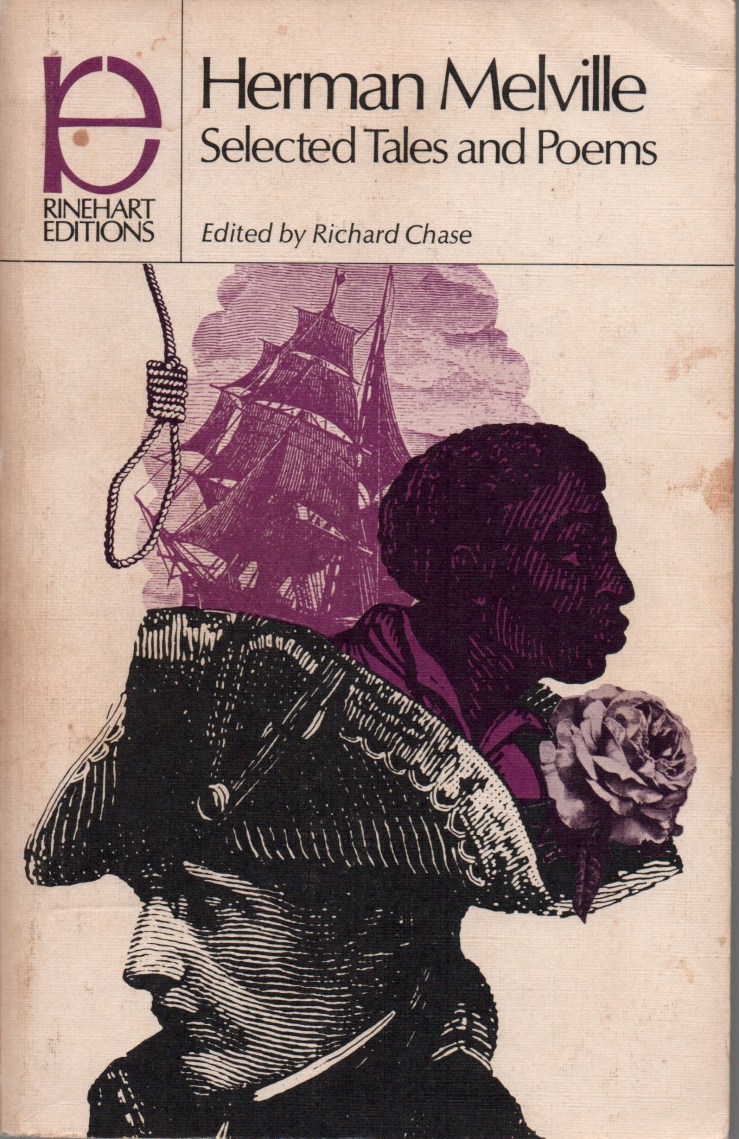
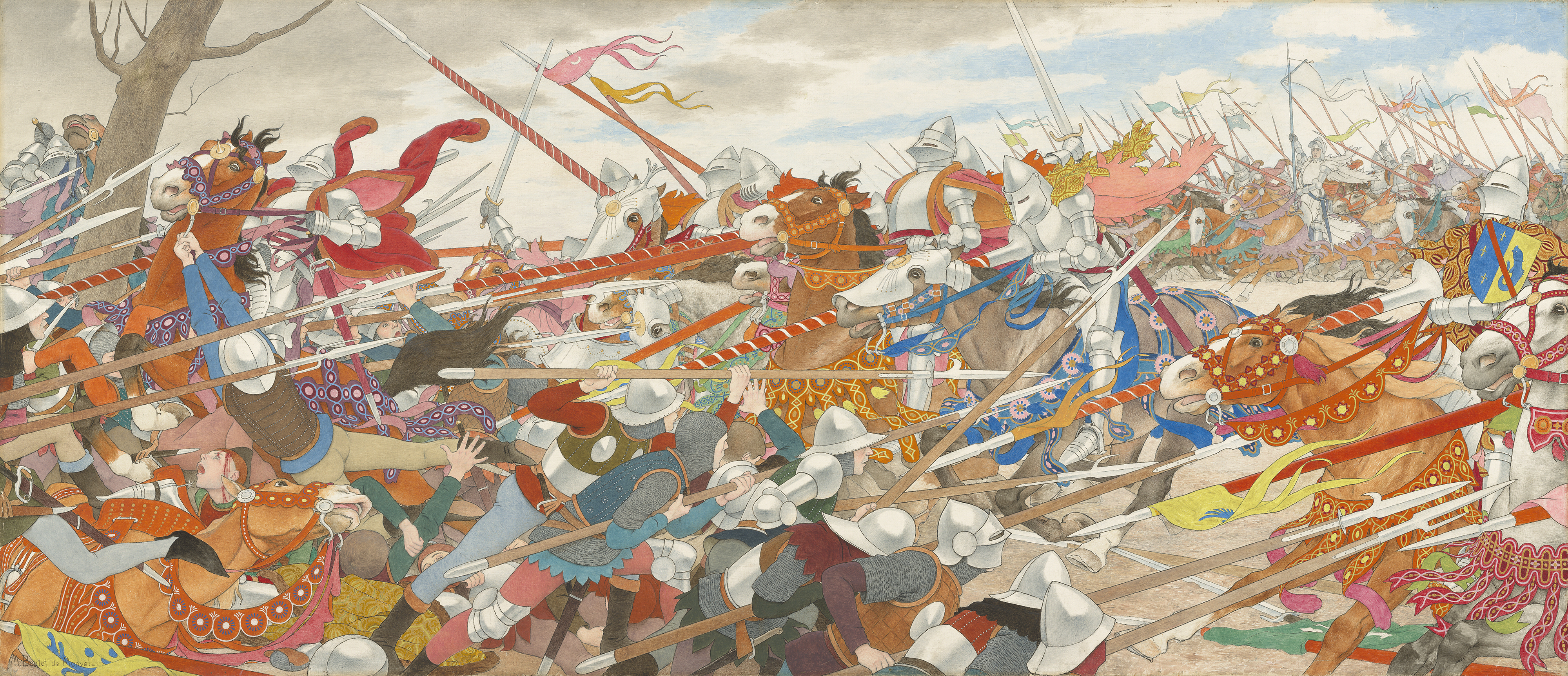
The rest of this post (after the image) contains significant spoilers. I highly recommend Benito Cereno, which is reprinted in any number of Melville collections (I read it again in Rinehart’s Selected Tales and Poems), including The Piazza Tales (which you can download for free at Project Gutenberg). While I think that Benito Cereno has gained more recognition in recent years, it remains under-read compared to Melville’s more famous novellas Bartleby and Billy Budd. Those are great books too, but I’d argue that Benito Cereno, with its critique of white supremacy, is more timely than ever. Check it out. (Again, spoilers ahead).
It is the end of July 2022 and I am on the seventh day of quarantine in my bedroom. I tested positive for COVID-19 again on Friday, and while I feel fine for the most part, the first few days of the illness were a fog. I had always thought I’d catch up on reading or watching films if I were to catch covid, but my brain didn’t work that way. Instead, I played a lot of online chess, losing a lot more than usual, with the extended editions of The Lord of the Rings films on in the background on an old laptop.
Over the past few days I’ve felt a lot better, and have been able to retain what I’ve read. A lot of that reading consisted of essay drafts for the online Summer B classes I’m teaching, which come to end very soon. But last night I was able to jump back into Vladimir Sorokin’s novel Blue Lard, in translation by Max Lawton (forthcoming from NYRB next year). It is simply amazing, a totally fucked up wild ride that’s impossible to summarize. Here’s a brief description from Max (via email): “The reader should be confused and it should hurt—then feel fucking good. This isn’t gloppy OLDOSEX; when reading Sorokin, we’re fucking nostrils with forked dicks (or—getting our nostrils fucked by the same).” THE READER SHOULD BE CONFUSED AND IT SHOULD HURT—THEN FEEL FUCKING GOOD! Yes!
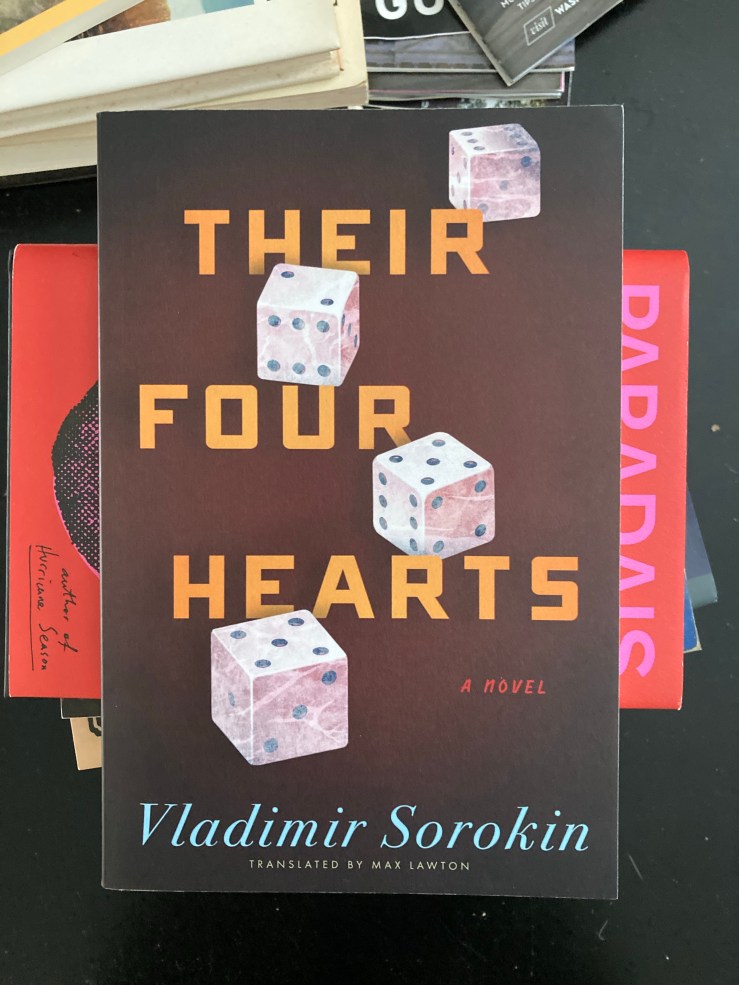
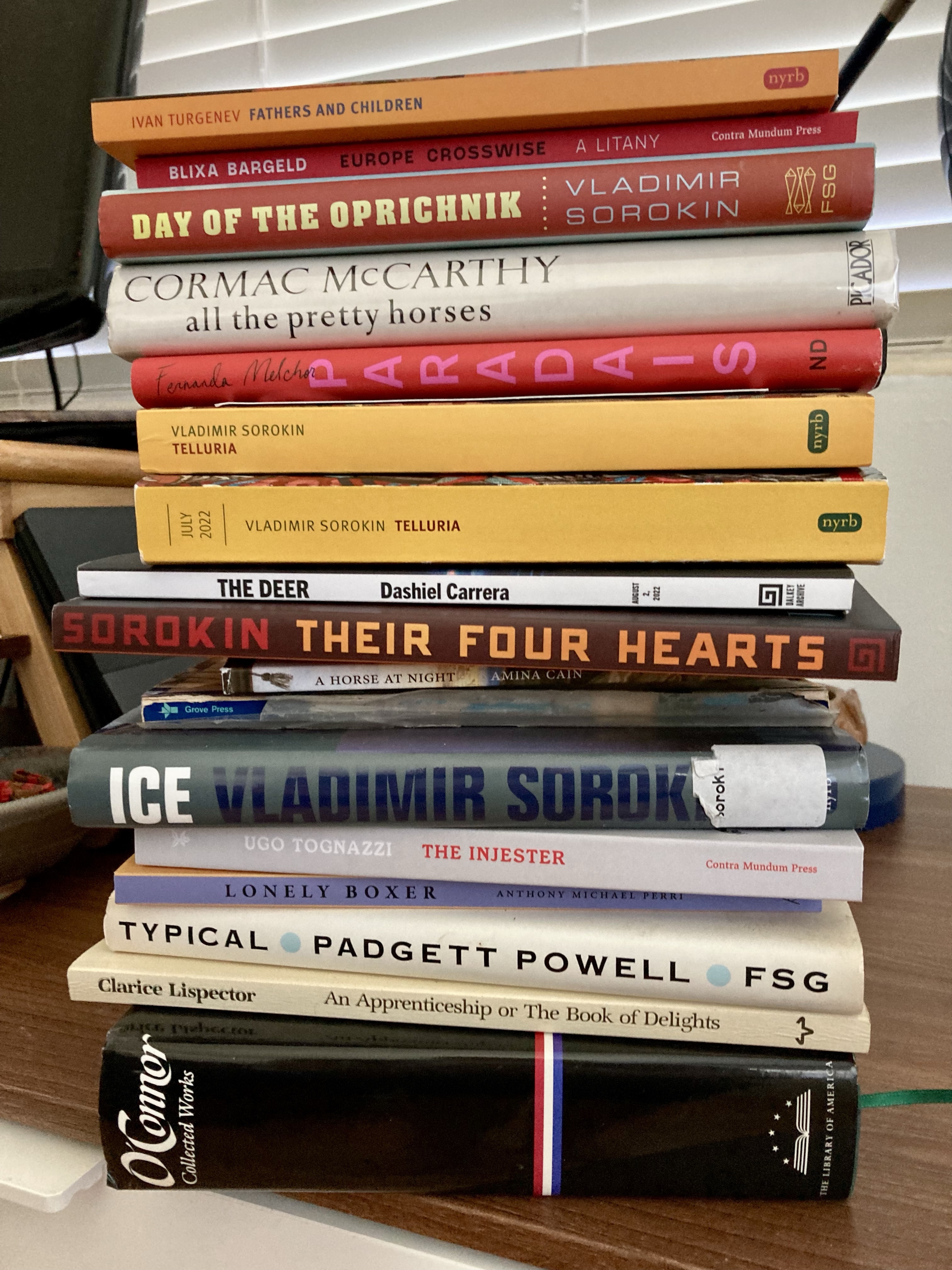
I have a big stack of books in the room, including several by Sorokin. They form a big stack only because I stacked them up to take the picture below to accompany this blog; previously they were in smaller stacks or strewn or in a basket to the right of my bed.
There’s a lot of Sorokin in the stack, but not Max Lawton’s Blue Lard translation, because it doesn’t exist in a hard copy in English. Day of the Oprichnik (trans. Jamey Gambrell) was good, but the language wasn’t nearly as rich as the language of Telluria—although Oprichnik felt like it could fit into Telluria, or at least the same universe. I got Their Four Hearts in the mail yesterday, and Ice a few weeks ago, but haven’t dipped into either.
Other thoughts on the stack: I felt well enough yesterday (aided by two coffees and a prednisone) to write something on Dashiel Carrera’s debut novel The Deer. I brought the Turgenev back here when I first tested positive with covid because it was on a stack on my coffee table of books I was ostensibly going to get to or needed to review. I read Blixa Barged’s Crosswise Europe back in June and couldn’t really think of anything to say about it. I had it out because I’ve been meaning to mail it to a friend.
I must’ve acquired the copy of McCarthy’s All the Pretty Horses on 14 July 2022, right before I left for a week in Washington, D.C. (the trip that undoubtedly resulted in the covid). I know the date because I posted some cool book covers on twitter that day.
I had painted our living room that week, which involved cleaning, moving, and sorting three ladder bookcases. I ended up culling about forty titles, and I took maybe half of those to the used bookstore on the fourteenth and turned them into a first edition hardback of All the Pretty Horses.
I wrote about acquiring Fernanda Melchor’s Paradais (and covid) in D.C. After I finish Blue Lard, this is on deck. Also in the stack but unread: Amina Cain’s A Horse at Night. Ugo Tognazzi’s The Injester is a cookbook from Contra Mundum. I read Anthony Michael Perri’s The Lonely Boxer earlier this month and need to write a review of it (it’s good!). The bottom three books (Powell, Lispector, O’Connor) I picked up at an estate sale two weeks ago (wrote about it here). I tried reading one of the Powell stories on Tuesday (or Wednesday?) but couldn’t focus.
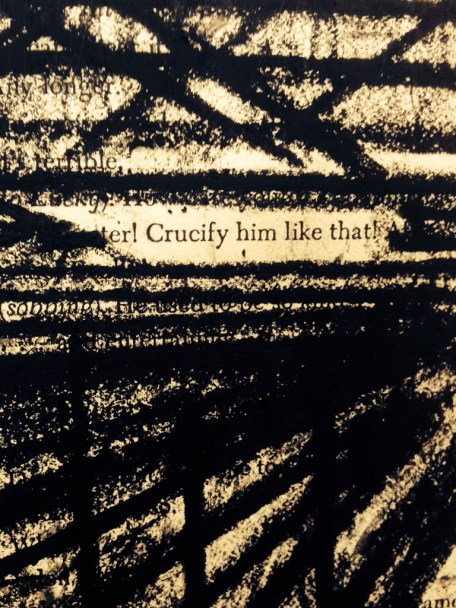
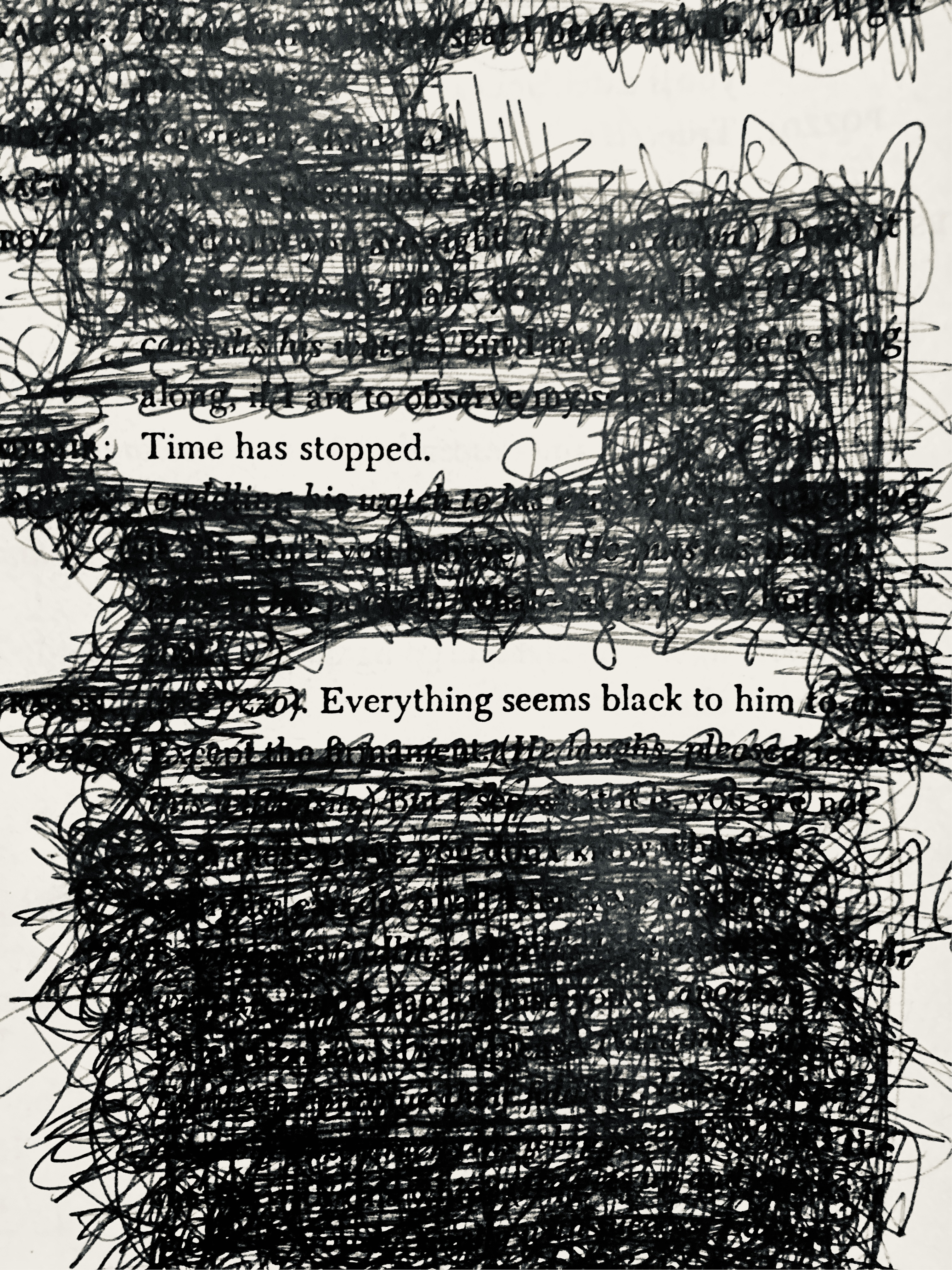
Wedged in the middle there is a Grove Press edition of Beckett’s Waiting for Godot that I had been destroying in office hours back in 2014. I had really been enjoying writing over it and posting pics of the pages I’d done, but someone wrote in to tell me that it was corny and for some reason that really got to me and I stopped. I was younger then (obviously); if someone did that today I’d probably ignore it completely.
I opened the book just now; I’d left off on page 24, although the last one I posted on the blog was page 22. Here is page 22:
I’ll do page 25 now.
Here is page 25:
Not my best work, but I enjoyed the process!
So there’s the stack.
So, end of July, ass end of summer. There were positive times—hanging with extended family on the Fourth of July week on the beautiful Florida Gulf Coast (my now not-so-little cousins actually still wanted to play D&D). Some nice museum visits in D.C., some good reads in between. But July came in with a host of draconian Supreme Court rulings that seem to push the U.S. more steeply towards an outright autocracy in the making and closed with my spending over a week in quarantine, and the only good thing about the global heatwave that’s burned up the month might be that it seemed to wake a few people up to a future that’s already here. So, yeah, fuck July.








 Biblioklept