Interrupted Reading — Camille Corot

Talking Heads, Live in Rome 1980 (Full Concert)

Max Roach — Jean-Michel Basquiat

“Jimber-jawed Serge” and Other Names from F. Scott Fitzgerald’s Notebooks

A grand duke—“Jimber-jawed Serge.”
Name: Umphadel Piluski
Gangster Salve Spitale—Saliva Spit.
Gooshoofenstein Von Beasinghausen
Meglomania McCarthy
English clubman named Cumbersom
Names Lee Spurgeon, Stoner, Mortimer, Flieshhacker, Henry P. Jacques. Borre.
Bryon Appledeck
Name for movie house “What’s at the Dementia?”
Mr. Schlchgd from Notre Dame in novel.
Beauty boy Johnston
Name Howya Bartlett
Joe Crusoe
Hummer for name
The Marquise de la Close d’Hirondelle
Tookey Ledoux
Harry Fantum
George Gratteciel
Marylyn Miller Swann, Sherlock Holmes Swann
Futility Trust Company
Name of “La Paix” changed to “Thropaca”
Grandfather called Mo’papa

—F. Scott Fitzgerald, The Notebooks

The Virgin Reading — Vittore Carpaccio

Ed Sanders and a Drunken Jack Kerouac on William F. Buckley’s Firing Line in 1968

RIP — In Honor of My Desktop PC, 2002-2012

Reading Monkey — Gabriel von Max

Little Libraries, Guerrilla Libraries, Ad Hoc Libraries and More

Read Shannon Mattern’s great essay “Marginalia: Little Libraries in the Urban Margins” (published at Places). From the essay:

These new library projects might seem to emerge from a common culture and uphold a common mission — a flurry of press coverage in late 2011 represented them as a coherent “little library” movement. But in fact they don’t. They have varied aims and politics and assumptions about what a library is and who its publics are; their collections and services differ significantly; and their forms and functions vary from one locality to another. I want to attempt here to identify a loose, and inevitably leaky, typology of “little libraries” — to figure out where they’re coming from, how they relate to existing institutions that perform similar roles, and what impact they’re having on their communities.

Finn Mac Cool Relates Those Musics He Has Found the Sweetest — A Passage from O’Brien’s Novel At-Swim-Two-Birds

Extract, from my typescript descriptive of Finn Mac Cool and his people, being humorous or quasi-humorous incursion into ancient mythology: Of the musics you have ever got, asked Conan, which have you found the sweetest?

I will relate, said Finn. When the seven companies of my warriors are gathered together on the one plain and the truant clean-cold loud-voiced wind goes through them, too sweet to me is that. Echo-blow of a goblet-base against the tables of the palace, sweet to me is that. I like gull-cries and the twittering together of fine cranes. I like the surf-roar at Tralee, the songs of the three sons of Meadhra and the whistle of Mac Lughaidh. These also please me, man-shouts at a parting, cuckoo-call in May. I incline to like pig-grunting in Magh Eithne, the bellowing of the stag of Ceara, the whinging of fauns in Derrynish. The low warble of water-owls in Loch Barra also, sweeter than life that. I am fond of wing-beating in dark belfries, cow-cries in pregnancy, trout-spurt in a laketop. Also the whining of small otters in nettle-beds at evening, the croaking of small-jays behind a wall, these are heart-pleasing. I am friend to the pilibeen, the red-necked chough, the parsnip land-rail, the pilibeen mona, the bottle-tailed tit, the common marsh-coot, the speckle-toed guillemot, the pilibeen sleibhe, the Mohar gannet, the peregrine plough-gull, the long-eared bush-owl, the Wicklow small-fowl, the bevil-beaked chough, the hooded tit, the pilibeen uisce, the common Corby, the fish-tailed mud-piper, the cruiskeen lawn, the carrion sea-cock, the green-lidded parakeet, the brown bog-martin, the maritime wren, the dove-tailed wheatcrake, the beaded daw, the Galway hill-bantam and the pilibeen cathrach. A satisfying ululation is the contending of a river with the sea. Good to hear is the chirping of little red-breasted men in bare winter and distant hounds giving tongue in the secrecy of fog. The lamenting of a wounded otter in a black hole, sweeter than harpstrings that. There is no torture so narrow as to be bound and beset in a dark cavern without food or music, without the bestowing of gold on bards. To be chained by night in a dark pit without company of chessmen – evil destiny! Soothing to my ear is the shout of a hidden blackbird, the squeal of a troubled mare, the complaining of wild-hogs caught in snow.

Relate further for us, said Conan.

It is true that I will not, said Finn.

A lovely early passage from Flann O’Brien’s first novel At Swim-Two-Birds.

Old Man Reading — Vincent van Gogh

Jackson Pollock Documentary

“Accounts to reconcile: Anecdotes to pick up: Inscriptions to make out: Stories to weave in: Traditions to sift: Personages to call upon: Panegyricks to paste up at this door; Pasquinades at that” — A Passage from Sterne’s Tristram Shandy

Chapter 1.XIV. Upon looking into my mother’s marriage settlement, in order to satisfy myself and reader in a point necessary to be cleared up, before we could proceed any farther in this history;–I had the good fortune to pop upon the very thing I wanted before I had read a day and a half straight forwards,–it might have taken me up a month;–which shews plainly, that when a man sits down to write a history,–tho’ it be but the history of Jack Hickathrift or Tom Thumb, he knows no more than his heels what lets and confounded hindrances he is to meet with in his way,–or what a dance he may be led, by one excursion or another, before all is over. Could a historiographer drive on his history, as a muleteer drives on his mule,– straight forward;–for instance, from Rome all the way to Loretto, without ever once turning his head aside, either to the right hand or to the left,- -he might venture to foretell you to an hour when he should get to his journey’s end;–but the thing is, morally speaking, impossible: For, if he is a man of the least spirit, he will have fifty deviations from a straight line to make with this or that party as he goes along, which he can no ways avoid. He will have views and prospects to himself perpetually soliciting his eye, which he can no more help standing still to look at than he can fly; he will moreover have various Accounts to reconcile: Anecdotes to pick up: Inscriptions to make out: Stories to weave in: Traditions to sift: Personages to call upon: Panegyricks to paste up at this door; Pasquinades at that:–All which both the man and his mule are quite exempt from. To sum up all; there are archives at every stage to be look’d into, and rolls, records, documents, and endless genealogies, which justice ever and anon calls him back to stay the reading of:–In short there is no end of it;–for my own part, I declare I have been at it these six weeks, making all the speed I possibly could,–and am not yet born:–I have just been able, and that’s all, to tell you when it happen’d, but not how;–so that you see the thing is yet far from being accomplished. These unforeseen stoppages, which I own I had no conception of when I first set out;–but which, I am convinced now, will rather increase than diminish as I advance,–have struck out a hint which I am resolved to follow;–and that is,–not to be in a hurry;–but to go on leisurely, writing and publishing two volumes of my life every year;–which, if I am suffered to go on quietly, and can make a tolerable bargain with my bookseller, I shall continue to do as long as I live.

Chapter XIV of the first book of Laurence Sterne’s The Life and Opinions of Tristram Shandy, Gentleman.

Man, Standing, Reading a Book — Vincent van Gogh

Man, Sitting, Reading a Book — Vincent van Gogh

Science Friction — Stan Vanderbeek

Books Acquired, 5.17.2012—Or, Here’s What’s New from Picador This June

20120521-122547.jpg

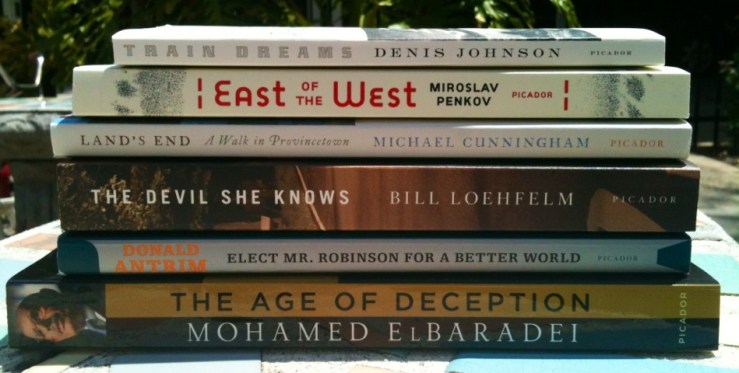
Nice little batch from the good folks at Picador, including Bill Loehfelm’s thriller The Devil She Knows, Mohamed ElBarardei’s The Age of Deception, an analysis of nuclear politics, and Michael Cunningham’s Land’s End, which I assume is a novelization of the clothing catalog.

Also in the batch: Denis Johnson’s novella Train Dreams, which I read in one sitting this Sunday. It’s a perfect novella, its pathos balanced with humor, its realism tempered in something of the mythic spirit of the American frontier. Full review forthcoming.

20120521-122553.jpg

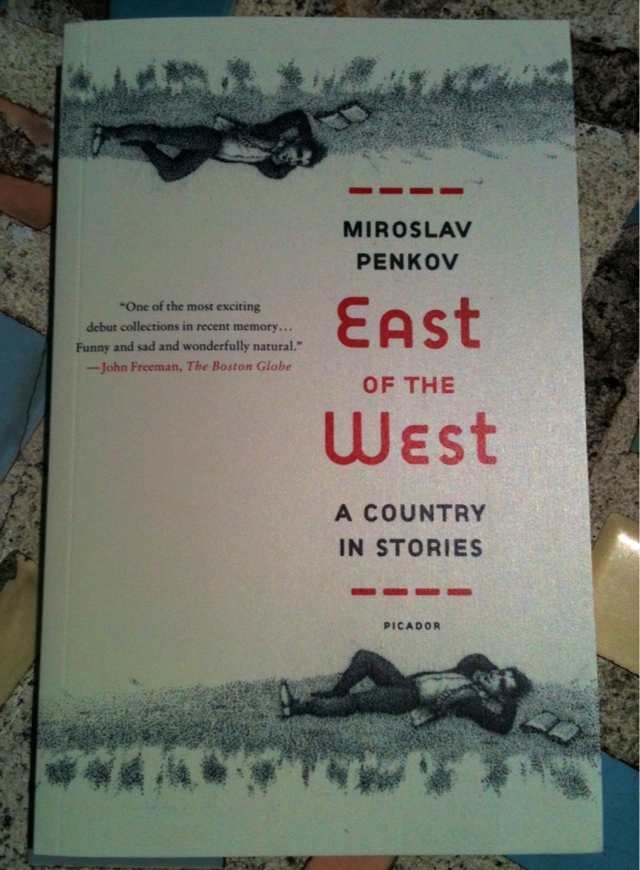
Miroslav Penkov’s collection East of the West looks pretty cool.

20120521-122559.jpg

Here’s a description from his website:

A grandson tries to buy the corpse of Lenin on eBay for his Communist grandfather. A failed wunderkind steals a golden cross from an Orthodox church. A boy meets his cousin (the love of his life) once every five years in the river that divides their village into east and west. These are Miroslav Penkov’s strange, unexpectedly moving visions of his home country, Bulgaria, and they are the stories that make up his charming, deeply felt debut collection.

20120521-122605.jpg

Donald Antrim’s debut Elect Mr. Robinson for a Better World has also been reissued with a new intro by Jeffrey Eugenides. Here’s an excerpt of the novel:

It was Friday, the day of the big theriomorphism workshop Rotary luncheon out at the Holiday Inn. My wife, Meredith, and I and a crowd of red-faced Rotarians and their well-dressed wives (Rotary Anns) sat around hotel banquet tables and listened to a visiting anthropology professor at the junior college say, “Pick an animal, any animal, fish, fowl, beast. Concentrate on aspects of the animal. Is it big? Small? Cute? Does it eat other animals? What color fur? If the animal is a bird, what color are its feathers? What song does it sing?”

“This is stupid,” I whispered to Meredith.

“It’s your fault we’re here, Pete. Why don’t you give it a chance?”

The anthropologist said, “Why don’t we all think about it for a minute? Okay, everybody got one?”

“Yes,” “No,” “Wait,” people said. Meredith whispered, “What’s yours?”

“I don’t know, what’s yours?”

“Coelacanth.”

“The prehistoric fish?”

“I need a volunteer,” declared the professor. Meredith raised her hand, and the man at the podium said, “Yes, back there. Tell us your name and the name of the animal you’ve chosen to become today.”

“Meredith Robinson. Coelacanth. It’s a kind of fish that scientists believed extinct until one was caught off the coast of Africa.”

“Excellent. Come forward. Sit here. Would someone please dim the lights?” I watched Rotary guys watch my wife. Bill Nixon, Tom Thompson, Abraham de Leon, Dick Morton, Terry Heinemann, Robert Isaac—all the usuals, plus others. Jerry and his wife, Rita, sat up front. The professor soothingly said, “Close your eyes, breathe deeply, and tell us about the coelacanth. Everybody else, let’s all breathe deeply too, and be thinking about our own animals. Go ahead, Meredith.”

“Well, it’s four feet long, deep slate blue, with bony, protruding fins and big jaws with scary teeth. It goes back seventy million years. It moves slowly, it dwells in dark water.” The professor nodded. Audience members inched forward in their seats. Meredith said, “At night it swims upside down with its head pointed to the sea bottom, bobbing along.”

“A feeding technique?”

“Maybe.”

“How’s the water?” I could see Meredith’s head settle forward as she softly answered, “Cold.”

“Feel the cold. Breathe that cold. Inhale that water. What do you feel?”

“Colors.”

“Colors?”

“Blue, black, indigo.”