Derrida (2002 Documentary)

Stump — Neil Welliver

Hooped Pots, Sneak-cup, and Other Drinking Customs in Shakespeare

Drinking Customs.

Shakespeare has given several allusions to the old customs associated with drinking, which have always varied in different countries. At the present day many of the drinking customs still observed are very curious, especially those kept up at the universities and inns-of-court. Alms-drink was a phrase in use, says Warburton, among good fellows, to signify that liquor of another’s share which his companion drank to ease him. So, in “Antony and Cleopatra” (ii. 7) one of the servants says of Lepidus: “They have made him drink alms-drink.”

By-drinkings.This was a phrase for drinkings between meals, and is used by the Hostess in “1 Henry IV.” (iii. 3), who says to Falstaff: “You owe money here besides, Sir John, for your diet, and by-drinkings.”

Hooped Pots.In olden times drinking-pots were made with hoops, so that, when two or more drank from the same tankard, no one should drink more than his share. There were generally three hoops to the pots: hence, in “2 Henry VI.” (iv. 2), Cade says: “The three-hooped pot shall have ten hoops.” In Nash’s “Pierce Pennilesse” we read: “I believe hoopes on quart pots were invented that every man should take his hoope, and no more.” The phrases “to do a man right” and “to do him reason” were, in years gone by, the common expressions in pledging healths; he who drank a bumper expected that a bumper should be drunk to his toast. To this practice alludes the scrap of a song which Silence sings in “2 Henry IV.” (v. 3): “Do me right, And dub me knight: Samingo.” He who drank, too, a bumper on his knee to the health of his mistress was dubbed a knight for the evening. The word Samingo is either a corruption of, or an intended blunder for, San Domingo, but why this saint should be the patron of topers is uncertain.

Rouse.According to Gifford, [972] a rouse was a large glass in which a health was given, the drinking of which, by the rest of the company, formed a carouse. Hamlet (i. 4) says: “The king doth wake to-night, and takes his rouse.” The word occurs again in the following act (1), where Polonius uses the phrase “o’ertook in’s rouse;” and in the sense of a bumper, or glass of liquor, in “Othello” (ii. 3), “they have given me a rouse already.”

Sheer Ale. This term, which is used in the “Taming of the Shrew” (Induction, sc. 2), by Sly—“Ask Marian Hacket, the fat ale-wife of Wincot, if she know me not: if she say I am not fourteen pence on the score for sheer ale”—according to some expositors, means “ale alone, nothing but ale,” rather than “unmixed ale.”

Sneak-cup. This phrase, which is used by Falstaff in “1 Henry IV.” (iii. 3)—“the prince is a Jack, a sneak-cup”—was used to denote one who balked his glass.

From Thomas Firminger Thiselton-Dyer’s indispensable volume Folk-lore of Shakespeare.

Child Reading (Red) — Will Barnet

“Chasing a Bee” — Mercury Rev

RIP Doc Watson

I Am Still Learning — Goya

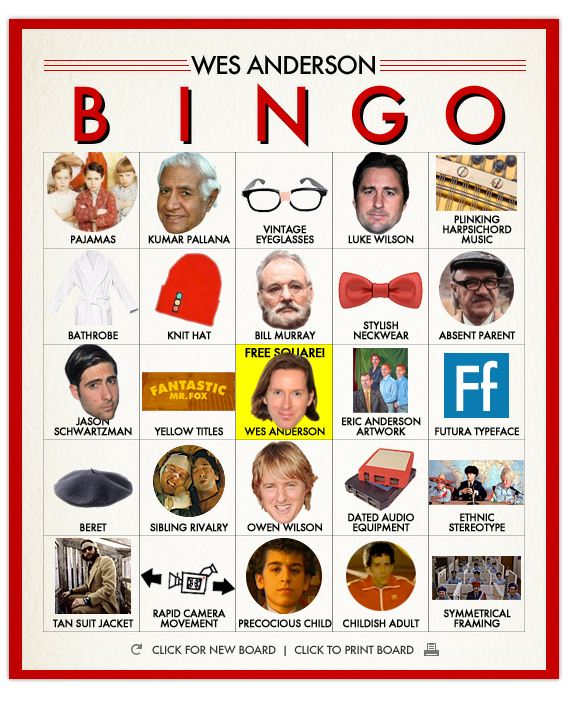
Wes Anderson Bingo

(Via Slate’s Brow Beat blog; go there to get printable variations of the board).

Reading — Gerhard Richter

Portrait of Fyodor Dostoevsky — Felix Vallotton

Finnegans Wake (With Bear)

20120527-204833.jpg

20120527-204844.jpg

20120527-204859.jpg

20120527-204905.jpg

20120527-204916.jpg

20120527-204937.jpg

20120527-204947.jpg

Boy Reading an Adventure Story — Norman Rockwell

Typed Notes for Train Dreams — Denis Johnson

(Via).

Cover Art for New David Foster Wallace Essay Collection Both Flesh and Not

Not really news, but I somehow missed this: Both Flesh and Not has a cover, apparently, as well as a product description:

Beloved for his epic agony, brilliantly discerning eye, and hilarious and constantly self-questioning tone, David Foster Wallace was heralded by both critics and fans as the voice of a generation. BOTH FLESH AND NOT gathers 15 essays never published in book form, including “Federer Both Flesh and Not,” considered by many to be his nonfiction masterpiece; “The (As it Were) Seminal Importance of Terminator 2,” which deftly dissects James Cameron’s blockbuster; and “Fictional Futures and the Conspicuously Young,” an examination of television’s effect on a new generation of writers.

Both Flesh and Not is due around Thanksgiving this year.

Two Deformed Heads — Wenceslas Hollar

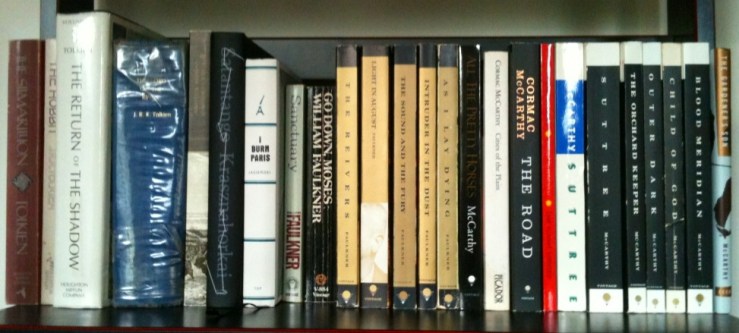
Book Shelves #22, 5.27.2012

20120527-111623.jpg

Book shelves series #22, twenty-second Sunday of 2012: Tolkien, Faulkner, McCarthy

As always, sorry for the glare. Shooting this case head on is almost impossible because of the windows on the other side of the room. Anyway.

I’ve read everything by Cormac McCarthy with the exception of his screenplay for The Gardener’s Son, which I found a week or two and picked it up. I don’t own a copy of No Country for Old Men because I haven’t found one that isn’t a movie tie-in.

20120527-111632.jpg

This copy of The Lord of the Rings—my first—was a kind gift from some friends we were staying with in Melbourne (the one in Australia, not Florida).

20120527-111642.jpg

I’ve read it at least four times; I have other copies of LoTR and have read them too. It’s probably the book I’ve read the most, although I haven’t read it since 2002. This copy is kindly inscribed:

20120527-111650.jpg

There’s a slim space on the shelf that currently holds a few books that I’ve been meaning to read:

20120527-111659.jpg

“They Hate Me More Than I Hate Them” — Michel Houellebecq on Critics and the Press

INTERVIEWER

What about your critics? Can you just sum up briefly what you hold against the French press?

HOUELLEBECQ

First of all, they hate me more than I hate them. What I do reproach them for isn’t bad reviews. It is that they talk about things having nothing to do with my books—my mother or my tax exile—and that they caricature me so that I’ve become a symbol of so many unpleasant things—cynicism, nihilism, misogyny. People have stopped reading my books because they’ve already got their idea about me. To some degree of course, that’s true for everyone. After two or three novels, a writer can’t expect to be read. The critics have made up their minds.

From his Paris Review interview.