Bill Murray Hosts a Tour of Moonrise Kingdom; Drinks Spiced Rum

Discussion of Fears (A Passage from Roberto Bolaño’s Novel 2666)

There are odder things than sacraphobia, said Elvira Campos, especially if you consider that we’re in Mexico and religion has always been a problem here. In fact, I’d say all Mexicans are essentially sacraphobes. Or take gephyrophobia, a classic fear. Eots of people suffer from it. What’s gephyrophobia? asked Juan de Dios Martinez. The fear of crossing bridges. That’s right, I knew someone once, well, it was a boy, really, who was afraid that when he crossed a bridge it would collapse, so he’d run across it, which was much more dangerous. A classic, said Elvira Campos. Another classic: claustrophobia. Fear of confined spaces. And another: agoraphobia. Fear of open spaces. I’ve heard of those, said Juan de Dios Martinez. And one more: necrophobia. Fear of the dead, said Juan de Dios Martinez, I’ve known people like that. It’s a handicap for a policeman. Then there’s hemophobia, fear of blood. That’s right, said Juan de Dios Martinez. And peccatophobia, fear of comitting sins. But there are other, rarer, fears. For instance, clinophobia. Do you know what that is? No idea, said Juan de Dios Martinez. Fear of beds. Can anyone really fear beds, or hate them? Actually, yes, there are people who do. But they can deal with the problem by sleeping on the floor and never going into a bedroom. And then there’s tricophobia, or fear of hair. That’s a little more complicated, isn’t it? Yes, very much so. There are cases of tricophobia that end in suicide. And there’s verbophobia, fear of words. Which must mean it’s best not to speak, said Juan de Dios Martinez. There’s more to it than that, because words are everywhere, even in silence, which is never complete silence, is it? And then we have vestiphobia, which is fear of clothes. It sounds strange but it’s much more widespread than you’d expect. And this one is relatively common: iatrophobia, or fear of doctors. Or gynophobia, which is fear of women, and naturally afflicts only men. Very widespread in Mexico, although it manifests itself in different ways. Isn’t that a slight exaggeration? Not a bit: almost all Mexican men are afraid of women. I don’t know what to say to that, said Juan de DiosMartinez. Then there are two fears that are really very romantic: ombrophobia and thalassophobia, or fear of rain and fear of the sea. And two others with a touch of the romantic: anthophobia, or fear of flowers, and dendrophobia, fear of trees. Some Mexican men may be gynophobes, said Juan de DiosMartinez, but not all of them, it can’t be that bad. What do you think optophobia is? asked the director. Opto, opto, something to do with the eyes, my God, fear of the eyes? Even worse: fear of opening the eyes. In a figurative sense, that’s an answer to what you just said about gynophobia. In a literal sense, it leads to violent attacks, loss of consciousness, visual and auditory hallucinations, and generally aggressive behavior. I know, though not personally, of course, of two cases in which the patient went so far as to mutilate himself. He put his eyes out? With his fingers, the nails, said the director. Good God, said Juan de Dios Martinez. Then we have pedophobia, of course, which is fear of children, and ballistophobia, fear of bullets. That’s my phobia, said Juan de Dios Martinez. Yes, I suppose it’s only common sense, said the director. And another phobia, this one on the rise: tropophobia, or the fear of making changes or moving. Which can be aggravated if it becomes agyrophobia, fear of streets or crossing the street. Not to forget chromophobia, which is fear of certain colors, or nyctophobia, fear of night, or ergophobia, fear of work. A common complaint is decidophobia, the fear of making decisions. And there’s a fear that’s just beginning to spread, which is anthrophobia, or fear of people. Some Indians suffer from a heightened form of astrophobia, which is fear of meteorological phenomena like thunder and lightning. But the worst phobias, in my opinion, are pantophobia, which is fear of everything, and phobophobia, fear of fear itself. If you had to suffer from one of the two, which would you choose? Phobophobia, said Juan de Dios Martinez. Think carefully, it has its drawbacks, said the director. Between being afraid of everything and being afraid of my own fear, I’d take the latter. Don’t forget I’m a policeman and if I was scared of everything I couldn’t work. But if you’re afraid of your own fears, you’re forced to live in constant contemplation of them, and if they materialize, what you have is a system that feeds on itself, a vicious cycle, said the director.

From “The Part About the Crimes,” 2666 by Roberto Bolaño.

Hedgehog in the Fog — Yuri Norstein

Reading Monk — Odilon Redon

Malice in Wonderland — Vince Collins

The Reader — Honore Daumier

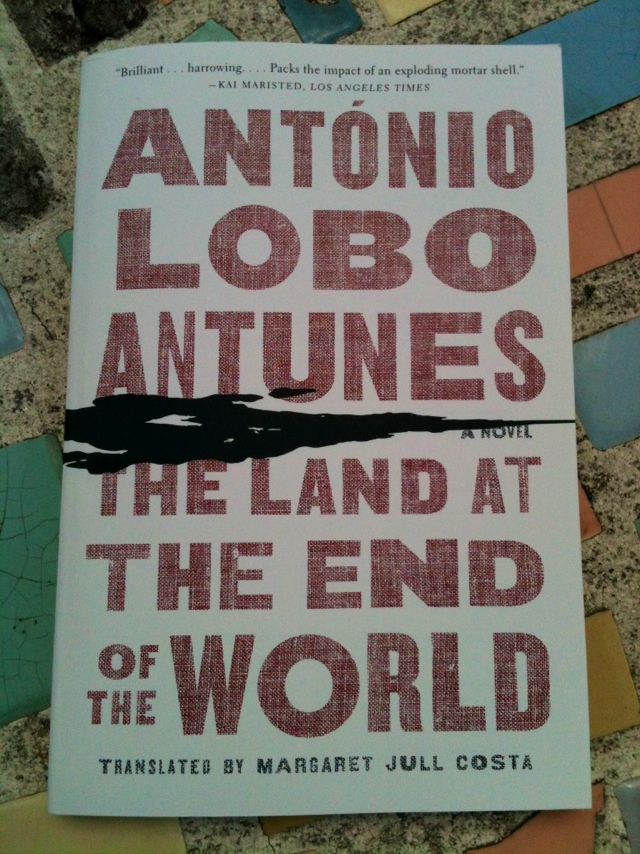
António Lobo Antunes (Book Acquired, 5.15.2012)

20120521-122454.jpg

I’ve never read anything by Portuguese author António Lobo Antunes, so I was psyched when his novel The Land at the End of the World showed up in paperback. Here’s an excerpt from Larry Rohter’s review at the NTY:

Combat experiences are like Tolstoy’s unhappy families: no two are alike, which may be why they often make for great novels, as Tolstoy also knew. The cause need not even be noble, since a hopeless situation and senseless violence can actually fortify a work of fiction. Certainly that is the case with António Lobo Antunes’s “Land at the End of the World,” set in Angola in the early 1970s, as Portugal’s ludicrous effort to preserve its African empire was meandering to an inglorious end. . . .

“The Land at the End of the World,” newly translated by Margaret Jull Costa, was originally published in 1979, four years after Portugal’s withdrawal from Africa and the final collapse of America’s intervention in Vietnam. At that time it was interpreted as a comment on the inherent futility of those recent Western adventures in the third world. But read at more than 30 years’ remove from those events much of this account of what Mr. Lobo Antunes’s narrator calls a “painful apprenticeship in dying” would no doubt make sense to survivors of the Iraq and Afghanistan wars.

20120521-122516.jpg

Slavoj Žižek Finally Weighs in on Santa Claus

“Morality Is the Adjustment of Matter to Its Environment” — H.P. Lovecraft

Morality is the adjustment of matter to its environment—the natural arrangement of molecules. More especially it may be considered as dealing with organic molecules. Conventionally it is the science of reconciling the animal Homo (more or less) sapiens to the forces and conditions with which he is surrounded. It is linked with religion only so far as the natural elements it deals with are deified and personified. Morality antedated the Christian religion, and has many times risen superior to coexistent religions. It has powerful support from very non-religious human impulses. Personally, I am intensely moral and intensely irreligious. My morality can be traced to two distinct sources, scientific and aesthetic. My love of truth is outraged by the flagrant disturbance of sociological relations involved in so-called wrong; whilst my aesthetic sense is outraged and disgusted with the violations of taste and harmony thereupon attendant. But to me the question presents no ground for connexion with the grovelling instinct of religion. However—you may exclude me from the argument, if you will. I am unduly secluded though unavoidably so. We will deal only with materials that may presumably lie within my feeble reach. Only one more touch of ego. I am not at all passive or indifferent in my zeal for a high morality. But I cannot consider morality the essence of religion, as you seem to. In discussing religion, the whole fabric must bear examination before the uses or purposes are considered. We must investigate the cause as well as alleged effects if we are to define the relation between the two, and the reality of the former. And more, granting that the phenomenon of faith is indeed the true cause of the observed moral effects; the absolute basis of that phenomenon remains to be examined. The issue between theists and atheists is certainly not, as you seem to think, the mere question of whether religion is useful or detrimental.

— From H.P. Lovecraft’s 1918 letter to his friend Maurice W. Moe; the letter is collected in The Portable Atheist (ed. Christopher Hitchens).

Roberto Bolaño Crochet Doll

Roberto Bolaño crochet doll by Santo Crochet; via Matt Bucher on Twitter

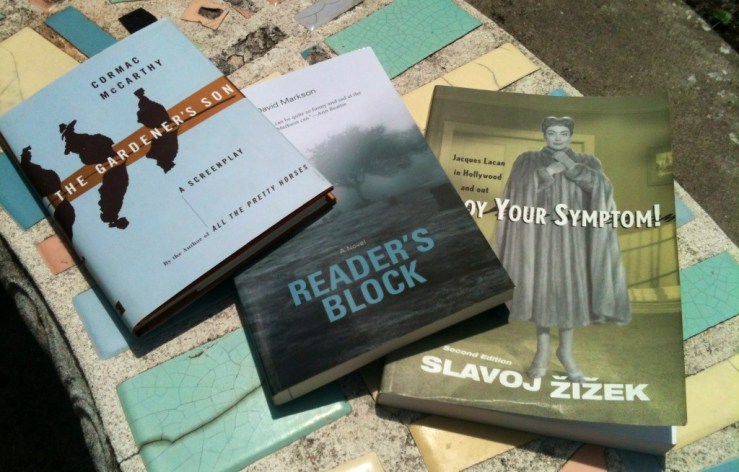
David Markson, Cormac McCarthy, Slavoj Žižek (Books Acquired, 5.19.2012)

20120521-122339.jpg

I ordered David Markson’s Reader’s Block from my local book shop, and intended to get it—and only it—this Saturday. Somehow I took a detour through the film section and picked up the Žižek and didn’t put it back; in the same section I also picked up McCarthy’s screenplay The Gardener’s Son, which is the only thing I haven’t read by him to date, so I picked it up too. So there you go.

Woman Reading to a Little Girl — Felix Vallotton

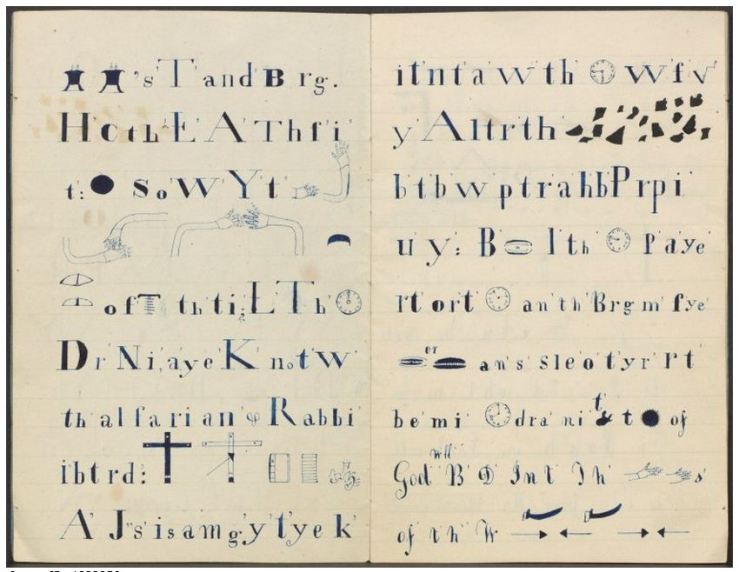
Spirit Message, 1843

(About).

Farmer Sitting at the Fireside and Reading — Vincent van Gogh

Book Shelves #21, 5.20.2012

20120520-111437.jpg

Book shelves series #21, twenty-first Sunday of 2012: William T. Vollmann and David Foster Wallace

Sorry about the glare in the photo above. As I seem to attest weekly, photography is hard. Photographing books is hard. Lighting issues, glare etc. Anyway, this shelf is half Vollmann, half DFW. I’ve written so extensively about these guys on the site that I won’t bother linking to anything here. A few months ago, Gaddis’s JR and The Recognitions was hanging out here, but then I put Expelled and Imperial on the shelf, bought Everything and More, and also picked up some more Gaddis, and, well, anyway, had to move him up with Joyce, where he seems to belong. The paperback of The Pale King is a review copy; it has additional stuff. Maybe I should part with the hardback. It seems ridiculous to have them both.

The copy of Girl with Curious Hair is extremely important to me, as silly as that sounds. It was one of the first books I ever “reviewed” on this blog, back when I still focused almost entirely on books I’d stolen or books I’d never returned to. From that review:

Scott Martin was kind enough to loan me this book. Did he know that it would forever change the way I read? It was the first semester of my freshman year in college, and I was slowly reaching beyond stuff like Henry Miller, Wm Burroughs and Franz Kafka. David Foster Wallace’s short story collection Girl With Curious Hair introduced me to a whole new world of writing. Reading DFW is like having a very witty friend tell you a moving and funny story over a few beers. He’s hilarious, thought-provoking, and not nearly as hard to read as people seem to think.

I leave the bookmark I’ve been using in almost every book I read. When I pulled Girl from the shelf, I found a Polaroid of my cat:

20120520-112636.jpg

He’s just a kitten here. His name is Remy. He no longer lives with us, but he’s still around. We moved a year ago from a bungalow set above the ground (i.e. with cat crawl space) to a ranch on a block (i.e. no crawl space). He didn’t want to move because he was having this romance with a stray my daughter named Pearly. I eventually trapped him and moved him to the new place, but I foolishly forgot he’d have no place to run and hide while getting acclimated. He ran away. A few months later I found him down the street. He looked happy and came up and talked to us. He followed us back to the new place and we gave him some people food treats. Then he left again. We seem him every now and then. He’s gotten surprisingly fat and seems to like the new people he’s taken up with. They have two boys, a little older than my kids. Sometimes I miss my cat.

Charles Bukowski Talks About Coping with Depression

“The House That Twain Built” (Mark Twain Sketch)

(Via/about).