Survival Story (Fragment from Roberto Bolaño’s 2666)

A small story from Roberto Bolaño’s 2666. Context not important:

Instead of ghosts, now the passengers in front of him were talking about a person they called Bobby. This Bobby lived in Jackson Tree, Michigan, and had a cabin on Lake Huron. One time this Bobby had gone out in a boat and capsized. He managed to cling to a log that was floating nearby and waited for morning. But as night went on, the water kept getting colder and Bobby was freezing and started to lose his strength. He felt weaker and weaker, and even though he did his best to tie himself to the log with his belt, he couldn’t no matter how hard he tried. It may sound easy, but in real life it’s hard to tie your own body to a floating log. So he gave up hope, turned his thoughts to his loved ones (here they mentioned someone called Jig, which might have been the name of a friend or a dog or a pet frog he had), and clung to the branch as tightly as he could. Then he saw a light in the sky. He thought it was a helicopter coming to find him, which was foolish, and he started to shout. But then it occurred to him that helicopters clatter and the light he saw wasn’t clattering. A few seconds later he realized it was an airplane. A great big plane about to crash right where he was floating, clinging to that log. Suddenly all his tiredness vanished. He saw the plane pass just overhead. It was in flames. Maybe a thousand feet from where he was, the plane plunged into the lake. He heard two explosions, possibly more. He felt the urge to get closer to the site of the disaster and that’s what he did, very slowly, because it was hard to steer the log. The plane had split in half and only one part was still floating. Before Bobby got there he watched it sinking slowly down into the waters of the lake, which had gone dark again. A little while later the rescue helicopters arrived. The only person they found was Bobby and they felt cheated when he told them he hadn’t been on the plane, that he’d capsized his boat when he was fishing. Still, he was famous for a while, said the person telling the story.

“And does he still live in Jackson Tree?” asked the other man.

“No, I think he lives in Colorado now,” was the response.

Then they started to talk about sports. The man next to Fate finished his water and belched discreetly, covering his mouth with his hand.

“Lies,” he said softly.

“What?” asked Fate.

“Lies, lies,” said the man.

Right, said Fate, and he turned away and stared out the window at the clouds that looked like cathedrals or maybe just little toy churches abandoned in a labyrinthine marble quarry one hundred times bigger than the Grand Canyon.

Albrecht of Brandenburg as St. Jerome in His Study — Lucas Cranach the Elder

William Gaddis’s Self-Portrait

Bill Murray Plays FDR (Hyde Park on the Hudson Trailer)

Lot and His Daughters — Joachim Wtewae

David Foster Wallace Defines The Word Despair

From David Foster Wallace’s essay “A Supposedly Fun Thing I’ll Never Do Again,” collected in the book of the same name:

The word’s overused and banalified now, despair, but it’s a serious word, and I’m using it seriously. For me it denotes a simple admixture—a weird yearning for death combined with a crushing sense of my own smallness and futility that presents as a fear of death. It’s maybe close to what people call dread or angst. But it’s not these things, quite. It’s more like wanting to die in order to escape the unbearable feeling of becoming aware that I’m small and weak and selfish and going without any doubt at all to die. It’s wanting to jump overboard.


Swift Cat — Ellen June

(More/via).

Anne Sexton Reads “Wanting to Die”

John Steinbeck: “I have never been a title man”

I have never been a title man. I don’t give a damn what it is called. I would call it [East of Eden] Valley to the Sea, which is a quotation from absolutely nothing but has two great words and a direction. What do you think of that? And I’m not going to think about it anymore.

From John Steinbeck’s 1969 interview in The Paris Review.

Young Girl Reading — Federico Zandomeneghi

Ralph Ellison: “I recognize no dichotomy between art and protest”

INTERVIEWER

Then you consider your novel a purely literary work as opposed to one in the tradition of social protest.

ELLISON

Now, mind, I recognize no dichotomy between art and protest. Dostoyevsky’s Notes from Underground is, among other things, a protest against the limitations of nineteenth-century rationalism; Don Quixote, Man’s Fate, Oedipus Rex, The Trial—all these embody protest, even against the limitation of human life itself. If social protest is antithetical to art, what then shall we make of Goya, Dickens, and Twain?

From his 1955 Paris Review interview.

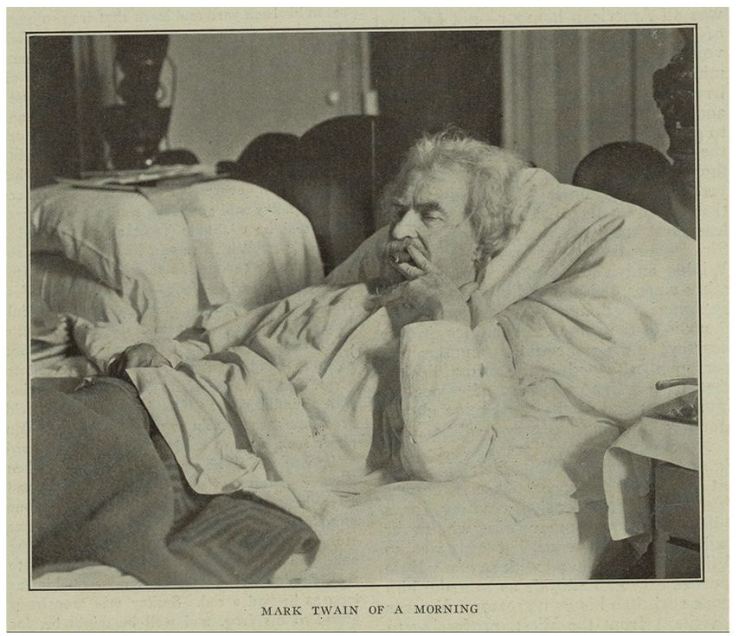
Mark Twain of a Morning

Don Quixote Reading — Honore Daumier

David Foster Wallace Explains How David Lynch Filmed That Hellacious Forced Joyride in Blue Velvet

From David Foster Wallace’s essay “David Lynch Keeps His Head,” collected in A Supposedly Fun Thing I’ll Never Do Again:

TIDBIT: HOW LYNCH AND HIS CINEMATOGRAPHER FOR BV FILMED THAT HELLACIOUS FORCED “JOYRIDE” IN FRANK BOOTH’S CAR, THE SCENE WHERE FRANK AND JACK NANCE AND BRAD DOURIF HAVE KIDNAPPED JEFFREY BEAUMONT AND ARE MENACING HIM INSIDE THE CAR WHILE THEY’RE GOING WHAT LOOKS LIKE 100+ DOWN A DISMAL RURAL TWO-LANER: The reason it looks like the car’s going so fast is that lights outside the car are going by so fast. In fact the car wasn’t even moving. A burly grip was bouncing madly up and down on the back bumper to make the car jiggle and roll, and other crewpeople with hand-held lamps were sprinting back and forth outside the car to make it look like the car was whizzing past streetlights. The whole scene’s got a claustrophobia-in-motion feel that they never could have gotten if the car’d actually been moving (the production’s insurance wouldn’t have allowed that kind of speed in a real take), and the whole thing was done for about $8.95.

Portrait of Charles Baudelaire — Gustave Courbet

“Sympathy for the Devil” Studio Sessions — Documentary Film of The Rolling Stones at Work


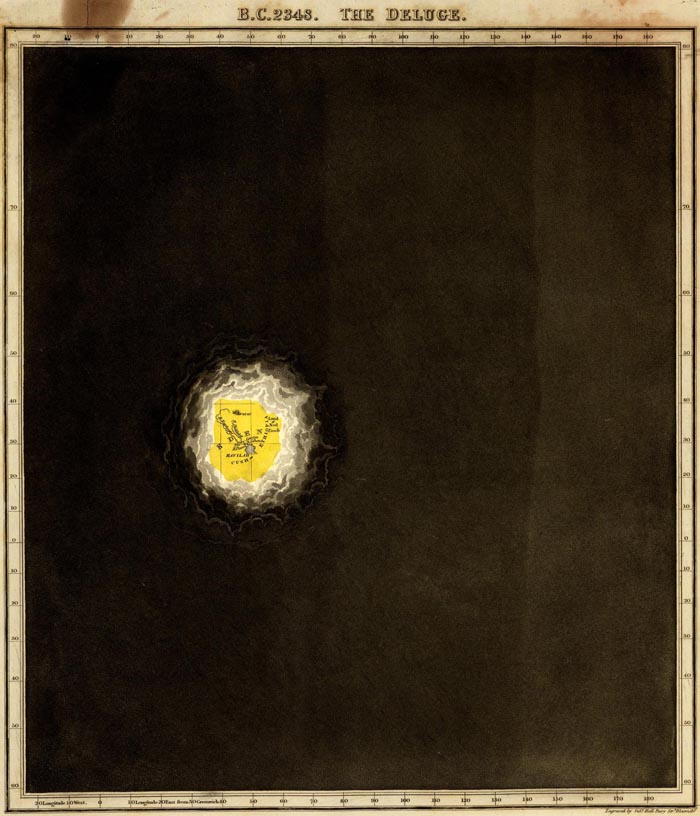
Timeline Map of The Deluge — Edward Quin

(About/via/more).