“Style and Content Must Match” — William Gaddis on Voice and Risk in His Novels

From a brief  1982 interview with William Gaddis

Q: The pervasive and distinctive authorial voice of The Recognitions gives way in J R to a self-effacing voice that seems to serve only functional purposes. Also in J R there is an increased dependence on dialogue. For verisimilitude in Lolita, Nabokov “travelled in school buses to listen to the talk of schoolgirls.” Did you take any special measures to hear and note the speech patterns of any of the wide variety of people who speak in “J R”?

William Gaddis: Style and content must match, must be complementary, accounting in part for a difference between the two books, though the lack of a conventional narrative style had already jarred a good many readers of The Recognitions when it appeared, as its hapless reviews show. J R was started as a story which quickly proved unsatisfactory, inspired- here’s the legitimate gossip—-by the postwar desecration of the Long Island village of Massapequa where my family had had property since around 1910, take a look at it now and you’ll see all the book’s worst hopes realized. In approaching J R as a novel, I was at pains to remove the author’s presence from the start as must be obvious. This was partly by way of what I mentioned earlier, obliging the thing to stand on own, take its own chances. But it was also by way of setting up a problem, a risk, in order to sustain my own interest, especially since the largely uninterrupted dialogue raised the further risk of presenting a convincing sense of real time without the conventional chapter breaks, white spaces, such narrative intrusions as “A week later . . .” How some of the writers I come across get through their books without dying of boredom is beyond me. As for what you call speech patterns, one is always listening and has got an ear or hasn’t, and without one, unless perhaps in dealing with an unfamiliar language and culture, no amount of your special measures like riding around on school buses will get you out of the swamp.
Ten Thousand Years Older — Werner Herzog

The Goodbye Place — Richard Kelly

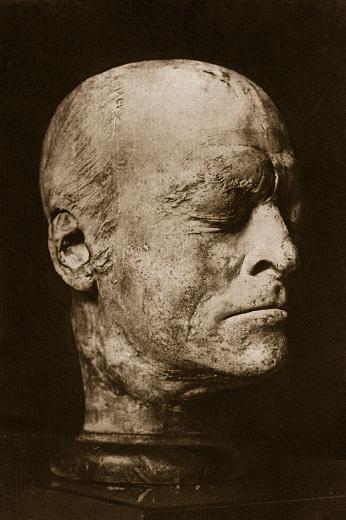
William Blake’s Death Mask

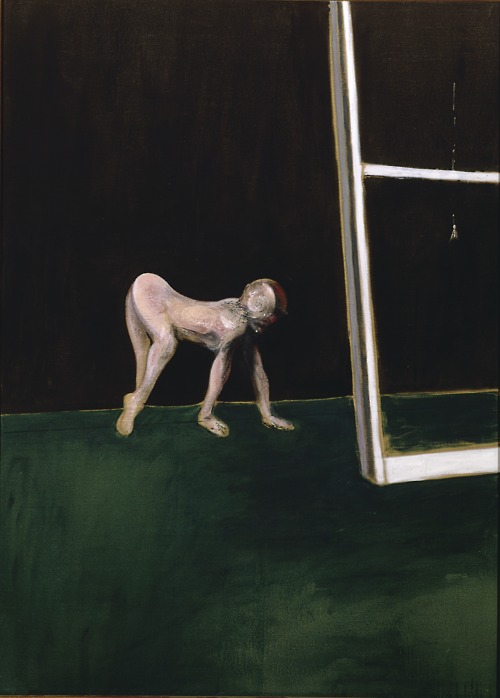
Paralytic Child Walking on All Fours (from Muybridge) — Francis Bacon

“Finnegans Wake: What It’s All About” — Anthony Burgess

Read Anthony Burgess’s essay on James Joyce’s Finnegans Wake. From said essay—

In his dream HCE, as we shall now call him, tries to make the whole of history swallow up his guilt for him. His initials are made to stand for the generality of sinful man, and they are expanded into slogans like “Here Comes Everybody” and “Haveth Childers Everywhere”. After all, sexual guilt presupposes a certain creative, or procreative, vitality, and a fall only comes to those who are capable of an erection. The unquenchable vitality appears in “our Human Conger Eel” (despite the “down, wantons, down” of the eel-pie-maker in King Lear); the erector of great structures is seen in “Howth Castle and Environs”. From the point of view of the ultimate dreamer of the dream, though (the author himself), “HCE” has a structural task to perform. As a chemical formula (H2CE3) or as a genuine vocable (“hec” or “ech” or even “Hecech”) it holds the dream down to its hero, is sewn to it like a mono­gram-HCE: his dream. But HCE has, so deep is his sleep, sunk to a level of dreaming in which he has become a collective being rehearsing the collective guilt of man. Man falls, man rises so that he can fall again; the sequence of falling and rising goes on till doomsday. The record of this, expressed in the lives of great men, in the systems they make and unmake and remake, is what we call history.

RIP Peter Falk

Bill Murray Reads Billy Collins’s Poem “Forgetfulness”

(More).

Anthony Burgess Laments the Loss of History

In 1972, Burgess could already see the loss of historical perspective that was happening in institutionalized education. I suppose he would consider 2011 a nightmare that no one is even attempting to wake up from. Also, is there anything like this on TV today? Seriously—is conservatism simply the opposite of intellectualism at this point? Could you imagine a leading conservative pundit having a literary author like Burgess on his or her show to actually, like, talk about history (or anything else for that matter)?
(See also).

Boy Bitten by Lizard — Caravaggio

See the Trailer for A Dangerous Method: David Cronenberg Does Freud and Jung

Parental Admonition — Gerard ter Borch

Int. Trailer. Night — Jim Jarmusch

“Remember That What We Call The Novel Is a Highly Artificial Form” — William Burroughs on the Picaresque Novel

In a fantastic 1974 interview with noted translator Philippe Mikriammos, William Burroughs discusses the picaresque novel (and much, much more)—-

PM: Have you been influenced by Celine?

WB: Yes, very much so.

PM: Did you ever meet him?

WB: Yes, I did. Allen [Ginsberg] and I went out to meet him in Meudon shortly before his death. Well, it was not shortly before, but two or three years before.

PM: Would you agree to say that he was one of the very rare French novelists who wrote in association blocks?

WB: Only in part. I think that he is in a very old tradition, and I myself am in a very old tradition, namely, that of the picaresque novel. People complain that my novels have no plot. Well, a picaresque novel has no plot. It is simply a series of incidents. And that tradition dates back to the Satyricon of Petronius Arbiter, and to one of the very early novels, The Unfortunate Traveler by Thomas Nashe. And I think Celine belongs to this same tradition. But remember that what we call the “novel” is a highly artificial form, which came in the nineteenth century. It’s quite as arbitrary as the sonnet. And that form had a beginning, a middle, and an end; it has a plot, and it has this chapter structure where you have one chapter, and then you try to leave the person in a state of suspense, and on to the next chapter, and people are wondering what happened to this person, and so forth. That nineteenth-century construction has become stylized as the novel, and anyone who writes anything different from that is accused of being unintelligible. That form has imposed itself to the present time.

“The Empty Room” — Jonathan Lethem

You can read “The Empty Room” by Jonathan Lethem in full at The Paris Review; the piece is part of the new summer issue, which is pretty great so far (Bolaño, William Gibson, poems, art, etc.). From “The Empty Room”—

Earliest memory: father tripping on strewn toys, hopping with toe outraged, mother’s rolling eyes. For my father had toys himself. He once brought a traffic light home to our apartment on the thirty-somethingth floor of the tower on Columbus Avenue. The light, its taxi yellow gone matte from pendulum-years above some polluted intersection and crackled like a Ming vase’s glaze where bolts had been overtightened and then eased, sat to one side of the coffee table it was meant to replace as soon as my father found an ­appropriate top. In fact, the traffic light would follow us up the Hudson, to Darby, to the house with the empty room. There it never escaped the garage.

William Gibson on Blood Meridian

At The GuardianWilliam Gibson says Cormac McCarthy’s Blood Meridian is his most memorable holiday read—

If that’s holiday as in “utterly removed from any sense of immediate surroundings”, my most memorable holiday reading is Cormac McCarthy’s Blood Meridian, which I started in the cab on the way to Vancouver airport, headed for a first trip to Berlin where I was doing something, I wasn’t sure what, with Samuel Delany and Wim Wenders at the Kunsthalle. I am uncertain as to the year, likely it was 1991, before the publication of All the Pretty Horses. I had recently read McCarthy’s astonishing The Orchard Keeper, and on the urging of the friend who had recommended that, I began Blood Meridian. I remember nothing else, door to door, between my home in Vancouver and the hotel room in which I finished the book in Berlin. I awoke from it as from some terribly potent dream, and found myself, quite unexpectedly, in a strange city. Being Berlin, and particularly then, it was a very strange city. A few nights later, over in the east, I continued to experience intense overlays of Blood Meridian. Indeed, I think those overlays helped me better comprehend what I was seeing, and not to panic. The Judge, I knew, would understand all of this.

A Poem for Father’s Day — Robert Hayden’s “Those Winter Sundays”

Robert Hayden’s poem “Those Winter Sundays”–

Sundays too my father got up early
and put his clothes on in the blueblack cold,
then with cracked hands that ached
from labor in the weekday weather made
banked fires blaze. No one ever thanked him.

I’d wake and hear the cold splintering, breaking.
When the rooms were warm, he’d call,
and slowly I would rise and dress,
fearing the chronic angers of that house,

Speaking indifferently to him,
who had driven out the cold
and polished my good shoes as well.
What did I know, what did I know
of love’s austere and lonely offices?