“Joyce Maims Words” — William Carlos Williams on James Joyce

William Carlos Williams on James Joyce (from Our Exagmination Round His Factification for Incamination of Work in Progress, a symposium on Finnegans Wake)—

Joyce maims words. Why? Because meanings have been dulled, then lost, then perverted by their connotations (which have grown over them) until their effect on teh mind is no longer what it was when they were fresh, but grows rotten as poi — though we may get to like poi.

Meanings are perverted by time and chance — but kept perverted by academic observance and intention. At worst they are inactive and get only the static value of anything, which retains its shape but is dead. All words, all sense of being is gone out of them. Or trained into them by the drill of the deadly minded. Joyce is restoring them.

Barry Hannah on Cormac McCarthy

From The Paris Review’s interview with Barry Hannah

INTERVIEWER

Some writers turn away completely from their origins, though. Like Cormac McCarthy.

HANNAH

Right, he turned western when he went out to El Paso. He’s one of my favorites. He invests a region. Learns it so thoroughly it’s as if God visited that place and made no mistakes about the botany, flora, fauna. He has about three thousand books, I hear. He had so many books on this upper story of this little concrete house he has, the floor was about to cave in. So the man reads everything there is about the place and you can tell that. Nobody else like him.


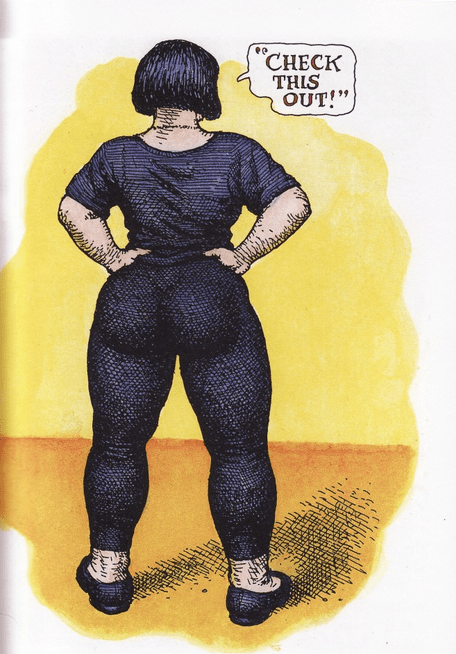
“Check This Out!” — Robert Crumb

Frank O’Hara Reads “Fantasy”

Barry Hannah Addresses the Whole “Pointing a Gun at a Student” Rumor

From The Paris Review’s interview with Barry Hannah

INTERVIEWER

But about the guns. When you left Alabama, there was an incident . . .

HANNAH

Yes, I was a tenured professor there, and I was fired. I had just been voted in, but I was too heavily into drinking. I was holding class at home or in my studio and they said, Don’t hold any more classes in your studio. And I said, Well, I will. I brought in an empty pistol once and, as I recall, twirled the chambers to explain six movements in a short story. And that is where the gun—pointing a gun at a student—rumor started, but I never pointed a loaded gun at anybody in my life. Even dead drunk. Never, never. I really don’t like that rumor now because of the school shootings. The world has changed so much. I still love my old .22’s from my youth, for shooting beer cans and rats in the city dump. I love the instrument. It’s just a beautiful, clean instrument—and the history —but I have never had any interest in pointing a gun at a person.

INTERVIEWER

Do you remember what the six movements were?

HANNAH

No. I could make up something, but it would be untrue. There’s just three, anyway: beginning, middle, and end. I was com-plicating something that didn’t need to be any more complicated. At one time I’m sure I had six points in my head and they may have been decent, but I refuse to remember them because they’re not necessary now.

INTERVIEWER

The rumor about pointing the gun was that you were playing your trumpet, trying to get their attention. When that didn’t work, you brought out the gun.

HANNAH

I did play my trumpet in class at Alabama. And at the University of Chicago. Blues solo. Ta da na tee. And I was pretty good sober but real loud and inappropriate in a small chamber. The people at Chicago enjoyed it, but a student complained at Alabama. Still, the trumpet’s a much better idea than bringing a pistol. It’s all alcoholism.


RIP Diana Wynne Jones

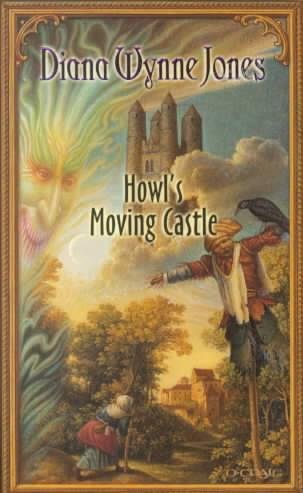
According to a number of sources, including Neil Gaiman and the fan-operated site she approved of, author Diana Wynne Jones has passed away after fighting cancer. Jones wrote dozens of novels, mostly in the fantasy genre, for adults and children alike, although she is perhaps most known for Howl’s Moving Castle, which Hayao Miyazaki adapted into an excellent film in 2004. Jones’s work bears comparison to the Harry Potter series, and recent reissues of her novels insure that a younger generation will have access to her work.

John Dillinger’s Death Mask

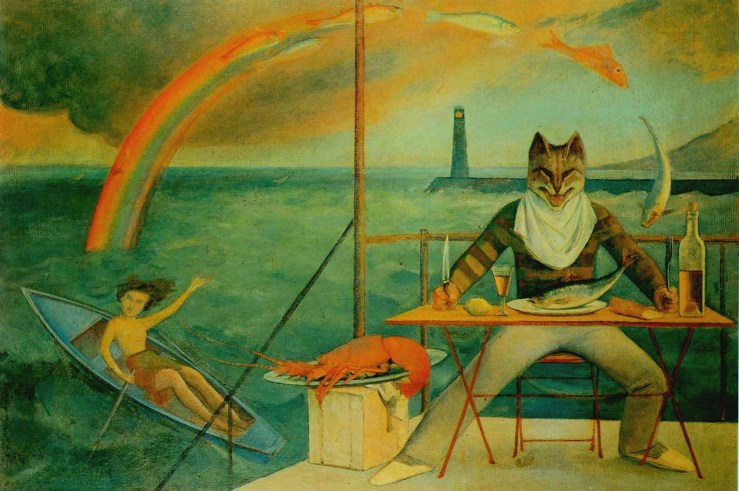
The Cat of the Mediterranean — Balthus

Amy Hempel on Gordon Lish and Steve Martin

Amy Hempel talks about studying under Gordon Lish (and how Steve Martin influenced her) in her 2003 interview with The Paris Review

INTERVIEWER

Why Lish?

HEMPEL

At Esquire in the seventies and, later, at Knopf, he was publishing the voices that interested me most. I felt allied with his choices, so he was the one I wanted to work with. Writers like Raymond Carver, Barry Hannah, Mary Robison. These were the three who had the most effect on me when I started.

INTERVIEWER

What about their work interested you?

HEMPEL

They didn’t sound like anyone else I had read. For me, they redefined what a story could be—the thing happening off to the side of the story other writers were telling; they would start where someone else would leave off, or stop where someone else would start. As Hannah said later in Boomerang, a lot of people have their overview, whereas he has his “underview,” scouting “under the bleachers, for what life has dropped.”

INTERVIEWER

Do you remember the first class?

HEMPEL

Vividly. The assignment was to write our worst secret, the thing we would never live down, the thing that, as Gordon put it, “dismantles your own sense of yourself.” And everybody knew instantly what that thing, for them, was. We found out immediately that the stakes were very high, that we were expected to say something no one else had said, and to divulge much harder truths than we had ever told or ever thought to tell. No half-measures. He thought any of us could do it if we wanted it badly enough. And that, when I was starting out, was a great thing to hear from someone who would know.

INTERVIEWER

What was, if you can say, your “worst secret”?

HEMPEL

I failed my best friend when she was dying. It became the subject of the first story I wrote, “In the Cemetery Where Al Jolson Is Buried.”

INTERVIEWER

You stayed on in his workshop as a student for years. You must have been repeatedly humbled.

HEMPEL

I felt humbled by realizing how hard the job was. How hard it is to write a moving, worthwhile, memorable story. But more often I was inspired. It turned out that one of the most helpful things I did without knowing it would be helpful later was hang out with stand-up comics in San Francisco. I went to their shows night after night after night. I watched them performing, working through the same material. I saw some nights it killed and other nights it bombed. All that time I was observing nuance, inflection, timing, how the slightest difference mattered. How the littlest leaning on a word—or leaning away from it—would get the laugh, and this lesson was so valuable. And the improv work—they called it “being human on purpose,” this falling back on the language in your mouth—was hugely important. Just listening to what you’re saying. I learned this when my late friend Morgan Upton, an actor and member of the Committee, took me to a Steve Martin show at the Boarding House in San Francisco. Back in the green room, Steve Martin was sick, but preparing to do his show anyway. I told him I admired that, I said I couldn’t go out there and make people laugh if I were sick. And he said, Don’t be silly—you couldn’t do it if you were well. A brilliant reply on any number of levels. I based an early story, “Three Popes Walk into a Bar,” on that night. Then I ran into him about twenty years later and reminded him of our exchange. He laughed and said, “It sounds mean!” But I thought it was great.

 

Terry Gilliam Explains Why Steven Spielberg Sucks and Stanley Kubrick Rules

“I Don’t Know If You’d Call It Stealing” — Sam Lipsyte, Book Thief

Sam Lipsyte read live from his novel The Ask last year on HTML GIANT’s Ustream channel. The reading was cool but the best part was the q&a session afterward. We asked Lipsyte the one question all true biblioklepts are dying to know (and the one question we ask every person we interview): “Have you ever stolen a book?”

Vodpod videos no longer available.

Here’s Lipsyte’s response, which you can hear/see at 31:25 in the video:

‘Have you ever stolen a book?’ There was one time when I stole a few books when I worked in a library; it was a university library and my job was to stick the metal strips into the spines of the books that would set off the alarm. And so if a particularly good book came through (and this only happened three or four times) I just wouldn’t–I don’t know if I’d call it stealing–but I wouldn’t put the strip in. And then once it was shelved I would take it.

That’s a pretty sophisticated operation. Kudos to Lipsyte for his candor.


What If The Wire Was a Victorian Novel?

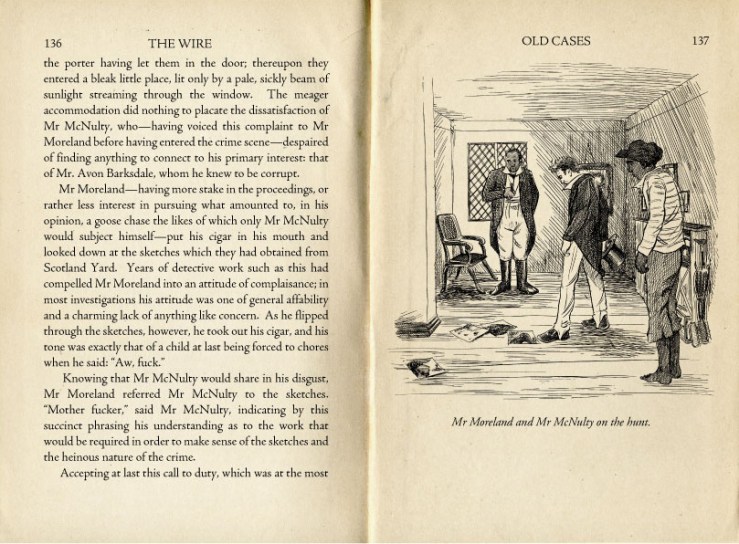
Do yourself a favor and read Joy Delyria and Sean Michael Robinson’s send up of lit crit “‘When It’s Not Your Turn’: The Quintessentially Victorian Vision of Odgen’s ‘The Wire.'” Their essay is a reappraisal of The Wire that imagines David Simon’s Baltimore saga as a serialized Victorian novel contemporary with Dickens.

Sam Lipsyte Makes Pork Buns, Considers Placentophagy

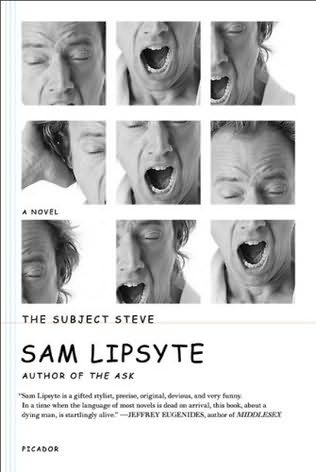
Win a Copy of Sam Lipsyte’s Debut Novel The Subject Steve

To promote their new edition of Sam Lipsyte’s first novel The Subject Steve, Picador will give away two copies of the book to two lucky Biblioklept readers (U.S. addresses only). What do you have to do to win? Simply post your favorite line (0r consecutive lines) from a Lipsyte novel in the comments section of this post (limit yourself to one response of one cohesive quotation, please). An Esteemed Panel of Honorable Judges will select their favorites. We’ll announce winners next week.

Bolaño the Biblioklept

The New York Review of Books has published an excerpt of Roberto Bolaño’s essay “Who Would Dare?” It’s from the forthcoming collection, Between Parentheses: Essays, Articles and Speeches (1998–2003) (translated by Natasha Wimmer; published by New Directions). A sample—

The books that I remember best are the ones I stole in Mexico City, between the ages of sixteen and nineteen, and the ones I bought in Chile when I was twenty, during the first few months of the coup. In Mexico there was an incredible bookstore. It was called the Glass Bookstore and it was on the Alameda. Its walls, even the ceiling, were glass. Glass and iron beams. From the outside, it seemed an impossible place to steal from. And yet prudence was overcome by the temptation to try and after a while I made the attempt.

The first book to fall into my hands was a small volume by [the nineteenth century erotic poet] Pierre Louÿs, with pages as thin as Bible paper, I can’t remember now whether it was Aphrodite or Songs of Bilitis. I know that I was sixteen and that for a while Louÿs became my guide. Then I stole books by Max Beerbohm (The Happy Hypocrite), Champfleury, Samuel Pepys, the Goncourt brothers, Alphonse Daudet, and Rulfo and Areola, Mexican writers who at the time were still more or less practicing, and whom I might therefore meet some morning on Avenida Niño Perdido, a teeming street that my maps of Mexico City hide from me today, as if Niño Perdido could only have existed in my imagination, or as if the street, with its underground stores and street performers had really been lost, just as I got lost at the age of sixteen.

“There Are at Least Two or Three Masturbation Scenes” — Sam Lipsyte Defends His Novel The Ask

It’s Sam Lipsyte Week at Biblioklept

It’s Sam Lipsyte week at Biblioklept. Why? Why not? Okay, here’s a more concrete reason: this month, Picador publishes the trade paperback début of his most recent novel, The Ask, as well as a new edition of his first novel The Subject Steve. We’ll be running new reviews for The Ask and Steve, as well as re-running older reviews, an excerpt or two of Lipsyte’s weird comic goodness, and other odds n’ ends. Like this video of Lipsyte reading from The Ask. Thou hast beenst warnedst.