The Three Marys — Henry Ossawa Tanner

The Three Marys, 1910 by Henry Ossawa Tanner (1859-1937)

How to Read James Joyce’s Ulysses (and Why You Should Avoid “How-to” Guides Like This One)

[Editorial note: What follows is an edit of a piece I first posted on June 16, 2010–Bloomsday. Today marks the 100th anniversary of the first publication of James Joyce’s masterpiece Ulysses. I tried to come up with something original, but I found I had nothing to say that I hadn’t already said here, which essentially amounts to, Read Ulysses. It’s not nearly as difficult as its reputation might suggest. And it’s really funny.]

James Joyce’s Ulysses is a celebrated and praised novel. However, the book’s reputation for density, erudition, and inscrutability still daunts many readers–leading to a glut of guidebooks, summaries, and annotations. Ironically, rather than inviting first-time readers to the text, the sheer volume of these guides to Ulysses can paradoxically repel. Their very existence seems predicated on an intense need, and although some of the guides out there can be helpful, others can get in the way. This need not be. Ulysses deserves its reputation as one the best books in the English language. It generously overflows with insight into the human experience, and it’s very, very funny. And, most importantly, anyone can read it.

Here are a few thoughts on how to read Ulysses, enumerated–because people like lists:

1. Ignore all guides, lists, maps, annotations, summaries, and lectures. You don’t need them; in fact, they could easily weigh down what should be a fun reading experience. Jump right into the text. Don’t worry about getting all the allusions or unpacking all the motifs.

Pretty soon though, you’ll get to the third chapter, known as “Proteus.” It’s admittedly hard to follow. You might want a guide at this point. Or you might just want to give up. (Of course, you might be a genius and totally get what Stephen is thinking about as he wanders the beach. Good for you). If frustration sets in, I suggest skipping the chapter and getting into the rich, earthy consciousness of the book’s hero, Leopold Bloom in chapter four, “Calypso.” It’s great stuff. You can always go back to chapter three later, of course. The real key, at least in my opinion, to reading (and enjoying) Ulysses is getting into Bloom’s head, matching his rhythm and pacing. Do that and you’re golden.

I’ve already advised you, gentle reader, not to follow any guides, so please, ignore the rest of my advice. Quit reading this post and start reading Ulysses.

For those who wish to continue–

2. Choose a suitable copy of the book. The Gabler edition will keep things neat and tidy and it features wide margins for all those clever game-changing annotations you’ll be taking. Several guides, including Harry Blamire’s The New Bloomsday Book align their annotation to the Gabler edition’s pagination.

3. Make a reading schedule and stick to it. The Gabler edition of Ulysses is nearly 700 pages long. That’s a long, long book–but you can read it in just a few weeks. There are eighteen episodes in Ulysses, some longer and more challenging than others, but reading one episode every two days should be no problem. If you can, try to read one episode in one sitting each day. As the book progresses, you’ll find yourself going back to previous chapters to find the figures, motifs, and traces that dance through the book.

4. So you’ve decided you need a guide. First, try to figure out what you want from the guide. Basic plot summary? Analysis? Explication? There’s plenty out there–too much really–so take the time to try to figure out what you want from a guide and then do some browsing and skimming before committing.

The most famous might be Stuart Gilbert’s James Joyce’s Ulysses, a dour book that manages to suck all the fun out of Joyce’s work. In a lecture on Ulysses, Vladimir Nabokov warned “against seeing in Leopold Bloom’s humdrum wanderings and minor adventures on a summer day in Dublin a close parody of the Odyssey,” noting that “it would be a complete waste of time to look for close parallels in every character and every scene in the book.” Nabokov scathingly continued: “One bore, a man called Stuart Gilbert, misled by a tongue-in-cheek list compiled by Joyce himself, found in every chapter the domination of one particular organ . . . but we shall ignore that dull nonsense too.” It’s perhaps too mean to call Gilbert’s guide “nonsense,” but it’s certainly dull. Harry Blamire’s The New Bloomsday Book is a line-by-line annotation that can be quite helpful when Joyce’s stream of consciousness gets a bit muddy; Blamire’s explications maintain a certain analytical neutrality, working mostly to connect the motifs of the book but letting the reader manage meaning. Don Gifford’s Ulysses Annotated is an encyclopedia of minutiae that will get in the way of any first time reader’s enjoyment of the book. Gifford’s notes are interesting but they can distract the reader from the text, and ultimately seem aimed at scholars and fanatics.

Most of the guidebooks I’ve seen for Ulysses share a common problem: they are obtrusive. I think that many readers who want some guidance or insight to aid their reading of Ulysses, rather than moving between books (what a chore!), should listen to some of the fantastic lectures on Joyce that are available. James Heffernan’s lectures for The Teaching Company provide a great overview of the book with some analysis; they are designed to be listened to in tandem with a reading of the book. The best explication I’ve heard though is a series of lectures by Joseph Campbell called Wings of Art. Fantastic stuff, and probably the only guide you really need. It’s unfortunately out of print, but you can find it easily via extralegal means on the internet. Speaking of the internet–there’s obviously a ton of stuff out there. I’ll withhold comment–if you found this post, you can find others, and have undoubtedly already seen many of the maps, schematics, and charts out there.

5. Another strategy: read, but listen to an audiobook as well. This will give you a chance to “reread” the novel. I highly, highly, highly recommend RTÉ’s 1982 full cast production. I reviewed it here some years back.

6. Keep reading. Reread. Add time to that reading schedule you made if you need to. But most of all, have fun. Skip around. If you’re excited about Molly’s famous monologue at the end of the book, go ahead and read it. Again, the point is to enjoy the experience. If you can trick a friend into reading it with you, so much the better. Have at it.

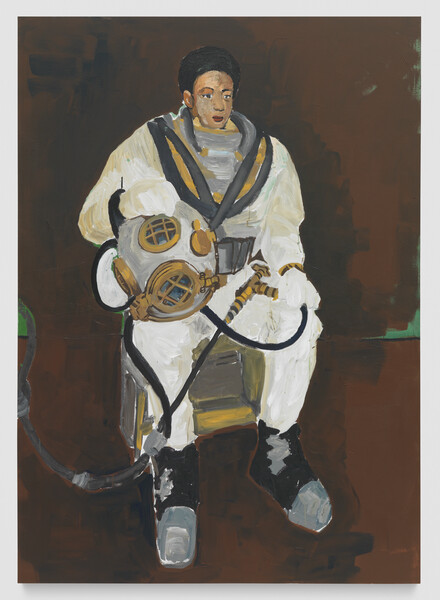
Andrea Notley Crabtree the First — Henry Taylor

Andrea Notley Crabtree the First, 2017 by Henry Taylor (b. 1958)

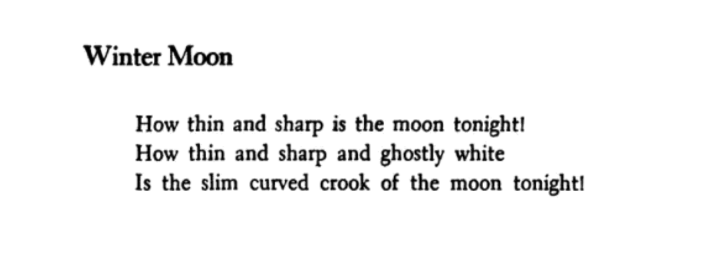
“Winter Moon” — Langston Hughes

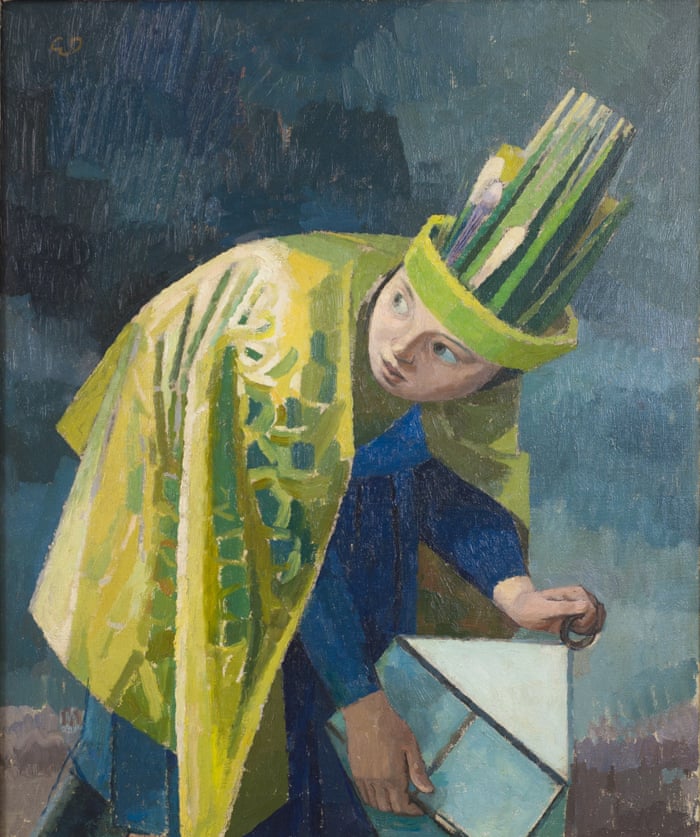
February — Evelyn Dunbar

February, 1938 by Evelyn Dunbar (1906-1960)

Next to Fire we must rank Water as the greatest destroyer of books | From William Blades’ The Enemies of Books

“Water”

from

William Blades’

The Enemies of Books 


NEXT to Fire we must rank Water in its two forms, liquid and vapour, as the greatest destroyer of books. Thousands of volumes have been actually drowned at Sea, and no more heard of them than of the Sailors to whose charge they were committed. D’Israeli narrates that, about the year 1700, Heer Hudde, an opulent burgomaster of Middleburgh, travelled for 30 years disguised as a mandarin, throughout the length and breadth of the Celestial Empire. Everywhere he collected books, and his extensive literary treasures were at length safely shipped for transmission to Europe, but, to the irreparable loss of his native country, they never reached their destination, the vessel having foundered in a storm.

In 1785 died the famous Maffei Pinelli, whose library was celebrated throughout the world. It had been collected by the Pinelli family for many generations and comprised an extraordinary number of Greek, Latin, and Italian works, many of them first editions, beautifully illuminated, together with numerous MSS. dating from the 11th to the 16th century. The whole library was sold by the Executors to Mr. Edwards, bookseller, of Pall Mall, who placed the volumes in three vessels for transport from Venice to London. Pursued by Corsairs, one of the vessels was captured, but the pirate, disgusted at not finding any treasure, threw all the books into the sea. The other two vessels escaped and delivered their freight safely, and in 1789-90 the books which had been so near destruction were sold at the great room in Conduit Street, for more than L9,000.

These pirates were more excusable than Mohammed II who, upon the capture of Constantinople in the 15th century, after giving up the devoted city to be sacked by his licentious soldiers, ordered the books in all the churches as well as the great library of the Emperor Constantine, containing 120,000 Manuscripts, to be thrown into the sea.

In the shape of rain, water has frequently caused irreparable injury. Positive wet is fortunately of rare occurrence in a library, but is very destructive when it does come, and, if long continued, the substance of the paper succumbs to the unhealthy influence and rots and rots until all fibre disappears, and the paper is reduced to a white decay which crumbles into powder when handled.

Few old libraries in England are now so thoroughly neglected as they were thirty years ago. The state of many of our Collegiate and Cathedral libraries was at that time simply appalling. I could mention many instances, one especially, where a window having been left broken for a long time, the ivy had pushed through and crept over a row of books, each of which was worth hundreds of pounds. In rainy weather the water was conducted, as by a pipe, along the tops of the books and soaked through the whole.

In another and smaller collection, the rain came straight on to a book-case through a sky-light, saturating continually the top shelf containing Caxtons and other early English books, one of which, although rotten, was sold soon after by permission of the Charity Commissioners for L200.

Germany, too, the very birth-place of Printing, allows similar destruction to go on unchecked, if the following letter, which appeared about a Year ago (1879) in the Academy has any truth in it:—

“For some time past the condition of the library at Wolfenbuttel has been most disgraceful. The building is in so unsafe a condition that portions of the walls and ceilings have fallen in, and the many treasures in Books and MSS. contained in it are exposed to damp and decay. An appeal has been issued that this valuable collection may not be allowed to perish for want of funds, and that it may also be now at length removed to Brunswick, since Wolfenbuttel is entirely deserted as an intellectual centre. No false sentimentality regarding the memory of its former custodians, Leibnitz and Lessing, should hinder this project. Lessing himself would have been the first to urge that the library and its utility should be considered above all things.”

The collection of books at Wolfenbuttel is simply magnificent, and I cannot but hope the above report was exaggerated. Were these books to be injured for the want of a small sum spent on the roof, it would be a lasting disgrace to the nation. There are so many genuine book-lovers in Fatherland that the commission of such a crime would seem incredible, did not bibliographical history teem with similar desecrations. (1)

 (1) This was written in 1879, since which time a new building has been
erected.

Water in the form of vapour is a great enemy of books, the damp attacking both outside and inside. Outside it fosters the growth of a white mould or fungus which vegetates upon the edges of the leaves, upon the sides and in the joints of the binding. It is easily wiped off, but not without leaving a plain mark, where the mould-spots have been. Under the microscope a mould-spot is seen to be a miniature forest of lovely trees, covered with a beautiful white foliage, upas trees whose roots are embedded in the leather and destroy its texture.

Inside the book, damp encourages the growth of those ugly brown spots which so often disfigure prints and “livres de luxe.” Especially it attacks books printed in the early part of this century, when paper-makers had just discovered that they could bleach their rags, and perfectly white paper, well pressed after printing, had become the fashion. This paper from the inefficient means used to neutralise the bleach, carried the seeds of decay in itself, and when exposed to any damp soon became discoloured with brown stains. Dr. Dibdin’s extravagant bibliographical works are mostly so injured; and although the Doctor’s bibliography is very incorrect, and his spun-out inanities and wearisome affectations often annoy one, yet his books are so beautifully illustrated, and he is so full of personal anecdote and chit chat, that it grieves the heart to see “foxey” stains common in his most superb works.

In a perfectly dry and warm library these spots would probably remain undeveloped, but many endowed as well as private libraries are not in daily use, and are often injured from a false idea that a hard frost and prolonged cold do no injury to a library so long as the weather is dry. The fact is that books should never be allowed to get really cold, for when a thaw comes and the weather sets in warm, the air, laden with damp, penetrates the inmost recesses, and working its way between the volumes and even between the leaves, deposits upon their cold surface its moisture. The best preventative of this is a warm atmosphere during the frost, sudden heating when the frost has gone being useless.

Our worst enemies are sometimes our real friends, and perhaps the best way of keeping libraries entirely free from damp is to circulate our enemy in the shape of hot water through pipes laid under the floor. The facilities now offered for heating such pipes from the outside are so great, the expense comparatively so small, and the direct gain in the expulsion of damp so decided, that where it can be accomplished without much trouble it is well worth the doing.

At the same time no system of heating should be allowed to supersede the open grate, which supplies a ventilation to the room as useful to the health of the books as to the health of the occupier. A coal fire is objectionable on many grounds. It is dangerous, dirty and dusty. On the other hand an asbestos fire, where the lumps are judiciously laid, gives all the warmth and ventilation of a common fire without any of its annoyances; and to any one who loves to be independent of servants, and to know that, however deeply he may sleep over his “copy,” his fire will not fail to keep awake, an asbestos stove is invaluable.

It is a mistake also to imagine that keeping the best bound volumes in a glass doored book-case is a preservative. The damp air will certainly penetrate, and as the absence of ventilation will assist the formation of mould, the books will be worse off than if they had been placed in open shelves. If security be desirable, by all means abolish the glass and place ornamental brass wire-work in its stead. Like the writers of old Cookery Books who stamped special receipts with the testimony of personal experience, I can say “probatum est.”

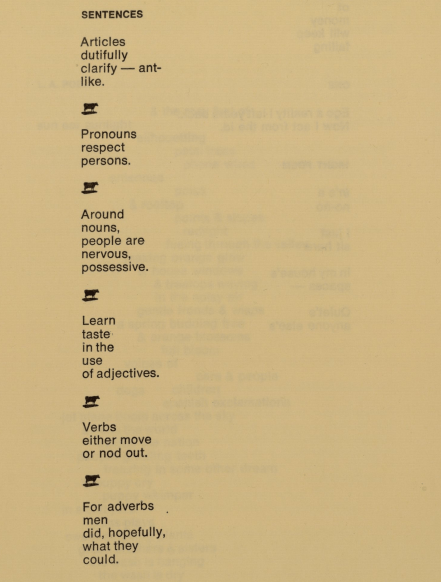
“Sentences” — Tom Clark

Rahel Varnhagen: The Life of a Jewish Woman by Hannah Arendt (Book acquired, mid-January 2022)

Hannah Arendt’s Rahel Varnhagen: The Life of a Jewish Woman is forthcoming from NYRB (in translation by Clara Winston and Richard Winston, and with an introduction by Barbara Hahn). NYRB’s blurb:

Rahel Varnhagen: The Life of a Jewish Woman was Hannah Arendt’s first book, largely completed when she went into exile from Germany in 1933, though not published until the 1950s. It is the biography of a remarkable, complicated, passionate woman, and an important figure in German romanticism. Rahel Varnhagen also bore the burdens of being an unusual woman in a man’s world and an assimilated Jew in Germany.

She was, Arendt writes, “neither beautiful nor attractive . . . and possessed no talents with which to employ her extraordinary intelligence and passionate originality.” Arendt sets out to tell the story of Rahel’s life as Rahel might have told it and, in doing so, to reveal the way in which assimilation defined one person’s destiny. On her deathbed Rahel is reported to have said, “The thing which all my life seemed to me the greatest shame, which was the misery and misfortune of my life—having been born a Jewess—this I should on no account now wish to have missed.” Only because she had remained both a Jew and a pariah, Arendt observes, “did she find a place in the history of European humanity.”

Best Books of 1972?

A conversation with a colleague this week led me on a not-entirely successful search for the “best” books of 1972.

The gist of the conversation is something like this: Asked about the “best” books that came out last year, I admitted I don’t read that much new fiction, so I had no idea.

I also said something cavalier along the lines of, It takes like half a century to know if a novel is important or not. (This is not a statement I entirely believe in.)

So what did folks in 1972 think the best books published that year were?

The first thing I did is check the bestsellers of fiction that year.

(I should be clear that I’m mostly interested in novels here, or books of a novelistic/artistic scope, whatever that means–so I didn’t really pursue nonfiction stuff that much here.)

The New York Time’s fiction bestsellers for 1972 is dominated by two novels: Herman Wouk’s The Winds of War (21 weeks) and Richard Bach’s Jonathan Livingstone Seagull (26 weeks). Fiction bestsellers are often (but not always) entertainments that we don’t expect to last over time, and while Wouk and Bach’s titles still get reprints every decade or so, they aren’t exactly Ulysses (published fifty years earlier in 1922).

So I looked for what titles the NYT critics deemed the best books of 1972. The contemporary NYT comes up with a list of ten titles each year (five fiction, five non-), but things were a little looser fifty years ago. In December of that year, the NYT offered just “Five Significant Books of 1972.”

This list is entirely nonfiction:

The Children of Pride: A True Story of Georgia and the Civil War, edited by Robert Manson Myers (“…a loving work of scholarship. From 6,000 letters written among several branches of a Southern family between 1854 and 1865, Robert Manson Myers has woven 1,200 of them into a massive and touching portrait of a bygone society.”)

The Master by Leon Edel (“With…the fifth and final volume of his biography of Henry James, Leon Edel brings to a close a literary labor of 20 years.”)

Fire in the Lake by Frances FitzGerald (“…the richest kind of contemporary history; it places political and military events in cultural perspective—something rarely done in the hundreds of books written about Vietnam during the last dozen years.”)

The Coming of Age by Simone de Beauvoir, translated by Patrick O’Brian (“…confronts a subject of universal private anguish and universal public silence…she has single‐handedly established a history of and a rhetoric for the process of aging.”)

A Theory of Justice by John Rawls (“…a magisterial exercise in ‘moral geometry.'”)

Rawls’s book is the only one I’ve heard of and de Beauvoir is the only other author whose name I recognize on the list (I did know that there was a ridiculously long multi-volume biography of Henry James). Beyond the list’s being all nonfiction (if there was a fiction version somewhere, I could not find it), it’s also remarkable how long each of the books is: the shortest is 491 pages; the longest is 1,845 pages. Those are long books!

I tried searching for other newspaper and magazine lists of best books of 1972 but came up short. If anyone has anything else to offer for contemporary thoughts on the best of ’72 (by which I mean, folks in ’72 on the best of ’72), I’m all virtual ears.

I then looked into what Goodreads had to say.

I have no idea how their list works, but Richard Adams’s Watership Down tops it. That book completely fucked me up as a kid, which is maybe why I didn’t press too hard when both of my children were reluctant to read it when I pressed it on them. I think it’s a classic though (oh, and it made The New York Times year-end list in 1974–I guess it didn’t get an American publication until then?).

I don’t really think Watership Down is a children’s book, but rounding out the top three on the Goodreads list are two classics of the genre: Arnold Lobel’s Frog and Toad Together and Judith Viorst’s Alexander and the Terrible Horrible No Good Very Bad Day. (Judy Blume’s Tales of a Fourth Grade Nothing comes in way too low at #44.)

And now, because I’m lazy, I will use the rest of the list to offer an incomplete, inconclusive, and ultimately unnecessary list of the best books of 1972. There are many books on the list I’m pilfering from I have not read (including ones by authors whose books I esteem, like Nabokov, Welty, DeLillo, and Atwood), and these books may deserve a spot, as might the many many books that have failed through no fault of their own to wind up under the right eyes, ears, hands.

A list:

Mumbo Jumbo, Ishmael Reed

Invisible Cities, Italo Calvino

The Infernal Desire Machines of Doctor Hoffman, Angela Carter

Watership Down, Richard Adams

The Farthest Shore, Ursula K. LeGuin

Ways of Seeing, John Berger

Roadside Picnic, Arkady Strugatsky and Boris Strugatsky

Chimera, John Barth

Augustus, John Williams

Sadness, Donald Barthelme

Fundamentals of Esperanto — Srikanth Reddy

“Fundamentals of Esperanto”

by

Srikanth Reddy


The grammatical rules of this language can be learned in one
sitting.

Nouns have no gender & end in -o; the plural terminates in -oj
(pronounced -oy) & the accusative, -on (plural 0ojn).

Amiko, friend; amikoj, friends; amikon & amikojn, accusative
friend & friends.

Adjectives end in –a & take plural & accusative endings to
agree with things.

Ma amiko is my friend.

All verbs are regular & have only one form for each tense or
mood; they are not altered for person or number. Mi havas
bonajn amikojn is simply to say I have good friends.

Adverbs end in –e.

La bonaj amiko estas ie. The good friend is here.

A new book appears in Esperanto every week. Radio stations in
Europe, the United States, China, Russia & Brazil broadcast in
Esperanto, as does Vatican Radio. In 1959, UNESCO declared the
International Federation of Esperanto Speakers to be in accord with
its mission & granted this body consultative status. The youth
branch of the International Federation of Esperanto Speakers, UTA,
has offices in 80 different countries & organizes social events where
young people curious about the movement may dance to recordings
by Esperanto artists, enjoy complimentary soft drinks & take home
Esperanto versions of major literary works including the Old
Testament & A Midsummer Night’s Dream. William Shatner’s first
feature-length vehicle was a horror film shot entirely in Esperanto.
Esperanto is among the languages currently sailing into deep space
on board the Voyager spacecraft.

Esperanto is an artificial language
constructed in 1887 by L.
L. Zamenhof, a polish
oculist. I first came
across Fundamento Esperanto, the text
which introduced this system
to the world, as I travelled abroad

following a somewhat difficult period
in my life. It was twilight & snowing on the
railway platform just outside
Warsaw where I had missed
my connection. A man in a crumpled track suit
& dark glasses pushed a cart
piled high with ripped & weathered volumes—

sex manuals, detective stories, yellowing
musical scores & outdated physics textbooks,
old copies of Life, new smut,
an atlas translated,
a grammar, The Mirror, Soviet-bloc comics,
a guide to the rivers &
mountains, thesauri, inscrutable

musical scores & mimeographed physics books,
defective stories, obsolete sex manuals—
one of which caught my notice
(Dr. Esperanto,
Zamenhof’s pen name, translates as He Who Hopes) &
since I had time, I traded
my used Leaves of Grass for a copy.

Mi amas vin, bela amiko.
I’m afraid I will never be lonely enough.
There’s a man from Quebec in my head,

a friend to the purple martins.
Purple martins are the Cadillac of swallows.
All purple martins are dying or dead.
Brainscans of grown purple martins suggest
these creatures feel the same levels of doubt

& bliss as an eight-year-old girl in captivity.
While driving home from the brewery
one night this man from Quebec heard a radio program
about purple martins & the next day he set out
to build them a house
in his own back yard. I’ve never built anything,
let alone a house,

not to mention a home
for somebody else.

I’ve never unrolled a blueprint onto a workbench,
sunk a post,
or sent the neighbor’s kid pedalling off
to the store for a bag full of nails.

I’ve never waited ten years for a swallow.

Never put in aluminum floors to smooth over the waiting.
Never piped sugar water through colored tubes
to each empty nest lined with newspaper shredded
with strong, tired hands.
Never dismantled the entire affair

& put it back together again.
Still no swallows.
I never installed the big light that stays on through the night

to keep owls away. Never installed lesser lights,
never rested on Sunday

with a beer on the deck surveying
what I had done
& what yet remained to be done, listening to Styx

while the neighbor kids ran through my sprinklers.
I have never collapsed in abandon.
Never prayed.
But enough about purple martins.

As we speak, Esperanto is being corrupted
by upset languages such as Interlingua,
Klingon, Java & various cryptophasic tongues.

Our only hope of reversing this trend is to write
the Esperanto epic. Through its grandeur
& homegrown humility, it will spur men

to freeze the mutating patios so the children
of our children’s children may dwell in this song
& find comfort in its true texture & frame.

It’s worth a try. As I imagine it, it ends
in the middle of things. Every line of the work
is a first & a last line & this is the spring

of its action. Of course, there’s a journey
& inside that journey, an implicit voyage
through the underworld. There’s a bridge

made of boats; a carp stuffed with flowers;
a comic dispute among sweetmeat vendors;
a digression on shadows; men clapping

in fields to scare away crows; an unending list
of warships: The Unternehmen, The Impresa,
The Muyarchi, Viec Lam, The Przedsiebiorstwo,

The Indarka, The Enterprise, L’Entreprise,
Entrepeno… One could go on. But by now,
all the characters have turned into swallows

& bank as one flock in the sky—that is,
all except one. That’s how we finally learn
who the hero was all along. Weary & old,

he sits on a rock & watches his friends
fly by one by one out of the song,
then turns back to the journey they all began

long ago, keeping the river to his right.

The Acrobats — Xiao Guo Hui

The Acrobats, 2020 by Xiao Guo Hui (b. 1969)

Attributes of the Moon — Ithell Colquhoun

Attributes of the Moon, 1947 by Ithell Colquhoun (1906-1988)

“The Ten Best Issues of Comic Books,” a poem by Alice Notley

“The Ten Best Issues of Comic Books”

by

Alice Notley


  1. X-Men #141 & 142

  2. Defenders #125

  3. Phoenix: The Untold Story

  4. What if. . .? #31

  5. New Mutants #1

  6. New Mutants #2

  7. Micronauts #58

  8. Marvel Universe #5

  9. New Mutants #14

  10. Secret Wars #1

The Old Man Stays Behind — Eric Fischl

The Old Man Stays Behind, 2021 by Eric Fischl (b. 1948)

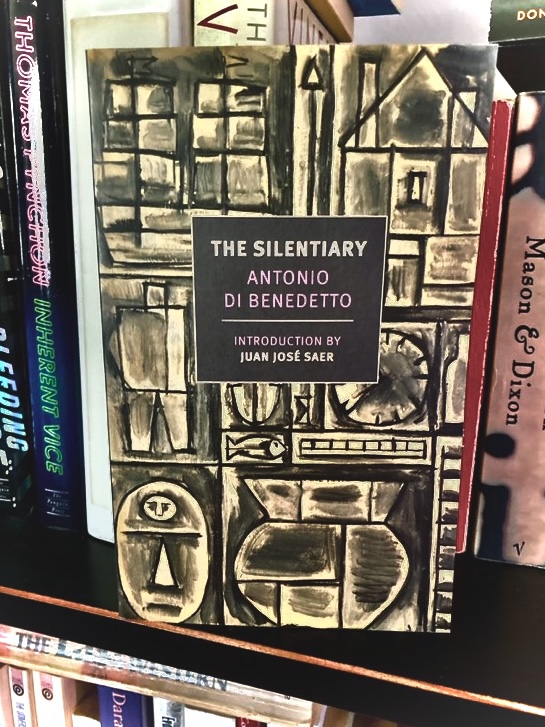
Antonio di Benedetto’s The Silentiary (Book acquired, 6 Jan. 2022)

This afternoon I finally jumped in to Esther Allen’s new translation of Antonio di Benedetto’s novel The Silentiary (the original title, El silenciero means something like “the silencer,” I think). We have an unnamed narrator living in an unnamed Latin America in a not-entirely unspecified time (“as of the late postwar era”). Our narrator is an office worker who lives with his mother. He dreams of being a writer and is in love with a neighbor. He despises noise, which is too bad because an autoshop has just opened up right next to his bedroom wall.

There’s a Kafkaesque vibe to The Silentiary—everything’s a bit uncanny, a wavelength off. The narrator is a wavelength off, I suppose. The prose is sometimes crisp and economic, and then zips out into wonderfully estranging images, like this odd sentence just a few pages in:

At dawn, the daylight a glaze of watery milk on the widowpanes, as my mind, jerked into a state of alertness, discerns a noise attached to the rear wall of my room, something like my heart grows agitated within me.

Or this little moment, longer than a haiku but still in the same spirit:

Last night the big gray cat of my childhood came to me.

I told him that noise stalks and harries me.

Slowly, intensely, he cast his animal, companionable gaze upon me.

It took me a few dozen pages to attune to the humor of The Silentiary. It’s just as odd and dry as the dark humor in Di Benedetto’s 1965 novel Zama,  but again, a wavelength off, a different flavor from the same palate. An episode of drinking that ends with our narrator carried home by his fellows is particularly entertaining. When I type out the description the bit seems hardly subtle. But it is.

More thoughts to come, but for now here’s NYRB’s blurb:

The Silentiary takes place in a nameless Latin American city during the early 1950s. A young man employed in middle management entertains an ambition to write a book of some sort. But first he must establish the necessary precondition, which the crowded and noisily industrialized city always denies him, however often he and his mother and wife move in search of it. He thinks of embarking on his writing career with something simple, a detective novel, and ponders the possibility of choosing a victim among the people he knows and planning a crime as if he himself were the killer. That way, he hopes, his book might finally begin to take shape.

The Silentiary, along with Zama and The Suicides, is one of the three thematically linked novels by Di Benedetto that have come to be known as the Trilogy of Expectation, after the dedication “To the victims of expectation” in Zama. Together they constitute, in Juan José Saer’s words, “one of the culminating moments of twentieth-century narrative fiction in Spanish.”

Spinner — Jacek Malczewski

Spinner, 1922 by Jacek Malczewski (1854-1929)

“The Preacher’s Daughter” — Victoria Kennefick


“The Preacher’s Daughter”

by

Victoria Kennefick


We drink too much pineapple rum, straight from the bottle,
bitch about the red-haired girl, the fetish model,
a preacher’s daughter with a thing for unreasonable shoes.

From her faded patchwork quilt, bleeding
hearts, we watched her mutate into a PVC Alice Liddell.
How did she manage in seven-inch patent heels?

She was tall as wheat — or the ceiling was low.
Cradling a mewing ginger-ball, she kissed the mirror
where their confederate-blue eyes

matched. Three scars began to scab on her arm,
deep big-cat scrawls she told us she cut herself
because it’s art and her clients like her

that way. We followed her clip-clop down
the rabbit hole; me, to hear tales of her running track
in those shoes; you, to see her white skin even paler

under lights. Back in your dorm room, I am static.
You pay to watch her pixelated Snow White online;
complain her constant chatter ruined it, or her, for you.