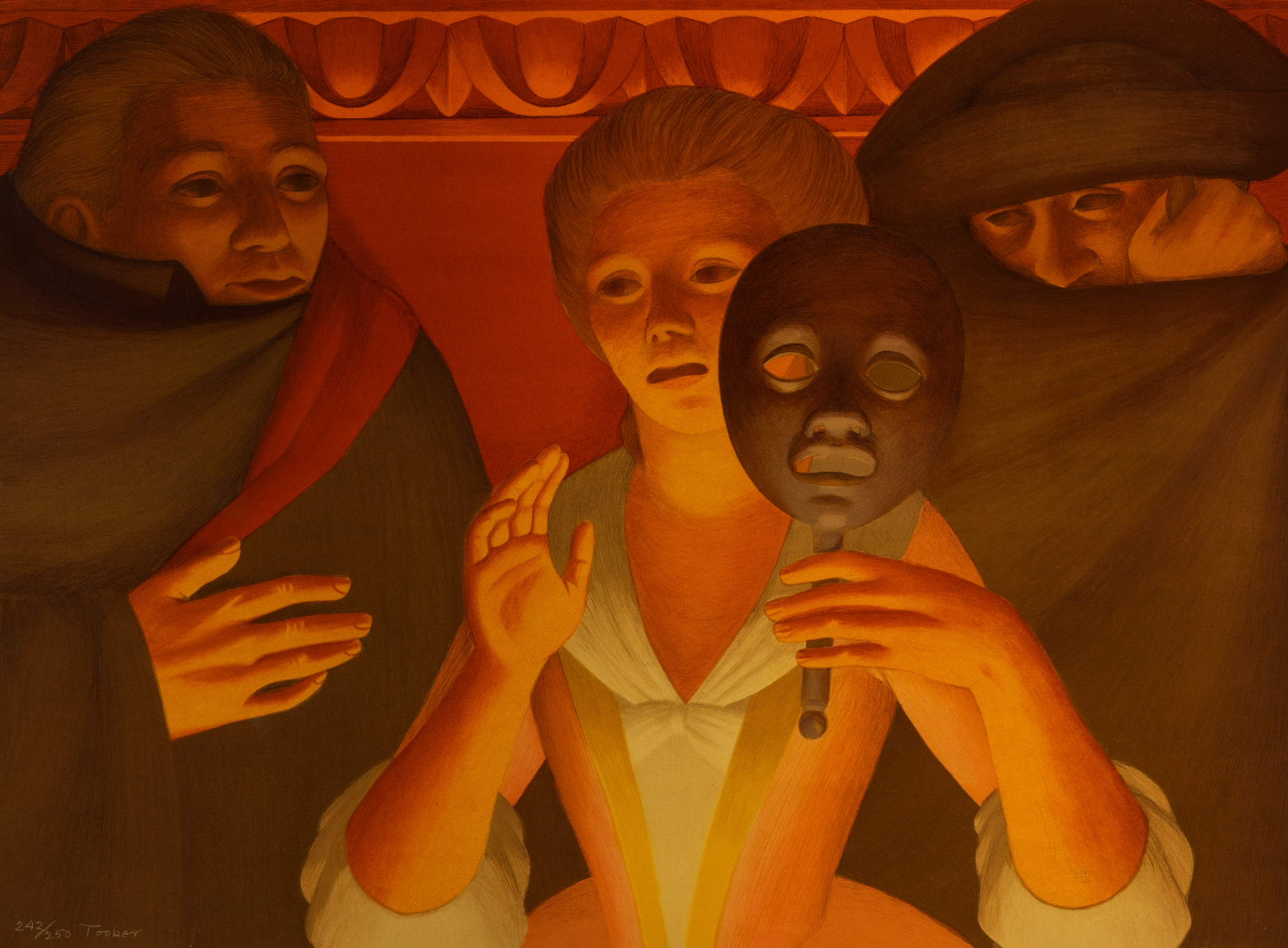
“A Chthonian Christmas” — Edward Gorey


Xmas or Xmess — Tomi Ungerer

A comic by Tomi Ungerer, from the 1 Dec. 1958 issue of Esquire.

Untitled (Conquest) — Benjamin Marra

Untitled sketch (Conquest) by Benjamin Marra (b. 1977)

Mass-Market Monday | Donald Barthelme’s Amateurs

Amateurs, Donald Barthelme. Kangaroo Pocket Books (1977). No cover artist or designer credited. 207 pages.

I’ve written a few times about my slow acquisition of someone else’s library. This person lives in Perry, Florida, a small panhandle town south of Tallahassee, and I guess he drives into Jacksonville at least once a year to sell books at the bookstore I frequent. I’ve talked to the bookstore’s owner about him a few times. Sometimes, I’ll spot a spine and think, Yeah, his name and address are going to be stamped on the inside cover. And there it was this Friday when I picked up his mass-market edition of Amateurs. His by-now familiar habit of checking off volumes by the same author is on display here too. He also put neat pencil dashes by some of the stories in Amateurs, including my favorite from the collection, “Some of Us Had Been Threatening Our Friend Colby.” He also checked off “The Educational Experience,” which, in this Kangaroo edition of Amateurs, sadly fails to include Barthelme’s collage illustrations that accompanied the piece when it first ran in Harper’s


Continue reading “Mass-Market Monday | Donald Barthelme’s Amateurs”

Dec. 16th (Peanuts)

On Tove Jansson’s odd and touching illustrations for Alice’s Adventures in Wonderland

This fall–just in time for the holiday season–the NYRB Kids imprint has published an edition of Lewis Carroll’s classic Alice’s Adventures in Wonderland illustrated by the Finnish author and artist Tove Jansson. Jansson is most famous for her Moomin books, which remain an influential cult favorite with kids and adults alike. She illustrated Carroll’s Alice in 1966 for a Finnish audience; this NRYB edition is the first English-language version of the book. There are illustrations on almost every page of the book; most are black and white sketches — doodles, portraits, marginalia — but there are also many full-color full-pagers, like this odd image about a dozen pages in:

Here we have Alice and her cat Dinah, transformed into a shadowy, even sinister figure, large, bipedal. Bats float in the background, echoing Goya’s famous print El sueño de la razón produce monstruos. The image accompanies Alice’s initial descent into her underland wonderland:  “Down, down, down. There was nothing else to do, so Alice soon began talking again,” addressing Dinah, who will “miss me very much to-night, I should think!” Wonderlanding if Dinah might catch a bat, which is something like a mouse, maybe, “Alice began to get rather sleepy, and went on saying to herself, in a dreamy sort of way, ‘Do cats eat bats? Do cats eat bats?’ and sometimes, ‘Do bats eat cats?; for, you see, as she couldn’t answer either question, it didn’t much matter which way she put it.” Jansson’s red flowers suggest poppies, contributing to the scene’s slightly-menacing yet dreamlike vibe. The image ultimately echoes the myth of Hades and Persephone.

All the classic characters are here, of course, rendered in Jansson’s sensitive ink. Consider this infamous trio —

There was a table set out under a tree in front of the house, and the March Hare and the Hatter were having tea at it: a Dormouse was sitting between them, fast asleep, and the other two were using it as a cushion, resting their elbows on it, and talking over its head.

I love Jansson’s take on the Hatter; he’s not the outright clown we often see in post-Disneyfied takes on the character, but rather a creature rendered in subtle pathos. The March Hare is smug; the Dormouse is miserable.

And you’ll want a glimpse of the famous Cheshire cat who appears (and disappears) during the Queen’s croquet match:

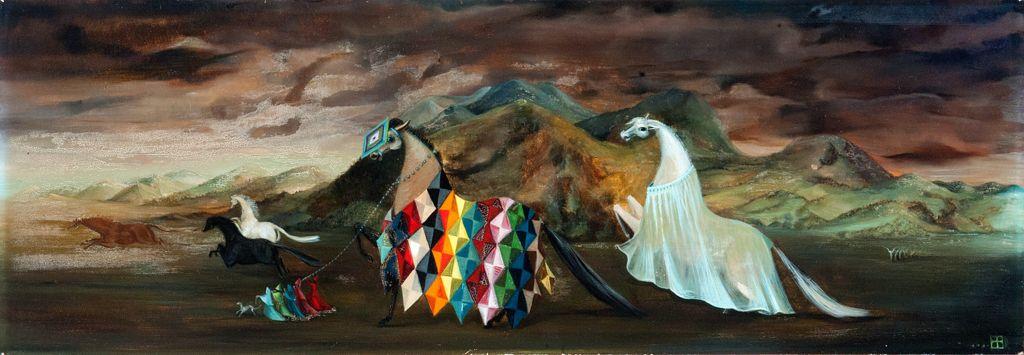
Jansson’s figures here remind one of the surrealist Remedios Varo’s strange, even ominous characters. Like Varo and fellow surrealist Leonora Carrington, Jansson’s art treads a thin line between whimsical and sinister — a perfect reflection of Carroll’s Alice, which we might remember fondly as a story of magical adventures, when really it is much closer to a horror story, a tale of being sucked into an underworld devoid of reason and logic, ruled by menacing, capricious, and ultimately invisible forces. It is, in short, a true reflection of childhood,m. Great stuff.

Science Fiction #2 — Anton van Dalen

Science Fiction #2, 1983 by Anton van Dalen (1938-2024)

Vogue Gorilla with Miss Harper — Eduardo Paolozzi

Vogue Gorilla with Miss Harper, 1972 by Eduardo Paolozzi (1924–2005)

To insist on the miraculous is to deny to the machine at least some of its claims on us, to assert the limited wish that living things, earthly and otherwise, may on occasion become Bad and Big enough to take part in transcendent doings. By this theory, for example, King Kong (?-1933) becomes your classic Luddite saint. The final dialogue in the movie, you recall, goes: ”Well, the airplanes got him.” ”No . . . it was Beauty killed the Beast.”

–Thomas Pynchon, “Is It O.K. To Be a Luddite?”


Ubik — Bob Pepper

Cover art for Philip K. Dick’s Ubik, 1982 by Bob Pepper (1938-2019). Via/more.

Salome with the Head of John the Baptist — Juan de Flandes

Salome with the Head of John the Baptist, c. 1496 by Juan de Flandes (c. 1460–1519)

19 Nov. 2024 (Blog about missing GY!BE and Alan Sparhawk this weekend in Atlanta)

This is Friday—not today, I mean, this, this blog, is Friday, four or five days ago, depending on how you count such things. We were maybe fifteen or twenty minutes on the road heading northwest to Atlanta—my wife driving the first leg before we stopped for gas—when I checked social media again to see if Godspeed You! Black Emperor were still going to play that night. They were not. This information came via opener Low legend Alan Sparhawk, who had reported the past two nights’ shows canceled.

We headed north anyway. The kids had left school early; my daughter pointed out that she had already missed an AP Bio test and that she wasn’t going with me and the boy to the show anyway, she just wanted to go to Atlanta to hang out. Fair point, of course.

My son was bummed and I was bummed. I don’t know exactly how he came to Godspeed You! Black Emperor’s strange, hypnotic, droney anthems—via an algorithm, really—but a few years ago I heard him blasting Lift Your Skinny Fists Like Antennas to Heaven in his bedroom. I gave him my copy of their debut LP, F♯ A♯ ∞, which I’d bought from the band back in 1998 or 1999 when they opened for Low at a record story I was working at in Florida. They knocked our socks off. It seemed there were more Godspeeds Yous than audience members, and to be clear, the tiny record store was packed. It was a summer afternoon in Florida; very hot and very sunny, a throbbing miasma of sound across Hemming Park, now James Weldon Johnson Park, in beautiful ugly downtown Jacksonville.

(It was just such a night my friend Travis was arrested for skateboarding across Laura Street. Jayskating. (I don’t think it was the same night.))

After the show I bought their record. It had a pouch crammed with incidentals—flattened pennies, a Canadian stamp, some illustrated scraps. I think I listened to it a million times that summer. One of the guys in the band asked me where they could get some hash in Jacksonville. I suggested the Waffle House. Low played after; everyone sat down, exhausted from what Godspeed had required. It was lovely. Perfect day.

I had really wanted to experience my imaginative inversion of this concert this past weekend, but it didn’t emerge. I mean Alan Sparhawk, whose new record is so strange and daring and wonderful—I wanted to see that with my kid, who, he, my kid, wanted to see the ensemble Godspeed do their drone magic. I bought him an Aphex Twin record at Wax n’ Facts as a consolation prize, and he bought himself the first volume of Katsuhiro Otomo’s Akira at A Capella Books. I picked up a first edition hardback of William Gaddis’s last novel Agapē Agape.

And so well we made a weekend of it, browsing book stores and record stores and walking the Beltline. Love that city and my best wishes to GY!BE founding member, Efrim Menuck—I hate that we missed you on the tour but I hope that your health recovers. Thank you for making music my son and I love. 


Mass-market Monday | Muriel Spark’s The Girls of Slender Means

The Girls of Slender Means, Muriel Spark. Penguin Books (1966). Cover photograph by Robert Croxford. 142 pages.

From a thing a wrote back in 2020:

Slender Means unself-consciously employs postmodern techniques to paint a vibrant picture of what the End of the War might feel like. The climax coincides with the bombings of Hiroshima and Nagasaki, the title takes on a whole new meaning, and the whole thing unexpectedly ends in a negative religious epiphany.

Curtain or Vision — Remedios Varo

Curtain or Vision, 1959 by Remedios Varo (1908-1963)

Reading — Ernest Haskell

Reading, c. 1914 by Ernest Haskell (1876-1925)

Mass-market Monday | Miguel de Unamuno’s Abel Sanchez and Other Stories

Abel Sanchez and Other Stories, Miguel de Unamuno. Translated by Anthony Kerrigan. Regnery Gateway (1956). No cover designer or artist credited; cover image credited to the Bettman Archive. 267 pages.

I wrote a bit about the collection back in February:

A few weeks ago, I picked up Anthony Kerrigan’s translation of Miguel de Unamuno’s Abel Sanchez and Other Stories based on its cover and the blurb on its back. I wound up reading the shortest of the three tales, “The Madness of Dr. Montarco,” that night. The story’s plot is somewhat simple: A doctor moves to a new town and resumes his bad habit of writing fiction. He slowly goes insane as his readers (and patients) query him about the meaning of his stories, and he’s eventually committed to an asylum. The tale’s style evokes Edgar Allan Poe’s paranoia and finds an echo in Roberto Bolaño’s horror/comedy fits. The novella that makes up the bulk of the collection is Abel Sanchez, a Cain-Abel story that features one of literature’s greatest haters, a doctor named Joaquin who grows to hate his figurative brother, the painter Abel. Sad and funny, this 1917 novella feels contemporary with Kafka and points towards the existentialist novels of Albert Camus. (I’m saving the last tale, “Saint Manuel Bueno, Martyr,” for a later day.)

7 Nov. 2024

On 5 Nov. 2024, or, really, technically, it was the very early hours of 6 Nov. 2024, I found myself unable to read, the distraction I had wanted, and instead found some respite from anxiety looking again at online copies (is copies the right word? digital reproductions? images, of course, but none of it is the real thing) of Francisco Goya’s Pinturas negras, his Black Paintings. Goya painted these strange, engrossing murals on the walls of his homestead the Quinta del Sordo, outside of Madrid, his last home in Spain before his exile in France.

I’m not sure how I got there. I have an impulse to return to his depiction of Saturn chomping on his son any time I feel the pain of a modern world that is always and forever ancient.

I have never seen another painting that makes as much sense to me, which means I’m a fucken sicko—I am sure that there are nicer paintings out there (I’ve seen so many). The idea that Goya would paint such paintings on the walls of his own home captivates me. The dog painting is my favorite; all negative space, which I’ll edit out, the negative space, here:

I stumbled out my bed that night to look for Robert Hughes’ wonderful biography Goya, which sheds no true light on the black paintings, as far as I can recall. Here is what he offers:

THE GREAT SERIES of paintings Goya made for his own pleasure at about the same time is equally enigmatic, and likely to remain so. These were the Pinturas negras, the so-called Black Paintings with which, in his last Madrid years, Goya was covering the walls of his farmhouse on the other side of the Manzanares outside the city, now converted into his studio and semi-solitary hermitage. Nothing, he felt, obliged him to be available to the court anymore; as for private clients, they could come to him. The new house, according to its title deed, was “beyond the Segovia bridge … on the site where the Hermitage of the Guardian Angel formerly stood.” It had twenty-two acres of arable land, and a vegetable garden. Comfortable but not palatial, and in need of some renovation, it was sturdily built of brick and adobe, with two stories divided into several rooms, two attics, a well by the garden, and another in the courtyard. Goya paid 60,000 reales for it, cash. By a peculiar coincidence, the property next door had been owned by a farmer who was deaf, and so was named the Quinta del Sordo, the Deaf Man’s House. This name passed to Goya’s own property, since he was the only notable deaf man around.

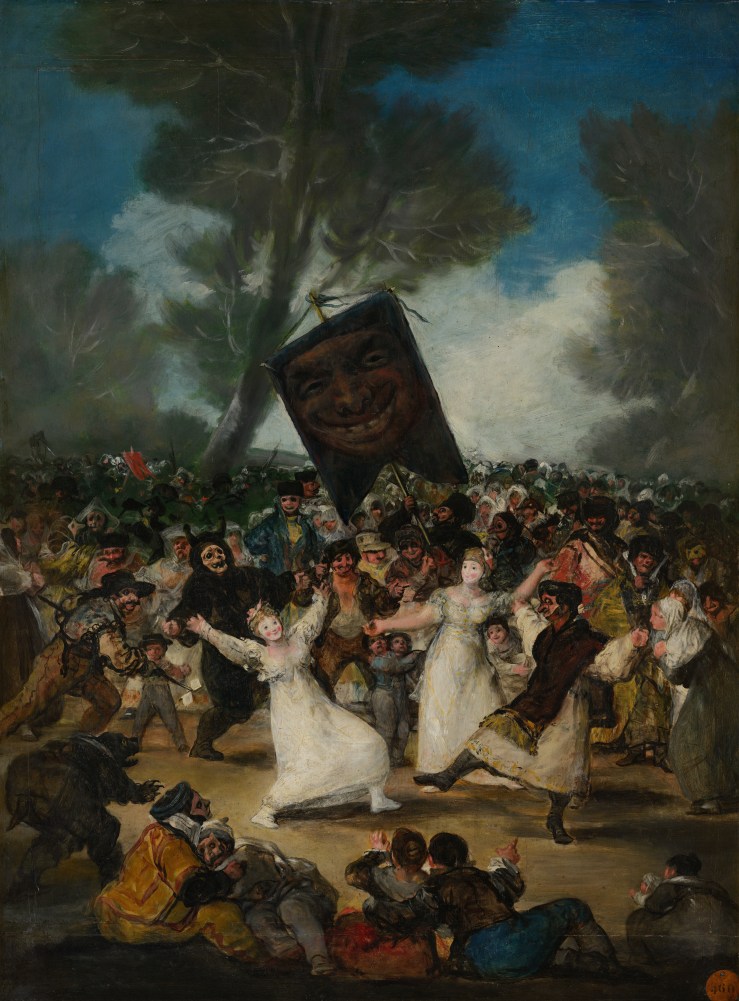
But Goya painted wild things on his walls—Judith and Holofrenes, flying mystics, a pilgrimage, a Satanic Sabbath, old people eating soup. Men hitting each other with sticks, red blood white clouds lovely blue sky:

I mean I think I guess that it’s he did what he did—the gross, rough, beautiful paintings—that he, Goya, did them for himself, the so-called Black Paintings—I think that’s what makes me drawn to him, beyond their aesthetic powers, which is really what I mean to say, the images, the colors, the contours, the phantasies—

November — Koloman Moser

november-1902hd

November, 1902 by Koloman Moser (1868-1918)