Blog about a list of films included in Antoine Volodine’s short story “The Theory of Image According to Maria Three-Thirteen”

img_1148

Antoine Volodine’s short story “The Theory of Image According to Maria Three-Thirteen” is collected in Writers, a book available in English translation by Katina Rogers from Dalkey Archive Press.

Writers is one of the best books I’ve read in the past few years: unsettling, bizarre, satirical, and savage, its stories focus on writers who are more than writers: they are would-be revolutionaries and assassins, revolting humans revolting against the forces of late capitalism.

Writers (which I wrote about here) functions a bit like a discontinuous novel that spins its own web of self-references to produce a small large gray electric universe—the Volodineverse, I guess—which we can also see in post-exotic “novels” like Minor Angels and Post-Exoticism in Ten Lessons, Lesson Eleven. 

Volodine’s post-exotic project refers obliquely to the ways in which the late 20th century damns the emerging 21st century. And yet the trick of it all is that the stories and sketches and vignettes seem ultimately to refer only to themselves, or to each other—the world-building is from the interior. This native interiority is mirrored by the fact that many of his writer-heroes are prisoners communicating from their cells, often to interrogators, but just as often to an unresponsive void.

“The Theory of Image According to Maria Three-Thirteen” takes place in such a void, a kind of limbo into which the (anti-)hero Maria Three-Thirteen speaks herself into existence. It’s an utterly abject existence; Maria Three-Thirteen crouches naked like “a madwoman stopped before the unknown, before strangers and nothingness, and her mouth and her orifices unsealed after death…all that remains for her is to speak.” She speaks to a semi-human tribunal, a horrorshow, creatures “without self-knowledge.” After several paragraphs of floating abject abstraction, Maria eventually illustrates her thesis—an evocation of speech without language, speech in a deaf natural voice–to this audience.

Her illustration is a list of scenes from 20th-century films.

I found this moment of the story initially baffling—it seemed, upon first reading, an utter surrender to exterior referentiality on Volodine’s part, a move inconsistent with the general interiority of Writers. Even though the filmmakers alluded to made and make oblique, slow, often silent, often challenging (and always beautiful) films, films aesthetically similar to Volodine’s own project, I found Volodine’s gesture too on-the-nose: Of course he’s beholden to Bergman, Tarkovsky, Bela Tarr!

Rereading the story, and rereading it in the context of having read more of Volodine’s work, I take this gesture as the author’s recognition of his aesthetic progenitors. Volodine here signals that the late 20th-century narrative that most informs his work is cinema—a very specific kind of cinema—and not per se literature.

This reading might be a misreading on my part though. Maybe Volodine simply might have wanted to make a list of some of his favorite scenes from some of his favorite films, and maybe Volodine might have wanted to insert that list into a story. And it’s a great list. I mean, I like the list. I like it enough to include it below. I have embedded the scenes alluded to where possible, and in a few places made what I take to be worthy substitutions.

Here is Volodine; here is Volodine’s Maria Three-Thirteen, speaking the loud deaf voice—

And now, she begins again, to illustrate, I will cite a few images without words or almost without words, several images that make their deaf voice heard. You know them, you have certainly attended cinema showings during which they’ve been projected before you. These are not immobile images, but they are fundamentally silent, and they make their deaf voice heard very strongly.

The chess match with death in The Seventh Seal by Ingmar Bergman, with, in the background, a procession of silhouettes that undertake the arduous a scent of a hill.

The man on all fours who barks in the mud facing a dog in Damnation by Bela Tarr.

The baby that cries in a sordid and windowless apartment in Eraserhead by David Lynch.

The bare facade of an abandoned apartment building, with Nosferatu’s head in a window, in Nosferatu by Friedrich Murnau.

The boat that moves away from across an empty sea, overflowing with cadavers, at the end of Shame by Ingmar Bergman.

The desert landscape, half hidden by a curtain that the wind lifts in Ashes of Time by Wong Kar Wai.

The early morning travel by handcar, with the regular sound of wheels, in Stalker by Andrei Tarkovsky.

The old man with cancer who sings on a swing in Ikiru by Akira Kurosawa.

The blind dwarfs with their enormous motorcycle glasses who hit each other with canes in Even Dwarfs Started Small by Werner Herzog.

The train station where three bandits wait at the beginning of Once Upon a Time in the West by Sergio Leone.

The flares above the river in Ivan’s Childhood by Andrei Tarkovsky.

The prairie traveled over by a gust of wind in The Mirror by Andrei Tarkovsky.

She is quiet for a moment.

There are many others she thinks. They all speak. They all speak without language, with a deaf voice, with a natural and deaf voice.
 

Blog about not seeing Darren Aronofsky’s seventh film Mother! in the theater

120171105173333

I did not see Darren Aronofsky’s seventh feature film Mother! in the theater.

***

I saw director Darren Aronofsky’s first feature film Pi at the Reitz Union theater at the University of Florida in the fall semester of my sophomore year of college. In my four years attending the University of Florida, I always made a point to go watch the free films the Union’s theater screened. I saw The Big Lebowski and Fear and Loathing in Las Vegas there. I saw Christopher Nolan’s film Memento there, and Harmony Korine’s follow-up to Gummo, the unfortunate Julien Donkey-Boy (Chloe Sevigny ice-skating to Oval’s skittering soundtrack left a permanent mark on my memory). I saw Austin Powers: The Spy Who Shagged Me there. I saw a hypnotist there, also. (It was all free, in the sense that no money was required). And, like I said, I saw director Darren Aronofsky’s first feature film Pi there.

***

I saw Pi with my girlfriend and her roommate and her roommate’s boyfriend, who I was starting to be friends with. We—by which I mean my girlfriend and I—loved it; roommate and roommate’s boyfriend hated it. We found this out minutes after leaving the theater. I might have argued for it, using terms like claustrophobia and paranoia and German expressionism; I am the kind of asshole who might have brought up, like, The Cabinet of Dr. Caligari at this point of my life. The roommate’s boyfriend—who turned out to be and remains to this day one of the greatest friends I’ve ever made—pointed out that the film was silly–self-important, muddled, vague. He may or may not have used the word histrionic.

(He could be entirely right. I’ve never rewatched Pi).

***

(I’ve never rewatched any film directed by Darren Aronofsky).

***

The same roommate’s boyfriend, at this point broken up with the roommate (also no longer the roommate) would have been present at the small-screen screening of Requiem for a Dream held in The House Where We Always Drank Excessively some time in the fall of 2000. We–the ten or maybe twelve of us—did not Drink Excessively during the film, leaving bottles and bongs and etc. largely untouched after the first half hour, our horror slowly growing. This was No Fun. We didn’t talk after, slinking off in the humid Gainesville night. We tacitly agreed not to see each other for at least a week or two.

***

Aronofsky’s film The Fountain arrived in the mail on DVD via the mail-DVD service Netflix some time at my house in 2007. The film had a certain mystique to it—it was a boondoggle, an interesting failure, a trial balloon that popped. I recall liking it quite a bit, as I told my wife after she woke up after having fallen asleep thirty minutes into the film.

***

(I might have actually watched The Fountain a few times).

***

My daughter was an infant when The Wrestler was in theaters. I watched it too via a mail-ordered DVD from Netflix, and thought it was Pretty Good, but no My Cousin Vinny or By the Time the Devil Knows You’re Dead. (Marisa Tomei Forever).

***

My son was an infant when Black Swan was in theaters. So again: Netflix DVD, no big screen. My wife liked this one—we both laughed and laughed. At some point, maybe, one of us, getting up to pee or pour another glass of wine or check that a child was tidily asleep—well, I guess we took to it as a kind of histrionic comedy, a comedy-horror. This could be an entirely wrong take, but I don’t know. (I’ve never rewatched any film directed by Darren Aronofsky).

***

By the time I watched Aronofsky’s sixth film Noah, I had essentially given up on him: I found his films a remarkable mix of camp, melodrama, and repulsion—hard to read, searingly original, visually compelling areas I couldn’t wait to leave. I reviewed Noah on this blog, writing,

Aronofksy is an auteur, and like most auteurs, I’m sure rewatching his films would enrich an understanding of the themes and problems he’s trying to address. However, I find his films repulsive, by which I mean the opposite of compelling. I have never wanted to exit a fictional world as much as I wanted to escape Requiem for a Dream. I found The Wrestler depressing and empty. I’m afraid if I watch Black Swan again it will turn out that Aronofsky was actually not attempting to make a comedy about psychosis, but was rather actually serious about his melodrama’s tragic scope.

***

When Mother! (or mother!, as it is sometimes stylized) came out last year I was intrigued, first by the film’s marvelous posters (by James Jean), and then by the advance word on it. Mother! sounded Rosemary’s Baby, but also something like Salo or Irreversible or even Ichi the Killer—something scary and a bit psychotic and divisive and depraved. Something that some folks would certainly hate. But two kids and a job and etc. make a movie hard to grab on the go, and we wanted to see PT Anderson’s Phantom Thread, of course, which is what I think we ended up seeing instead of Mother! Maybe a week or two later at a party, a friend immediately asked me if I had seen Mother! yet. She wanted to talk about it very much. She told me to go see it.

***

Mother!: I should have gone to the theater to see Mother!

***

We watched Mother! via a streaming service in a very dark room on the largest TV we have ever owned, and I’m sure that this is not even close to what it was like to see the film in the theater. It was great. Great! I should have gone to see Mother! in the theater.

***

This blog began with the bestest of best intentions. I was going to write a proper review of Mother!, or not a review so much as a riff, or not so much a riff, really, but rather an appreciation, a take on the feeling of watching Mother!—but when I started writing I realized that I had these other thousand words to write first. And now that I’ve written them, I hate to just delete them—and anyway, it’s only blog. But I mostly see that I’d like to  watch Mother! again before I write about it again.

w3jbjps3wbmz


Yes, it was King Kong, back in action (Donald Barthelme)

I went to a party and corrected a pronunciation. The man whose voice I had adjusted fell back into the kitchen. I praised a Bonnard. It was not a Bonnard. My new glasses, I explained, and I’m terribly sorry, but significant variations elude me, vodka exhausts me, I was young once, essential services are being maintained. Drums, drums, drums, outside the windows. I thought that if I could persuade you to say “No,” then my own responsibility would be limited, or changed, another sort of life would be possible, different from the life we had previously, somewhat skeptically, enjoyed together. But you had wandered off into another room, testing the effect on members of the audience of your ruffled blouse, your long magenta skirt. Giant hands, black, thick with fur, reaching in through the window. Yes, it was King Kong, back in action, and all of the guests uttered loud exclamations of fatigue and disgust, examining the situation in the light of their own needs and emotions, hoping that the ape was real or papier-mache according to their temperments, or wondering whether other excitements were possible out in the crisp, white night.

“Did you see him?”

“Let us pray.”

From “The Party” by Donald Barthelme.

PK_15822_burke_img4
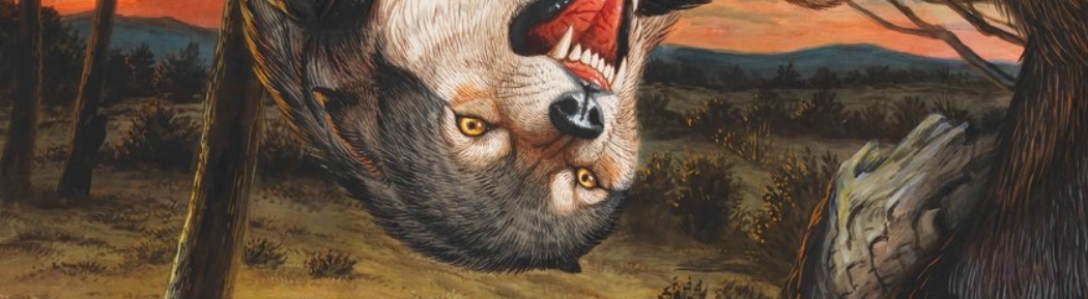
I Don’t Like to Look at Him, Jack by Walton Ford