Grim grey double plus unfun, Michael Radford’s 1984 adaptation of George Orwell’s 1948 novel 1984 is painful to watch. I think I first saw the film when I was in high school, in the mid-nineties, probably after I read the book, and I never bothered to watch it again until this morning. (It’s probably not a morning film). I might wait another 20 years to watch it again.
1984 is about as faithful to its source novel as it could be, capturing Orwell’s grim vision in relentlessly bleak (and occasionally gorgeous) shots of a dystopian post-war London. The film’s initial “worldbuilding” scenes are some of its most intriguing, including scenes of Winston Smith not fully participating in the Two Minutes Hate, looking for black market razors, prowling among the proles, and generally not fitting in among his peers. John Hurt is perfect as Winston Smith. His eyes convey an intelligent soul in despair, a soul slowly pulsing under a stoic mask that Winston has to wear to survive. Surviving isn’t enough though, and Winston finds his soul ignited by Julia (Suzanna Hamilton). The pair’s illicit love affair is doomed, and the great tragedy of 1984 is their ultimate betrayals of each other and themselves.
Roger Deakins’ cinematography is a highlight of 1984, particularly in the rare scenes in which gray gives way to green. The Eurythmics soundtrack is hardly intrusive, and the music they made was quite good, but the film would have done better to dispense with extra-diegetic music altogether. Radford’s direction is remarkably understated; drama evolves from setting and vibe. And even in more direct moments, Radford is subtle, as when Winston scratches out his own thoughts (thoughtcrimes!) on paper. Some directors might feel compelled to underline such moments, drive the thesis in—but Radford shows us Winston in the process of discovering his own thoughts and feelings.
Faithful to its source material, 1984 is in no way a fun film, but it conveys the book’s central message and core humanity admirably. I’ve always preferred Brave New World to 1984—not that the two need to be in a contest—but Huxley’s book, with its zany details and wild contours is simply more engaging. There’s more complexity to its flavors (if not its argument). Sure, 1984 has its strong flavors too, but a big bitter bite with sour notes is not something one returns to again and again.
How I watched it: On a large television, via a streaming service, with full attention.
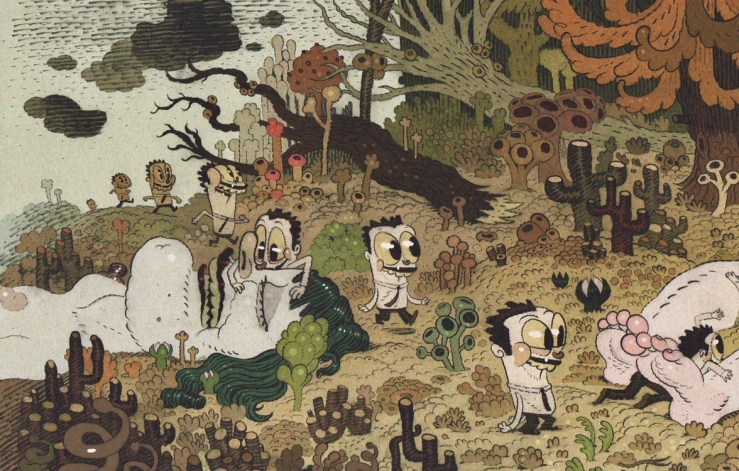
In Mudbite, Dave Cooper conjures a perverse and lurid dreamworld that seethes and wriggles with its own nightmare logic. The erstwhile hero of this world is Eddy Table, an apparent alter-ego for Cooper himself. Mudbite collects two new Eddy Table adventures, “Mud River” and “Bug Bite”, abject fantasias of intense sexual anxiety rendered in Cooper’s compellingly repellent style.
The two tales are bound tête-bêche; after you finish “Bug Bites”, you can flip the book over and read “Mud River.” Or maybe you’ll read the stories in the other order. Mudbite’s playful design invites the reader to participate in ordering the relationship between the stories. Cooper’s inimitable aesthetic unifies the project’s themes of aberrant sexuality and libidinal anxieties.
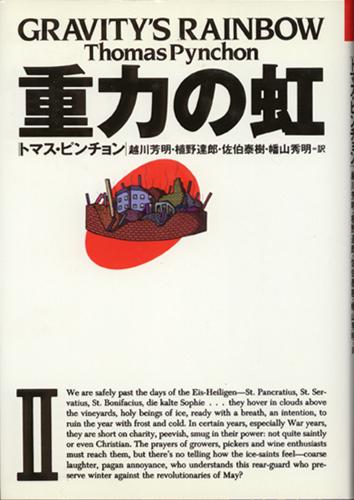
Captain Geoffrey “Pirate” Prentice’s bodacious banana breakfast for a bunch of hung over army officers (Gravity’s Rainbow)—
Routine: plug in American blending machine won from some Yank last summer, some poker game, table stakes, B.O.Q. somewhere in the north, never remember now….Chop several bananas into pieces. Make coffee in urn. Get can of milk from cooler. Puree ‘nanas in milk. Lovely. I would coat all the booze-corroded stomachs of England. . . . Bit of marge, still smells all right, melt in the skillet. Peel more bananas, slice lengthwise. Marge sizzling, in go long slices. Light oven whoomp blow us all up someday oh, ha, ha, yes. Peeled whole bananas to go on broiler grill soon as it heats. Find marshmallows. . . .
“You one of those right wing nut outfits?” inquired the diplomatic Metzger. Fallopian twinkled. “They accuse us of being paranoids.” “They?” inquired Metzger, twinkling also. “Us?” asked Oedipa.
“Not quite how it sorts out. Differences among the world religions are in fact rather trivial when compared to the common enemy, the ancient and abiding darkness which all hate, fear, and struggle against without cease”— he made a broad gesture to indicate the limitless taiga all around them— “Shamanism. There isn’t a primitive people anywhere on Earth that can’t be found practicing some form of it. Every state religion, including your own, considers it irrational and pernicious, and has taken steps to eradicate it.”
“What? there’s no ‘state religion’ in the U.S.A., pardner, we’ve got freedom of worship, it’s guaranteed in the Constitution—keeps church and state separate, just so’s we don’t turn into something like England and keep marching off into the brush with bagpipes and Gatling guns, looking for more infidels to wipe out. Nothing personal o’ course.”
“The Cherokee,” replied Prance, “the Apache, the massacre of the Sioux Ghost Dancers at Wounded Knee, every native Red Indian you’ve found, you people have either tried to convert to Christianity or you’ve simply killed.”
“I suggest it was about the fear of medicine men and strange practices, dancing and drug-taking, that allow humans to be in touch with the powerful gods hiding in the landscape, with no need of any official church to mediate it for them. The only drug you’ve ever been comfortable with is alcohol, so you went in and poisoned the tribes with that. Your whole history in America has been one long religious war, secret crusades, disguised under false names. You tried to exterminate African shamanism by kidnapping half the continent into slavery, giving them Christian names, and shoving your peculiar versions of the Bible down their throats, and look what happened.”
“The Civil War? That was economics. Politics.”
“That was the gods you tried to destroy, waiting their hour, taking their revenge. You people really just believe everything you’re taught, don’t you?”
“I’ll be in the bar,” said Reef. Yzles-Bains was in fact one of the few places on the continent of Europe where a sober Anarchist could find a decent Crocodile—equal amounts of rum, absinthe, and the grape spirits known as trois-six—a traditional Anarchist favorite, which Loïc the bartender, a veteran of the Paris Commune, claimed to have been present at the invention of.
1. You may never get to touch the Master, but you can tickle his creatures. 2. The innocence of the creatures is in inverse proportion to the immorality of the Master. 3. If they can get you asking the wrong questions, they don’t have to worry about answers. 4. You hide, they seek. 5. Paranoids are not paranoid because they’re paranoid, but because they keep putting themselves, fucking idiots, deliberately into paranoid situations.
“Somebody quoted Norman Mailer as saying that he wasn’t a better writer because his contemporaries weren’t better…I don’t know whether he really said that or not, but the point I want to make is that no one in Pynchon’s generation can make that statement. If we’re not as good as we should be it’s not because there isn’t a standard. And I think Pynchon, more than any other writer, has set the standard. He’s raised the stakes.”
THE NEXT DAY Reef, Cyprian, and Ratty were out on the Anarchists’ golf course, during a round of Anarchists’ Golf, a craze currently sweeping the civilized world, in which there was no fixed sequence—in fact, no fixed number—of holes, with distances flexible as well, some holes being only putter-distance apart, others uncounted hundreds of yards and requiring a map and compass to locate. Many players had been known to come there at night and dig new ones. Parties were likely to ask, “Do you mind if we don’t play through?” then just go and whack balls at any time and in any direction they liked. Folks were constantly being beaned by approach shots barreling in from unexpected quarters. “This is kind of fun,” Reef said, as an ancient brambled guttie went whizzing by, centimeters from his ear.

























 Biblioklept