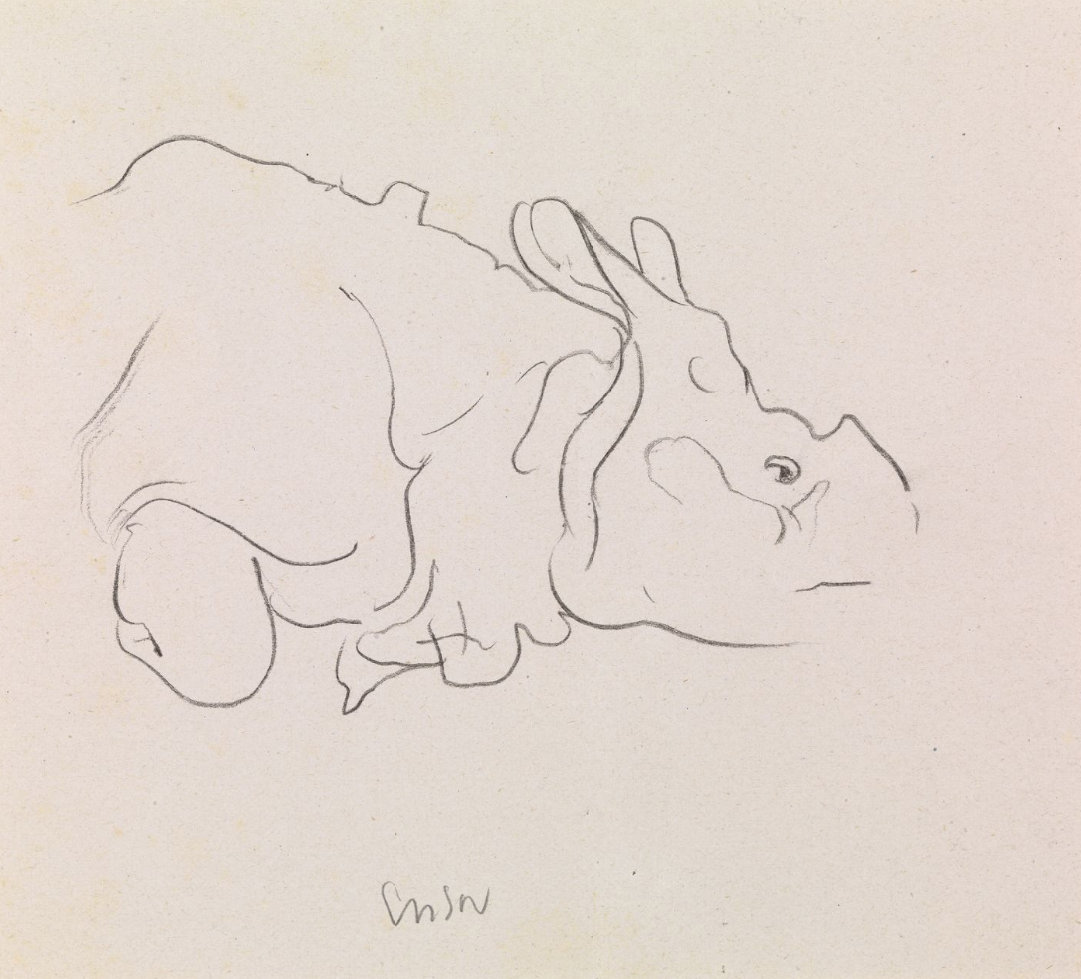
Mass-market Monday | Thomas Pynchon’s V.

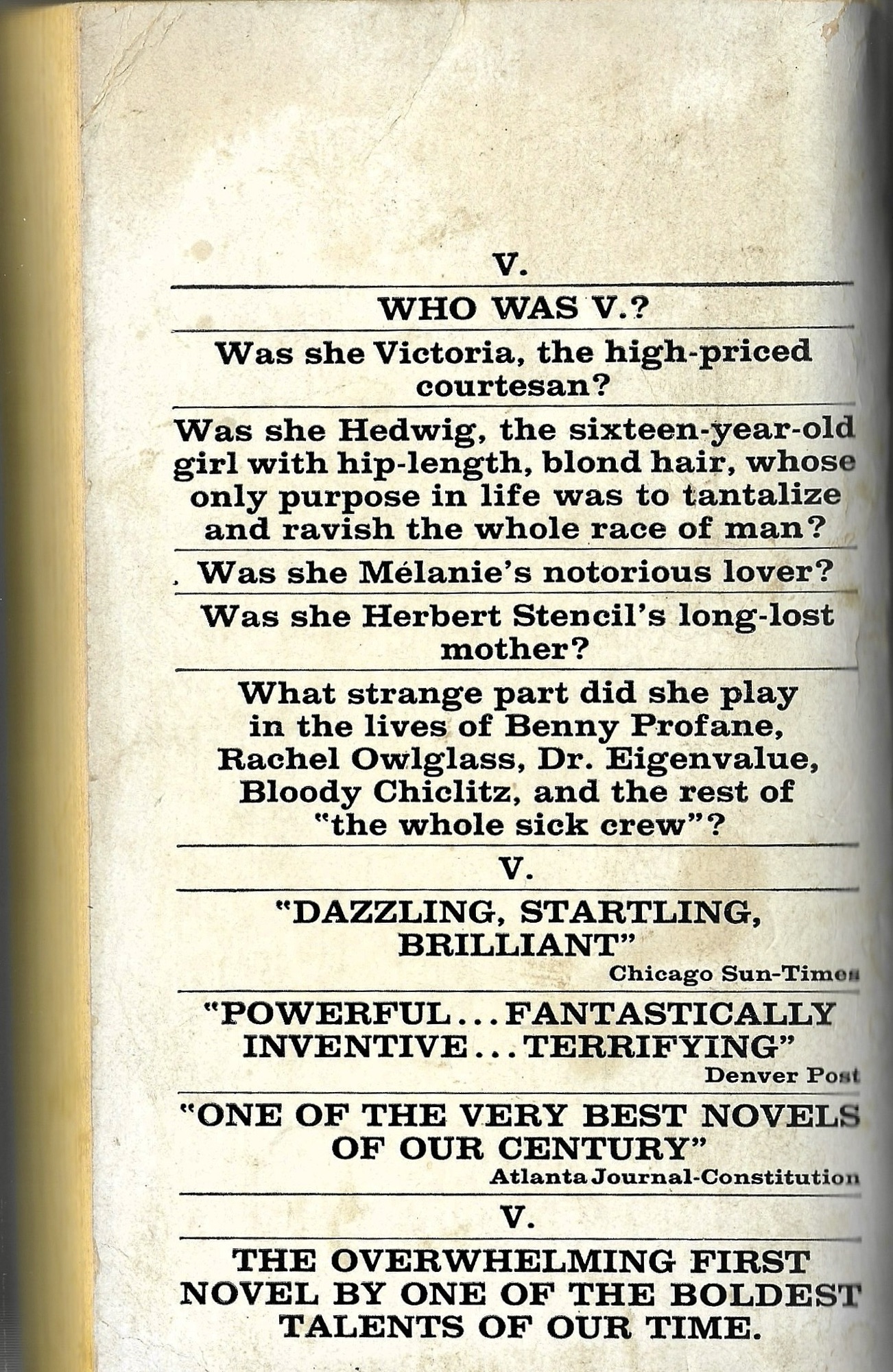
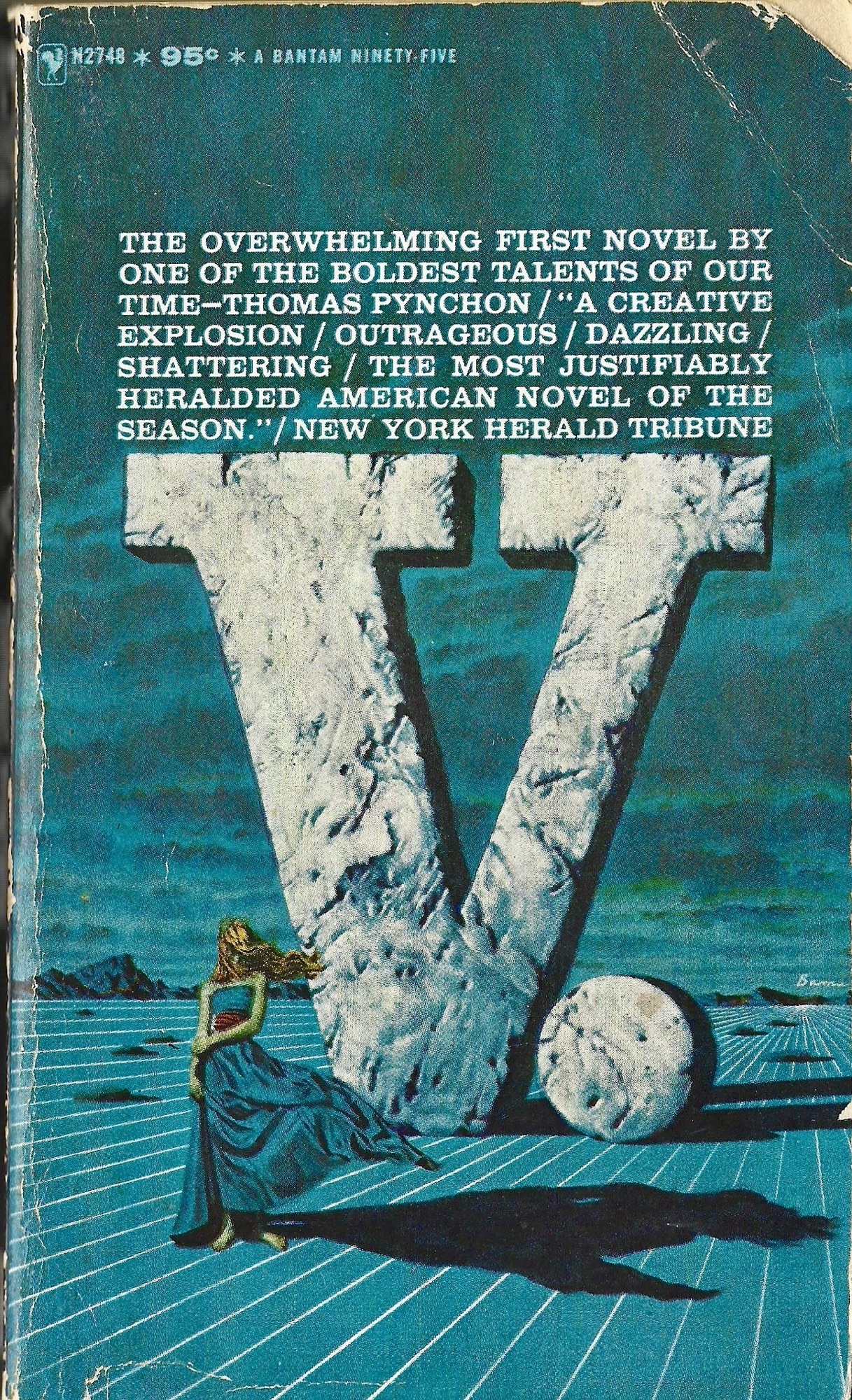
V., Thomas Pynchon. Bantam Books, third printing (1964). No cover artist credited. 463 pages.

Although artist James Bama is not credited, you can see his signature on the right side of the cover, just above the horizon.

I reread V. a few years back, concluding my piece with,

The grist, grit, and horror of the big postwar world will cling to the present. Nobody’s stepping down from heaven, or Heaven, and there are no magic words—but there is a kind of love, a loving with your mouth shut, a kind of radical, earnest, transcendent love that Pynchon evokes, soils, and sanctifies here.

Mass-market Monday | Samuel R. Delany’s Nova

Nova, Samuel R. Delany. Bantam Books, ninth printing (1979). No cover artist credited. 215 pages.

Although he is not credited, Eddie Jones is the artist for this marvelous cover to Bantam’s mass-market reprint of Delany’s 1968 novel Nova. 

Nova is one of my favorite SRD novels. Let me self-plagiarize myself from a few years ago:

I couldn’t make it through Delany’s cult favorite Dhalgren a few years back, but Nova was easier sledding. The book is a riff on Moby-Dick, tarot, monoculture, and the grail quest. It’s jammed with ideas and characters, and if it never quite coheres into something transcendent, it’s a fun quick read (even if the ending, right from the postmodern metatextual playbook is too clever by half).

On Vladimir Sorokin’s Blue Lard, pp. 223-76 | I love coarse aesthetics! Fucking people up furiosamente!

Previously on Blue Lard…

pp. 1-47

pp. 48-110

pp. 111-61

pp. 162-87

pp. 188-222

The following discussion of Vladimir Sorokin’s novel Blue Lard (in translation by Max Lawton) is intended for those who have read or are reading the book. It contains significant spoilers; to be very clear, I strongly recommend entering Blue Lard cold.

When I started this series of posts, I was rereading the print edition of Blue Lard after having read Max’s manuscript translation a few years ago. I have gotten so behind in this post series that I am now re-rereading. After having read the book essentially three times now, I find that it is far more precise and controlled than my initial impression–which I guess makes sense. Blue Lard is hypersurreal, shocking, deviant. But it’s also more balanced and nuanced than a first go-through might suggest, not just absurdist shit-throwing and jabberwocky, but an accomplished analysis of the emerging post-Soviet era.

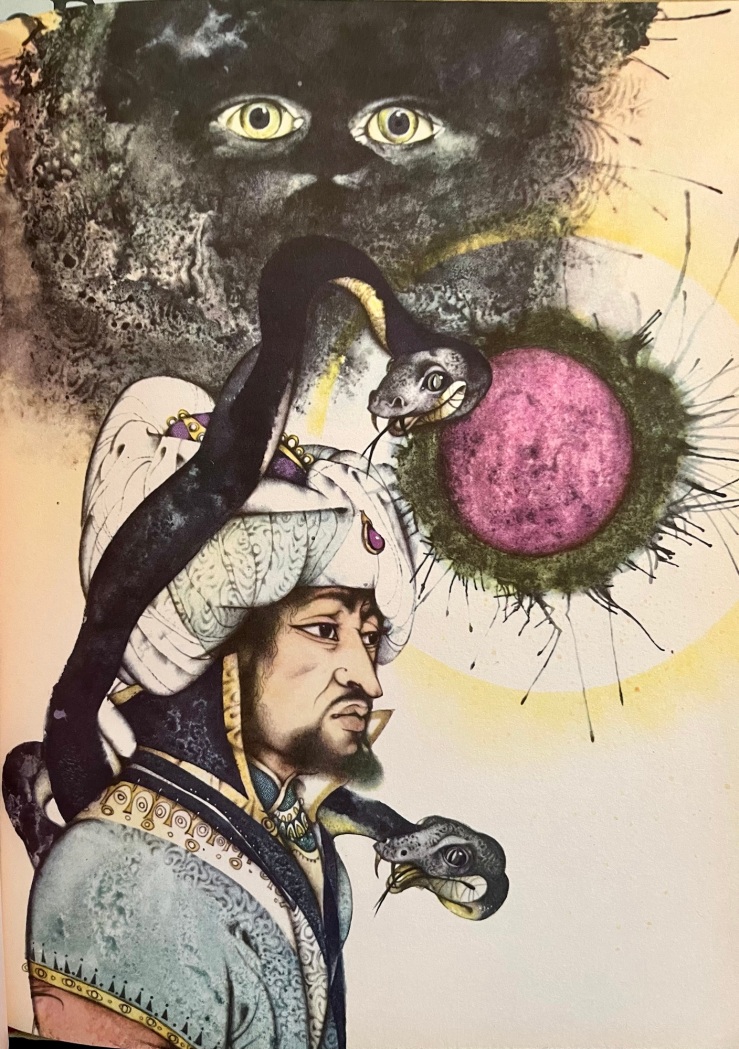
We left off our Blue Lard riffs with the pop art glamour and swagger of the Stalin family, drawn in bold but neat caricature. Stalin departs the dramatic inner circle/family circle on his way first to lieutenant Beria’s and then to his part-time lover Khrushchev’s, but as he’s on his way, “a fat woman dressed in rags hurl[s] herself toward the motorcade with a mad cry.” Stalin’s guards draw their weapons, but Our Boy is quicker: “‘Don’t shoot!’ Stalin ordered. ‘It’s Triple-A! Stop!'”

Triple-A is the poet Anna Akhmatova (who we first met via reincarnation as the kindaclone Akhmatova-2 back in the future). She’s fat gross and happy, pregnant with an aesthetic revelation of abjection:

Her wide, round face with its broken nose was flat and her small eyes shone with madness; tiny rotten teeth stuck out from beneath her formless wet lips; her unbelievably tattered rags adorned a squat body that widened freakishly as it went down; her dirty gray hair stuck out from beneath a ragged woolen kerchief; her bare feet were black with filth.

AAA is one of Sorokin’s fouler concoctions, proclaiming proclamations like

“Did you know that Kharms feeds canaries with his worms?” Stalin asks AAA. (The absurdist poet and children’s author Daniil Kharms died in a Soviet prison in his mid-thirties. “Send him to the deepest north!” Sorokin’s Akhmatova advises Sorokin’s Stalin.) The conversation over Soviet writing continues: “‘I have an active dislike for Fadeyev’s Young Guard,'” declares Stalin.” A paragraph or two later, AAA licks the soles of his boots. I don’t know nearly enough about Soviet and Russian literature to figure out what or if Sorokin is satirizing here, but I think I know enough about the relationship of aesthetics and power to take a big hint. 

Stalin’s motorcade drove up to Arkhangelskoye. Here, in a magnificent palace built during the reign of Catherine II, lived the count and previous member of the Politburo and of the Central Committee of the CPSU Nikita Aristarkhovich Khrushchev, who had been removed from his state duties by the October Plenum of the Central Committee.

There is a famous infamous horny sensual sex scene between Stalin and Khrushchev coming up, one that has made Blue Lard famously infamous—but let’s set that aside for now. Sorokin’s Khrushchev’s patronymic Aristarkhovich doesn’t gel with our historical Khrushchev’s patronymic Sergeyevich. Is the “new” patronymic “Aristarkhovich” an allusion to the avant-garde painter Aristarkh Lentulov? 

Sorokin’s presentation of Khrushchev as a hunchback may allude to the following incident, as reported in a 1973 The New York Times profile on the poet Yevgeny Yevtushenko:
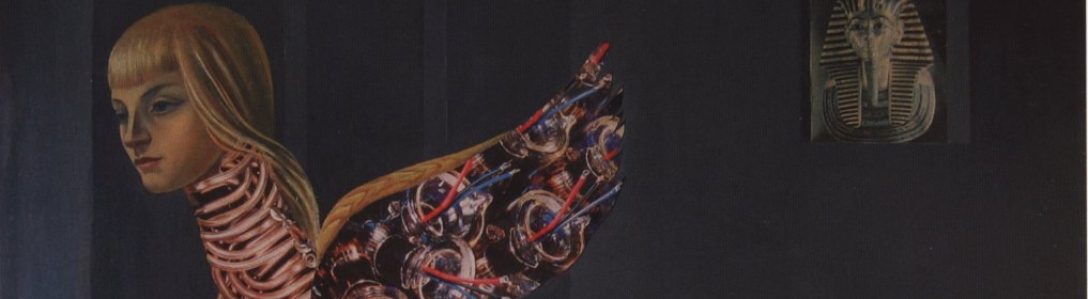
Mass-market Monday | Ishmael Reed’s The Last Days of Louisiana Red

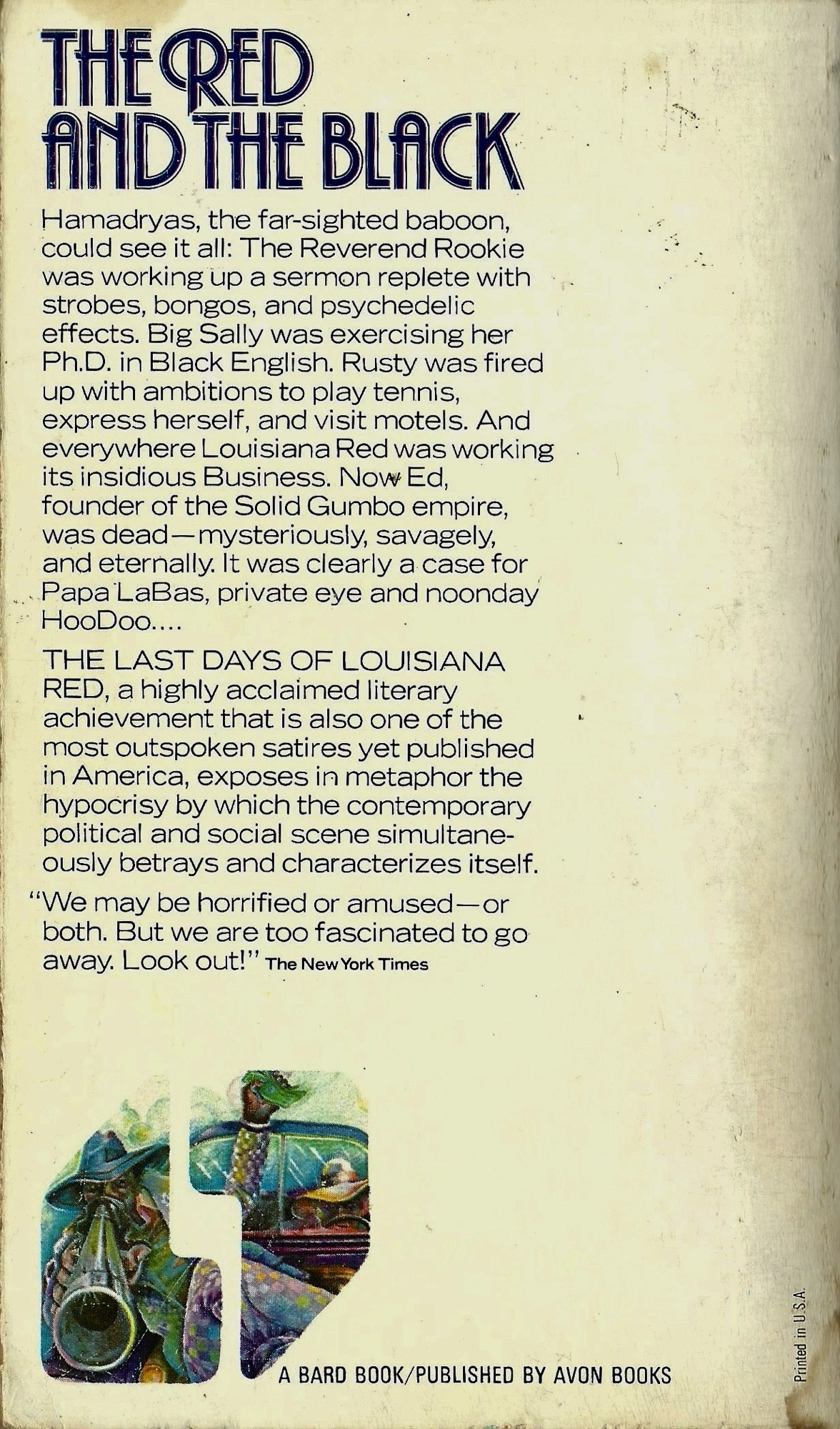
The Last Days of Louisiana Red, Ishmael Reed. Bard Books, First Bard Printing (1976). Cover art is by Andrew Rhodes (not credited). 191 pages.

From my review of The Last Days of Louisiana Red:

Ishmael Reed’s 1974 novel The Last Days of Louisiana Red is a sharp, zany satire of US culture at the end of the twentieth century. The novel, Reed’s fourth, is a sequel of sorts to Mumbo Jumbo (1972), and features that earlier novel’s protagonist, the Neo-HooDoo ghost detective Papa LaBas.

In Mumbo Jumbo, Reed gave us the story of an uptight secret society, the Wallflower Order, and their attempt to root out and eradicate “Jes’ Grew,” a psychic virus that spreads freedom and takes its form in arts like jazz and the jitterbug. The Last Days of Louisiana Red also employs a psychic virus to drive its plot, although this transmission is far deadlier. “Louisiana Red” is a poisonous mental disease that afflicts black people in the Americas, causing them to fall into a neo-slave mentality in which they act like “Crabs in the Barrel…Each crab trying to keep the other from reaching the top.”

Mass-market Monday | Philip K. Dick’s Solar Lottery

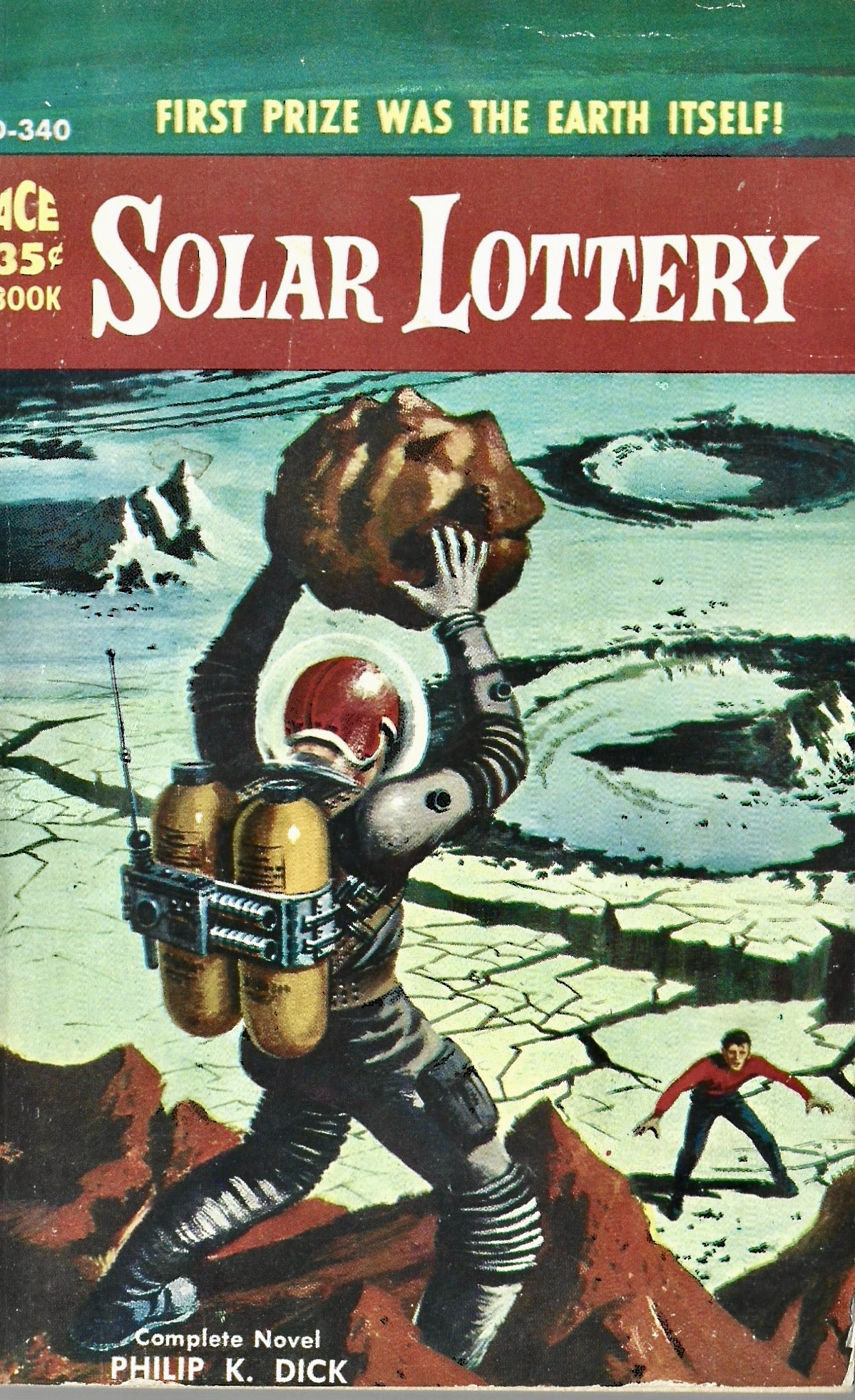
Solar Lottery, Philip K. Dick. Ace Books, first edition, second printing (1959). Cover art by Ed Valigursky. 188 pages.

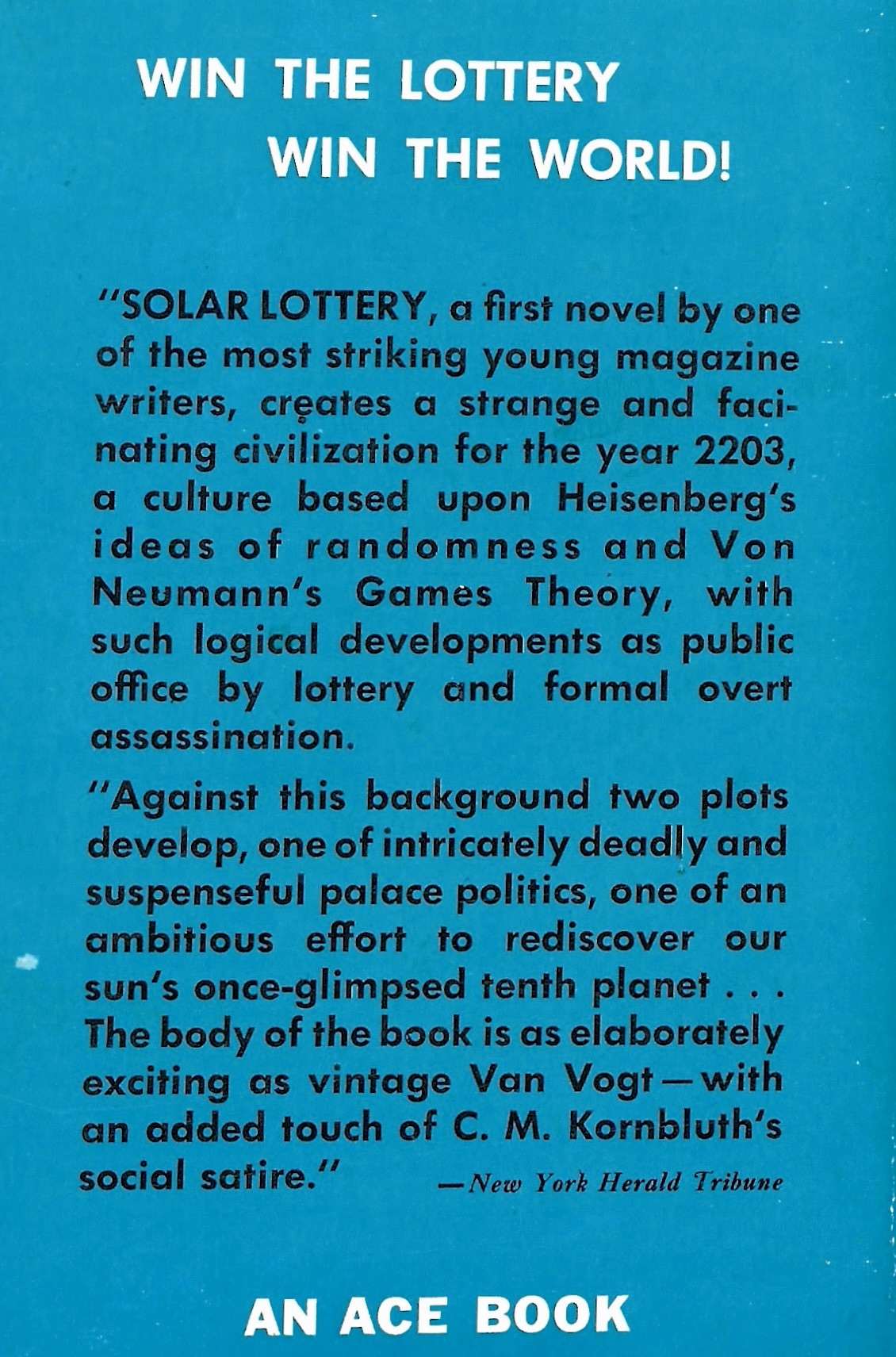
Here is a summary from this edition’s first page:

WINNER TAKE THE WORLD!

By the summer of 2203, Ted Benteley managed to break away from his old Industrial Hill oath and was free at last to offer himself in new bondage to Quizmaster Verrick. Of course, like everyone else on Earth, Ted held a ticket on the great lottery that could suddenly make him the next quizmaster with the whole world as his possession, but he could hardly figure on that one chance in six billion!

What Bentley didn’t realize when he went to swear himself forever to Verrick was that the lottery was about to take a wilder turn than ever before, one that would make Benteley himself the deciding factor in a power game of truly cosmic proportions!

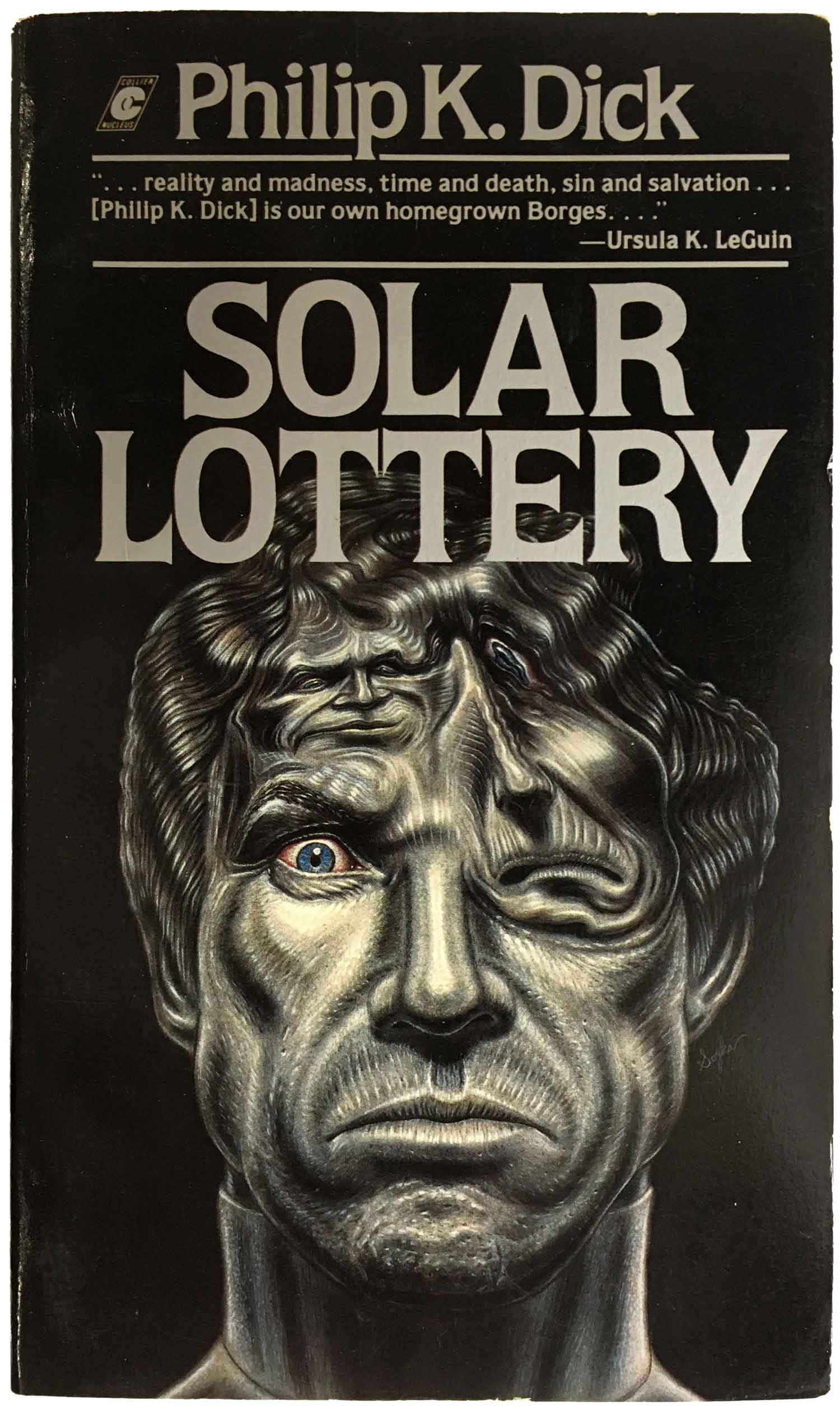
Philip K. Dick’s first-published novel, Solar Lottery (1955) is hardly his finest work (even as it points to his later themes). Neither is Ed Valigursky’s pulp fiction cover especially creative, at least when compared with the dozens of covers that came after. But I figured today’s solar eclipse made Solar Lottery a nice pick for an inaugural series where I kinda sorta go through all the mass-market paperbacks I can’t seem to get rid of and post something about them. Many if not most of the mass-market paperbacks I own were, at least on their first go around, marketed in genre ghettos, assuring that they actually got cool art and interesting designs—even if Valigursky’s hammy space dude cover can’t match, say, the Cronenberg vibes of Edward Soyka’s cover for Collier’s 1992 reprint, it’s still more interesting and human than the handsome, sterile series of PKD reprints Mariner Books did in the 2010s which seemed to scream, No, this isn’t really sci-fi, this is literature!

Posted in Art

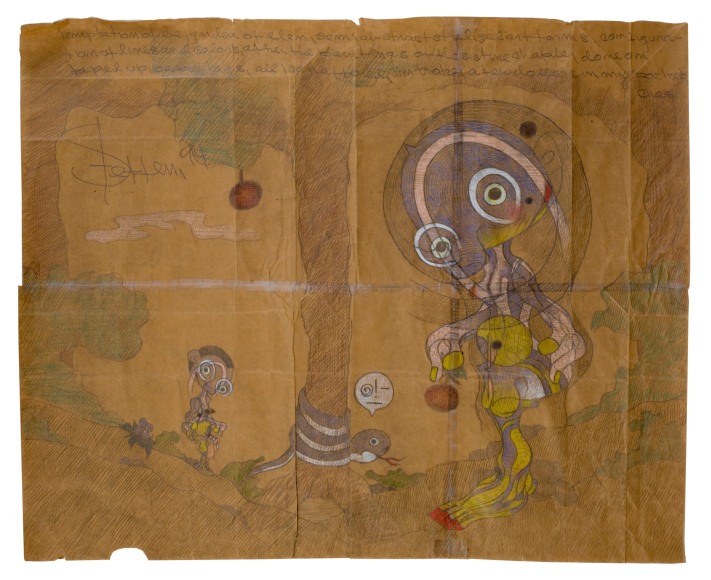
“Good-bye to the Fruits” — John Barth

“Good-bye to the Fruits”

by

John Barth

I agreed to die, stipulating only that I first be permitted to rebehold and bid good-bye to those of Earth’s fruits that I had particularly enjoyed in my not-extraordinary lifetime.
What I had in mind, in the first instance, was such literal items as apples and oranges. Of the former, the variety called Golden Delicious had long been my favorite, especially those with a blush of rose on their fetchingly speckled yellow-green cheeks. Of the latter–but then, there’s no comparing apples to oranges, is there, nor either of those to black plums: truly incomparable, in my opinion, on the rare occasions when one found them neither under- nor overripe. Good-bye to all three, alas; likewise to bananas, whether sliced transversely atop unsweetened breakfast cereal, split longitudinally under scoops of frozen yogurt, barbecued in foil with chutney, or blended with lime juice, rum, and Cointreau into frozen daiquiris on a Chesapeake August late afternoon.
Lime juice, yes: Farewell, dear zesty limes, squeezed into gins-and-tonics before stirring and over bluefish filets before grilling; adieu too to your citric cousins the lemons, particularly those with the thinnest of skins, always the most juiceful, without whose piquance one could scarcely imagine fresh seafood, and whose literal zest was such a challenge for us kitchen-copilots to scrape a half-tablespoonsworth of without getting the bitter white underpeel as well. Adieu to black seedless grapes for eating with ripe cheeses and to all the nobler stocks for vinting, except maybe Chardonnay. I happened not to share the American yuppie thirst for Chardonnay; too over-flavored for my palate. Give me a plain light dry Chablis any time instead of Chardonnay, if you can find so simple a thing on our restaurant wine-lists these days. And whatever happened to soft dry reds that don’t cost an arm and a leg on the one hand, so to speak, or, on the other, taste of iron and acetic acid? But this was no time for such cavils: Good-bye, blessed fruit of the vineyard, a dinner without which was like a day without et cetera. Good-bye to the fruits of those other vines, in particular the strawberry, if berries are properly to be called fruits, the tomato, and the only melon I would really miss, our local cantaloupe. Good-bye to that most sexual of fruits, the guava; to peaches, plantains (fried), pomegranates, and papayas; to the fruits of pineapple field and coconut tree, if nuts are fruits and coconuts nuts, and of whatever it is that kiwis grow on. As for pears, I had always thought them better canned than fresh, as Hemingway’s Nick Adams says of apricots in the story “Big Two-Hearted River”–but I couldn’t see kissing a can good-bye, so I guessed that just about did the fruits (I myself preferred my apricots sun-dried rather than either fresh or canned).

Read the rest of “Goodbye to the Fruits” — and two other John Barth shorts — in the Spring ’94 issue of Conjunctions.

Posted in Art