The Distributor of Crowns — Odilon Redon

The Barber Shop — Edward Hopper

Reclining Woman with Green Stockings — Egon Schiele

Dwelling in the Pure and Infinite — William T. Wiley

“A sublime murkiness and original pent fury” | Walt Whitman on Millet’s Paintings

The Diggers, Jean-Francois Millet

April 18.—Went out three or four miles to the house of Quincy Shaw, to see a collection of J. F. Millet’s pictures. Two rapt hours. Never before have I been so penetrated by this kind of expression. I stood long and long before “the Sower.” I believe what the picture-men designate “the first Sower,” as the artist executed a second copy, and a third, and, some think, improved in each. But I doubt it. There is something in this that could hardly be caught again—a sublime murkiness and original pent fury. Besides this masterpiece, there were many others, (I shall never forget the simple evening scene, “Watering the Cow,”) all inimitable, all perfect as pictures, works of mere art; and then it seem’d to me, with that last impalpable ethic purpose from the artist (most likely unconscious to himself) which I am always looking for. To me all of them told the full story of what went before and necessitated the great French revolution—the long precedent crushing of the masses of a heroic people into the earth, in abject poverty, hunger—every right denied, humanity attempted to be put back for generations—yet Nature’s force, titanic here, the stronger and hardier for that repression—waiting terribly to break forth, revengeful—the pressure on the dykes, and the bursting at last—the storming of the Bastile—the execution of the king and queen—the tempest of massacres and blood. Yet who can wonder?

Could we wish humanity different? Could we wish the people made of wood or stone? Or that there be no justice in destiny or time?

The true France, base of all the rest, is certainly in these pictures. I comprehend “Field-People Reposing,” “the Diggers,” and “the Angelus” in this opinion. Some folks always think of the French as a small race, five or five and a half feet high, and ever frivolous and smirking. Nothing of the sort. The bulk of the personnel of France, before the revolution, was large-sized, serious, industrious as now, and simple. The revolution and Napoleon’s wars dwarf’d the standard of human size, but it will come up again. If for nothing else, I should dwell on my brief Boston visit for opening to me the new world of Millet’s pictures. Will America ever have such an artist out of her own gestation, body, soul?

—From Walt Whitman’s journal of 1881


In the Barber Shop — Ilya Bolotowsky

“The same blue rocks and spectral grottos could be seen in Leonardo’s Virgin of the Rocks” | J.G. Ballard

From J.G. Ballard’s short story “The Gioconda of the Twilight Noon”:

‘There’s a postcard from your mother. They’re near Malta, somewhere called Gozo.’

‘Give it to me.’ Maitland felt the card in his hands.

‘Gozo – that was Calypso’s island. She kept Ulysses there for seven years, promised him eternal youth if he’d stay with her forever.’

‘I’m not surprised.’ Judith inclined the card towards her. ‘If we could spare the time, you and I should go there for a holiday. Wine–dark seas, a sky like heaven, blue rocks. Bliss.’

‘Blue?’

‘Yes. I suppose it’s the bad printing. They can’t really be like that.’

‘They are, actually.’

Still holding the card, Maitland went out into the garden, feeling his way along the string guiderail. As he settled himself in the wheelchair he reflected that there were other correspondences in the graphic arts. The same blue rocks and spectral grottos could be seen in Leonardo’s Virgin of the Rocks, one of the most forbidding and most enigmatic of his paintings. The madonna sitting on a bare ledge by the water beneath the dark overhang of the cavern’s mouth was like the presiding spirit of some enchanted marine realm, waiting for those cast on to the rocky shores of this world’s end. As in so many of Leonardo’s paintings, all its unique longings and terrors were to be found in the landscape in the background. Here, through an archway among the rocks, could be seen the crystal blue cliffs that Maitland had glimpsed in his reverie.


Original Sin — Salvador Dali

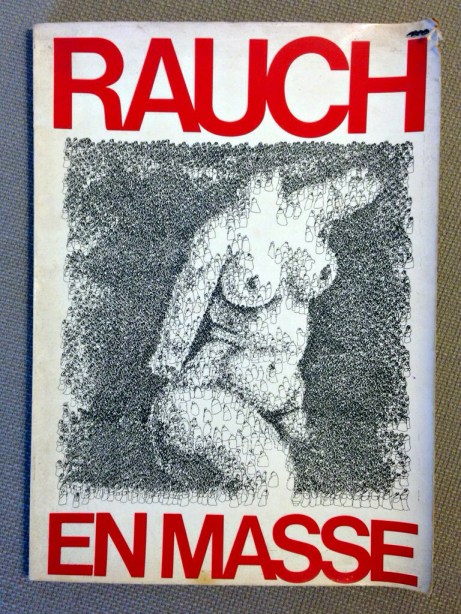
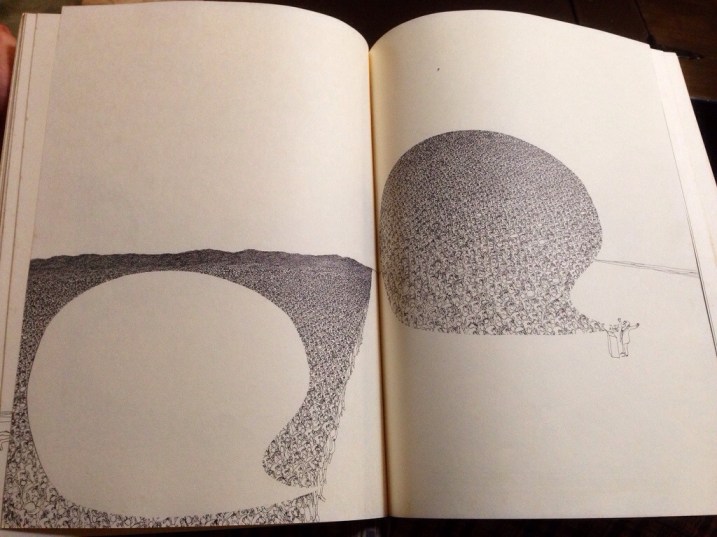
Rauch’s En Masse (Book Acquired, 12.09.2013)

r

Meandering through the bookstore on a Monday morn, I spied this beat up copy of Hans-Georg Rauch’s En Masse and had to have it.

I’d never heard of Rauch before, but his spidery ink drawings immediately intrigued me.

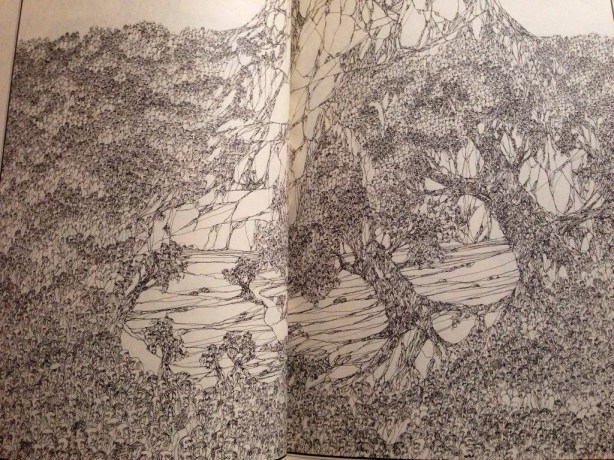
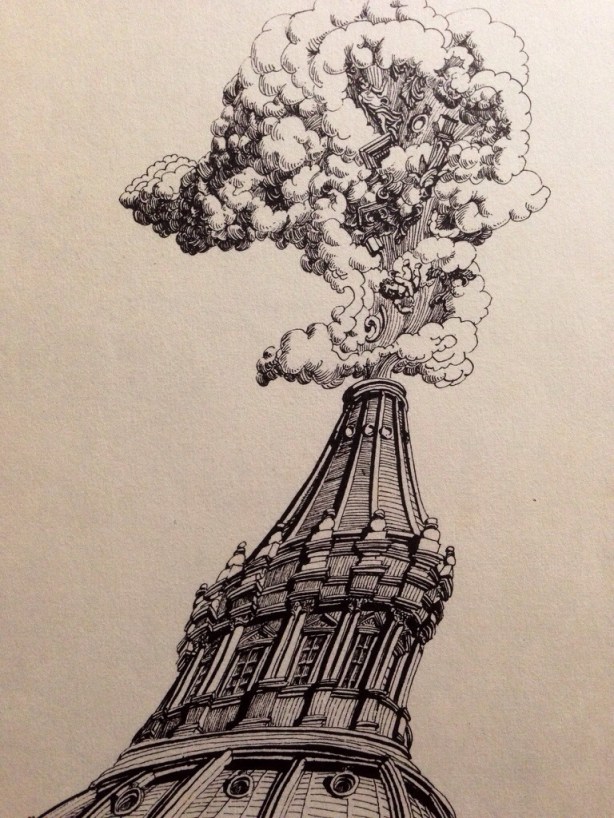
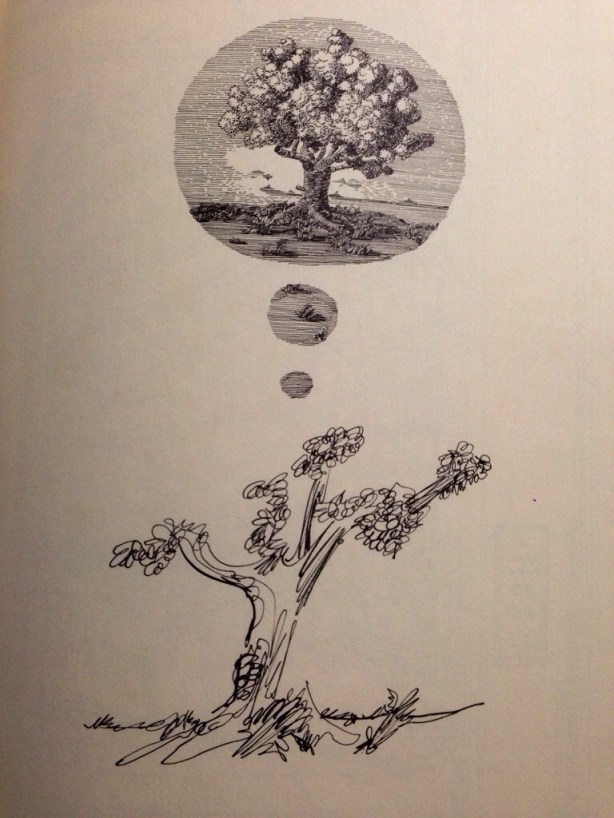
None of the images in En Masse is labeled—indeed, there are no words in the book.

Instead, Rauch plays with themes of creation and nihilism, sex and politics, architecture and nature.

20131211-143452.jpg

This two page spread came out blurry via my iPhone pic—sorry—but in the book’s oversize 13″ x 9″ format  the effect is overwhelming.

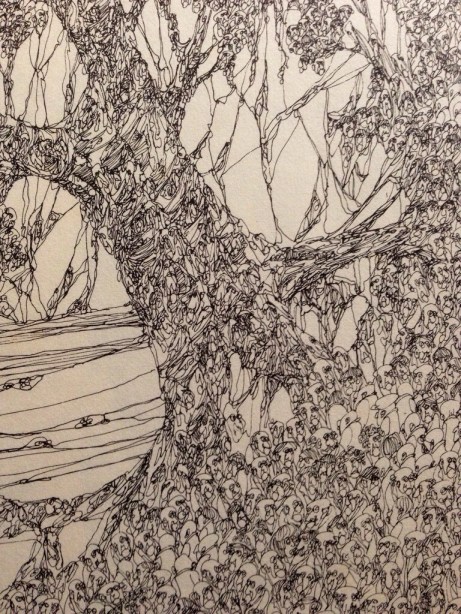
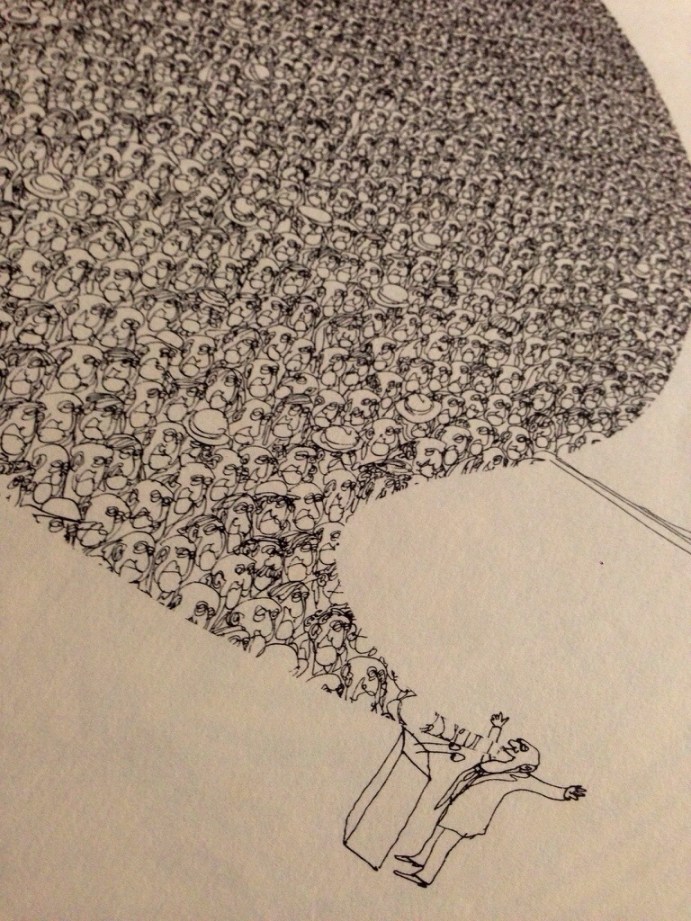
You can see some of the masses perhaps better in this close-up:

20131211-143459.jpg

Rauch’s cartoony style is balanced with an Escher-like acumen; the guy can draft. But there’s a sense of humor here that I think puts him closer to Tomi Ungerer.

20131211-143505.jpg

20131211-143518.jpg

20131211-143525.jpg

Lovely stuff.

20131211-143532.jpg

The Council Chamber — Edward Burne-Jones

Love — Martiros Saryan

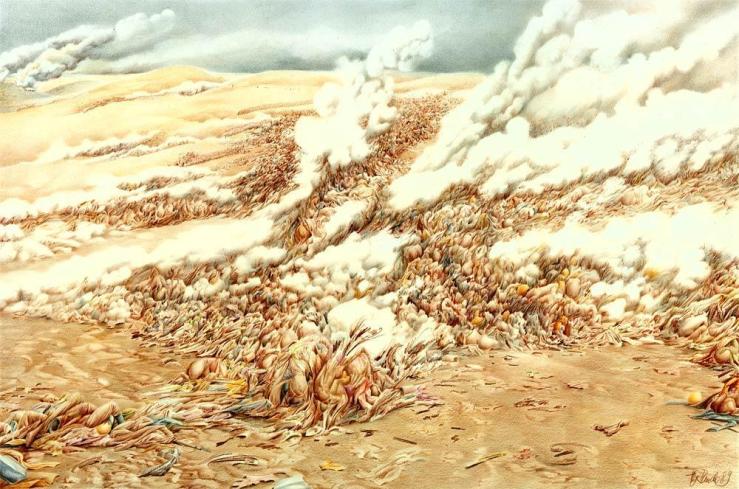
Battle Paintings II — Hans-Georg Rauch

battle

Hero and Leander (To Christopher Marlowe) — Cy Twombly

Still Life with Hourglass, Pencase and Print — Gerrit Dou

François Truffaut: The Man Who Loved Cinema (Documentary)

Shop (The Perry Bible Fellowship)

PBF261-Shop