The whole universe is harnessed to men’s attempts to force one another into good citizenship (Mary Douglas)

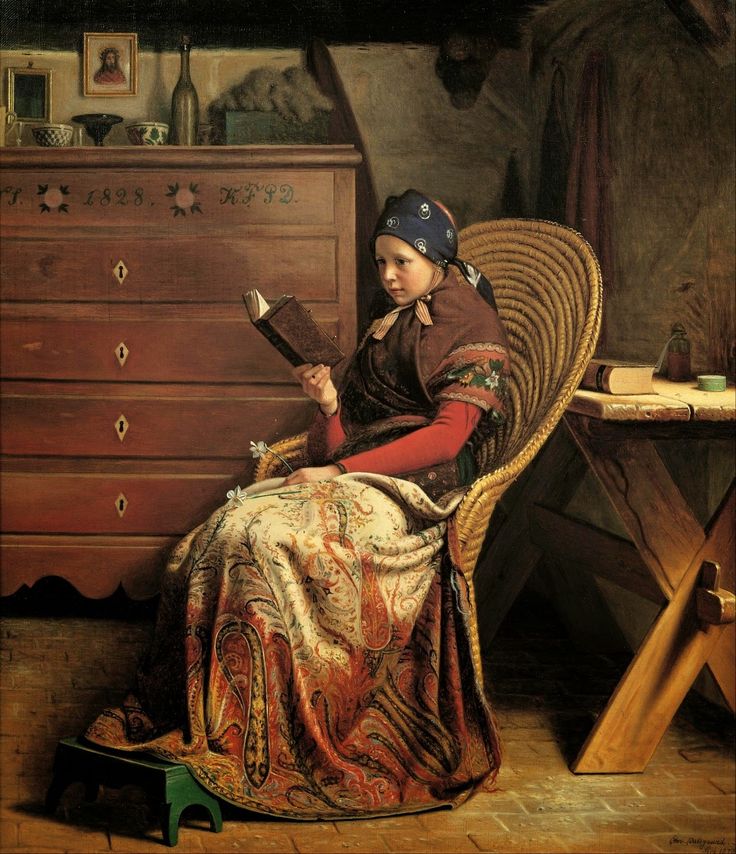
Pollution ideas work in the life of society at two levels, one largely instrumental, one expressive. At the first level, the more obvious one, we find people trying to influence one another’s behavior. Beliefs reinforce social pressures: all the powers of the universe are called in to guarantee an old man’s dying wish, a mother’s dignity, the rights of the weak and innocent. Political power is usually held precariously and primitive rulers are no exception. So we find their legitimate pretensions backed by beliefs in extraordinary powers emanating from their persons, from the insignia of their office or from the words they can utter. Similarly the ideal order of society is guarded by dangers which threaten transgressors. These danger-beliefs are as much threats which one man uses to coerce another as dangerous which he himself fears to incur by his own lapses from righteousness. They are a strong language of mutual exhortation. At this level the laws of nature are dragged in to sanction the moral code: this kind of disease is caused by adultery, that by incest; this meteorological disaster is the effect of political disloyalty, that the effect of impiety. The whole universe is harnessed to men’s attempts to force one another into good citizenship. Thus we find that certain moral values are upheld and certain social roles defined by beliefs and dangerous contagion, as when the glance or touch of an adulterer is held to bring illness to his neighbors or his children.

From Mary Douglas’s study of pollution and taboo, Purity and Danger.

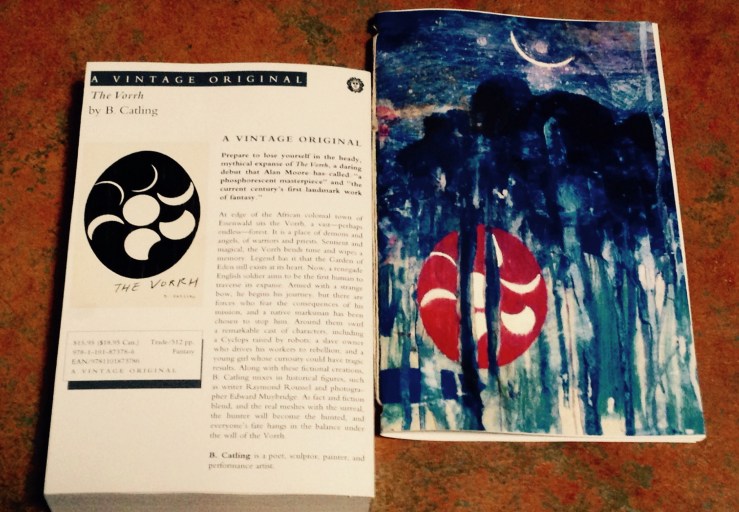
The Vorrh (Book Acquired, 11.13.2014)

IMG_4020

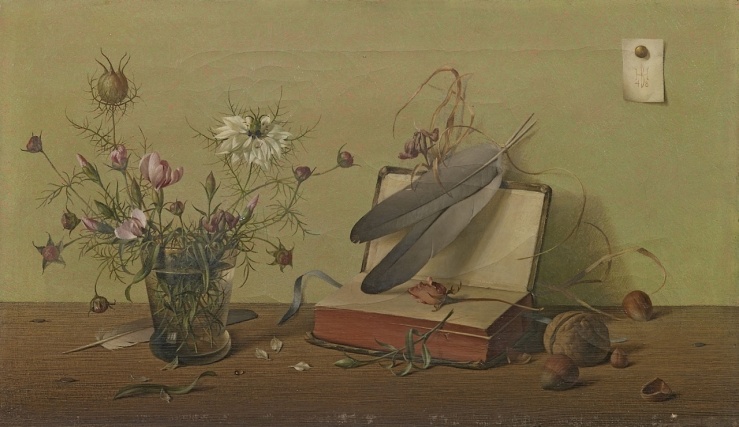
Brian Catling’s historical-fantasy novel The Vorrh is getting a U.S. publication next year from Vintage. I’m thinking that the actual cover will be that image on the upperish-mid-left side of the back cover of the uncorrected proof I got. Vintage also send this neat little string-bound teaser that consists of Alan Moore’s gushing introduction to The Vorrh and an interview with Catling. The cover is one of Catlin’s paintings.

Vintage’s blurb:

The Vorrh follows a brilliant cast of characters through a parallel Africa where fact, fiction, and fantasy collide. Tsungali, a native marksman conscripted by the colonial authorities–against whom he once led a revolt–is on the hunt for an English bowman named Williams. Williams has made it his mission to become the first human to traverse the Vorrh, a vast forest at the edge of the colonial city of Essenwald. The Vorrh is endless, eternal; a place of demons and angels. Sentient, oppressive, and magical, the Vorrh can bend time and wipe a person’s memory. Between the hunter and the hunted are Ishmael, a curious and noble Cyclops raised by Bakelite robots; the evil Dr. Hoffman, who punishes the son of a servant by surgically inverting his hands; and the slave owner MacLeish, who drives his workers to insanity, only to pay the ultimate price. Along with these fictional creations, Brian Catling mixes in historical figures, including surrealist Raymond Roussel and photographer and Edward Muybridge.  In this author’s  hands none of this seems exotic or fantastical. It all simply is.

Clothes, Clothes, Clothes. Music, Music, Music. Boys, Boys, Boys. (Book Acquired, 11.18.2014)

IMG_3996.JPG

This one looks pretty good: Viv Albertine’s memoir Clothes, Clothes, Clothes. Music, Music, Music. Boys, Boys, Boys. U.S. publisher St. Martin’s Press’s blurb:

Viv Albertine is a pioneer. As lead guitarist and songwriter for the seminal band The Slits, she influenced a future generation of artists including Kurt Cobain and Carrie Brownstein. She formed a band with Sid Vicious and was there the night he met Nancy Spungeon. She tempted Johnny Thunders…toured America with the Clash…dated Mick Jones…and inspired the classic Clash anthem “Train in Vain.” But Albertine was no mere muse. In Clothes, Clothes, Clothes. Music, Music, Music. Boys, Boys, Boys., Albertine delivers a unique and unfiltered look at a traditionally male-dominated scene.

Her story is so much more than a music memoir. Albertine’s narrative is nothing less than a fierce correspondence from a life on the fringes of culture. The author recalls rebelling from conformity and patriarchal society ever since her days as an adolescent girl in the same London suburb of Muswell Hill where the Kinks formed. With brash honesty—and an unforgiving memory—Albertine writes of immersing herself into punk culture among the likes of the Sex Pistols and the Buzzcocks. Of her devastation when the Slits broke up and her reinvention as a director and screenwriter. Or abortion, marriage, motherhood, and surviving cancer. Navigating infidelity and negotiating divorce. And launching her recent comeback as a solo artist with her debut album, The Vermilion Border.

Clothes, Clothes, Clothes. Music, Music, Music. Boys, Boys, Boys. is a raw chronicle of music, fashion, love, sex, feminism, and more that connects the early days of punk to the Riot Grrl movement and beyond. But even more profoundly, Viv Albertine’s remarkable memoir is the story of an empowered woman staying true to herself and making it on her own in the modern world.

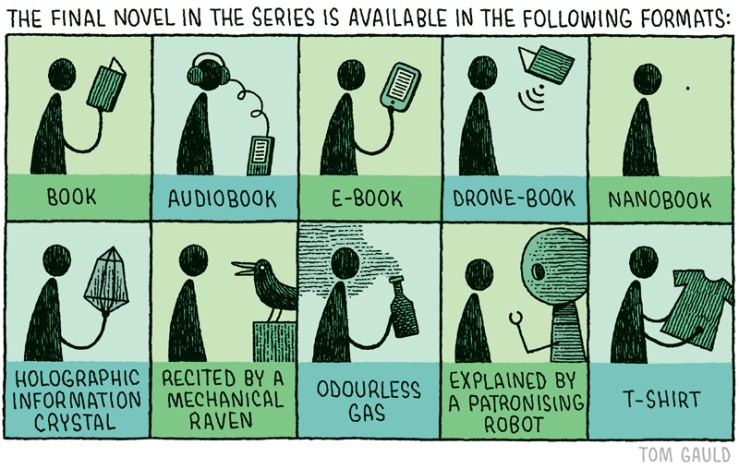
The Top 10 Best Novels of 2014

10. The Beekeeper’s Daughter by Sissy Sextuplington

By turns uproarious, scandalous, and emotionally-moving, this kaleidoscopic novel tells the multi-generational story of the Apis clan, from their humble beginnings starting a clandestine honey-service in the catacombs of Ellis Island in the 1890s, to their triumphant crest in the honey-boom of the Buzzing Twenties, to their decline and rebirth from their own ashes/wax over the course of the 20th century. This sting stuns!

9. Cacanisius’ Crossing by Caomh-Caolan FitzSimmons-Hughes

How wonderful that this “lost classic” has been recovered anew! FitzSimmons-Hughes of course wrote the novel over a series of decades; each section was written in the language of the European country he was living in self-imposed exile in at the time. Cacanisius’ Crossing was then translated into Irish Gaelic, and has finally been translated into English. The 1085-page story details the last five minutes in the life of its central character. Kaleidoscopically stunning.

8. Dovetail by Samuel Samold

In this dystopian romance-thriller, society is split into two groups: those who have earned their genetically-grafted tails, and those who must go “SansTail.” Will plucky Becky Fang pass the Trials of Wattle and earn her place in the dominant tribe (along with dreamboat Crispin’s affection)—or will she follow the strange mysteries of the secret resistance force, The Cloacal Tunnel? A compelling stunner.

7. The Kite Runner 2 by Khaled Hosseini

The whole book club bawled. Again.

6. Jimmy Hat Johannson and the Crystal Creeper Caper (A Charleston ‘Nights’ Mystery) by Edwin Turner

I feel a little weird putting my own NaNoWriMo novel on here—not the least because it hasn’t come out yet (FS&G in hardback in the US, March 2016; Penguin in the UK, Australia, Canada, and NZ in May 2016; Japanese and Latvian translations TBD)—but it’s really, really good. I even let a friend look over it to check for any bad writing (there wasn’t any) before I sent it to the Wylie Agency. The plot: Jimmy Hat Johansson is just a good ole boy from a backwoods burg…but a summer job with his Uncle Ray’s lawn business plunges him headfirst into a world of sinister intrigue–housewife murderesses, a corrupt sheriff, and a crystal meth syndicate!

5. The Lumberjack’s Apprentice by Knob Hayden

Knob Hayden’s remarkable journey comes to life in this remarkable collection of stories (The Lumberjack’s Apprentice is a novel-in-stories). Remarkably, this book was Hayden’s thesis for an experimental MFA program offered by the EGS (via Transylvania University, Kentucky). Each short story is a remarkable entry in this angry young man’s tour-de-force-of-truth. Hayden is only 24, but he’s hardly tender—six days as a lumberjack’s apprentice will roughen any soft palms! Our hero also tries his hand as a busboy, a mail clerk at Monsanto, and a cabin boy. This guy has definitely read Jesus’ Son!

4. Working On My Screenplay by Angela Criss

Kudos to Penguin for this achievement. This is a book of tweets from people who have included the phrase “working on my screenplay” in their tweet, interspersed with sketches of kittens. Sure, you might criticize it as lazy, not particularly insightful, barely interesting, the sort of joke that others like John Cage played decades ago, a gimmick, cruel, boring, or smug. But it’s art and it’s subversive and it provides much-needed metacommentary and it can be yours for only 10 bucks!

3. Too Many Cooks: The Novelization by Jonathan Franzen

Stunningly remarkable work from Franzen, who slowly teases out the Adult Swim’s immediate cult-classic 11-minute video to 475 pages in this sweeping multigenerational epic. Stunning to think that Mr. Franzen never even watched the short film!

2. Brooklyn Novel Title TK  by Daktoa Rugburn

Wyoming Strongniece has no idea what to do after college—an internship at a Fortune 500 company offered by one of her father’s friends? An experimental MFA program offered by the EGS? Should she work the summer at her favorite bar, making artisanal cocktails for the surly locals, and continue to support her suicidal roommate Hershey as she tries to launch her acting career? Or maybe—just maybe—she can have it all. A dazzling debut sure to stun and reward.

1. The Sector of Attention by Moses Kingson

In vivid prose, Kingson’s unforgettable 27th novel explores the nadirs and acmes of the human soul. A swirling kaleidoscope of epiphanies and soul-searching, this kaleidoscopic stunner makes us reexamine all we thought we knew about WWII. I can’t wait to actually read it.

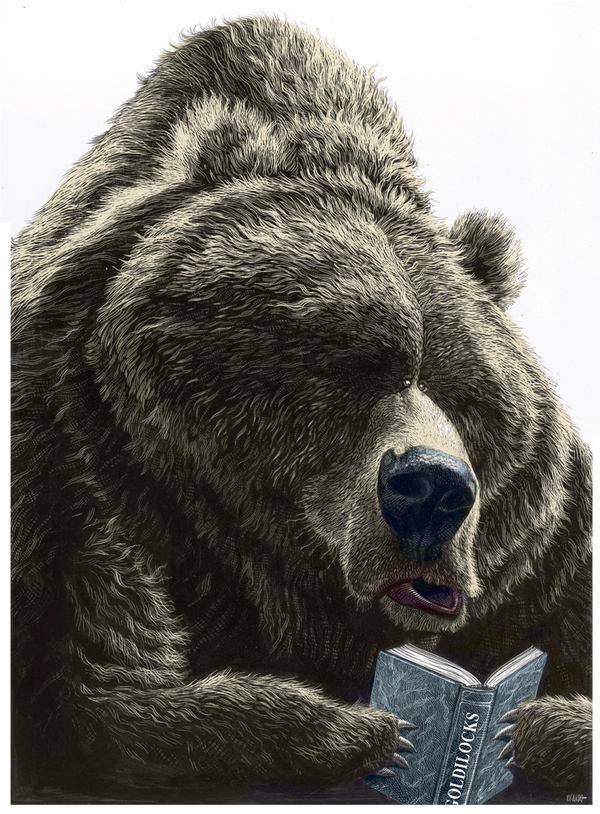
Selections from One-Star Amazon Reviews of Chinua Achebe’s Things Fall Apart

[Ed. note: The following citations come from one-star Amazon reviews of Chinua Achebe’s novel Things Fall Apart. (See also: Mary Shelley’s Frankenstein, Thomas Pynchon’s Gravity’s RainbowGeorge Orwell’s 1984, Herman Melville’s Moby-Dick, James Joyce’s Ulysses and David Markson’s Wittgenstein’s Mistress). I’ve preserved the reviewers’ own styles of punctuation and spelling].

There were too many details

no plot, lousy tales, and distant characters.

Gnerally, I am extremely open-minded about other cultures,

Don’t buy this unless you need it for some reason out of your control.

DOES THIS GUY EVEN KNOW WHAT THE FUDGE HE IS TALKING ABOUT!

I read two chapters and quit It was horrible, and I say BAH!!!!!!!!!BAH!!!!!!!and a BOOOOOOOO!!!!!

This is one of those “politically correct” books they force you to read in school, in hope of “broadening our horizons” and “opening our minds.”

The main character had a lot of mental problems, including violence, chauvinism, and overambition to become the ‘model citizen’ of his tribe. I had no sympathy for him, neither should you.

Throught the book the auther keeps bringing in new charecters that have almost the identicle spelling of another and it gets very confusing

While Chinua Achebe claims to be an African freedom activist, her(? I can never figure out these new-fangled names) style of writing is stereotypical of the reactionary Brench and their quest to retain Africa.

The author seems to have some sort of infatuation with yams, because the entire book revolves around idiotic descriptions of yams and characters struggling with their declining yam output.

I found this story went no where, there were no real accomplishments done by the main character, his could have check in to an asylum for a year, dealt with his tribal issues, what he missed out on as a kid, came back to his tribe and really made a difference with his people. Instead, we just see some ones life that just gets worse.

This story could have been told in about 20 pages, but streches out into a full book that finally makes a point in the very last pages. Achebe’s work needs some fine tuning.

Why coudln’t they just at least change the names you could at least pronoucne it, ne ways if you plan on reading it, your want lots of time, so u can understand it.

“THINGS FALL APART” IS LIKE ABOUT A GUY WHO GROWS YAMS AND BEATS HIS FAMILY, AND IT JUST TALKS ABOUT THAT THE WHOLE TIME ITS A TERRIBLE HORRIBLE BOOK!

Almost nothing happens for the first 100 pages except we find out that he has three wives and he beats his kids. GREAT, That took 100 pages to say!!

If your looking for a good novel about African people by an African writer, it’s not here. Try Toni Morrison.

Anyone with sense would be rooting for the imperialists by the end of this book.

the writer is only famous because he is a minority.

the story have no point at all.

It draged on and on.

It was like reading a quick obituary.

the names are way too hard to pronounce.

All you never wanted to know about yams… and other such things

This book is way too confusing for the average reader (I am an honors student) and even the more advanced reader would find difficulty reading this book.

Better by far to have young atudents enjoy ayn rand tom woods and john allison milton friedman and peter schiff adn be poastive free neterpirse and successful.

the only thing you’ll enjoy is saying Okwonko over and over again

This makes Africa look worse, not better….

No one cared about Okonkwo’s yams!

How DARE we let children read this book.

it just SUXED

In retrospect, the story lived up to it’s name.