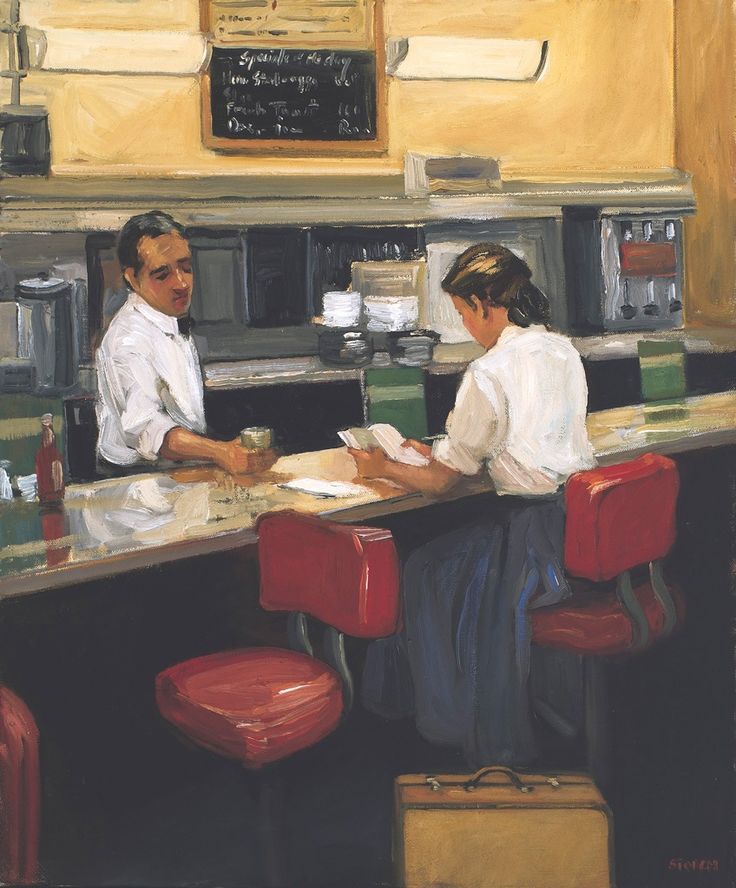
Night Cafe — Sally Storch

06dbbbf1463c62eef9208e4b55d82e65

“The Absence of Any Purpose Is the Starting Point for My Work” | An Interview with Roman Muradov

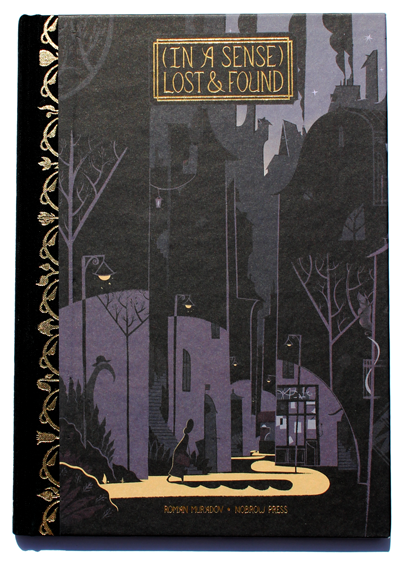
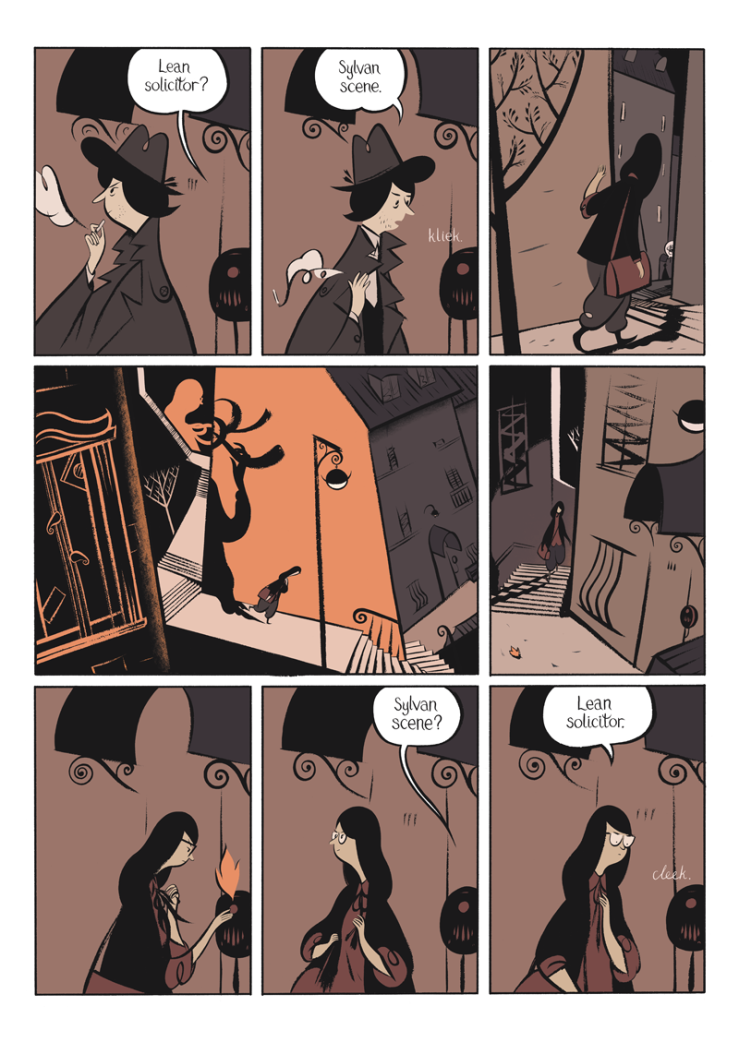
I’ve been a fan of Roman Muradov’s strange and wonderful illustrations for a while now, so I was excited late this summer to get my hands on his début graphic novella, (In a Sense) Lost and Found (Nobrow Press). In my review, I wrote: “I loved Lost and Found, finding more in its details, shadowy corners, and the spaces between the panels with each new reading.” The book is a beauty, so I was thrilled when Roman agreed to discuss it with me over a series of emails. We also discussed his influences, his audience, his ongoing Yellow Zine projects, his recent cover for Joyce’s Dubliners, and his reaction to some of the confused Goodreads reviews his novella received. Check out Roman’s work at his website. You won’t be disappointed.
inasense400photo

Biblioklept: When did you start working on (In a Sense) Lost and Found? Did you always have the concept kicking around?

Roman Muradov: The idea came to me in 2010 in the form of the title and the image of a protracted awakening. I wrote it as a short story, which had a much more conventional development and actually had some characters and plot movements, all of them completely dropped one by one on the way to the final version apart from the basic premise. I didn’t have a clear understanding of what was to be done with that premise, but the idea kept bothering me for some time, until I rewrote it a few times into a visual novella when Nobrow asked me if I wanted to pitch them something. Since then it went through several more drafts and even after everything was drawn and colored I had to go back and edit most of the dialogues, which is a nightmarish task in comics, since it involved re-lettering everything by hand.

Biblioklept: When you say you wrote it as a short story, I’m intrigued—like, do you mean as a sketch, or a set of directions, or as a tale with imagery? Part of the style of the book (and your style in general) is a confidence in the reader and the image to work together to make the narrative happen. When you were editing the dialogues, were you cutting out exposition, cues, contours?

RM: No, I mean a traditional pictureless short story. I was struggling with forms at the time and didn’t feel confident with any of them. In a way this still persists, because my comics are often deliberately deviating from the comics form, partially in my self-published experiments. The story itself was still ambiguous, I never considered showing what she lost, or how. With time I edited down all conversation to read as one self-interrupting monologue.

Biblioklept: I want to circle back to (In a Sense) Lost and Found, but let’s explore the idea that your work intentionally departs from the conventions of cartooning. When did you start making comics? What were the early comics that you were reading, absorbing, understanding, and misunderstanding?

RM: I came to comics pretty late; I only discovered Chris Ware & co around 2009. As a child I spent one summer drawing and writing little stories, ostensibly comics, then I stopped for a couple of decades. I’m not really sure why I started or stopped. In general my youth was marked by extraordinary complacency and indifference. I followed my parents’ advice and studied petroleum engineering, then worked as a petroleum engineer of sorts for a year and a half, then quit and decided to become an artist. I still feel that none of these decisions were made by me. Occasionally certain parts of my work seem to write themselves and I grow to understand them much later, which is weird.

Biblioklept: Was Ware a signal figure for you? What other comic artists did you find around that time?

Ware, Clowes & Jason were the first independent cartoonist I discovered and I ended up ripping them off quite blatantly for a year or so. Seth was also a big influence, particularly his minute attention to detail and his treatment of time, the way he stretches certain sequences into pages and pages, then skips entire plot movements altogether. Reading Tim Hensley’s Wally Gropius was a huge revelation, it felt like I was given permission to deviate from the form. Similarly, I remember reading Queneau’s “Last Days” in Barbara Wright’s translation, and there was the phrase “the car ran ovaries body” or something like that, and I thought “oh, I didn’t know this was allowed.”

saladface

Biblioklept: Your work strikes me as having more in common with a certain streak of modernist and postmodernist prose literature than it does with alt comix. Were you always reading literature in your petroleum engineer days?

RM: That’s certainly true, nowadays I’m almost never influenced by other cartoonists. I wasn’t a good reader until my mid-twenties, certainly not back in Russia. I stumbled upon Alfred Jarry (not in person) while killing time in the library, and then it was a chain reaction to Quenau, Perec and Roussel, then all the modernists and postmodernists, particularly Kafka, Joyce, Nabokov and Proust.

Biblioklept: How do you think those writers—the last four you mention in particular—influence your approach to framing your stories?

RM: From Nabokov I stole his love for puzzles and subtle connections, a slightly hysterical tone, his shameless use of puns and alliteration, from Kafka–economy of language and a certain mistrust of metaphors–it always seems to me that his images and symbols stretch into an infinite loop defying straightforward interpretation by default, from Joyce and Proust the mix of exactitude and vagueness, and the prevalence of style over story, the choreography of space and time. I should’ve say “I’m in the process of stealing,” I realize that all of these things are far too complex, and I doubt that I’ll ever feel truly competent with any of these authors as a reader, let alone as a follower.

Biblioklept:(In a Sense) Lost and Found begins with a reference to Kafka’s Metamorphosis, and then plunges into a Kafkaesque—to use your phrasing—“infinite loop defying straightforward interpretation.” How consciously were you following Kafka’s strange, skewed lead?

RM: I wanted the reference to be as obvious as possible, almost a direct copy, as if it’s placed there as an act of surrender–I’m not going to come up with a story, here’s one of most famous opening lines that you already know. Usually I know the beginning and the ending and I often downplay their importance, so that the work becomes focused mostly on the process and so that readers don’t expect any kind of resolution or satisfactory narrative development. In the password scene the phrases are copied directly from Eliot’s Wasteland, which itself refers to Paradise Lost in these passages. It’s a bit like a broken radio, shamelessly borrowing from the narrator’s visual and literary vocabulary, the way it happens in a dream.
premise_0022_22.psd Continue reading ““The Absence of Any Purpose Is the Starting Point for My Work” | An Interview with Roman Muradov” →

A Coffee Thesaurus

A COFFEE THESAURUS — From William H. Ukers’s All About Coffee (1922)

Encomiums and descriptive phrases applied to the plant, the berry, and the beverage

The Plant

The precious plant
This friendly plant
Mocha’s happy tree
The gift of Heaven
The plant with the jessamine-like flowers
The most exquisite perfume of Araby the blest
Given to the human race by the gift of the Gods

The Berry

The magic bean
The divine fruit
Fragrant berries
Rich, royal berry
Voluptuous berry
The precious berry
The healthful bean
The Heavenly berry
The marvelous berry
This all-healing berry
Yemen’s fragrant berry
The little aromatic berry
Little brown Arabian berry
Thought-inspiring bean of Arabia
The smoking, ardent beans Aleppo sends
That wild fruit which gives so beloved a drink

The Beverage

Nepenthe
Festive cup
Juice divine
Nectar divine
Ruddy mocha
A man’s drink
Lovable liquor
Delicious mocha
The magic drink
This rich cordial
Its stream divine
The family drink
The festive drink
Coffee is our gold
Nectar of all men
The golden mocha
This sweet nectar
Celestial ambrosia
The friendly drink
The cheerful drink
The essential drink
The sweet draught
The divine draught
The grateful liquor
The universal drink
The American drink
The amber beverage
The convivial drink
The universal thrill
King of all perfumes
The cup of happiness
The soothing draught
Ambrosia of the Gods
The intellectual drink
The aromatic draught
The salutary beverage
The good-fellow drink
The drink of democracy
The drink ever glorious
Wakeful and civil drink
The beverage of sobriety
A psychological necessity
The fighting man’s drink
Loved and favored drink
The symbol of hospitality
This rare Arabian cordial
Inspirer of men of letters
The revolutionary beverage
Triumphant stream of sable
Grave and wholesome liquor
The drink of the intellectuals
A restorative of sparkling wit
Its color is the seal of its purity
The sober and wholesome drink
Lovelier than a thousand kisses
This honest and cheering beverage
A wine which no sorrow can resist
The symbol of human brotherhood
At once a pleasure and a medicine
The beverage of the friends of God
The fire which consumes our griefs
Gentle panacea of domestic troubles
The autocrat of the breakfast table
The beverage of the children of God
King of the American breakfast table
Soothes you softly out of dull sobriety
The cup that cheers but not inebriates
Coffee, which makes the politician wise
Its aroma is the pleasantest in all nature
The sovereign drink of pleasure and health
The indispensable beverage of strong nations
The stream in which we wash away our sorrows
The enchanting perfume that a zephyr has brought
Favored liquid which fills all my soul with delight
The delicious libation we pour on the altar of friendship
This invigorating drink which drives sad care from the heart


The Angry One — Ferdinand Hodler

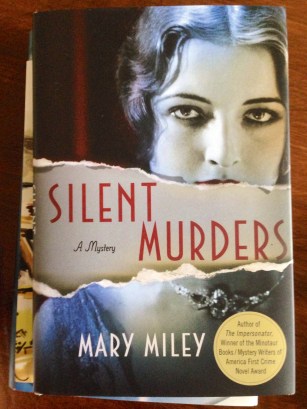
Silent Murders (Book Acquired, 9.02.2014)

IMG_3229

Mary Miley’s Silent Murders. Macmillan/Minotaur’s blurb:

Vaudeville actress Leah Randall took on her most daring role ever when she impersonated missing heiress Jessie Carr in order to claim Jessie’s inheritance inThe Impersonator. Now that the dust has settled around that tumultuous time in her life, Leah has adopted Jessie’s name as her own and moved to Hollywood, where she’s taken a modest but steady job in the silent film industry.

Jessie’s thrilled when Bruno Heilmann, a movie studio bigwig, invites her to a party. She’s even more delighted to run into a face from her past at that party. But the following day, Jessie learns that sometime in the wee hours of the morning both her old friend and Bruno Heilmann were brutally murdered. She’s devastated, but with her skill as an actress, access to the wardrobes and resources of a film studio, and a face not yet famous enough to be recognized, Jessie is uniquely positioned to dig into the circumstances surrounding these deaths. But will doing so put her own life directly in the path of a murderer?

“Titian Paints a Sick Man” — Roberto Bolaño

“Titian Paints a Sick Man”

by

Roberto Bolaño

At the Uffizi, in Florence, is this odd painting by Titian. For a while, no one knew who the artist was. First the work was attributed to Leonardo and then to Sebastiano del Piombo. Though there’s still no absolute proof, today the critics are inclined to credit it to Titian. In the painting we see a man, still young, with long dark curly hair and a beard and mustache perhaps slightly tinged with red, who, as he poses, gazes off toward the right, probably toward a window that we can’t see, but still a window that somehow one imagines is closed, yet with curtains open or parted enough to allow a yellow light to filter into the room, a light that in time will become indistinguishable from the varnish on the painting.

1

The young man’s face is beautiful and deeply thoughtful. He’s looking toward the window, if he’s looking anywhere, though probably all he sees is what’s happening inside his head. But he’s not contemplating escape. Perhaps Titian told him to turn like that, to turn his face into the light, and the young man is simply obeying him. At the same time, one might say that all the time in the world stretches out before him. By this I don’t mean that the young man thinks he’s immortal. On the contrary. The young man knows that life renews itself and that the art of renewal is often death. Intelligence is visible in his face and his eyes, and his lips are turned down in an expression of sadness, or maybe it’s something else, maybe apathy, none of which excludes the possibility that at some point he might feel himself to be master of all the time in the world, because true as it is that man is a creature of time, theoretically (or artistically, if I can put it that way) time is also a creature of man.

2

In fact, in this painting, time — sketched in invisible strokes — is a kitten perched on the young man’s hands, his gloved hands, or rather his gloved right hand which rests on a book: and this right hand is the perfect measure of the sick man, more than his coat with a fur collar, more than his loose shirt, perhaps of silk, more than his pose for the painter and for posterity (or fragile memory), which the book promises or sells. I don’t know where his left hand is.

How would a medieval painter have painted this sick man? How would a non-figurative artist of the twentieth century have painted this sick man? Probably howling or wailing in fear. Judged under the eye of an incomprehensible God or trapped in the labyrinth of an incomprehensible society. But Titian gives him to us, the spectators of the future, clothed in the garb of compassion and understanding. That young man might be God or he might be me. The laughter of a few drunks might be my laughter or my poem. That sweet Virgin is my friend. That sad-faced Virgin is the long march of my people. The boy who runs with his eyes closed through a lonely garden is us.

From Between Parentheses.

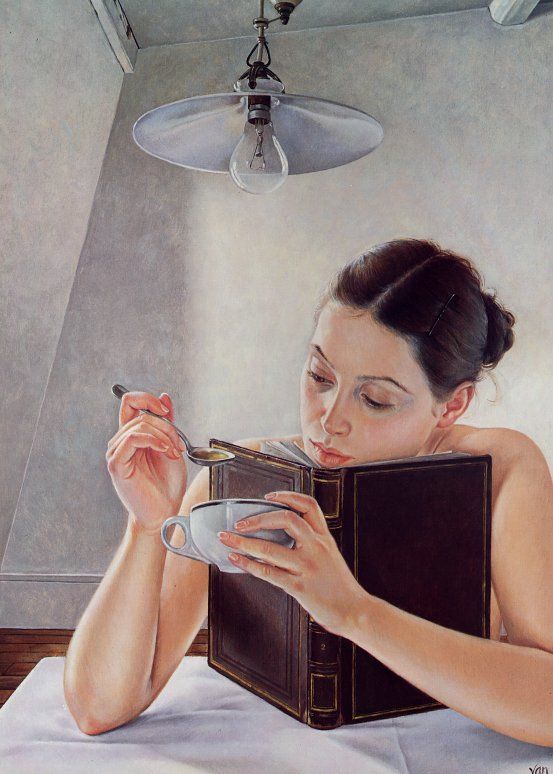
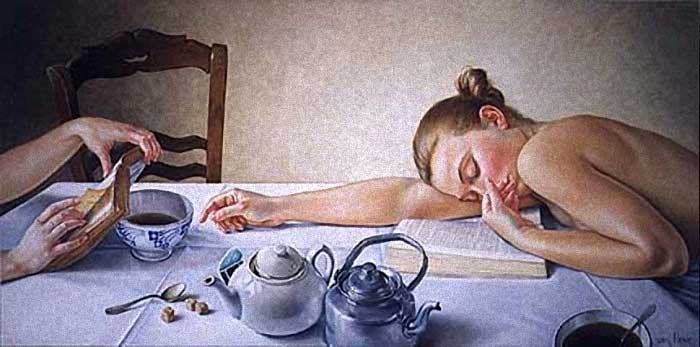
Reader — Francine Van Hove

879c93ba3bac48e60a0133c45eff7fbc

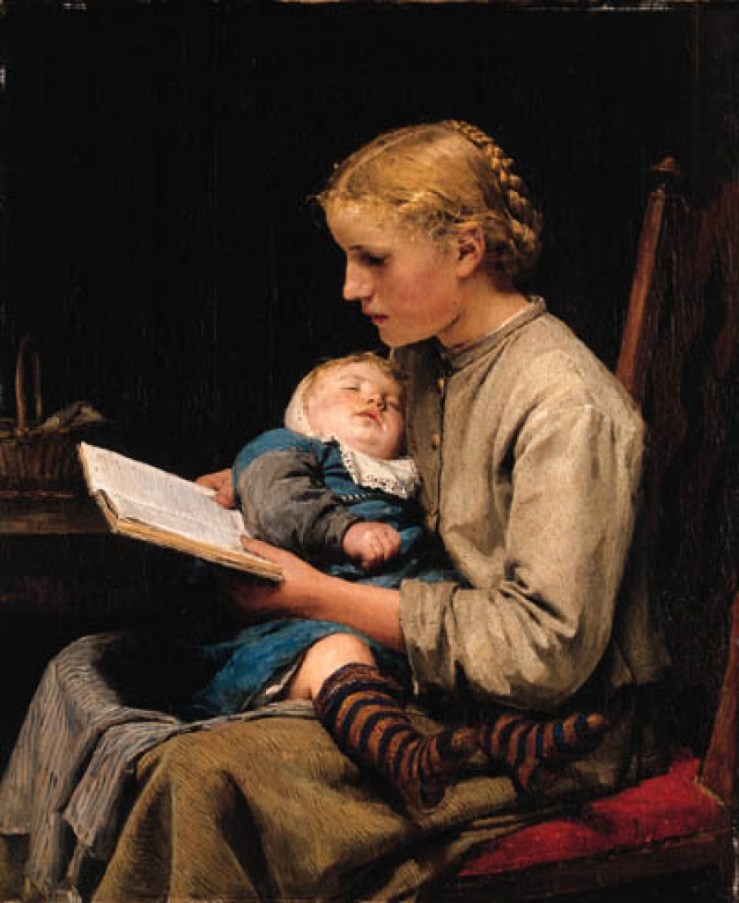
Rosa and Bertha Gugger — Albert Anker

xgagbxws3vwl

They will not do us any good—the good books (William H. Gass)

They will not do us any good—the good books—no—if by good we mean good looks, good times, good shoes; yet they still offer us salvation, for salvation does not wait for the next life, which is anyhow a vain and incautious delusion, but is to be had, if at all, only here—in this one. It is we who must do them honor by searching for our truth there, by taking their heart as our heart, by refusing to let our mind flag so that we close their covers forever, and spend our future forgetting them, denying the mind’s best moments. They extend the hand; we must grip it. Spinach never made Popeye strong sitting in the can. And the finest cookbook ever compiled put not one pot upon the stove or dish upon the table. Here, in the library that has rendered you suspect, you have made their acquaintance—some of the good books. So now that you’ve been nabbed for it, you must become their lover, their friend, their loyal ally. But that is what the rest of your life is for. Go now, break jail, and get about it.

From William H. Gass’s essay “To a Young Friend Charged with Possession of the Classics.” Collected in A Temple of Texts.

Saving Simon (Book Acquired, 9.15.2014)

IMG_3341.JPG

Saving Simon by Jon Katz is new in hardback from Random House. Their blurb:

In this heartfelt, thoughtful, and inspiring memoir, New York Times bestselling author Jon Katz tells the story of his beloved rescue donkey, Simon, and the wondrous ways that animals make us wiser and kinder people.

In the spring of 2011, Jon Katz received a phone call that would challenge every idea he ever had about mercy and compassion. An animal control officer had found a neglected donkey on a farm in upstate New York, and she hoped that Jon and his wife, Maria, would be willing to adopt him. Jon wasn’t planning to add another animal to his home on Bedlam Farm, certainly not a very sick donkey. But the moment he saw the wrenching sight of Simon, he felt a powerful connection. Simon touched something very deep inside of him. Jon and Maria decided to take him in.

Simon’s recovery was far from easy. Weak and malnourished, he needed near constant care, but Jon was determined to help him heal. As Simon’s health improved, Jon would feed him by hand, read to him, take him on walks, even confide in him like an old and trusted friend. Then, miraculously, as if in reciprocation, Simon began to reveal to Jon the true meaning of compassion, the ways in which it can transform our lives and inspire us to take great risks.

This radically different perspective on kindness and empathy led Jon to a troubled border collie from Ireland in need of a home, a blind pony who had lived outside in a pasture for fifteen years, and a new farm for him and Maria. In the great tradition of heroes—from Don Quixote to Shrek—who faced the world in the company of their donkeys, Jon came to understand compassion and mercy in a new light, learning to open up “not just to Simon, not just to animals, but to the human experience. To love, to risk, to friendship.”

With grace, warmth, and keen emotional insight, Saving Simon plumbs the depths of the bonds we form with our animals, and the rewards of “living a more compassionate, considered, and meaningful life.”

The Housemaid — William McGregor Paxton

william-mcgregor-paxton-the-hausmaid-1910

The Haunting Ballad (Book Acquired 9.12.2014)

IMG_3296.JPGThe Haunting Ballad by Michael Nethercott. PW’s review:
Set in 1957, Nethercott’s diverting second Lee Plunkett mystery (after 2013’s The Séance Society) takes the Connecticut PI and his fiancée, Audrey Valish, to Greenwich Village. At the Cafe Mercutio, they witness an acrimonious dispute between two performers, “song-catcher” Lorraine Cobble and troubadour Byron Spires. When Lorraine apparently leaps to her death from the roof of her apartment building, her distraught cousin, Sally Joan Cobble, hires Lee to prove she didn’t commit suicide. Lee is the nominal detective, but the heavy lifting is done by wily Irishman Mr. O’Nelligan, who lends sage advice and guidance. Together, the duo approach Lorraine’s former housemates, such as “ghost chanter” Mrs. Pattinshell and 105-year-old Civil War vet Cornelius Boyle. Nethercott has fun with the bustling Bohemian atmosphere and Lee and Audrey’s awkward romance, but reserves the best lines for the exchanges between O’Nelligan and Lee as they close in on the unlikely culprit.

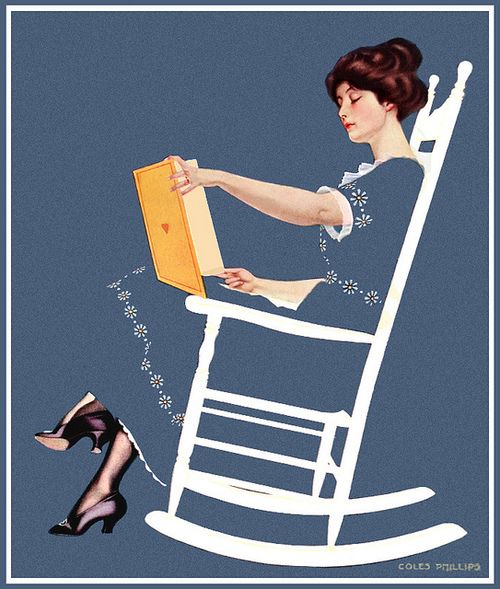
Reading — Clarence Coles Phillip

cole

The Small Kettle — Francine Van Hove

fvp

Cioran’s Insomnia

How did your severe insomnia affect this attitude at the time?
 
It was really the profound cause of my break with philosophy.  I realized that in moments of great despair philosophy is no help at all, that it holds absolutely no answers.  And so I turned to poetry and literature, where I found no answers either, but states that were analogous to my own.  I can say that the white nights, the sleepless nights, brought about the break with my idolatry of philosophy.
 
When did these sleepless nights begin?
 
They began in my youth, at about nineteen.  It wasn’t simply a medical problem, it was deeper than that.  It was the fundamental period of my life, the most serious experience.  All the rest is secondary.  Those sleepless nights opened my eyes, everything changed for me because of that.
 
Do you suffer it still?
 
A lot less.  But that was a precise period, about six or seven years, where my whole perspective on the world changed.  I think it’s a very important problem.  It happens like this:  normally someone who goes to bed and sleeps all night, the next day he begins a new life almost.  It’s not simply another day, it’s another life.  And so, he can undertake things, he can express himself, he has a present, a future, and so on.  But for someone who doesn’t sleep, from the time of going to bed at night to waking up in the morning it’s all continuous, there’s no interruption.  Which means, there is no suppression of consciousness.  It all turns around that.  So, instead of starting a new life, at eight in the morning you’re like you were at eight the evening before.  The nightmare continues uninterrupted in a way, and in the morning, start what?  Since there’s no difference from the night before. That new life doesn’t exist.  The whole day is a trial, it’s the continuity of the trial.  While everyone rushes toward the future, you are outside.  So, when that’s stretched out for months and years, it causes the sense of things, the conception of life, to be forcibly changed.  You don’t see what future to look forward to, because you don’t have any future.  And I really consider that the most terrible, most unsettling, in short the principal experience of my life.  There’s also the fact that you are alone with yourself.  In the middle of the night, everyone’s asleep, you are the only one who is awake.  Right away I’m not a part of mankind, I live in another world.  And it requires an extraordinary will to not succumb.
 
Succumb to what, madness?
 
Yes.  To the temptation of suicide.  In my opinion, almost all suicides, about ninety percent say, are due to insomnia.  I can’t prove that, but I’m convinced.

From Jason Weiss’s 1983 interview with Emil Cioran, which is now available in full at his website, Itineraries of a Hummingbird. The interview was originally published in Weiss’s book, Writing at Risk, which is now out of print.

Reviving Álvaro Mutis, Who Died One Year Ago Today

Homenaje-Alvaro-Mutis

The Colombian writer Álvaro Mutis died one year ago today.

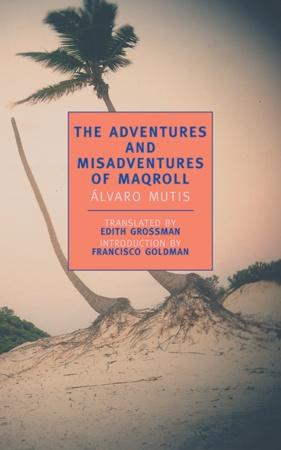
Mutis wasn’t on my radar until a few years ago, when a friend of mine, Dave Cianci, urged me to read the author’s opus, The Adventures and Misadventures of Maqroll, a collection of seven novellas that speak to each other in a loose, rich, intertextual poetics of adventure, romance, and loss. My friend Cianci was so enthusiastic about the book that he reviewed it for this blog (the review convinced me to read it). I’ll crib from that review:

The Adventures and Misadventures of Maqroll is difficult to categorize. It’s an outlaw adventure story populated by men and women who live where and how they must; these are the people who work near shipyards and the banks of unexplored river tributaries, people who value candor and honesty but for whom strict adherence to the law is often inconvenient. The book is a philosophical rumination on friendship and creation, romance and deception, obstinance and poverty.

Later in his review, Cianci characterizes the titular Maqroll—the Gaviero, the “lookout” —as “who we all dream of being when we contemplate throwing everything away.” In one of my own pieces on Maqroll, I described the world that Mutis offers, part fantasy, part nightmare, as

a life of picaresque adventures (and titular misadventures), of loss and gain, of love and despair, drinking, sailing, scheming and plotting—a life full of allusions and hints and digressions. Mutis’s technique is marvelous (literally; he made this reader marvel): he gives us an aging (anti-)hero, a hero whose life is overstuffed with stories and mishaps and feats and enterprises and hazards; he gives us one strand of that life at a time in each novella—but then he points to the other adventures, the other serials of Maqroll that we would love to tune into if only we could.

maq

John Updike explained the attraction to Mutis and Maqroll in his 2003 New Yorker review of NYRB’s Maqroll collection:

The problem of energy, in this enervated postmodern era, keeps arising in Mutis’s pursuit of a footloose, offhandedly erudite, inexplicably attractive shady character. A lowly seaman with some high-flying acquaintances on land, Maqroll is a drifter who tends to lose interest in his adventures before the dénouement is reached. Readers even slightly acquainted with Latin-American modernism will hear echoes of Borges’s cosmic portentousness, of Julio Cortázar’s fragmenting ingenuities, of Machado De Assis’s crisp pessimism, and of the something perversely hearty in Mutis’s fellow-Colombian and good friend Gabriel García Márquez—a sense of genial amplitude, as when a ceremonious host sits us down to a lunch provisioned to stretch into evening. Descriptions of food consumed and of drinks drunk, amid flourishes of cosmopolitan connoisseurship, are frequent in Mutis, even as the ascetic Maqroll goes hungry. North Americans may be reminded of Melville—more a matter, perhaps, of affinity than of influence.

Updike’s review is one of the only prominent and long English-language pieces about Álvaro Mutis that I’ve come across. There’s a good 2001 interview with Mutis in Bomb by Francisco Goldman (who wrote the NYRB edition’s introduction), and a few translated poems of Mutis’s can be found online, but on the whole, despite accolades throughout the Spanish-reading world, his reputation among English-readers seems relegated to “friend of Gabriel Garcia Marquez” (who called Mutis “one of the greatest writers of our time”).

Álvaro Mutis deserves a bigger English-reading audience. NYRB’s collection of his novellas in Edith Grossman’s translation bristles with energy. At once accessible and confounding, these tales that ask us to read them again, like Borges’s puzzles Bolaño’s labyrinths.

Is it tactless to name Bolaño here? Maybe—he’s perhaps too-easy an example: A Spanish-language author whose readership radically expanded after his death. Anyone who follows literary trends (ach!) will see how quickly a writer’s currency elevates after his or her death. (Ach! again). But I think that Mutis should attract fans of Bolaño, whose currency still spends (and will spend in the future, I think). Another comparison I would like to be able to make though would be John Williams’s sad novel Stoner, which, as any one who follows literary trends (ach!) could tell you became an unexpected best seller last year. Stoner—also published by the good people at NYRB—had to wait half a century to get its due. I don’t see why the English-reading world should wait that long to embrace Mutis.

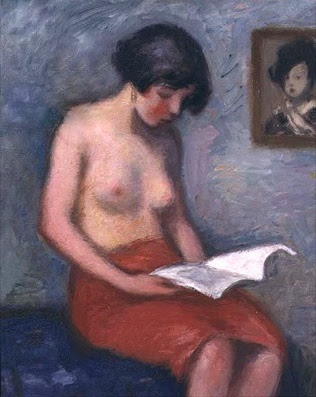
Nude Looking at Pictures — Georges d’Espagnat

Espagnat, George d' (1870-1950) Nude looking at pictures